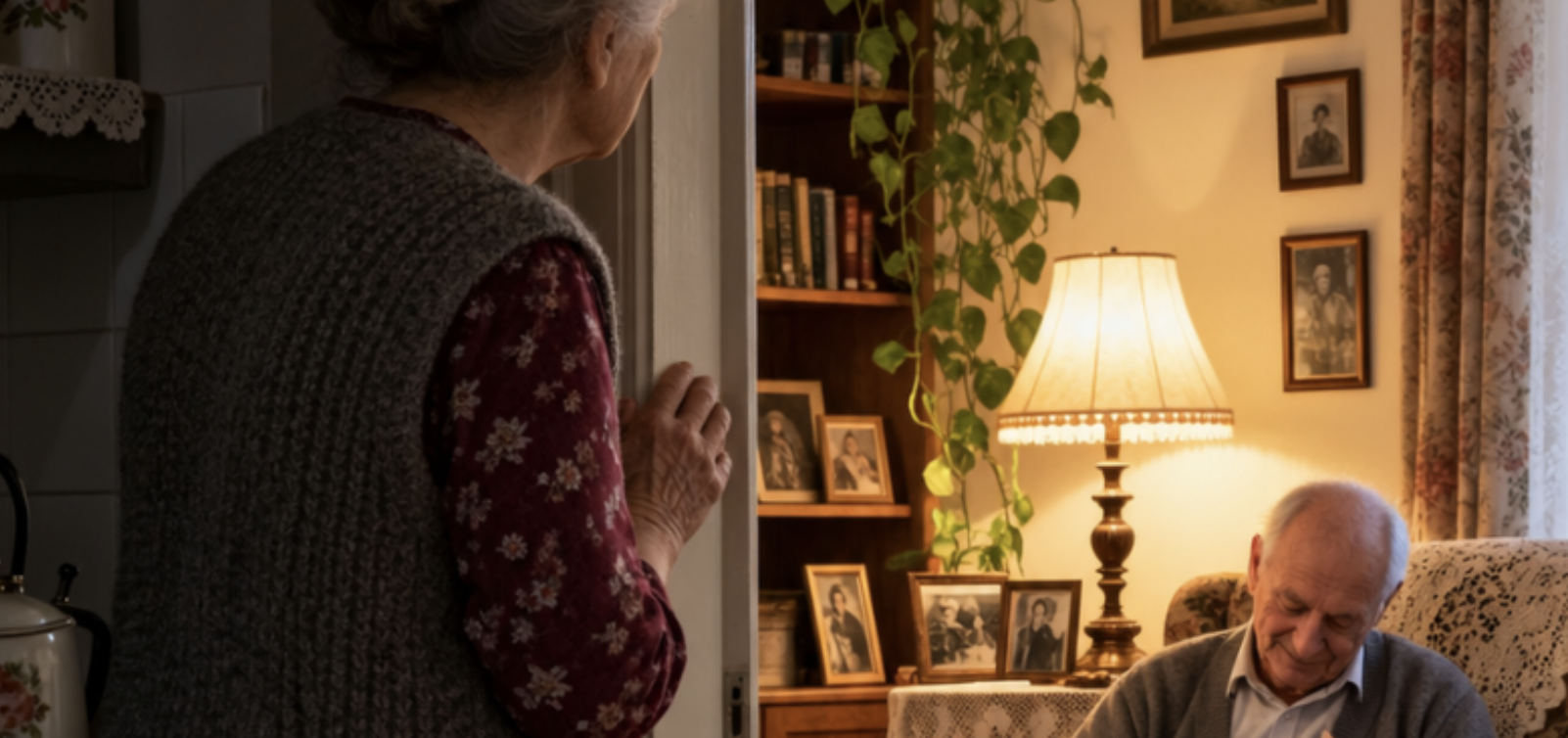
Vira Kuzmivna stood in the kitchen doorway, looking at her own husband.
Grandpa Hryts was sitting in his armchair with a mug of linden tea, while a fluffy cat dozed on his lap. He was quietly telling her something—not giving commands, not saying “kitty-kitty,” but truly talking to her. And she listened, narrowing her large yellow eyes, amber-bright.
They had lived together for fifty-three years.
And suddenly Vira caught herself thinking that she was jealous of the cat.
Hryhorii Panasovych—or simply Grandpa Hryts, as everyone around called him—adored drinking tea made from dried linden blossoms. At any time of year.
He refused to recognize ordinary tea leaves.
“There’s no proper aroma in it, no health benefit either—just wasted money. Now linden tea, that’s something else!” Grandpa liked to say, sipping the fragrant drink with jam or a fruit caramel. “Back in the hard times, we hardly drank store-bought tea at all. It was all herbs and flowers. And people were better off for it.”
On the outskirts of the small town, where a long-vanished manor estate had once stood, an old avenue of linden trees remained.
In summer, as soon as clusters of tiny fragrant yellow flowers appeared on the branches and bees swarmed in from all around, the old man forgot about every ache and pain and went to gather the blossoms into a cloth bag.
No matter how hot the day was, he never returned home until the bag was completely full.
Grandma Vira waited for him at home, having spread newspapers over the windowsills, tables, and cabinets so the blossoms could dry.
“Well done, you. Look how much you gathered! Sit down and eat.”
“Oh, the blossoms this year!” Grandpa would exclaim, flushed from the hot borscht. “The lindens are blooming so heavily you can barely see the leaves. I’ll go again tomorrow, Virochka. We ought to make a bigger supply. It doesn’t take up much room. Who knows whether I’ll still be able to gather them next year? We’re old people now.”
“You should take care of yourself, Hryts. It’s terribly hot. What if your heart acts up out there?”
“Don’t worry. I have my pills with me.”
The next morning, he put a bottle of water into his bag and set off.
He picked blossoms from the lower branches, moved to another tree, and picked some more. His sack was almost full when, beneath some low, spreading branches, he noticed a shaggy bundle.
A cat.
She lay on her side with her tongue hanging out.
Grandpa touched her to see whether she was still alive. Her body was hot, but her eyes were closed.
He took out his bottle and poured some water into his palm, splashing it over the poor animal’s head. The cat opened her eyes and began licking the drops from his hand.
“So you’re thirsty, are you? All right, then.”
He poured more water into his cupped palm and held it to her mouth. The cat drank greedily. She could not stand up—she only looked at him pleadingly and meowed almost soundlessly.
“Well, this is something. What am I supposed to do with you?”
Grandpa placed the cat inside his cloth bag and carried her home, holding the sack of linden blossoms in his other hand.
“It’s all right, sweetheart. Just hang on. Grandma will give you some milk, and you’ll recover in no time. Just hold on.”
On the way home, he suddenly remembered something he had not thought about in almost sixty years.
How, as a little boy, he had lived with his mother in a tiny house. His father had died early, and his mother worked twelve-hour shifts at the factory, leaving her son to look after the household.
While he was tending the stove, boiling potatoes, sweeping, feeding the chickens and rabbits, there was no time to be afraid.
But when he was left alone in the dim light of a kerosene lamp, fear came over him.
The only living soul beside him then was a cat named Murka.
She would press her shaggy side against him and purr soothingly. Hryts would not even notice when he fell asleep with his arms around the warm, affectionate cat, never managing to wait up for his mother.
When his wife saw what her husband had brought home, she abandoned her chores and immediately began complaining.
“And what exactly are we supposed to do with her, old man? We don’t live in a cottage—we live in an apartment. Why did you bring her here? Do you want fleas jumping all over the floor?”
“Oh, stop grumbling. We’ll figure it out. Bring some warm milk. Can’t you see the poor creature is unwell?”
To calm the cat, Grandpa took her out of the bag and held her in his arms. She immediately pressed herself against him and, frightened by Grandma’s voice, clung even more tightly to her rescuer.
That was how the cat Lipka appeared in the old couple’s home.
There really were fleas living in her thick pale fur, mercilessly biting the exhausted animal.
Grandpa placed a basin of warm water in the bathtub and carried the full-bellied, half-asleep cat in for a wash.
Vira Kuzmivna, realizing that her husband had made up his mind, began helping him.
But the moment Lipka found herself in Vira’s hands, she unsheathed her claws and began struggling furiously.
“You go on, Virochka. Don’t interfere. I’ll manage myself.”
The moment Vira stepped away, the cat calmed down and patiently endured the entire long bathing process.
That was the first blow to Vira’s pride.
Then things only became worse.
In the evenings, when the old couple watched television as usual, Grandpa no longer sat beside his wife.
He moved to the armchair with the cat in his arms, because whenever Vira sat down on the sofa, the dozing Lipka would wake up and hiss threateningly.
Now Hryhorii Panasovych drank his linden tea in the company of the cat, who had grown healthier, prettier, and plumper.
Lipka slept only near her master’s head, on his pillow. She followed him everywhere.
Grandpa bought her a collar and leash and took her outside for walks like a little dog. He even managed to bring her with him to the pharmacy and the grocery store.
The cat refused to eat from the mistress’s hands. She would take food only from him.
“Look at that, Hryts. Such ingratitude. I make porridge for her, give her cutlets, and she turns her nose up like some princess. She’s not a cat—she’s a punishment.”
“I’ve lived with you, Virochka, for so many years it’s frightening to count, and I never knew you disliked animals so much,” Grandpa said reproachfully, shaking his gray head.
“What makes you say that? I do like animals. But Lipka is unbelievably difficult. I can’t even pet her—she immediately hisses and scratches my hands. But with you, she’s all sweetness. She purrs for you like a tractor, and hisses at me like I’m her enemy. We’ve grown distant because of her. We don’t talk the way we used to. We’ve even started arguing.”
“Don’t exaggerate and don’t take offense. She’s only a cat. You can’t explain things to her or order her around. She lives by her own rules.”
Besides their tea drinking, Lipka’s favorite pastime was looking out the window.
She and Grandpa could sit there for hours, silently glancing at one another and watching everything happening in the street below.
If Grandma Vira joined them, Lipka would immediately move away and sit at a distance.
From there, she would stare reproachfully at her master.
In autumn, after the first snowfall, Grandpa began to feel unwell.
His worn-out heart was failing him.
Without telling his wife, he swallowed pills by the handful, tried to act cheerful, and hid just how serious the situation had become.
Then one night, Vira Kuzmivna woke because the cat was loudly meowing and violently tugging at the hem of her nightgown.
She even scratched Vira’s leg.
“Shoo! What are you doing? Hryts! Look what your cat is doing!”
There was no answer.
Lipka darted toward the sofa, where her master lay motionless in a cold sweat, as white as snow.
The ambulance took Grandpa to the hospital.
The cat rushed around the apartment, crying loudly and refusing to let the woman sleep.
In the end, Vira had to take her outside.
There, Lipka quickly twisted free of her poorly fastened collar and ran away.
After searching for a while, Vira Kuzmivna gave up and went back home to prepare for the hospital.
As she left the building, she did not notice Lipka climbing down from a nearby tree and cautiously following her.
At the hospital ward, they gave Vira a white coat and allowed her inside.
“You called the ambulance just in time,” the doctor told her approvingly. “We’ll get him back on his feet, don’t worry. He’ll stay here for a couple of weeks, and then he’ll be running around again.”
“You should thank our cat for that. Lipka.”
And Vira told him what had happened.
“Really? Well, would you look at that. Take good care of your cat and give her my regards,” the doctor joked before hurrying away.
She was allowed to sit with her husband only briefly.
When she told him how Lipka had saved him, tears ran down the old man’s cheeks.
He kept asking about the cat, and Vira could not bring herself to tell him the truth. For his sake, she lied and said that everything at home was fine.
“Get well, Hryts. Promise me you’ll recover quickly. We simply can’t manage without you. We’re waiting for you.”
“All right. I promise.”
When Grandma Vira stepped outside the hospital, she suddenly felt weak.
Everything she had been through had drained the strength from her legs.
She sat down on a bench to rest and gather her thoughts.
Heavily, she lowered herself onto it and stared up at the third-floor window of the ward where her Hryhorii Panasovych was lying.
What was she supposed to do now?
The cat did not accept her and probably would never come home again.
She had failed to keep her safe.
And then, no longer trying to hide it, Vira began to cry.
She wept aloud—for her husband, for herself, and for Lipka.
It was ridiculous, really.
An old foolish woman had become jealous of her husband because of an ordinary cat—a cat who had simply been happy to find a home and had repaid that kindness in the only way she could.
She had saved his life.
Vira sat there blaming herself, completely losing track of time.
She did not notice that her feet were freezing or that her body had begun trembling with cold.
She had no strength to stand up and go home.
But clever Lipka had been watching her all that time from around the corner of the hospital building.
And finally, she decided it was time to intervene.
She ran over and jumped onto the cold bench.
Vira Kuzmivna felt something soft press against her side.
She could hardly believe it.
Lipka was rubbing herself against Vira’s coat and purring loudly.
“Lipka. My little Lipka. Clever girl. Where did you come from? Come on, let’s go home quickly. You must be hungry and freezing. Your master is all right. Thank you, my sunshine. Come on, let’s go.”
They walked home through the fresh snow—an old woman and a cat.
They talked to each other, each in her own language.
And they walked home to wait together for their old man.