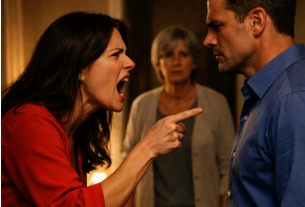
I realized my marriage was over not in court, or even that night when Igor started yelling so loudly that the neighbor’s dog barked back in response through the wall. It ended earlier—on a Saturday morning, when his mother, still in her muddy boots, stomped through my freshly cleaned hallway, set a bag of tangerines down on a stool, and said in a tone like she was coming to collect her paycheck, not to visit:
“You have money now, Marina. So, it’s time to stop playing the poor relative. Family needs support.”
I was standing there with a wet rag in my hand. Soup was bubbling on the stove, the washing machine was rattling away in the bathroom, and from the window came the chilly March smell mixed with hints of gasoline from the parking lot. Everything in my life was ordinary, a little worn out—the fridge covered with bills, a bag of bags under the sink. And in that ordinariness, something suddenly snapped—quietly, with no dramatic music.
For five years, I honestly convinced myself that we had a normal family. Not perfect, of course—but whose is? Igor worked as a supervisor at a car service on the outskirts, bringing home about sixty thousand. I was a senior specialist at a transport company, managing shipments, stressed out drivers, invoices, mistakes that weren’t mine, and my own relentless deadlines. I earned on average one hundred and twenty thousand, and sometimes more if my bonus didn’t get lost somewhere between accounting and the boss’s fantasy.
On paper, we seemed respectable. Two working adults, a place to live, a car that sort of functioned, and a vacation once a year. If you squinted, it almost looked like an ad for a happy mortgage family. Only the apartment was mine, bought before the marriage—a one-bedroom I later traded up for a small two-bedroom in a quiet neighborhood. Not the city center but close to the grocery store, pharmacy, a bus stop, and a courtyard where teenagers practiced swearing in the evenings like they were taking an exam.
Every month, I transferred seventy-five thousand to our shared account—for utilities, groceries, household stuff, internet, medicine, and the inevitable ‘something broke again.’ Igor contributed twenty, sometimes thirty if there was no ‘problem.’ Problems for him were regular: he had to pay a friend back, work delayed his bonus, or the car suddenly demanded urgent repairs. At first, I argued, but eventually I got tired. Some conversations feel like trying to tell a kettle it whistles too loudly. It’s not the kettle’s fault. That’s just how it is.
The renovation ended up being mine, too. A year and a half ago, we decided to finally make the apartment livable: we changed the linoleum, redid the bathroom, painted the hallway, ordered a new closet. I put in almost three hundred and fifty thousand. Igor chipped in twenty-five and walked around looking like he’d rebuilt a city after a war. For a week after, he’d tell his friends on the phone: “We just finished a huge renovation.” We. Such a useful word. You can hide someone else’s money, nerves, and evenings spent in a hardware store in that word.
I used to buy him shirts because he’d show up to work in ones where the collar was begging for retirement. I gave him a new phone when his old one kept dying in the cold. I even paid for the car diagnostics courses that Igor picked out himself, all fired up and sparkling with excitement. He stuck with them for four classes before declaring the teacher was ‘airless’, the material was ‘not right’, and anyway, now wasn’t the time. The laptop I bought ‘for study’ ended up shelved and gathering dust. Sometimes I’d wipe it off and think at least the dust isn’t pretending to be useful.
My mother-in-law, Zoya Pavlovna, would show up about every two weeks. She lived in the next district, in an old nine-story building with an elevator that smelled of cats and boiled cabbage. She’d either come by unannounced or call ten minutes ahead: ‘I’m on my way, put the kettle on.’ She’d always bring a token offering—a jar of pickles, half a kilo of cookies, a bag of onions. And every time, as soon as she sat at the table, she’d start her inspection tour.
— Your bathroom towels are kind of rough. Igor has never liked those since he was a kid.
— That soup’s too thin. A man needs it thick enough for the spoon to stand up in.
— There’s dust on the windowsill. You are a woman, Marina.
I usually smiled. Not because I was a saint, but because I was already tired in advance. Igor would disappear in those moments. He might be physically sitting next to me, munching cookies, scrolling on his phone, but inside he checked out so far I could never reach him. If I asked him later, ‘Did you hear what your mom said?’ he would make a face.
— Please don’t start. She doesn’t mean any harm.
People can do shockingly hurtful things even without meaning harm.
I got used to his disappearances. Igor was great as long as there were no sides to pick. As long as everything was calm, as long as dinner was on the table, my salary arrived on time, his mother was satisfied—he could be quite sweet: buy bread, fix an outlet, hug me in the kitchen, tell me I was overworked. But as soon as there was any conflict, he’d turn empty. Like a billboard after the ad’s been taken down—structure still there, but no meaning left.
I didn’t think of myself as unhappy. That’s the silliest part. Truly unhappy people often don’t even have the strength to admit they’re unhappy. I called it a ‘rough patch,’ ‘adjusting,’ ‘everyone has their quirks.’ Sometimes, at night, when Igor was sleeping next to me, breathing heavily into his pillow, I’d lie there staring at the ceiling, wondering: if I disappeared for a week, who would notice the empty fridge first—my husband, or the trash can?
Everything changed on Wednesday at half past two.
I was sitting at work, eating cold buckwheat from a container and replying to a supplier from Kazan who’d been promising to ‘sort it out today’ for three days straight. My phone started buzzing with a number I didn’t recognize. I wanted to ignore it but ended up picking up—could be the driver, a client, or some new piece of joy.
A woman spoke to me—dry and polite, with the kind of tone people use when their job is to break news about how life has shifted someone’s fate. She was a notary from Perm. She told me that my paternal cousin, Valentina Sergeevna, had died, and named me as the sole heir in her will. I remembered seeing her maybe four times as a child: tall, short hair, always smelling of tobacco and expensive cream, giving me chocolates and telling my mother, ‘Don’t break the girl’s spirit.’ Then she vanished from our lives—left town, had a falling out, and stopped writing. Adults back then seemed to know how to disappear without explanations, like there was some secret button for it.
The inheritance turned out to be money in an account. Two million one hundred eighty thousand rubles.
I asked the notary to repeat herself. She did. I wrote down the address, the list of documents, the date. Then I hung up and sat for a few minutes staring at my screen, where an email glowed: ‘Please urgently confirm the shipping schedule.’ Urgent. How ironic.
Two million one hundred eighty thousand. Maybe it’s not a fortune for some, but for me—it’s air. Peace of mind. The ability to refill my emergency fund, invest a bit, finish the kitchen, stop counting every big expense as a little betrayal of myself. I didn’t even get happy right away. At first, I was scared. Money is a strange thing: when you don’t have it, you dream of it; when it suddenly appears, you start wondering whose hand will reach out for it first.
I didn’t tell Igor. Not out of cunning—I just wanted time to sort things out quietly. To visit the notary, get the paperwork done, open a separate account, talk to a lawyer or a financial consultant. I needed a bit of space where nobody was whispering in my ear: ‘Why don’t we buy…’
But the secret lasted only six days.
On Monday evening, I came home late—feet soaked, head full of other people’s invoices. I took off my shoes, put my phone on the nightstand, and went to shower. When I returned, Igor was sitting on the bed. He was holding my phone. On the screen—a bank notification about the money deposit. I’d forgotten to turn off push notifications. A tiny, everyday hole in my defenses.
He looked up at me, and instantly I knew—his happiness wasn’t for me. His face showed someone whose wishes had finally been funded by fate.
‘Marina, what’s this?’
‘An inheritance,’ I said, taking my phone back. ‘From Valentina Sergeevna.’
‘Two million?’ He didn’t even try to hide his excitement. ‘Wow. That’s… that changes everything.’
I silently dried my hair with a towel.
‘What changes?’
‘Everything. Something normal. Something alive. We haven’t gone anywhere decent in ages, and it’s laughable to even mention your last Turkey trip—the hotel was like a dorm room. We could go to Dubai. Or the islands. I need to replace my car—you know my Ford is already a wreck with a radio. And we need a new TV, too. Everyone has a proper screen, ours is like a receptionist’s monitor.’
‘Igor,’ I said. ‘You’re listing these expenses like you’re the one who won the money.’
He frowned, but only slightly. He still thought this was just my initial caution, something he could overcome with a bit of affection, a little sulking, or maybe even by bringing in his mother.
‘We’re family. Isn’t it always «us,» not «you» and «me»?’
I almost burst out laughing. Not because it was funny, but because she absolutely nailed the moment.
«It happens. When I’m the one paying for the renovation, it happens somehow. When I’m the one filling up our shared account, it happens too. But as soon as there’s an inheritance, it’s suddenly ‘ours.'»
«Here we go,» he sighed. «That’s not what I meant.»
«Well, that’s exactly what I mean.»
He stood up, paced the room, rubbed his neck, then sat back down.
«Don’t make me out to be the bad guy. I’m just saying: now we have a chance to finally live a little.»
«Living a little doesn’t mean blowing all the money in six months.»
«Nobody said we have to blow it all.»
«In the last three minutes you’ve mentioned a vacation, a car, a TV, and I’m pretty sure a gaming console is on your wish list too.»
He looked hurt because the console really was on the list. I could tell by his face.
The next few days turned into a quiet kind of siege at home. Igor sulked, answered me in monosyllables, and would even pointedly eat his eggs without bread, saying «if someone wants bread, they’ll just buy it.» The bread was actually in the cupboard—he just didn’t look. On the third day he told me I’d become «like a stranger.» On the fourth, he said money changes people. On the fifth, he asked if I even planned on consulting my husband anymore, or if he was just a tenant now.
I wanted to reply that tenants sometimes pay more, but held my tongue. Not out of nobility—just to save my energy.
Meanwhile at work, I had my own little crisis: the driver mixed up the warehouse address, the client screamed at us like we’d personally stolen his truck, and my boss paced the office looking like he’d fire everyone—but only after lunch. By Friday, I came home feeling like I’d spent the whole day mopping up other people’s messes. Igor greeted me with, «Did you call your mom?»
«Why would I?»
«Just because. She’s worried.»
I took off my jacket.
«What’s she worried about?»
«Well… just in general. About us.»
This should’ve been a warning sign. But I was just too tired. When you’re exhausted, you tend to miss the sound of an oncoming train.
On Saturday morning, Zoya Pavlovna showed up herself.
I opened the door and she strode right in like she owned the place. She carried a bag of tangerines, wore a knitted hat with sequins, and her lips were pressed into a businesslike line. The hallway immediately filled with the chill from the stairwell, the scent of damp newspapers, and her perfume—so sweet it gave me a headache.
«Is Igor here?» she asked.
«He left to get a part. Want some tea?»
«Later. We need to talk.»
She went to the kitchen, sat down, inspected the table, the stove, the dish towel hanging on the oven handle. Even when big decisions were on the table, Zoya Pavlovna never missed a crumb.
«I’ve been thinking for a long time,» she started. «I need my own business. I’m done scraping by. My pension is a joke, I’m not made of iron anymore, but I’ve got hands and brains. There’s a spot opening up near the bus stop. I could open a flower kiosk there. People always need flowers—weddings, funerals, the first day of school, guilty husbands—steady flow.»
I nodded automatically. It did make some sense. Zoya Pavlovna truly loved flowers—she knew the names of all the varieties and could whip up a bouquet from three sprigs and cellophane that someone sentimental would gladly pay a thousand for.
«But I need a start-up,» she went on. «A fridge, rent, first batch of flowers, sign, register, paperwork. I’ve done the math. Nothing fancy, just basic, I’ll need nine hundred thousand.»
I already knew where this was heading, but I still held out hope for a simple, respectful request. Sometimes, I can be stubbornly optimistic.
“I see,” I said. “What about a loan?”
She looked at me as if I’d suggested she sell a kidney.
“A loan at my age? The banks would love nothing better than to squeeze me dry. And why get a loan anyway when we have money in the family?”
“In the family?”
“Yours,” she clarified, not even blinking. “But you’re my son’s wife. So you’re not a stranger.”
I was filling my glass from the water filter. Suddenly, the glass felt unexpectedly heavy in my hand.
“Zoya Pavlovna, I’m not going to invest nine hundred thousand in your pavilion.”
She didn’t even get upset at first. She just froze. Apparently, in her scenario I was supposed to hesitate, ask for her bank details, maybe shed a tear of happiness at being entrusted with such an important family mission.
“You don’t understand,” she said slowly. “I’m not asking for a fur coat. I want to start a business. It’ll benefit everyone. It’ll make things easier for Igor down the road, you’ll both see profits. I’m not an outsider.”
“I understand. The answer is no.”
“Why?”
“Because this is my money. My inheritance. I’m not ready to risk almost a million on a business idea you came up with just a week ago.”
“Not a week ago!” She slapped her palm on the table. The spoon rattled in her mug. “I’ve dreamed all my life of not breaking my back working for others, but having something of my own. And here you are, sitting in this apartment that you got by some stroke of luck, clutching your money. Igor is right, money has spoiled you.”
“Money hasn’t spoiled me. It just showed me how people really see me.”
That line slipped out on its own. Zoya Pavlovna narrowed her eyes.
“And who exactly do you think you are? So smart? Your salary, your apartment, your money. So what is your husband then? An accessory? You belittle him, that’s why he can’t flourish.”
I set down my glass.
“Igor is a grown man. If he can’t flourish, maybe he should check that he’s not locking himself in from the inside.”
She flushed with red patches. In a different situation, I might have been scared. But right then, I felt a strange calm—like before a storm, when the air already smells like iron.
“I never liked you,” she said. “You’re cold. Always counting everything. That’s not how a family lives.”
“A family also doesn’t live with one person always paying, while the other makes spending plans with their mom.”
“Don’t you dare say anything about my mother… I mean, about me…” She trailed off, even more furious. “You’re so ungrateful. We welcomed you.”
“Into my own apartment?” I asked. “How generous.”
She jumped up. Her chair scraped loudly against the tiles.
“I’ll tell Igor everything. Time for him to finally be a man.”
“While you’re at it, let him know I said ‘no.’ So he doesn’t have to ask again.”
Zoya Pavlovna stormed out, slamming the door so hard that a shoe brush fell from the shelf in the hallway. I picked it up, put it back, and suddenly spotted dirty boot prints all over the floor—smudged right across the hallway I’d just cleaned yesterday. Sometimes it’s those small, domestic details that hit hardest. You keep holding it together after a shouting match, but then you’re scrubbing up someone else’s mess and you realize: how much more can I take.
Igor came home that evening. I can’t remember if he brought the spare part with him or not. What I do remember is his face was already set in a look of resentment, no doubt warmed up by a call from his mother.
“Why did you upset my mom?”
I was slicing cucumbers for the salad. The knife moved evenly, thinly, and precisely.
«She walked here on her own.»
«Marina, don’t be sarcastic. She was crying.»
«A lot?»
«Is this funny to you?»
«No. I just wonder—when did she even find time to do that? Was it before she demanded money or after she called me ungrateful?»
He tossed his keys onto the nightstand.
«She didn’t demand anything. She asked for help.»
«A request means you can say no. She gave an order.»
Igor sat down on a chair and clasped his hands together.
«Let’s be calm about this. Mom really needs a chance. Her life didn’t turn out the way she wanted. My father drank, then left, and she never had a good job. She raised me alone. I owe her.»
«You owe her,» I said. «Not me.»
«We’re a family.»
«You always bring up that word when you need my money.»
He looked at me with tired eyes, but it wasn’t the situation that made him weary—it was my persistent refusal to be convenient.
«How long are we going to keep measuring everything in money?»
I put the knife down.
«Igor, for five years I measured things not by money. That’s why we ended up with this bookkeeping—where I pay, and you talk about spiritual matters.»
He stood up abruptly.
«You’re humiliating me.»
«No. I’m just calling things what they are.»
«Mom’s right. You always thought you were better than us.»
«Just because someone stands on their own two feet doesn’t mean they’re looking down on everyone else. Maybe the others are just sitting down.»
He left for the other room and slammed the door. I stayed in the kitchen with the cucumbers, dill, and a feeling that the apartment had shrunk. That evening, he didn’t eat the salad. Of course, he ate it the next day—but with a martyr’s look on his face.
Then came two weeks of disciplinary efforts. Zoya Pavlovna called me, but I didn’t answer. So she began texting: «Marina, come to your senses. Greed destroys families.» Then Igor’s aunt from Tula got involved—even though I’d only met her once, at a birthday party. She wrote that «elders must be respected,» and added that she was ashamed of me. I replied, «Shame is a personal feeling—you can manage it yourself.» She didn’t write again.
Igor switched up his tactics. First, he tried pressure: «You have to consider the interests of the family.» Then he acted hurt: «I get it—I don’t belong here.» Then he turned affectionate: he brought me coffee, touched my shoulder, said, «Why are we acting like strangers?» I looked at him and thought how even his tenderness worked like a tool—like a screwdriver: to tighten, to pry, to open.
One evening, the pipe under the sink started leaking—right in the middle of another conversation about how nine hundred thousand «isn’t such a big sum, if you think globally.» Water started dripping into a basin, then poured faster. Igor crawled under the sink, cursing, searching for a wrench he couldn’t find, blaming me for «losing all the good rags somewhere.» I stood nearby, holding the flashlight.
«Shine it properly!» he barked.
«I’m shining right at the pipe.»
«Not there!»
«Igor, there’s only one pipe.»
He crawled out, soaked, angry, face flushed red.
«You’re always like this. Can’t even help properly.»
I looked at the water, his dripping t-shirt, the basin catching our family philosophy. Suddenly it became painfully clear: he can’t even be there for a leaky pipe. So what hope is there for life?
I called the plumber myself. Paid him myself, too. Later Igor told me he could have fixed it, if only the “tense atmosphere” hadn’t gotten in the way.
That night I couldn’t sleep for hours. I lay on the edge of the bed, listening to Igor’s heavy breathing, replaying all those years in my mind. There I was, heading to Leroy Merlin after work to buy a faucet, because for Igor it was “too far and there was traffic.” There I was, transferring money to cover his insurance, because he was having a “cash flow problem.” There I was, smiling at Zoya Pavlovna as she explained that you need to fry cutlets in a mix of oils, otherwise a man will be spiritually hungry. And then Igor saying, “Don’t start.” Always that—“don’t start.” As if I wasn’t reacting to what was happening, but instead conjuring a conflict out of thin air, like a magician pulling out a dove.
The next day at lunch I left the office, grabbed a coffee to go, and sat in my car in the parking lot. The day was gray, snow turning into dirty slush, the wipers lazily smearing water across the windshield. I found the number of a family law attorney—a colleague had once given it to me after her own divorce, where her husband tried to claim even the slow cooker. I called.
The lawyer, Anna Viktorovna, spoke calmly. Not in a sweetly sympathetic, official way, but truly calm—like someone who’s seen enough marriages to never be surprised by human audacity.
She explained: inheritance is the spouse’s personal property and can’t be divided. The apartment I bought before marriage stays mine. Everything we acquired together—appliances, furniture, money in the joint account—gets split. If Igor wants to prove he invested in renovations, he’ll need proof. His twenty-five thousand, compared to all my transfers, looked less like a share in the property and more like pitching in for laminate flooring—on a good day.
“Are you ready for a conflict?” Anna Viktorovna asked.
I looked outside and saw a man in a puffer jacket trying to push a Solaris out of a snowbank, while another man stood back, giving directions without touching the car. A very familiar family dynamic.
“I already live in one,” I said. “I just want to make it official.”
Two days later, I filed for divorce.
I didn’t tell Igor right away. Not because I wanted a dramatic scene. On the contrary—I just wanted a few days of peace, at least until the paperwork was safely out of my hands. I packed a small bag and hid it in the closet: documents, underwear, my charger, a couple of sweaters, the folder with bank statements. I made copies of the renovation receipts. Opened a new bank account. Revoked Igor’s access to our shared app—where he loved to check the balance and sigh.
He didn’t notice everything, but he sensed the tension. People who live off someone else’s stability can always tell when their support is slipping away.
The turning point came on Thursday.
I got home from work earlier than usual. On the way, I picked up cottage cheese, eggs, laundry detergent on sale, and—almost out of habit—a chocolate bar with nuts. Maybe my body was craving compensation for the ongoing theater of the absurd. Igor was in the kitchen on his phone. On the table was a piece of paper, covered in his handwriting. I caught a glimpse of numbers: 900,000, 300,000, car, vacation. He was making a spending plan for my money. His sudden initiative, in all the wrong places.
«We need to have a serious talk,» he said.
«Alright, let’s talk.»
He straightened up.
«I’ve thought it through. Mom needs our help. Not the whole amount, I get it, you’re afraid. Let’s give her seven hundred to start, she’ll figure out the rest. I need at least five hundred for a car, because honestly, it’s embarrassing to drive mine anymore. We need a vacation too, we’re both burnt out. The rest you can keep for your investments, like you wanted. I think that’s fair.»
I put the bag down on the table.
«So you’ve gone ahead and divided up my inheritance, leaving me permission for what’s left?»
«Don’t twist my words.»
«I’m not twisting anything. That’s a transcript.»
He slapped his hand on the page.
«You push me to the point where I have to start counting! Because you completely shut down. You’ve turned into a bank that won’t approve a loan. I’m your husband, not a beggar.»
«Then stop pleading like a beggar and demanding like a debt collector.»
He turned pale.
«Watch your mouth.»
That’s when I realized: the moment had come. Not a beautiful one, not planned, with a bag of powder on the table and cottage cheese that needed to go in the fridge. But most important things in life happen alongside something ridiculous.
«I filed for divorce, Igor. You won’t get the inheritance. Nor the apartment. We’ll split what’s truly shared according to the law.»
He was silent. Three seconds. Then five. Then his face looked as if I’d slapped him in front of witnesses.
«What did you do?»
«I filed for divorce.»
«Are you crazy?» He jumped up. The chair flew back. «Do you even hear yourself? Over money? You’re breaking up a family over some money?»
«Not over money. Because you see me as a function.»
«What do you mean, a function?»
«An ATM who cooks. Sometimes has sex. Sometimes does repairs.»
He started waving his arms.
«There! That’s the real you! Holding everything in, writing it all down, right? You never loved me.»
«I loved you. But love doesn’t have to pay for someone else’s immaturity.»
«My mom always said you’d leave us.»
«Your mom said a lot. Usually more than enough.»
He came closer. He didn’t hit me, no. Igor wasn’t like that. He came from a different breed—the ones who don’t break bones, but suffocate the air around you, so you start to suffocate yourself.
«You’ll regret this. I’ll hire a lawyer. I’ll prove it’s all shared. You got that money while we were married.»
«Go ahead, hire one. I’ve already consulted.»
He looked at me, and for the first time in five years, I didn’t see a husband, a hurt little boy, or someone to understand. I saw a grown man terrified his gravy train was ending. It wasn’t tragic—just unpleasant. Like finding mold behind the furniture: quietly living there until you pull the wardrobe back.
I walked into the bedroom and grabbed my bag. He followed me, talking nonstop: about betrayal, about his mother, about how I was «never really a wife,» about how «normal women fight for the family.» I checked my documents, grabbed my charger from the nightstand, and put on my coat.
«Where are you going?»
«To my mom’s.»
«Of course. Run. Just don’t ask to come back later.»
I stopped by the door.
«Igor, remember this moment. Not because it’s beautiful. Because someday you’ll tell people I left you suddenly. I didn’t. I’ve been leaving for five years. Today, I just made it to the door.»
He wanted to say something, but I was already out the door. I closed it quietly behind me. The stairwell smelled like damp, fried onions, and someone’s cheap cigarettes. The elevator took forever to arrive. I stood there with my bag, listening to Igor pacing around the apartment on the other side of the door. Something crashed. Maybe a chair. Maybe his ideas about our family.
Mom lived across town in a Soviet panel apartment with her husband and a cat who despised guests but respected people carrying bags. She opened the door, looked at me, and didn’t ask, “What happened?” I’m still grateful for that. Some questions are only asked to make a person finally fall apart.
«Come on in,» she said. «I made borscht. And there are slippers.»
At the table, I told her everything. Mom listened in silence; the only time she moved was to turn off the kettle that had been boiling and clicking in protest for ages. My stepdad sat in the other room watching TV, but he turned the volume down. He was a discreet man by nature—he could show support simply by not interfering.
When I finished, Mom said:
«I was just waiting for you to see it yourself.»
«Why didn’t you tell me?»
«If I had, you would have just defended him. That’s what everyone does—until they’re ready to see the truth.»
I wanted to argue, but I couldn’t. She was right.
The divorce dragged on for three months. Not because it was legally complicated, but because Igor and Zoya Pavlovna turned it into a public soap opera. He hired a lawyer who insisted that the inheritance «was received during the marriage and should therefore be considered family property.» Anna Viktorovna listened to this with the expression of a doctor hearing a patient claim they’re treating a broken bone with a cabbage leaf.
Vadim… No, Igor—I sometimes caught myself calling him by other names in my head, as if my brain refused to file him under the old label—texted me almost every day. First, threats: “You’ll see what the court decides.” Then accusations: “Mom ended up in bed because of you.” Then pity: “I feel awful without you, the apartment is so empty.” Then, suddenly, love: “I get it now, let’s start over.” I read his messages and didn’t reply. Or rather, I only responded when it came to logistics: documents, court dates, belongings.
Zoya Pavlovna took it even further. She called our relatives, friends, even our neighbor from the fifth floor, who stopped me once at the entrance.
“Marinochka, just think about it,” she said, clutching a bag of potatoes to her chest. “He’s your husband, after all. There aren’t many men these days.”
I looked at her. I wanted to ask: does scarcity mean you have to keep whatever you get, like expired rice during a shortage? But all I said was:
«That’s exactly why he should go to someone who needs him more.»
I didn’t share any details at work. I just told my boss I was getting divorced and would need to take time off to go to court occasionally. She looked at me over her glasses.
«Need me to cover for your paperwork?»
«No, I’ll manage.»
«Managing is good. But if your ex starts acting up, let me know. My brother’s in the police—not a saint, but useful.»
That kind of support made more sense to me than long words of comfort.
As the divorce went on, little details started coming to light. For example, I found out that Igor had secretly been giving a part of his salary to his mother «for her health» for the past six months. Meanwhile, Zoya Pavlovna would tell me that her poor son couldn’t help her because his wife always took all his money. Then I discovered that he took out a microloan for car repairs and listed my number as a reference. That’s when I started getting calls from some very eager people who sounded like a meat grinder. I directed them to Igor and blocked their numbers.
The debt itself wasn’t even the worst part. What really bothered me was how naturally it fit into the bigger picture. Igor wasn’t a movie villain—he didn’t come up with clever schemes or hide millions in offshore accounts. He just lived as if the consequences were always meant for someone else: his mom, his wife, or whoever happened to be closest to the door.
At the second hearing, Igor tried to look noble. He showed up in the shirt I had bought him, with his hair neatly styled. The courthouse hallway smelled of dust, paperwork, and cheap vending machine coffee. Zoya Pavlovna sat beside him, clutching her purse on her knees, and gave me a look as if I had stolen her son, her store, and her entire reason for living—all at once.
Igor approached me right before it started.
«Marina, let’s skip the circus. I don’t want a war.»
«Then why did you come with a lawyer?»
«I’m defending my rights.»
«Defend them. Just don’t call this peace.»
He lowered his voice:
«Mom really isn’t feeling well. Her blood pressure’s bad. Can’t you at least be human about this…»
«If you want to be human, stop using her blood pressure as an argument in a property dispute.»
He stepped back. Maybe I’d started speaking more firmly. Or maybe I’d always said the same things, just quieter before.
The court divided the shared property without any dramatic surprises. The appliances were valued so ridiculously that it was funny: the fridge we bought for forty-eight was now, on paper, an old retiree worth fifteen. The sofa—ten. The washing machine—eight. Everything else split equally. The apartment stayed with me. The inheritance too. Igor’s lawyer tried to make a case for the renovations, but receipts, transfers, and dates settled everything. His contribution amounted to helping choose the wall color, and even that was debatable.
When the judge announced the decision, Igor sat completely still. In the hallway, Zoya Pavlovna immediately started loudly whispering so everyone could hear:
«Just look at our laws. A woman strips a man of everything and feels good about it.»
I walked past her. Suddenly, she called after me:
«You’ll end up alone anyway. No one lives with someone like you.»
I stopped. Turned around.
«Zoya Pavlovna, the only people who have a hard time living with me are the ones who are used to living at my expense.»
She opened her mouth, but couldn’t find any words. It felt almost ceremonial: Zoya Pavlovna, speechless. A rare natural phenomenon.
After the divorce, I returned to the apartment. First thing I did was mop the floors. Not because they were dirty—Igor had left in decent order, taking his things, his old game console, the toolbox, and, for some reason, my favorite blanket. I cleaned to reclaim my space. The water in the bucket turned gray quickly. I scrubbed the baseboards, kitchen cabinets, the bathroom shelf. I tossed out the dried-up air freshener, his old car magazines, and the mug that said «Garage King.» The mug was intact, but I still took it to the trash. Let him reign there.
The first few weeks felt strange. The silence in the apartment wasn’t freedom—it was just the absence of the usual noise. I caught myself still shopping “for two”: two packs of cottage cheese, a big loaf of bread, a kilo of chicken thighs. Then I’d laugh at myself and freeze the extra. In the evenings, I could skip making dinner and just have an omelet or salad. No one told me a man needed meat. No one inspected the fridge like an auditor. No one asked why detergent was so expensive.
I made an appointment with a financial specialist. Not one of those online gurus promising passive income from a beach, but a proper woman with a license, spreadsheets, and the wonderfully dull phrase: «First, build a reserve, then think of instruments.» I put some money in a savings account, some in bonds, and I set aside a bit for kitchen repairs. Not for a designer paradise with marble countertops and fancy lighting, but for a regular kitchen where drawers close without a prayer.
Then came the plot twist I never saw coming.
Valentina Sergeevna, my quirky aunt from childhood, left behind not just money. The notary called me after all the court stuff was done and told me that, among the documents, they found an envelope with my name on it. It had gotten lost among the medical papers. I went to pick it up.
The envelope was plain, with yellowed edges. Inside was a short letter written in messy but strong handwriting. Valentina Sergeevna said she’d watched over me for years through my mother: she knew where I worked, that I got married, that I was «carrying more than I let on.» Turns out, my mom used to call her sometimes, but never told me—they had their own adult reasons and old resentments.
The letter wasn’t sentimental. Even there, my aunt sounded like someone who just doesn’t tolerate nonsense.
«Marina, money is not a reward and not compensation. It’s a tool. Don’t give it to those whose first question is how much they can take. Give your time and energy to those who ask how you managed before now.»
I sat in my car outside the notary’s office and reread those lines about five times. Then suddenly, I started crying. Not pretty, not like in a movie. I just bowed my head onto the steering wheel and sobbed until I saw the worried face of the parking attendant appear at the window. He knocked:
«Miss, are you okay?»
I looked up, mascara smudged, and said:
«I’m better now.»
And that was the truth.
The letter didn’t change the events, just the perspective. Before, I thought the inheritance ruined my marriage. After reading it, I realized: it just turned on the light. The room was always a mess—it’s just that I’d been feeling my way through in the dark and calling my bruises married life.
A month later, Igor messaged me. It wasn’t long. «Mom finally opened a flower shop. It’s small. She took out a loan. I help out after work. It’s hard, but I guess it’s working. You were right about the money. Back then, I didn’t really want to save the family—I just wanted everything to come easily. I’m sorry.»
I stared at the message for a long time. I didn’t feel spiteful or affectionate. Just a calm surprise: so it turns out a person can take out a loan, work after hours, and not die from missing out on someone else’s inheritance. Wonders of the local economy.
I didn’t answer right away. Later, I wrote: «I hope it works out for you. Take care.» That was all I could give without sacrificing myself. And for the first time, it didn’t feel like it wasn’t enough.
That summer, I finished my kitchen. Light cabinets, a proper countertop, a deep sink, and a spice drawer I’d oddly dreamed of more than a seaside vacation. My mom came to see it and brought a pie. My stepdad screwed in a hook for the towel, even though I hadn’t asked. The three of us sat at the new table, drank tea, and the cat sprawled out on the windowsill, pretending he was a stylish décor element.
«It’s really nice now,» Mom said.
I looked around. The kitchen wasn’t fancy—nothing out of a magazine. Just mine. No one else’s lists of expenses, no mom’s inspections, no heavy male silence crowding more space than the wardrobe.
«Yeah,» I said. «Finally doesn’t feel crowded.»
Of course, the square footage hadn’t changed. All we removed from the apartment was the old habit of feeling responsible in places where no one even bothered to ask if I was still alive.