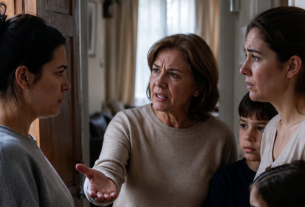
“Mom, why are you just standing there? Bring the bags in—the kids are going to get burned in the sun!”
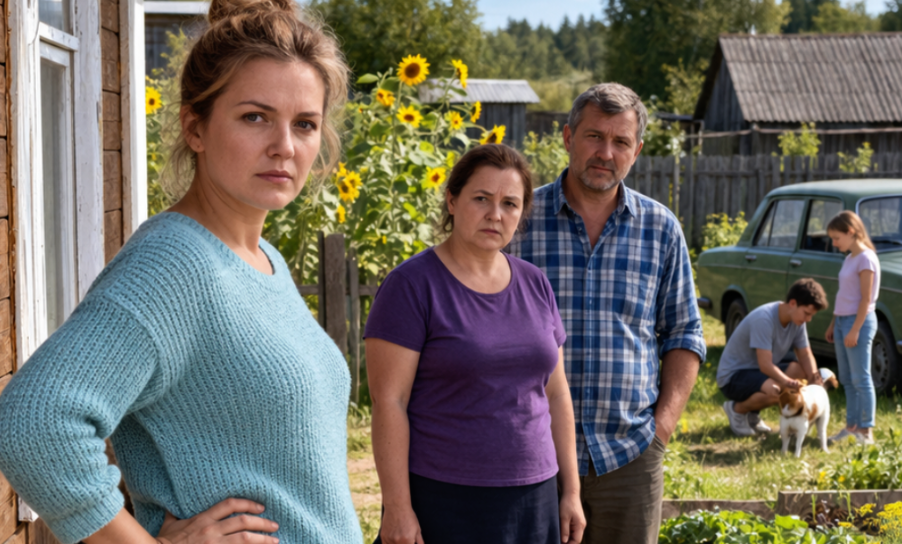
Tamara was already standing on the porch of her brother’s summer cottage—or rather, her sister-in-law’s, because the cottage belonged to Irma, having been left to her by her late aunt. But Tamara never thought about that. She didn’t think about things like that at all. The cottage was a family place. If her brother stayed there, then naturally the rest of the family belonged there too.
She was the first to squeeze into the entryway and set a bag full of swimsuits on the bench—a large sports bag with the word “SPORT” printed on the side, bought back in winter especially for the summer.
image
“Irma, finally! We left at six in the morning. Denis got carsick on the way.”
Irma did not come out of the room right away. She appeared slowly. That bothered Tamara a little—normally her sister-in-law would rush out, throw up her hands and exclaim, “Oh, you’re here! I’ll put the kettle on!”
But this time she came out quietly, wearing a long-sleeved sweater even though June was warm.
“Hello, Toma,” Irma said.
“Well, hello to you too.” Tamara was already walking through the rooms as usual, confidently, as if she owned the place. “We’ll take the far room like always. The kids can sleep on the veranda. Slava, bring in the mattresses!”
Slava, her husband, was unloading the car in silence, the way he did everything. Their two children were already running around the property.
Tamara walked as far as the vegetable garden and stopped.
“Irma, why are your garden beds empty?”
The earth lay in uneven clumps, untilled and overgrown with weeds around the edges. Near the fence stood three beds untouched since the previous year.
“You always planted things. Cucumbers, tomatoes, all those herbs of yours. And now there’s nothing. Have you let the place go?”
Irma stood on the porch holding on to the railing.
“I didn’t plant anything this year.”
“Well, that’s something.” Tamara shook her head. “And when are we heating the bathhouse? We were counting on it. Denis needs to steam his nose—he’s had a runny nose for months.”
She said it without malice. Truly without malice. She had been coming here every summer for seven years, and every year there had been a hot bathhouse, vegetable beds, and Irma’s cabbage pies. That was simply how things were done. And Tamara respected established routines.
“The bathhouse isn’t being used,” Irma said.
“Why not?”
“The firewood hasn’t been chopped.”
Tamara spread her hands as if she had just been told something absurd.
“Well, Slava can chop it. Slava! Did you hear? The firewood needs chopping!”
Slava muttered something from behind the car. He was always muttering something, and it was never possible to tell whether he had agreed or not.
By then, Tamara had almost forgotten what had happened in the spring. Irma had been in the hospital. Something had been removed—some kind of women’s surgery. Slava had said, “We should call her,” so Tamara had called once in the evening and said, “Hang in there, Irma, everything will be all right,” before hanging up because she had to drive Denis to his tutor.
She had called, after all. What else was she supposed to do?
Tamara went into the kitchen and opened the refrigerator as casually as she always did.
“Oh. Why is it so empty? Irma, you need to go shopping. The kids are hungry.”
She took a notebook out of her bag. A real spiral-bound notebook. She always brought it with her, writing down what needed to be bought and what should be cooked. She was an organized housekeeper; no one could deny that.
“Right, listen. Buy the meat from Gurgen at the market. The kids won’t eat supermarket meat—it’s full of water. Get a farm chicken too. And cottage cheese by weight. I’ll write out the menu for the whole week, and you can do your best. You’re good at cooking.”
She tore out the page and placed it on the table in front of her sister-in-law.
A neat list.
Monday—pilaf.
Tuesday—cutlets.
Wednesday—okroshka, but only with proper homemade kvass, not the bottled kind.
“And one more thing.” Tamara lowered her voice confidentially, the way relatives do. “Cook Denis’s food separately without salt. His kidneys, you know. You don’t mind, right? It’s no trouble for you.”
Irma picked up the piece of paper.
She looked at it.
And then—Tamara noticed this but thought nothing of it—Irma placed it back on the table in an oddly precise way, aligning the corners as though taking aim.
“It’s no trouble,” Irma said.
Then she went back into her room.
“Well, good,” Tamara thought with satisfaction. “Now we can relax.”
And she intended to relax thoroughly.
For seven whole days.
The first evening passed almost as usual.
Almost.
Irma did not fry anything. She said she was tired and went to bed early. Tamara shrugged and boiled some frozen dumplings she had brought just in case. The children splashed around in the water barrel. Slava silently fixed the gate and silently went to bed.
During the night, Tamara heard her sister-in-law getting up, walking into the kitchen, and drinking water in small sips.
She wondered what that was about.
Then she fell asleep.
The next morning, a sheet of paper was hanging on the veranda.
An ordinary A4 sheet pinned to the doorframe, positioned so no one could walk past without noticing it.
Tamara came outside in her robe, yawning, saw it, and at first did not understand what it was.
Written neatly by hand in block letters:
“RECOVERY SEASON.
The vegetable garden has not been planted—doctor’s orders prohibit heavy lifting.
The bathhouse is not operating—the firewood has not been chopped and there is no one to heat it.
Accommodation at the cottage is provided in exchange for work.
List of tasks:
weed the garden beds,
carry water to fill the barrels,
paint the street-facing side of the fence.
Food—you cook whatever you bring yourselves.
Owner of the cottage—Irma.”
Tamara read it.
Then she read it again.
Something shifted inside her—not exactly hurt feelings, but confusion.
“Irma!” she shouted into the house.
Her sister-in-law came out onto the veranda.
She was wearing the same long-sleeved sweater.
Calm.
Far too calm for someone who had put up something like that.
“What is this?” Tamara jabbed a finger at the sheet.
“Those are the conditions,” Irma said.
“What conditions?! Have you lost your mind? We’re family! We came here on vacation!”
“Then enjoy your vacation.” Irma slowly sat down on a stool beside the table, supporting her side with one hand. “Weed the garden, carry the water, and then relax.”
Tamara stood there holding the sheet and felt something hot and familiar rising inside her.
“Do you even understand what you’re saying? I’m your husband’s sister. I’ve been vacationing here for seven years! Every year! This is a family cottage!”
“It isn’t a family cottage,” Irma replied evenly. “It belonged to my aunt. She left it to me. In her will. Before she died.”
She stood, walked to the dresser, opened a drawer, and took out a document folded into quarters.
She unfolded it.
Despite herself, Tamara glanced at it—a stamp, Irma’s surname, “six sotkas,” the year.
There it was.
The trump card.
Irma had clearly kept it for exactly such an occasion.
She had probably expected the paper to settle everything—that once Tamara saw it, she would quiet down and understand that she was in someone else’s house.
But Tamara barely looked at it.
“I don’t give a damn what your aunt left you!” Her voice rang out sharply. “She was part of our family too! She used to babysit my Slava! And you came into this family twenty years ago and started grabbing everything for yourself! Now you’re waving some piece of paper in my face! You’ve got no conscience, Irma! We came here with open hearts, with our children, and you give us a list of chores! Like we’re farmhands!”
At that, something in Irma’s expression trembled.
For the first time.
She stood there holding the document—something precious to her, perhaps her only shield—and saw that the shield did not work.
That the paper had not stopped Tamara for even a second.
For a moment, Irma looked almost lost.
Tamara noticed it and, like anyone sensing weakness, pressed harder. It came naturally to her, not out of cruelty. That was simply how she was.
“Put that paper away. We’re family. You’ll go to the market, fry some meat—what, are your hands going to fall off? We only come once a year. The kids have been looking forward to this. Denis talked about the bathhouse the entire drive. And you want us to paint the fence! Shame on you, Irma.”
And that was when Irma put the document back into the drawer.
Slowly.
She closed it.
Then she began talking about something else.
Not about the will.
“Toma. I was in the hospital in April. I had surgery. Two weeks in a room with six people, with cold air coming through the window. Then a month at home, living on broth. When I walked to the bathroom, I had to hold onto the wall.”
“Well, you were sick. That happens to everyone…”
“Your Slava knew.” Irma did not raise her voice. “You knew. Your husband’s mother knew. Nobody came. Nobody brought me water. Nobody went to the pharmacy.”
“I called you!” Tamara burst out indignantly. “I called and asked how you were!”
“Once. In the evening. For a minute and a half.”
“What was I supposed to do?! I have Denis, I have his tutor, I have my own life! I can’t travel halfway across the city all the time. I have a family!”
“I had surgery too.”
Irma paused.
“And now that it’s June, you arrive with swimsuits and a list of things for me to cook.”
Tamara opened her mouth.
Then closed it.
And here was the most genuine, recognizable thing about her—she did not feel ashamed.
She truly did not understand what the problem was.
In her mind, these were two separate things.
Illness was illness.
Vacation was vacation.
The two had nothing to do with each other.
“But that was in spring,” she said more quietly, though with the same certainty. “And now it’s summer. Look at you. You’re back on your feet.”
“I’m back on my feet,” Irma agreed.
Then she sat down on the stool again.
Tired.
“Weed the beds, carry the water, paint the fence. Or leave. There is no third option.”
Slava stepped onto the veranda.
He had heard everything—the walls of the cottage were paper-thin.
He stood in the doorway, large and hunched, looked at his sister, then at his sister-in-law.
“Tamar,” he finally said. “Maybe I really should… chop the firewood. Why not?”
That was the most unexpected thing of all.
Tamara turned toward her husband as if he had betrayed her.
“Whose side are you on?”
Slava gave a heavy shrug.
“Irma was sick, Tom. We really didn’t come. I… thought about that afterward.”
“Oh, you thought about it!” Tamara was nearly shouting now. “Did you think about me when I’m the one doing everything here?! He’s going to chop firewood! She can chop it herself if she’s so proud with all her precious paperwork!”
Slava said nothing.
He walked outside.
Stood beside the woodpile.
Picked up the axe.
And did not chop anything.
He simply stood there.
Then he put the axe back.
He was one of those men who had enough conscience to feel guilty, but not enough backbone to do anything about it.
That was as far as he could go.
Tamara started packing by the evening of the following day.
A day and a half.
That was how long her vacation lasted.
Not because she felt ashamed.
Because it had become boring.
The bathhouse was not heated.
No one fried meat.
Irma withdrew into herself and cooked only for herself. Tamara boiled pasta for the children from the food she had brought and grew increasingly irritated.
Naturally, she did not paint the fence.
She did not weed the garden beds.
Slava carried water—two buckets at a time, secretly, so his wife would not see.
“We’re leaving,” Tamara told her husband on the second day. “It’s boring here now. At least they used to welcome people properly. Now it’s like some cheap sanatorium—you have to do everything yourself.”
She packed the swimsuits back into the bag marked “SPORT.”
They were dry and had never been worn.
The water barrel did not count as swimming, and the bathhouse had never been heated.
As they were leaving, Tamara stopped by the gate.
She turned toward her sister-in-law, who had come outside to see them off—out of politeness, not affection.
“You know, Irma,” Tamara said, and her voice sounded almost plaintive, almost wounded, and her sense of injury was completely sincere, “I thought you were a decent person. But you’re just a miserable old owl. Sitting here alone with your precious fence. Fine, then sit here. We won’t come again.”
Irma nodded.
Just nodded.
And that hurt Tamara more than anything else—that her sister-in-law did not argue, did not beg them to stay, did not rush to make peace.
The car drove away.
And strangely enough, both women felt bitter afterward.
Tamara stared silently out the window the entire drive, feeling cheated. She, the good sister who had come with her children and the best intentions, had practically been thrown out.
And Irma remained alone in the cottage with the unweeded garden beds and the cold bathhouse.
There was no sense of victory.
There was a document no one had respected.
There was her husband’s brother, who had understood—but still had not chopped the firewood.
There was silence.
Nobody won.
One family drove away.
The other woman stayed behind.
And between them now stood that spring Tamara had never understood.
In July, Vitya came to the cottage.
He was a nephew—the son of another sister, the one who had moved to Kemerovo long ago.
The same Vitya who had called Irma twice in April.
Once to ask how the surgery had gone.
Then again a week later to ask whether she needed him to bring anything.
He arrived without calling first, but brought canned stew and bread.
He did not ask about swimming.
He did not dictate a menu.
He silently looked around the yard, noticed the woodpile, and picked up the axe.
“Aunt Irma, go sit down. I’ll chop it.”
He chopped firewood all evening until it grew dark.
He did not complain.
He did not expect anyone to cook pilaf for him.
Later, Valentina, Irma’s neighbor at the cottage—the woman who eventually told others what had happened there—said that Irma heated the bathhouse for Vitya herself that evening.
With her own hands, even though the doctor had forbidden it.
She carried water into the tank.
Lit the stove.
For the first time that summer, smoke rose from the chimney.
Valentina knew little about Tamara.
She never came back.
Slava called his brother a couple of times and kept saying he would “drop by one of these days,” but he never did.
Irma’s mother-in-law permanently crossed her daughter-in-law off the list of “family” and told everyone that “Irma had driven the relatives away from the house.”
After that summer, Vitya called his aunt every Sunday.
The calls were short.
But he called every time.
Irma eventually planted cucumbers that year after all.
In July.
It was late, but they sprouted.
She picked the first cucumber at the end of August—a slightly crooked one covered in bumps—standing beside the garden bed in that same long-sleeved sweater.
In the past, she would have put it aside for visitors.
As a gift.
“Let them taste one of mine, fresh from the cottage.”
Instead, Irma wiped the cucumber on her sleeve and ate it right there beside the garden bed.
She did not save a single piece for anyone.