.
That winter was brutally harsh. The temperature dropped to nearly minus thirty and stayed there for weeks, with no intention of letting up.
In the city, it was windy and damp; in the villages, people said birds were freezing in midair.
But in a small yet cozy two-room apartment on the seventh floor of a nine-story panel building, it was warm and dry.
When Elena woke up early that morning, the first thing she did was go over to the radiator and press her palms against it with pleasure.
Nearby, in the kitchen, the coffee machine was already hissing. Nikolai, her husband, sat at the table with his phone in his hand, frowning and wrinkling his forehead. In front of him, an almost untouched plate of fried eggs was growing cold.
“Kolia, eat already. It’ll get cold,” Lena said gently, pouring herself coffee.
“Just a second,” he brushed her off without looking away from the screen. “Mother is calling again. Third morning in a row.”
Lena tensed inside. The topic of her mother-in-law was painful for both of them. Tatyana Mikhailovna, a woman who was not yet old, only fifty-seven, lived alone in her parents’ house in a village two hundred kilometers away.
Though “lived” was a generous word. The house she had inherited from her parents was slowly falling apart.
The roof of the shed had sprung leaks, the fence had tilted, and most importantly, the stove—the old brick stove without which surviving winter in the village was impossible—needed repairs.
As her son, Kolia felt responsible. Regularly, every month or two, he transferred money to his mother “for the household,” as he put it.
Over the course of a year, a decent sum had accumulated. Lena estimated it at around one hundred and fifty thousand, maybe even more.
But nothing ever moved forward. Whenever he asked whether she had called a repairman, bought a pipe, or ordered bricks, Tatyana Mikhailovna answered evasively: “Oh, Kolienka, everything is so expensive now, I’ll go next week,” or “I waited for him, but he never came—probably a drunk,” or her favorite: “I’m fine as it is, I’ll endure it, don’t worry.”
Nikolai worried. Lena worried too, but mostly about her husband, who was tormenting himself with guilt.
The previous year, they had gone to the village for the May holidays, and Lena had seen this “repair” with her own eyes.
The money was clearly going somewhere else. Back then, a neighbor, Aunt Zina, had whispered to Lena in confidence: “Your Tanka goes wandering into town, to a friend in the district center. And that friend, people say, is no good—has all sorts of men over. Looks like she’s living it up with your money.”
Lena did not repeat this to Kolia, but the unpleasant aftertaste remained.
And now these calls.
Finally, Kolia put the phone down and picked up his fork.
“What does she want?” Lena asked carefully.
“She wants to warm up,” Kolia muttered. “Says the house has gotten cold, the stove is smoking terribly, she can’t stand it anymore. She’s asking if she can come stay with us until the frost lets up.”
Something inside Lena went colder than the street outside. She imagined their hard-won little idyll collapsing.
Whenever Tatyana Mikhailovna had visited before—and it had happened a couple of times—she behaved like the absolute mistress of the house. She criticized Lena’s soups: “Kolia always loved rich borscht, and this is just water with cabbage.” She rearranged dishes in the cupboard: “It’s more convenient this way.” And worst of all, she smoked through the kitchen vent window, leaving the smell of tobacco embedded in the curtains for weeks.
Lena took a deep breath, trying to speak calmly and reasonably.
“Kolia, what about the repairs? We gave her money for the stove. So it means she spent it… well, not on that. And now she wants to come and live with us? Are we supposed to just put up with it?”
“I understand, Len,” Kolia pushed his plate away, his appetite gone completely. “But she can’t freeze either. Look at the cold we’re having.”
“Maybe she wasted that money?” Lena could not hold back. “Kolia, think about it rationally. We work, we have our own plans. I’m not ready for round-the-clock hospitality for an indefinite period. Why didn’t she take care of her own house?”
“What am I supposed to tell her?” Kolia raised his voice, and Lena heard that familiar helplessness in it—the helplessness he always had before his mother’s pressure. “Sit there and freeze? She’s my mother.”
“Tell her the truth,” Lena said firmly. “That we can’t take her in. That we both work, that we have our own responsibilities. And that starting Monday, you’ll take control of the situation with the house yourself. You’ll hire a crew, go there, supervise everything. But she will not live with us. It’ll never end, Kolia. She’ll move in, and we’ll never get her out again.”
That evening, there was a difficult conversation. Kolia called his mother. Lena did not eavesdrop, but his muffled, exhausted phrases drifted in from the other room.
“Mom, it just won’t work… yes, we have things to do… Lena works too… no, I’m not saying you’re a stranger… Mom, stop it… I said no. I’ll come myself and fix everything. I won’t transfer you money anymore. I’ll handle it myself.”
When he entered the room, he looked as if he had unloaded a freight car full of coal.
Lena hugged him without asking anything. Kolia only exhaled.
“That’s it. I told her no. She got offended, of course. Hung up on me.”
Lena felt enormous relief mixed with pity for her husband. She thought the unpleasant subject had been closed once and for all.
Three days later, as Lena was returning from work, she noticed a strange figure near the entrance.
A woman in an old wool coat and a downy shawl stood leaning against the wall, smoking and staring at one spot.
Lena’s heart skipped. She slowed her steps. The woman turned her head.
It was Tatyana Mikhailovna.
“Hello, Lenochka,” her mother-in-law said in a voice hoarse from the cold. “I’ve been waiting for you.”
“Tatyana Mikhailovna?” Lena was stunned, stopping a few steps away. “You… how are you here? Did you call Kolia?”
“Why call?” her mother-in-law said with bitter, theatrical offense in her voice. “You said I couldn’t come. So I didn’t call. I’m just standing here. On lodging.”
“What do you mean, standing here?” Lena felt panic rising to her throat. “How long have you been here?”
“Three days already,” Tatyana Mikhailovna said, shivering her shoulders. “During the day, I warm myself in the shop. There’s a Magnit across the road. At night, I sleep in the entrance hall. You’ve got a warm radiator on the first floor. Your neighbors have already gotten used to me. They walk past and stare. Such shame, Lenochka. A son’s disgrace in my old age.”
Lena was speechless from shock. She immediately pictured it: her mother-in-law crouched by the radiator in the stairwell, waking at every slam of the door, followed by pitying or judgmental looks from the neighbors.
“Tatyana Mikhailovna, come upstairs,” Lena managed to force out. “Right now. You’ll freeze.”
“And what will Kolia say? You didn’t allow it,” her mother-in-law continued playing her part, though a triumphant spark flashed in her eyes.
“Come on,” Lena said, taking her by the elbow.
Her hand was icy.
She led her mother-in-law into the apartment, helped her take off her coat, sat her down in the kitchen, and poured her tea with raspberry jam—the tea she usually saved for Kolia when he caught a cold.
Her hands were shaking with anger, resentment, and some absurd despair. Tatyana Mikhailovna sat there, warming her palms around the mug and looking around the kitchen with the gaze of a mistress inspecting her property.
“It’s clean here,” her mother-in-law said. “Though the curtains could use washing. They’re a bit dusty.”
At that moment, keys jingled in the hallway. Kolia had come home from work. Seeing his mother at the kitchen table, he froze in the doorway. His face stretched in shock, then flushed red.
“Mom?” His voice was quiet and tense. “How are you here? You didn’t call…”
“Well, son, I came to visit, to warm up,” Tatyana Mikhailovna answered calmly, sipping her tea. “I spent three days sleeping in your entrance hall, and during the day I sat in the shop. Good thing there was a radiator. People looked at me, shook their heads. Asked, ‘Granny, whose are you?’ And I kept quiet. I was ashamed to say that my own son had thrown his mother out onto the street.”
Kolia shifted his gaze to Lena. In his eyes was a mixture of pain, anger, and confusion.
“You… lived in the entrance hall? For three days? Why didn’t you call me?” he asked again.
“Why call? You said yourself I couldn’t come. So I didn’t impose myself on you,” his mother’s voice trembled with tears. “I thought at least I’d warm up in the entrance. Still warmer than at home.”
“My God, Mom.” Kolia sat down on a stool and covered his face with his hands. “What are you doing?”
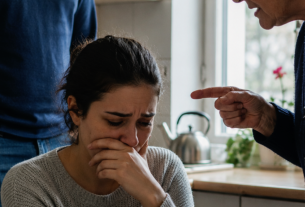
Lena stood by the stove, clasping her hands together so they would not shake. She wanted to scream, to say that this was a performance, that his mother had done it on purpose to shame them and force them to let her in, but she remained silent.
The performance had worked. Her mother-in-law was here. And judging by the look of her, she had no intention of leaving tomorrow or the day after.
The evening passed in oppressive silence. Tatyana Mikhailovna settled on the sofa in the living room, looking like a fire victim who had finally been given shelter. Lena and Kolia locked themselves in the bedroom.
“This is the end,” Lena whispered. “Do you understand this is the end of our peaceful life? She’ll live here now.”
“Len, what can I do?” Kolia was crushed. “She’s my mother. She spent three days sitting in the entrance hall! What will people think? That we’re monsters?”
“Don’t you understand she did it on purpose?” Lena tried to speak quietly so she would not start shouting. “She needed a result, and she got it. At the cost of your shame and my peace.”
“Enough!” Kolia cut her off sharply. “I’ll figure it out myself. She’ll stay for a little while until the frost lets up. And I’ll go to the village and deal with the house. I’ll do everything myself, like I promised.”
Lena understood that arguing was useless. He felt guilty, not his mother. And that guilt could not be rooted out of him now.
The month spent with Tatyana Mikhailovna felt like an eternity to Lena. Her mother-in-law turned out to be right about the curtains—at her insistence, Lena washed them.
And about the borscht too—she had to cook it rich and hearty. Tatyana Mikhailovna commented on everything: how Lena chopped onions—wrong; how she ironed Kolia’s shirts—he had always liked them done with a steamer; how she arranged shoes in the hallway.
She occupied the bathroom in the mornings when Lena needed to get ready for work, and in the evenings she spoke loudly on the phone with her friends, complaining about her daughter-in-law, who was “trying to drive her out of her own home.”
By the end of the month, Kolia looked gaunt. He became silent and irritable. He was barely home, staying late at work. Lena understood that their marriage was cracking at the seams.
Finally, the frost eased. Calendar spring arrived, though snow still lay on the ground. Kolia announced that he was going to the village the coming weekend.
He kept the promise he had made to himself. Tatyana Mikhailovna took the news without enthusiasm.
“What are you going to do there alone?” she drawled capriciously. “You’ll only throw money away. Better let me tell you whom to pay, and he’ll do everything.”
“No, Mom,” Kolia said firmly. “Enough. I’ll handle it myself.”
He left on Friday evening and returned late Sunday night, tired, angry, but with some new determined glint in his eyes. Lena was waiting for him.
“Well?” she asked.
Kolia dropped heavily onto a chair.
“I saw everything with my own eyes,” he began dully. “The stove is falling apart—that’s true. But the money I sent is nowhere near there. I found boxes in her room with new cosmetics, perfume, some clothes, bus tickets to the district center, and photos. She’s there with some man. Apparently, Mother was lending him money. But what kind of loan, Len… She was simply spending our money on her entertainment. And then she came to us because in winter, in that crumbling house, it really is cold, and there was nothing left for repairs.”
He fell silent. Lena sat beside him, afraid to move.
“I made an agreement with a crew,” Kolia continued, staring at one spot. “They start Monday. I’ll go there every weekend and supervise. And not another kopeck will go to her. I told her that. First she screamed, then cried, and then declared that in that case, she would stay with us permanently.”
Lena went cold.
“And you?”
“And I said that in that case, I’d throw her out,” Kolia raised his tired eyes to Lena.
“And what did she say?” Lena asked, holding her breath.
“She said we were monsters and that she’d leave tomorrow. Said she has a friend in the city who’ll take her in. Let her go. I bought her a ticket for tomorrow. I’ll see her off and breathe freely. And you breathe too, Len. Forgive me for this month. And for everything.”
Lena hugged him, feeling the weight that had pressed on her shoulders all month finally begin to lift.
Ahead lay long work: work on the house in the village, on their relationship, on the guilt Kolia would still have to live through.
But the most important thing had been done. He had finally taken responsibility himself and stopped being merely a wallet and an object of manipulation.
The next day, Lena was in no hurry to come home from work. She did not want to be present for the departure scene.
When she returned, the apartment was suspiciously quiet and clean. Kolia sat in the kitchen with a cup of tea and smiled.
“She left?” Lena asked.
“She left,” Kolia nodded. “Of course, she made a scene before going. The neighbors heard everything again. Said we’d regret it, that we weren’t children but a punishment, and that I married you and forgot about my mother. The usual set.”
“And you?”
“I sat and listened. Then I stood up, kissed her on the cheek, and said, ‘Mom, I’ll repair the house in the village. It will be warm there. And you will always be able to return there. But we will live separately. It will be better for everyone.’ She slammed the door so hard the plaster crumbled, but she left.”
He was silent for a moment, then took Lena’s hand.
“You know, I’ve just realized something. I was so afraid of hurting her, so desperate to be a good son, that I nearly lost my own family. The one I created myself. It’s my fault that I allowed her to manipulate us for so long. But it won’t happen again. From today on, we build our own life ourselves. And her… we will help her, but on our terms.”
Outside the window, the March snow was melting, and for the first time in a long while, the little apartment on the seventh floor felt truly calm and warm.