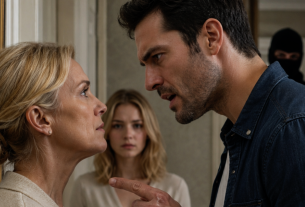
“Yegor, tell me honestly, did your mother happen to work in the privatization department when she was young? Or maybe at some agency called Happy Relocation?” Inessa carefully placed the mortgage receipt on the table. This month, for some reason, it smelled not only of printer’s ink, but also of hopelessness.
Yegor, who was intently poking at a plate of fried potatoes with his fork, did not even raise his head. He had long ago developed a tactic of mimicking the kitchen cabinets: if he sat quietly and did not draw attention to himself, the storm might pass by and only hit the microwave.
“What happened?” he muttered, trying not to meet his wife’s eyes. “Mom is just looking out for our well-being. You know how she is. She believes in the rational use of resources.”
Inessa smirked. In Margarita Nikolayevna’s mouth, “rational use” usually meant that anything lying around carelessly should belong to her precious son, and anything lying around securely should be sold to pay off his debts.
Late April had turned out deceptively gentle: the willow was blooming outside the window, sunlight flooded their three-room apartment with the mortgage attached to it, and in Inessa’s bag lay the main gift for her forty-fifth birthday — the keys to her parents’ two-room apartment on the embankment.
Leonid Mikhailovich and Yulia Romanovna had been saving for that generous gesture roughly since the moment Inessa started first grade. They denied themselves everything: her father repaired old shoes until they looked like museum exhibits, and her mother knew forty ways to cook pollock so that it seemed like sturgeon.
And now, it had finally happened. The documents were signed, the deed of gift was in her hands. Inessa felt like someone who had suddenly found a spacesuit in the storage loft — a valuable thing, certainly, but how exactly one was supposed to walk around sinful earth in it remained unclear.
“Your mother brought a realtor to my new apartment this morning,” Inessa said softly. “While I was at work. She opened the door with her key, which she had ‘just in case’ coaxed out of my mother under the pretext of watering the ficus. But there is one small nuance: my mother doesn’t have a ficus. She has a cactus there, which hasn’t had a drink since last Christmas and is doing perfectly fine.”
Yegor choked on his potatoes.
“What do you mean, brought one? Why?”
“Because, my dear, Margarita Nikolayevna has already calculated everything,” Inessa said, rising and beginning to wipe down an already spotless countertop. “Why do I need, and I quote, ‘personal property,’ when we still have two years left on the mortgage here? She thinks the apartment should be sold, our debt paid off, and with the leftover money she should buy herself a little house in the countryside because she has ‘high blood pressure and a yearning for the soil.’”
“Well, in some ways she’s right… about the mortgage,” Yegor said timidly. “It is hard for us.”
Inessa looked at him the way one looks at a person who claims the Earth is flat and rests on three whales, one of which is his mother.
“Hard is when you try to cram the uncrammable into the family budget. That apartment is a gift from my parents to me. Personally. Do you understand the difference between ‘ours’ and ‘mine’?”
At that moment, the front door creaked, and Margarita Nikolayevna’s cheerful voice rang out in the hallway. She entered other people’s apartments as if she were commanding a parade on Red Square — confidently, loudly, and with a slight shade of superiority.
“Inessochka, darling, are you already home?” her mother-in-law materialized in the kitchen doorway. She was wearing a blue raincoat and such a determined expression that even a ficus, had one existed, would have wilted from fear. “I just stopped by to discuss the details. I was in that little dump on the embankment today. The layout, of course, is dreadful, the corridor is as narrow as a tank, but the river view adds five hundred thousand to the price. I’ve already found a buyer! A respectable man, a widower, looking for peace and quiet.”
“Margarita Nikolayevna,” Inessa exhaled slowly, counting to ten and remembering the film Love and Doves, where everything had somehow been simpler. “That ‘little dump,’ as you put it, is worth more than our three-room apartment. And I am not going to sell it.”
Her mother-in-law carefully placed her handbag on a chair and sat down, moving the sugar bowl aside with the air of a hostess.
“Don’t be selfish, Inessa. Your children are growing up! Olya is already twenty, she’ll be getting married soon. Anya is seventeen — she has university ahead of her. And you two are stuck in this banking bondage. We’ll sell the two-room apartment, pay off the debt, and you’ll finally breathe freely. I’ve already written it all out. Yegor’s father and I don’t need much — just a little house in the suburbs, six hundred square meters of land, enough for our own cucumbers. It’s for the common good!”
“For the common good, or for your gardening itch?” Inessa folded her arms across her chest. “My parents saved for that apartment for thirty years. Dad broke his back working in the North, Mom ran between two jobs. They gave it to me so I would have security. And you’re suggesting I throw it all into your cucumbers?”
“Mom,” Yegor interjected, “Inessa is right. It’s her inheritance.”
Margarita Nikolayevna gave her son a look of such deep disappointment that it was as if he had just confessed he did not know how to tie his shoelaces.
“It’s inheritance when someone has died. This is a living gift. Inessa, you must understand, personal property in a marriage is like a stash hidden under the mattress: it smells of mistrust. You two are one whole! Why do you need those square meters? So you’ll have somewhere to run away if Yegorushka doesn’t wash one extra plate?”
“Exactly,” Inessa snapped. “So I have territory where no one discusses selling my things behind my back. By the way, how much did the realtor value the ‘little dump’ at?”
Her mother-in-law brightened, missing the sarcasm completely.
“Seven million, if we don’t bargain! Can you imagine? We’ll use five million to close your mortgage, and with two million we’ll buy a wonderful log house near Gatchina. Fresh air! Silence!”
“And none of you will be heard in this apartment,” Inessa whispered, softly enough that only the refrigerator could hear.
The evening promised to be long.
Their eldest daughter, Olya, came out of her room. She looked like someone who had just woken from a century-long sleep, even though it was only eight in the evening. Olya was studying law and viewed everything through the prism of the Civil Code.
“Grandma,” Olya yawned, “are you aware that your actions qualify as an attempt to dispose of someone else’s property without power of attorney? If Mom files a complaint, the realtor could go down as an accomplice too.”
“Just look at her!” Margarita Nikolayevna raised her eyes to the ceiling. “Dragging her own grandmother to court! And for what? For caring! I want you all to live without debts. I want your father not to slave away at three jobs.”
Yegor worked one job, though a very responsible one: he was a system administrator and spent most of his time battling printers and user stupidity. Physically, he could not handle “three jobs,” preferring to spend his free time lying on the sofa in the fetal position.
“Mom, no one is selling anything,” Yegor tried to take control of the situation. “Let’s have some tea.”
“What tea?” His mother-in-law pursed her lips in offense. “They’re supposed to bring a deposit tomorrow. Serious people. Inessa, you simply don’t understand your own good fortune. Money has fallen from the sky for you, and you’re clinging to old walls. That place needs repairs — dear heavens! The wallpaper is peeling, and the linoleum remembers the 1980 Olympics. Can you imagine how much money you’d have to pour into it?”
“Margarita Nikolayevna, I will decide for myself what to do with the linoleum,” Inessa’s voice became as cold as kefir pulled from a freezer. “And please return the keys.”
“What keys?” Her mother-in-law put on an innocent face. “I left them with the realtor so he could show the apartment to another set of buyers tomorrow. He has a line of people waiting!”
A silence fell over the kitchen so complete that one could hear someone sneeze in the neighboring entrance. Inessa slowly put down the towel. She understood: peace talks were over. Guerrilla warfare had begun.
“You gave the keys to my apartment to a stranger?” Inessa began slowly advancing toward her. “Without my consent?”
“It was for business!” Margarita Nikolayevna began backing toward the exit. “Yegor, tell her! It’s a profitable deal! The widower is ready to add another fifty thousand for the built-in wardrobe!”
“The widower can go take a hike,” Inessa grabbed her phone. “Yegor, if the keys are not on this table within an hour, I am calling the police and reporting unlawful entry. And I don’t care whether the realtor is your third cousin’s nephew or whoever he is to you.”
Sensing that things smelled burned — and not of the cutlets Inessa had never started frying — her mother-in-law darted into the hallway.
“Fine, live in your debts then! Look at her, the great property owner! And your parents are something else too, Inessa — planting a real-estate pig in the middle of the family. They brought discord into the home!”
The door slammed. Yegor sat gloomily at the table. Olya patted her mother sympathetically on the shoulder.
“Mom, do you want me to draft a lawsuit? Just as a preventive measure.”
“No,” Inessa sat down on the edge of a chair. “I have a better plan.”
The next day, Inessa did not go to work. She took a day off “for family reasons.” At ten in the morning, outside the door of her parents’ apartment, she ran into the very same “widower” and the realtor, who turned out to be a fidgety young man in a cheap suit.
“Good morning,” Inessa smiled brilliantly. “I’m the owner. And you must be the people who want to buy the apartment with the ghost?”
The widower, a respectable-looking man in glasses, flinched.
“With the… what ghost?”
“Oh,” Inessa lowered her voice conspiratorially. “There’s quite a story here. The apartment is wonderful, but the former owner, my great-grandmother, was a woman of strict principles. She especially disliked men who were ‘looking for peace and quiet.’ They say she still walks the corridor at night and checks whether the linoleum is dusty. And if she finds dust, she starts singing the Soviet national anthem. Loudly. In a bass voice.”
The realtor swallowed nervously.
“Margarita Nikolayevna didn’t mention that.”
“Of course she didn’t!” Inessa flung the door open hospitably. “She wants to sell it. But come in, come in. Do you see that stain on the ceiling? That isn’t a leak. That’s ectoplasm. Just kidding! It’s only tea. But my great-grandmother spilled it in 1994, and no paint has been able to cover it since. Mystical, isn’t it?”
The widower began backing away.
“You know, I think I’ll look at a few more options. I do need peace and quiet… the ordinary kind. Without vocals.”
When the entrance door slammed shut, Inessa resolutely locked the door with every turn of the bolt and went to the hardware store. She bought the cheapest roll of poisonous-green wallpaper and a can of paint that smelled as if it had been brewed in the underworld.
By evening, the apartment had been transformed. Inessa was not doing repairs — she was creating an installation called “Madness Lives Here.” Scattered newspapers, a patch of wall painted green right in the middle of the room, and an old padded jacket artfully thrown over a hanger.
Two hours later, when Margarita Nikolayevna burst into the apartment with yet another “client,” she was in for a surprise.
“Here we are!” her mother-in-law announced joyfully, opening the door with her own key — the old fox had made a duplicate after all. “Come in, Mr. Potapov, it’s spacious here… Oh, dear Lord!”
Inessa was sitting in the middle of the room on an overturned bucket, diligently painting an old boot gold.
“Margarita Nikolayevna! Perfect timing! Allow me to introduce you — this is Mr. Potapov, yes? Very nice to meet you. I’ve decided not to sell. I’ve decided to open a conceptual art studio here called The Golden Bast Shoe. We’ll make installations out of old things and sell them for insane amounts of money. The taxes are high, true, and the neighbors are already complaining about the smell of solvent, but art demands sacrifice!”
Mr. Potapov, a solid-looking man in an expensive coat, looked at Inessa, at the golden boot, at the green square on the wall, and silently left.
“What are you doing?” her mother-in-law shrieked once the buyer had closed the door behind him. “You ruined my deal! Five million doesn’t just lie around in the street!”
“It doesn’t hang on my wall either,” Inessa stood up, setting the boot aside. “So here’s how it’s going to be, Mother. The keys — on the table. Both sets. Tell the realtor that if he comes here one more time, I will sue both him and the agency. And I am renting the apartment out. Starting tomorrow.”
“To whom?” Margarita Nikolayevna clutched at her heart. “To some students who’ll smoke up the whole place?”
“No. To my parents. They’ve decided to sell their old dacha and move closer to us, into this very two-room apartment. And the money from the sale of the dacha…” Inessa paused for effect. “They will give to us so we can close the mortgage. But on one condition.”
Her mother-in-law froze.
“What condition?”
“The little house near Gatchina is canceled. My parents will buy themselves a small studio apartment in this same building, on the first floor. So they can always be close to their granddaughters. And to me. As for you, Margarita Nikolayevna, you may visit us. By prior appointment. And without realtors.”
Her mother-in-law opened her mouth, but no words came out. She looked like a fish thrown onto the shore of common sense.
“And one more thing,” Inessa added, wiping her hands on a rag. “Yegor fully agrees. He has decided it’s better to have living in-laws nearby than a dead great-grandmother singer in his nightmares.”
Margarita Nikolayevna threw the keys onto the floor and flew out of the apartment without saying goodbye.
Peace was restored, although the smell of paint promised to linger for another week. Inessa walked over to the window. The April sun was setting, coloring the river pink. Her phone vibrated in her pocket — a message from Yegor: “I bought your favorite cheese and grapes. Shall we celebrate your parents’ housewarming?”
Inessa smiled. She knew there would still be many battles ahead over the “rational use of resources,” but today her fortress had held.
Two days passed. Inessa was sitting in the kitchen, making a shopping list for her parents’ move, when the doorbell rang. Yegor stood on the threshold, his face completely pale.
“Inessa, here’s the thing… Mom… she didn’t go to the dacha.”
“And where is she?” Inessa felt everything inside her tighten.
“She has barricaded herself in that two-room apartment and says she has ‘the right of the first night’ there and won’t leave until you sign a waiver in favor of the grandchildren. And she also brought some woman with suitcases…”
Inessa rose from her chair. It seemed peace talks had not merely ended — they had never even begun.
“Yegor, tell me, are that woman’s suitcases gold too?” Inessa calmly removed her apron, feeling the excitement of an old commander awakening inside her. “Or did she come straight away with a folding cot?”
“Inessa, it’s more serious than that,” Yegor wiped sweat from his forehead. “Mom locked herself in from the inside with the chain. And that lady, Eleonora Vikentyevna, claims she is a ‘distant relative through the third-cousin jelly line’ and has nowhere to live while major repairs are being done in her apartment. Mom announced that the two-room flat is now a ‘family guest fund.’”
Inessa snorted. Margarita Nikolayevna had decided to go all in: if she could not sell the apartment, then she would occupy it, smoking out the rightful owner with the smell of someone else’s domestic life.
“Well then, let’s go, Yegorushka. Let’s take a look at this ‘fund.’ But first we’ll stop by a store.”
Half an hour later, they were standing outside the door of her parents’ apartment. From behind the imitation-leather upholstery came the sounds of an old romance song and the lively knocking of a knife against a cutting board. It smelled of fried bread and some impossibly cheap perfume, so strong it stung the nose even through the cracks.
“Margarita Nikolayevna, open the door,” Inessa tapped the doorframe with her key. “This is the department for combating the illegal seizure of square meters.”
“I won’t open!” came the militant cry from behind the door. “Inessa, you must understand: the apartment is empty, and a person is suffering! Eleonora is an intelligent woman. She’ll look after the place while you’re painting your ‘installations.’ This is my answer to your selfishness!”
Inessa looked at the bag in her hand. Inside were three powerful air fresheners scented “Sea Breeze” and a huge head of garlic.
“Yegor, step aside,” Inessa commanded. “Margarita Nikolayevna, I warned you. Since you’ve decided to set up a dormitory named after Madame Gritsatsuyeva, I am introducing my own rules. Since I am the owner, I am calling a locksmith service right now. And after that — a police unit. Does your Eleonora have her passport with her? Is she registered at this address?”
Silence fell behind the door. Judging by the rustling, Eleonora Vikentyevna had clearly grown nervous.
“Inessa, don’t you dare!” her mother-in-law’s voice trembled. “We were just… just being neighborly!”
“Neighborly is when someone comes over for salt, not when they move in with suitcases,” Inessa cut her off. “Yegor, call Emergency Services. Tell them there are people locked inside the apartment in an unstable state, and there is a smell of gas.”
The word “gas” worked like magic. The chain rattled, the lock clicked, and Margarita Nikolayevna appeared on the threshold in a kitchen apron over her raincoat. Behind her stood a tall lady with a bouffant hairstyle resembling cotton candy.
“What police? What Emergency Services?” her mother-in-law wailed. “I simply wanted to show that the apartment should be useful!”
“And it will be,” Inessa entered the hallway, moving Eleonora and her suitcase aside. “Tomorrow a crew of workers is moving in here. Major renovations, Margarita Nikolayevna. We’re tearing down walls. Dust will rise in clouds, and the hammer drill will roar from eight in the morning until eleven at night. Eleonora Vikentyevna, do you like sleeping to the sound of a jackhammer?”
The bouffant-haired lady blinked in fear and pulled her bag closer.
“Margarita, you didn’t say anything about tearing down walls… I have migraines!”
“And also,” Inessa began busily hanging garlic on the hooks in the hallway, “I’ve invited an extermination service. They’ll be poisoning imaginary bedbugs. The smell is specific and lasts a month. Not great for your health, but excellent for prevention.”
Eleonora Vikentyevna did not wait for an invitation to leave. She grabbed her suitcase.
“You know what, Margarita, I’d rather go to my nephew in Khimki. It’s cramped there, but at least there’s no ectoplasm or bleach!”
When the entrance door slammed behind the “distant relative,” Inessa turned to her mother-in-law. She was sitting on a stool, fanning herself with her hand.
“You… you’re nothing but a snake in the grass, Inessa,” Margarita Nikolayevna exhaled. “So much effort to help the family, and you…”
“Mom,” Yegor said firmly for the first time in a long while. “Enough. You have crossed every line. This is Inessa’s apartment. And if you try to command things here one more time, I will personally take away your keys to our apartment. You’ll ring the intercom and wait until you’re allowed in.”
His mother looked at him as if he had suddenly begun speaking Chinese. She understood: her “little boy” had grown up, and the “gold mine” in the form of the apartment had slipped out of her hands for good.
“Fine then!” Margarita Nikolayevna stood, adjusting her raincoat. “Live however you want. But when your parents start imposing their own order here, don’t complain! I wash my hands of this. I’ll go home. At least the cucumbers on my windowsill don’t argue with their mistress.”
She left with her head held high, although Inessa noticed how treacherously her handbag was trembling.
A week later, Leonid Mikhailovich and Yulia Romanovna moved into the apartment. Of course, Inessa never started any major renovations — they simply replaced the wallpaper in the bedroom and threw out the old linoleum that “remembered the Olympics.”
That evening, at the end of April, the whole family gathered around the large table in that very two-room apartment. Her father opened a jar of homemade mushrooms, her mother sliced bread, and Inessa looked at the city lights reflected in the river. The mortgage was almost paid off with the money from the dacha sale, and the home finally smelled not of intrigue, but of peace and freshly brewed tea.
“You know, Yegor,” Inessa whispered to her husband when they stepped out onto the balcony. “Your mother called today. She asked whether my parents needed some ‘Bull’s Heart’ tomato seedlings.”
“And what did you say?” Yegor smiled.
“I said there’s only room for flowers on my balcony. But if she wants, she may send one little plant. Only one. And under my personal supervision.”