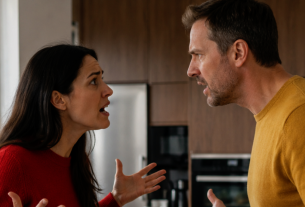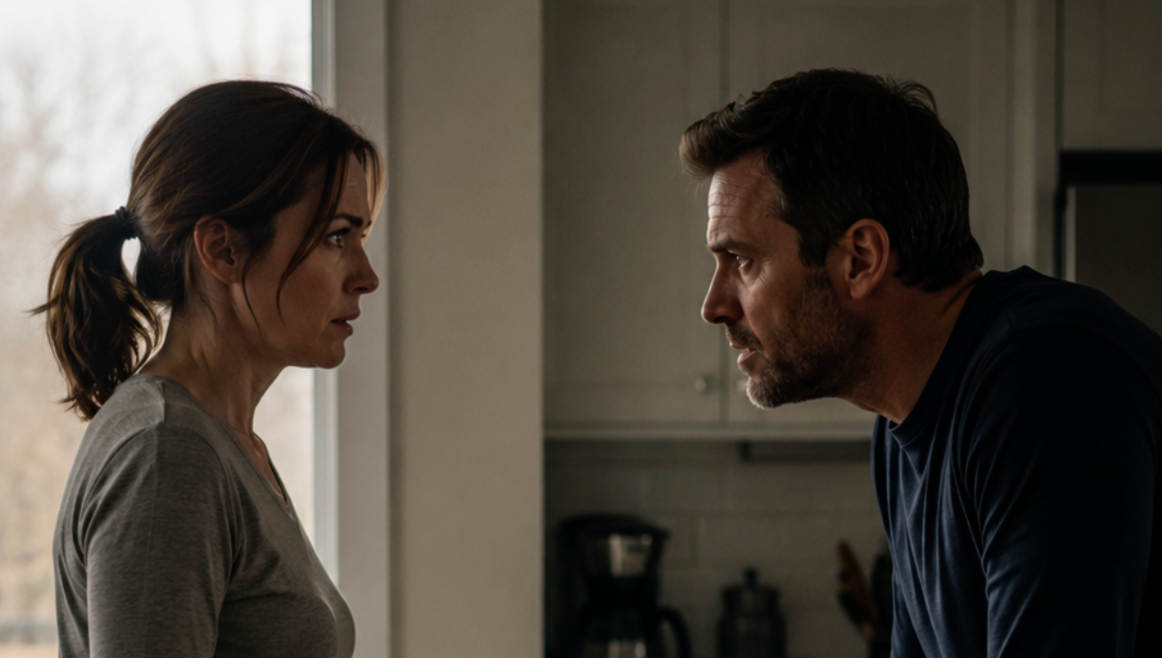
Suitcases in your hands and out the door. I’m not going to babysit you,” Vika said so calmly that even her husband immediately stopped trying to justify himself.
And that very morning, she had thought Sunday would pass quietly.
Vika had inherited the apartment from her grandmother. It was a two-room place, not huge, but comfortable: a bedroom, a living room, a kitchen, a narrow hallway, and a glazed balcony where Vika kept boxes of winter clothes and an old sewing machine. Her grandmother had left the apartment to her in her will. Vika entered into the inheritance after the required six months, registered ownership, and from then on treated the apartment not as some lucky gift, but as her foundation.
For years she had heard from her husband’s relatives that she had “gotten lucky.” Coming from them, that word always sounded as if Vika had done nothing, as if she had simply picked up the keys to a ready-made life off the ground. No one remembered that in her grandmother’s final years, the old woman could barely get out of bed. No one remembered that after work Vika went to her, bought medicine, cooked, washed the floors, and sat beside her at night when the elderly woman became frightened.
Her husband, Artyom, had understood everything at first. At least, that was what Vika had believed.
They had married four years earlier. Artyom moved in with her almost immediately after the wedding. He had no home of his own; he had been renting a room with a friend, so Vika herself had suggested:
“Live with me. But the apartment is mine. No discussions and no decisions behind my back.”
Back then he had nodded easily, even gratefully.
“Of course. I’m not stupid. What’s yours is yours.”
Vika remembered that phrase. Not because she was suspicious, but because it sounded like a promise. A simple, human promise.
For the first few years, they lived normally. They argued over little things and made peace quickly. Artyom loved noisy gatherings; Vika valued silence more. He could invite a friend over for the evening, forgetting to warn her, and afterward she would silently clear cups from the table and explain that the apartment was not a public passageway. He grumbled, but seemed to listen.
Things were harder with his family.
Artyom’s mother, Galina Petrovna, lived in a neighboring district of the city with her daughter Svetlana and two grandchildren. Svetlana was six years older than Artyom, divorced, worked shifts in a household goods store, and often complained that everything in life was difficult for her. Her children were very different: fourteen-year-old Dima, a tall, gloomy teenager, and seven-year-old Alisa, a lively girl who could not calmly pass by someone else’s makeup bag, purse, or phone.
Vika was not against helping. She could bring groceries or sit with Alisa for a couple of hours if Svetlana urgently had to go somewhere. But helping and moving people in were different things. Especially when outsiders entered your home as if the keys had been handed to them at a general family meeting.
The first warning sign came a week before that Sunday.
Artyom came home late, fussed around in the hallway for a long time, then entered the kitchen with the expression of a man who had already invented an excuse and was now afraid to hear the question.
“Vika, there’s something,” he began.
She was taking a pan of stewed vegetables off the stove and immediately turned her head.
“What?”
“Svetka has problems with her apartment.”
“What apartment?”
“Well, they rent. The landlady has decided to sell the place. She told them to move out.”
Vika put the spatula down on a plate and looked at her husband more carefully.
“And?”
“They need somewhere to stay for a while. Not for long.”
“How long is ‘not for long’?”
Artyom scratched the bridge of his nose and looked away toward the window.
“Well… a month. Maybe two.”
Vika smiled only with her eyes.
“We have a two-room apartment. We sleep in one room. In the other I work, rest, and sometimes host your friends when you suddenly bring them over. Where exactly are you planning to put Svetlana, two children, and Galina Petrovna, who will surely also come to ‘help’?”
“Mom won’t necessarily come.”
“She will, Artyom. You know your family.”
He tiredly ran his palm over his face.
“Why are you reacting like this right away? People are in trouble.”
“People in trouble look for a rental, negotiate, calculate their options, and ask for help honestly. But right now you’re speaking as if the decision has already been made.”
“It hasn’t.”
“Then my answer is no.”
Artyom raised his head.
“We won’t even discuss it?”
“We are discussing it. I’m saying no.”
He sharply pulled out a chair and sat down, but did not touch the food.
“You’ve become hard.”
“I’ve become attentive. This is my apartment. I don’t want to turn it into a dormitory.”
“She’s my sister.”
“I’m not forbidding you from helping your sister. Help her find housing. Move her things. Watch the children. But don’t move anyone into my apartment.”
Artyom fell silent. A hurt expression appeared on his face, familiar and slightly childish. Before, Vika would react to such hurt: she would start explaining more softly, look for a compromise, smooth things over. But this time she felt not pity, but exhaustion. Not from this particular conversation, but from the whole pattern: Artyom brought someone else’s problem, placed it on the kitchen table, and then waited for Vika to carefully pick it up for herself.
The next few days passed tensely.
Artyom spoke little. He answered his mother’s calls in the bathroom or on the stair landing. Vika did not eavesdrop, but phrases still reached her: “I’ll talk to her,” “she’s against it for now,” “we need to be gentler,” “well, not today.”
The word “for now” bothered Vika most of all.
On Friday evening, she asked him directly:
“Did you tell them I’m against it?”
Artyom was sitting on the sofa with his phone in his hand. The screen had gone dark, but he was still staring at it.
“I did.”
“And?”
“Mom got upset. Sveta cried.”
Vika slowly nodded.
“I see.”
“You see? And that’s all?”
“What do you want to hear?”
“Some kind of sympathy, at least.”
Vika sat across from him, on the edge of the armchair.
“Artyom, sympathy is when I can help without destroying my own life. I don’t want to wake up to children screaming, search for my belongings, tolerate your mother in my kitchen, and listen to complaints that I don’t welcome guests properly. I already see all of it in advance.”
“You’re exaggerating.”
“No. I’m simply not closing my eyes.”
He wanted to object, but the phone in his hand vibrated. The screen showed: “Mom.” Artyom quickly rejected the call.
Vika noticed the movement. Her face became still.
“Why didn’t you answer?”
“I don’t want to right now.”
“Or you don’t want me to hear?”
“Vika, don’t start.”
She stood up.
“I’m not starting. I’m ending the conversation. No one is moving in here.”
That night Artyom went to bed late. Vika heard him walking around the kitchen, opening the refrigerator, closing it again, going out into the hallway. In the morning he was quiet, even affectionate. He bought bread, took out the trash, and suggested they go grocery shopping together. Vika became wary, but said nothing out loud.
On Sunday, she woke up before him. The day was bright and dry, with a sharp wind. Vika turned on the washing machine, sorted through documents on the table, and called her friend Larisa. They talked about little things: Larisa’s new haircut, the broken elevator in her building, how difficult it was to find a good shoe repairman.
All this time, Artyom was unusually active. He went out for bread, then suddenly decided to wash the floor in the hallway, then checked his phone several times. Vika watched him out of the corner of her eye. His helpfulness did not look like a desire to help; it looked like an attempt to occupy a place near the door until the right moment.
At around three in the afternoon, the intercom rang.
Artyom jumped up so quickly that the chair rocked.
“I’ll open.”
Vika looked up from her laptop.
“Who are we expecting?”
He did not answer immediately. He pressed the button and said into the receiver:
“Come up.”
Then he turned to his wife.
“Just don’t start shouting right away.”
Vika slowly closed the laptop.
“Who is it?”
“Mom and Sveta.”
“With what?”
Artyom did not have time to answer. Voices were already heard behind the door, along with shuffling and the knocking of wheels on the landing. Vika stood up. Her body gathered itself: shoulders straightened, fingers tightened on the edge of the table, her gaze fixed on the hallway.
Artyom opened the door.
The first things to enter were two large suitcases. Behind them came Svetlana, flushed, with a bag over her shoulder. Dima carried a backpack and a bag with sneakers. Alisa hugged a stuffed rabbit. Galina Petrovna entered last, wearing a dark coat. She looked around the hallway and immediately exhaled as if she had finally reached her rightful place.
“Oh, thank God. We barely made it,” she said, walking inside without an invitation.
Vika stood at the entrance to the room.
“What is going on?”
Svetlana smiled guiltily, but her eyes wandered around the apartment with possessive interest.
“Vik, don’t be angry. Artyom said we could stay for a couple of days. We brought our things just so we wouldn’t have to drag them back and forth.”
“I never said that,” Vika replied.
Galina Petrovna was already taking off her coat.
“Oh, here we go. Let people get undressed after the road. You can talk later.”
Vika turned to her husband.
“Artyom?”
He was standing by the door, holding the second suitcase.
“Vik, they’re already here. We can’t throw them out at the doorstep.”
“I said no a week ago.”
“I thought you’d cool down.”
“I’m not a pot on the stove to cool down.”
Dima quietly snorted, but immediately hid his smile when Vika looked in his direction. Meanwhile, Alisa had already gone to the cabinet and reached for a small cat figurine that Vika had brought back from a trip.
“Alisa, don’t touch that,” Vika said calmly.
The girl pulled her hand back and looked at her mother.
Svetlana waved tiredly.
“Let her look. She’s a child.”
“She can look with her eyes.”
A short pause followed. In that pause, Vika clearly saw the setup: they had not come to ask. They had come to test how far they could go.
“Where should we unpack our things?” Galina Petrovna asked, as if the question of their stay had already been settled.
Vika did not answer at once. She looked at Artyom.
“Did you tell them I agreed?”
He looked away.
“I said we’d come to an arrangement.”
“No. You said it in a way that made them come.”
Svetlana immediately stepped in.
“Vika, don’t do this in front of the children. We really won’t stay long. I need to find an option, gather documents, talk to the landlady. You understand how unexpectedly everything happened.”
“Unexpectedly? Artyom told me about this a week ago.”
Svetlana blinked.
Galina Petrovna sharply turned to her son.
“You told her a week ago?”
Artyom frowned.
“Mom, that’s not the point right now.”
“How is it not the point?” Vika tilted her head slightly. “It is exactly the point. You had a week not to come here with suitcases.”
Galina Petrovna quickly pulled herself together.
“Vika, you’re a young woman. It’s hard for you to understand. When people are in trouble, normal relatives help.”
“Help does not begin with deceit.”
“What deceit?” Svetlana flared up. “We’re not strangers!”
“For my apartment, you are strangers as tenants if I did not give my consent.”
Artyom tightened his grip on the suitcase handle.
“Vik, enough. Let them at least spend one night.”
Vika looked at the open door, then at the suitcases.
“One night turns into a week. A week turns into a month. A month turns into ‘Where are we supposed to go now?’ I’ve heard this from other people before, and I’m not going to test it on myself.”
Galina Petrovna’s face changed.
“So you’re putting us out on the street?”
“I did not invite you into the apartment.”
Svetlana suddenly stopped pretending to be tired.
“But Artyom invited us. He lives here too.”
Vika slowly turned her head toward her, without abruptness.
“He lives here. But he does not own the apartment.”
That sentence instantly changed the air in the hallway. Galina Petrovna stopped taking off her shoes. Svetlana straightened up. Artyom turned red, as if Vika had said something indecent.
“Why would you say that?” he muttered quietly.
“Because it’s true.”
“You make it sound like I sleep on a stool by the door.”
“You live here as my husband. That does not give you the right to move people in.”
Svetlana lifted her chin.
“So that’s how it is. My brother is here on sufferance?”
“Not with you, Svetlana. With me. And not on sufferance, but by a human agreement, which he violated today.”
Dima stood by the wall, looking down at his sneakers. He felt awkward. Alisa was already tired and asked:
“Mom, where are we going to sleep?”
Svetlana immediately used it.
“You see? The child is asking. Can’t you at least have pity on the children?”
Vika looked at the girl. Alisa was not to blame for the adults’ decisions. But Vika knew too well how children were used as shields for other people’s insolence.
“Their mother should have pity on them before taking them somewhere they are not expected.”
Svetlana opened her mouth, but did not immediately find an answer. Red patches appeared on her cheeks.
Galina Petrovna said sharply:
“Artyom, bring the things into the room. We’ll sort it out later. No use standing in the doorway.”
And that was when Vika understood: gentle explanations were over.
She walked to the front door and opened it wider.
“No. The things stay in the hallway.”
Artyom froze.
“Vik…”
“Not ‘Vik.’ I said no.”
Galina Petrovna smirked.
“What a temper. Grandma’s apartment went to your head?”
Vika calmly looked at her.
“At least my grandmother asked before entering someone else’s room.”
“Are you going to be rude to me?”
“I’m going to speak in my own home in a way that finally makes me heard.”
Svetlana suddenly bent down to the suitcase and unzipped it.
“Mom, don’t talk. We’ll unpack, and then she’ll calm down.”
Vika stepped forward.
“Svetlana, close the suitcase.”
“Don’t order me around.”
“In my apartment, I will give orders about anything concerning my apartment.”
Svetlana sharply opened the suitcase wider. Inside were children’s clothes, bags, towels, house robes. She took out a stack of T-shirts and headed toward the living room.
Vika blocked her path.
“Put the things back.”
“Move.”
“No.”
They stood opposite each other, and for the first time Svetlana seemed to understand that Vika was not playing at politeness. She was not trying to seem nice. She was not afraid of what anyone would think of her.
Artyom put the suitcase on the floor.
“Sveta, don’t. Let’s do this calmly.”
“Calmly?” Svetlana turned to her brother. “You said everything was settled. We gave up a temporary option with an acquaintance because you told us to come here!”
Vika shifted her gaze to her husband.
“What temporary option?”
Artyom was silent.
Galina Petrovna sharply interrupted:
“What’s the point of remembering that now? It would have been inconvenient there. A one-room place, far from the school, and the landlady is nervous.”
Vika smiled slowly, but there was no warmth in that smile.
“So there was an option.”
Svetlana broke off.
“There was, but…”
“But you chose my apartment because it was more convenient here.”
“You talk as if we came to stay forever.”
“You arrived with suitcases, children, your mother, and already started unpacking.”
Artyom said quietly:
“I thought if they came, you wouldn’t make a scene.”
Vika looked at him for a long time. At that moment, something inside her finally clicked into place. It did not break, did not explode, but simply locked into position — straight and firm, like a latch in a lock.
“So you decided to present me with a fait accompli.”
He did not answer.
“Fine,” Vika said. “Then here is my fact. They are leaving.”
Galina Petrovna threw up her hands.
“Son, do you hear that? She’s throwing us out!”
“Yes,” Vika answered. “Exactly.”
Svetlana tossed the T-shirts back into the suitcase but did not close it.
“And what if we don’t leave?”
Vika took out her phone.
“Then I’ll call the police and say there are people in my apartment who refuse to leave after I’ve demanded it. I have the documents for the apartment. You are not registered here. There is no rental agreement. There is no consent from me.”
Galina Petrovna went pale with rage.
“Have you lost all conscience?”
“No. I finally stopped confusing conscience with being convenient for other people.”
Artyom came closer.
“Vika, don’t disgrace us in front of the neighbors.”
“You brought the neighbors in as spectators yourself when you decided to arrange a move-in without my consent.”
He lowered his voice.
“She’s my mother.”
“This is my apartment.”
“You’re going too far.”
“No. You went too far when you decided my ‘no’ could be bypassed with suitcases.”
Dima quietly said to his mother:
“Mom, maybe we really should leave?”
Svetlana sharply turned to him.
“Be quiet.”
Vika noticed how the boy tightened his grip on the backpack strap. He was not a bully, not an invader. Just a teenager dragged into an ugly scene by adults. And that made Vika feel even more unpleasant.
She looked at Svetlana, now without the same sharpness.
“You have children. For their sake, at least don’t turn this into a circus. Gather your things and look for the option you refused.”
“We can’t go there anymore.”
“Call and find out. Or go to Galina Petrovna’s.”
Galina Petrovna was indignant:
“I don’t have space.”
“So space must appear in mine?”
“There are two rooms here!”
“In one, Artyom and I live. The second is not a spare bed for the entire family.”
Svetlana suddenly laughed loudly.
“So the real Vika has finally come out. And here I thought you were polite and calm. If I’d known you were like this, I would never have introduced my brother to you.”
“You didn’t introduce us,” Vika answered dryly. “We met on our own.”
Artyom twitched.
“Don’t nitpick words.”
“I’m not nitpicking words. I’m holding on to boundaries that you opened today with someone else’s hands.”
Galina Petrovna approached her son and placed her palm on his shoulder.
“Artyom, tell her like a man already. Are you the husband here or what?”
Vika looked at that hand. The scene was almost funny: a mother pushing her adult son to give orders in an apartment to which she herself had no relation.
Artyom swallowed, but still said:
“Vika, close the door. They’ll stay until tomorrow. We’ll decide in the morning.”
“No.”
“I said…”
“And I heard you. Now you listen to me. If they stay, I call the police. And after that, you and I will no longer be discussing guests, but your moving out.”
He looked at her as if seeing her for the first time. Vika even understood: Artyom had been certain until the very end that she would stop. That she would be frightened by his hurt feelings, his mother’s tears, the children’s eyes, the neighbors’ curiosity. That she would give in, and then she herself would cook dinners, clear shelves, wash other people’s clothes, and tolerate comments about not being greedy.
But Vika no longer wanted to be convenient.
She unlocked her phone.
“I’m counting to ten. Then I call.”
For the first five seconds, no one moved.
Then Dima lifted his backpack.
“Mom, I’ll go downstairs.”
“Stay where you are,” Svetlana barked.
The boy stopped, but it was already clear: he did not want to participate. Alisa began to whimper softly, clutching the rabbit to her chest.
Vika did not raise her voice.
“Svetlana, don’t make things worse for the children.”
Svetlana abruptly bent down and started throwing the T-shirts back into the suitcase. Not folding them, but throwing them. Galina Petrovna rushed to her bag, muttering something about ingratitude. Artyom stood in the middle of the hallway as if switched off.
Vika did not help. She held the door open and watched to make sure no one moved deeper into the apartment.
As Svetlana zipped up the suitcase, she suddenly said:
“We’ll talk again.”
“No,” Vika replied. “Today you will leave. After that, you can talk to Artyom, but not about my apartment.”
“He is your husband!”
“That is exactly what I’ll deal with separately.”
Galina Petrovna grabbed her bag, then suddenly turned.
“And the keys? Artyom, give me the spare ones. I’ll pick something up later if we forget anything.”
Vika sharply lifted her gaze.
“What spare keys?”
Artyom turned pale.
The silence became so thick that even Alisa stopped whimpering.
Vika approached her husband.
“Does your mother have keys to my apartment?”
He was silent.
Galina Petrovna realized she had said too much and quickly began talking:
“Why are you reacting like that? Just in case. Anything can happen. My son gave them to me, so he had the right.”
Vika held out her hand.
“The keys.”
“Now isn’t the time,” her mother-in-law muttered.
“The keys. Now.”
Galina Petrovna looked at Artyom, expecting protection. But he said nothing. Then she rummaged in her bag for a long time, took out a keyring, and separated one key.
“Choke on it.”
Vika took the key with two fingers and placed it on the small cabinet by the door.
“The rest.”
“What rest?”
“To the entrance, the second door, the mailbox, if Artyom gave you a full set.”
Artyom said quietly:
“Mom, give them back.”
Galina Petrovna exhaled noisily and took out two more keys. Vika took them and turned to her husband.
“Your set too.”
He frowned.
“Are you serious?”
“Absolutely.”
“I live here.”
“For now. But after today, I won’t leave you the opportunity to bring people in again when I’m not home.”
“Are you throwing me out too?”
Vika looked at him without anger. The anger had passed, leaving only clarity.
“Right now I’m throwing out your family. You’ll stay if you can explain why I should trust you after this. But until we talk, the keys will stay with me.”
Artyom slowly took out his keyring, removed the apartment keys, and placed them on the cabinet. The metal rang out briefly and dryly.
Svetlana watched them with unpleasant interest.
“Well, Artyom, congratulations. You played at love and lost.”
Vika sharply turned to her.
“The suitcase.”
Svetlana yanked the suitcase handle. The wheels got stuck at the threshold, and she irritably pulled harder. Dima helped silently. Alisa followed them out, still clutching the toy. Galina Petrovna stopped last.
“You’ll still come asking for forgiveness,” she said to Vika.
“I won’t.”
“We’ll see.”
“Watch from your own apartment.”
Galina Petrovna stepped onto the landing. Vika did not close the door immediately. She waited until all the suitcases were beyond the threshold, until Artyom removed his foot from the doormat, until not a single bag remained in the hallway.
Only then did she turn the lock.
The apartment became quiet.
Artyom stood beside the cabinet where the keys lay. He looked not angry, but confused. As if he had been deprived not of power, but of his usual certainty that Vika would smooth everything over.
“You could have been softer,” he finally said.
“I was softer for a week.”
“They’ll hate me now.”
“But they’ll know your wife has a voice.”
“You humiliated me.”
“No. You did that yourself when you decided to bring people into my home by deception.”
He rubbed his face with both hands.
“I just wanted to help.”
“No. You wanted to help with someone else’s hands, someone else’s apartment, and my patience.”
Artyom sat on the edge of the sofa in the living room. Vika remained standing by the door.
“I thought you would understand,” he said dully.
“Understanding does not mean agreement.”
“Sveta really is having a hard time.”
“I believe that. But having a hard time doesn’t mean you can invade.”
“So what, are you going to change the locks now?”
“Yes.”
He raised his head.
“Because of one time?”
Vika laughed quietly, but without joy.
“Artyom, this is not one time. This is the result. You knew my answer for a week. You spoke to them secretly. You told them to come. You gave your mother keys. And when they started unpacking, you asked me not to get angry. You didn’t stop them. You didn’t protect my home. You stood there and waited for me to swallow it.”
He wanted to say something, but the words stuck. It was clear from his face: he had nothing to argue with.
Vika went to the kitchen, poured water into a glass, and took several sips. Her hands trembled slightly, but her voice remained even.
“You’re sleeping here tonight. Tomorrow after work, we’ll talk. If you believe your family has the right to decide who lives in my apartment, you pack your things and leave. If you understand what you did, we’ll think about whether it can be fixed.”
“And if I don’t leave?”
Vika placed the glass on the counter.
“Then I’ll resolve the issue legally. But I hope it won’t come to that.”
Artyom looked at her for a long time.
“You’ve become a stranger.”
“No. I’ve become the mistress of my own home. There’s a big difference.”
He turned away.
Vika took out her phone and wrote to Larisa: “I need the number of a good locksmith tomorrow. Urgently.” Then she opened the folder with documents and checked where the ownership extract was. The documents were in place. She photographed them just in case, put them back, and closed the folder.
The night passed almost without sleep. Artyom went to the kitchen, then returned and lay down on the sofa. Vika closed the bedroom door. For the first time in a long while, she did not want to explain why she was hurt, offended, and upset. She did not want to lay out her thoughts before her husband like items for inspection. She had already said everything.
In the morning, Artyom left early. On the cabinet lay a note: “I didn’t want it to turn out this way. We’ll talk tonight.”
Vika read it and put the paper in a drawer. Then she called the locksmith. She did not file any statements. She did not ask anyone for permission to protect her own door. She simply called a master and changed the lock cylinder. She put the old keys into a bag and put it away.
That evening, Artyom came home alone. He rang the doorbell because he no longer had keys. Vika did not open immediately. First she looked through the peephole, then let him in.
He noticed the new lock and exhaled heavily.
“I see.”
“Good that you do.”
They sat opposite each other in the kitchen. Vika did not set the table and did not pretend it was a family evening. In front of her lay a notebook, and beside it, a pen.
“What’s that?” Artyom asked.
“A list of questions.”
He smiled tiredly.
“An interrogation?”
“A conversation you kept postponing.”
Vika opened the notebook.
“First question. Why did you give your mother keys?”
Artyom lowered his gaze.
“She had asked for them a long time ago. She said, what if something happened. I didn’t attach importance to it.”
“You didn’t attach importance to the keys to my apartment?”
“I understand I was wrong.”
“Second question. Why did you tell them to come after I refused?”
He was silent for a long time.
“Because I thought you wouldn’t be able to throw them out when you saw the children.”
Vika leaned back in her chair. Her face became harder.
“So you consciously decided to pressure me through the children.”
“I didn’t think of it that crudely.”
“But that is exactly what you did.”
“Yes.”
That “yes” sounded quiet, but honest. Vika nodded.
“Third question. What would have happened next if I had given in?”
Artyom rubbed the bridge of his nose.
“They would have stayed for a little while.”
“How long?”
“I don’t know.”
“Exactly. You didn’t even know the deadline.”
He looked at her.
“Vika, I’m guilty. I really am. Mom pressured me, Sveta called, the children… I got confused. I decided that since we had space…”
“We don’t have space, Artyom. I have an apartment where the two of us live. Those are different things.”
“I understand.”
“No. So far, you’re only saying it.”
He clenched his hands on the table.
“What should I do?”
“To begin with, call them in front of me and say you have no right to move anyone into my apartment. That the matter is closed. No ‘for now,’ no ‘later,’ no ‘she’ll cool down.’”
Artyom darkened, but he took out his phone. He called his mother on speaker.
Galina Petrovna answered immediately:
“Well? Did you bring your queen to her senses?”
Vika did not even move.
Artyom closed his eyes for a second.
“Mom, don’t talk like that.”
“How should I talk? She threw us out like vagrants.”
“You came without her consent. I was wrong to invite you. The apartment belongs to Vika. I cannot decide who lives in it.”
The other end went quiet.
Then Galina Petrovna’s voice turned icy.
“So your wife has trained you.”
“No. I violated her boundaries myself.”
“You speak so beautifully now. Is she sitting next to you?”
“Yes.”
“I knew it.”
Artyom looked at Vika. She was silent.
“Mom, Sveta needs to look for other housing. We can help with moving, with listings, but she will not live at Vika’s. And you will no longer have keys.”
Galina Petrovna laughed sharply.
“Well, live under her heel now.”
Artyom turned pale but did not lose control.
“I called to say the main thing. The conversation is over.”
He ended the call.
For the first time in twenty-four hours, Vika saw in him not a boy hiding behind his mother, but an adult man who felt uncomfortable yet still said what needed to be said.
“Svetlana too,” she said.
He nodded and called his sister.
Svetlana answered irritably:
“Well? Did your mistress of the house change her mind?”
Artyom exhaled sharply.
“Sveta, enough. I’m guilty for inviting you. Vika was against it from the beginning. You won’t come to her without an invitation again. Find your own apartment. I’ll help look for options and move things, but you can’t live with us.”
“With us?” Svetlana sneered. “Or with her?”
“With her. And I should have said that right away.”
Svetlana fell silent, then snapped:
“Thanks, brother. You really helped.”
“I’ll help in another way.”
“Keep your help.”
She hung up.
Artyom put the phone on the table.
“That’s it.”
Vika looked at him carefully.
“That is the beginning, not everything.”
“I understand.”
“The keys stay with me for now. I’ll give you a new set when I see that you really understood. And one more thing: if your relatives come here again, the door does not open for them. Not by you, not by me. If they try to force their way in, I call the police.”
“All right.”
“And lastly. You will no longer discuss my apartment with them as a resource. No ‘we have space,’ no ‘Vika can help,’ no ‘you can stay for a while.’ If you want to help, help with your own time, your own hands, and finding options. But not with me.”
Artyom nodded. He looked tired, but this time not offended.
“I was afraid of looking like a bad son and a bad brother,” he said after a pause. “And in the end, I became a bad husband.”
Vika did not comfort him. She only answered:
“That is what you need to work on.”
The following weeks were not easy. Galina Petrovna called Artyom almost every day, but Vika did not interfere in those conversations. If her husband left the room, she did not follow him. If he returned gloomy, she did not ask first. One day Artyom sat down beside her himself and said:
“Mom wants to come and talk.”
“No.”
“That’s what I told her.”
Vika looked at him.
“Good.”
Svetlana eventually rented a small apartment not far from Dima’s school. Artyom found the option through an acquaintance. He helped move the things, assembled a bed, and connected the washing machine. Vika did not take part and did not give money. When Artyom once cautiously asked whether he could buy his sister a few things for the kitchen from their shared household purchases, Vika calmly replied:
“With your personal money, you can. With mine, no. And nothing of mine leaves this home.”
He did not ask again.
A month later, Galina Petrovna sent Vika a long message. It was full of grievances, accusations, phrases about cruelty and loneliness. Vika read it to the end without replying. Then she deleted it. Not because she was afraid, but because she was not going to feed someone else’s scandal with her time.
Artyom noticed.
“She wrote to you?”
“She did.”
“What did you answer?”
“Nothing.”
“Why?”
“Because she already heard my answer at the door.”
He nodded and did not ask again.
Vika did not pretend that everything quickly returned to normal. Trust does not come back after one correct phone call. She gave Artyom a new set of keys only two months later. Before that, they talked again. Calmly, without shouting.
“I don’t want to live expecting that one day I’ll come home and find someone unpacking a suitcase here,” she said.
“That won’t happen.”
“I’ll believe actions.”
“Fair.”
He began warning her about everything in advance. He did not bring friends over without agreement. He did not promise anyone help on Vika’s behalf. He communicated with Galina Petrovna himself, without passing every jab on to his wife. And one day, when his mother again started talking about the “empty room,” Artyom did not try to justify himself.
“Mom, that topic is closed. Don’t start.”
Vika heard it by chance as she passed by the kitchen. She did not stop and did not listen further. But for the first time in a long time, her shoulders relaxed on their own.
That Sunday scene still remained in her memory. Not as shame and not as a family catastrophe, but as the point after which it became easier to breathe in the apartment.
Vika often remembered the moment when she stood in the center of the room and looked at the open suitcases. Things had already been laid out, unfamiliar voices filled the space, and her husband’s relatives behaved as if they had lived there for a long time. Artyom tried to explain something about “temporarily,” about a difficult situation, about how nothing terrible would happen.
But Vika was not listening then.
She calmly walked to the door and opened it. A draft passed through the hallway, stirred the edge of the light blanket on the armchair, and seemed to sweep the last traces of someone else’s certainty out of the apartment. The voices in the room began to fade. Someone tried to object; Svetlana had already drawn breath; Galina Petrovna prepared to press with her stare; Artyom took a step toward his wife.
But Vika did not let them finish.
She looked straight at them. For several seconds, silence stood in the apartment. No one moved. Even the children froze, understanding that the adults had reached the line beyond which ordinary persuasion no longer worked.
And then Vika said evenly:
“Suitcases in your hands and out the door. I’m not going to babysit you.”
The smiles disappeared. Svetlana was the first to bend down to the things, no longer with her earlier arrogance. Dima hurriedly lifted his backpack. Galina Petrovna still tried to keep her face composed, but her fingers nervously zipped up her bag. Artyom fell silent.
And in that exact moment, it became clear: in this home, she was the one who made the decisions.