«Borya, take this photo for yourself. It’s you and your dad fishing—you’re probably around twelve here.»
Karina pulled an old photo from the stack and handed it to her husband. In the picture, Boris is wearing an oversized cap, squinting into the sun as he grips a sad-looking crucian carp by the gills. Next to him, his father—still young—is laughing straight at the camera.
Lyudmila Fyodorovna immediately swept the photo off the table.
«No, I’m saving this one for Tanya. She’s building family albums.»
«Mom, Tanya already has half a closet full of these pictures,» Boris said. «Can I at least have one?»
«We’ll decide later.»
Karina shrugged.
«Okay, how about this one then? It has all three of you. It’s a good picture.»
Lyudmila Fyodorovna looked at her as if Karina had just suggested cutting the photo into four equal parts with scissors.
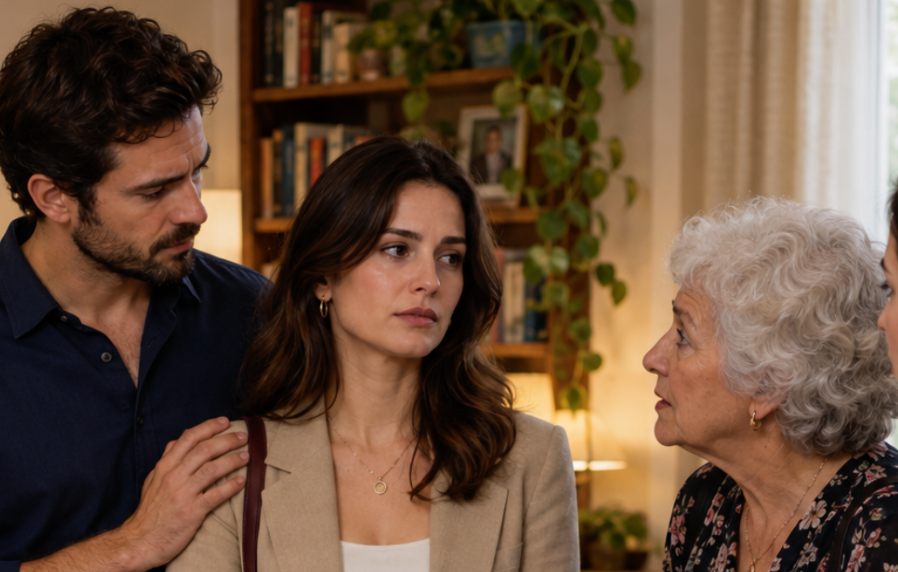
«Karina, please don’t interfere. This is our family matter. After all, you’re an outsider.»
For a moment, the whole table fell silent.
Even Tanya’s eight-year-old son stopped scraping his fork on his plate.
Karina at first thought she’d misheard.
Not because her mother-in-law never said hurtful things—she had. But usually it was more subtle: «That’s not how we do things in our family,» or, «You wouldn’t know how it was for us,» or, «Borya’s been used to this since childhood.» Karina could usually chalk it up to differences in personality, age, or habits.
But «outsider» was the blunt truth, stripped of any nice wrapping.
Karina looked over at her husband.
Boris gave a slight twitch at the corner of his mouth.
«Come on, don’t take it to heart,» he said. «Mom’s just talking about the photos. Don’t read into it.»
Tanya, sitting across from them, was quick to chime in:
«Really, Karina, these are our parents’ things. Mom just wants to decide herself.»
«I’m not deciding anything,» Karina replied. «I just suggested Boris take a photo of his own father.»
«See, you’re making it into an argument already,» Lyudmila Fyodorovna sighed. «That’s it, topic closed.»
Karina really did drop it.
She picked up her cup, took a sip of coffee that had already gone cold, and looked down at the table.
The roast duck was from the restaurant down the street. The two salads came from there too. Karina picked up the cake herself that morning, because Boris «didn’t have time.» The cheese, fruit, mineral water, juices, and coffee—she’d hauled those home from a trip to the hypermarket yesterday.
The lunch was at her apartment.
Afterward she had the dishwasher to load—twice—the greasy roasting pan, crumbs under the table, and a juice stain on the light-colored rug that her own son was already trying to cover up with his foot.
Karina suddenly thought, with almost scientific curiosity: what an interesting dynamic this is turning out to be.
She’s apparently the outsider.
Yet somehow, the apartment feels completely like home.
And, judging by appearances, so does her bank card.
Karina and Boris met five and a half years ago. She was thirty-six, he was thirty-eight. At the time, she was a purchasing department head at a large construction company, and he was an engineer at a service agency.
By then Karina already owned her own two-bedroom apartment, which she’d bought long before meeting Boris. No mortgage, no parental funds, no complicated stories—just ten years of hard work, savings, and the money from selling a tiny studio she’d once bought with a loan.
Boris owned a one-bedroom apartment on the other side of town. Ten months into their relationship, he moved in with Karina because her place was more convenient for both of their commutes. Another year later, they got married.
Boris started renting out his apartment.
At first, the plan was to save that extra money for trips together and big purchases. But soon, Lyudmila Fyodorovna’s washing machine broke down.
Then she needed new glasses.
Then there was the dentist.
Then they realized her pension was barely enough for her to get by.
«Let me help Mom with the rent money,» Boris said one day. «At least until she gets back on her feet a bit.»
Karina didn’t object.
Lyudmila Fyodorovna lived alone. Her husband had passed away a few years earlier. Her pension was small. She suffered from joint pains and needed constant medication, and from time to time she had to hire someone to wash windows or move heavy furniture.
They made a simple arrangement: Boris would give most of the rental income from his apartment to his mother, and Karina would temporarily cover more of their shared expenses.
But it turned out the word “temporarily” became the most enduring member of their family.
It lasted almost four years.
At first, Karina paid all their apartment bills herself. Then it so happened that she started buying groceries more often too. The internet bill went on her card. For vacations, Karina would usually contribute about seventy percent, since Boris always seemed to have some ‘circumstances’ pop up before every trip.
Sometimes Lyudmila Fyodorovna needed money for a massage course.
Sometimes her faucet started leaking and they had to replace some plumbing.
Sometimes Tatyana would ask Boris to help with a birthday gift for their mother’s milestone.
Even Boris’s car insurance had been paid by Karina for the past two years.
Not because he wasn’t working.
He had a job. He earned a decent salary.
It’s just that his money always seemed to have more ‘important’ uses.
For a long time, Karina didn’t see this as a problem. She had a good salary herself. She never liked turning household budgets into an accounting session over every bag of pasta and she could never understand couples who split the bill by dish at restaurants.
But last winter, her mother-in-law needed a kitchen renovation.
«The cabinets are literally falling apart,» Boris explained. «And the wiring is outdated.»
Lyudmila Fyodorovna hoped to finish everything for two hundred and fifty thousand, but she didn’t have enough saved up.
Karina lent her one hundred eighty thousand.
And lent was the key word.
They made that clear when discussing it.
Lyudmila Fyodorovna was even a little offended:
«Of course I’ll pay you back. Do you really think I would just take your money and forget?»
The first repayment came a month later—ten thousand.
That’s where repayments ended.
A couple of months later, Karina carefully asked Boris what was going on. He scratched his chin and said:
«Mom thinks it feels wrong to settle debts within the family.»
Karina actually laughed at that.
«Was it not wrong when she borrowed the money?»
«Come on, why are you being like this?»
«I’m not. I just want to clarify the etiquette of the process.»
Boris promised he would talk to his mother.
Apparently, the conversation went so well that Karina never saw another cent.
And now, over Sunday lunch, the final terminology was revealed.
According to the family, it’s «inappropriate» to expect a loan to be repaid «among your own.»
And Karina can’t be in the family photos, because she’s not really family.
That’s a pretty convenient way to see things.
Karina finished her coffee.
«Lyudmila Fyodorovna, am I understanding this right? Have I always been an outsider to you?»
Her mother-in-law raised her eyebrows in surprise.
«Oh for goodness’ sake, you’re at it again. I was talking about family matters.»
«No, I just want to clarify exactly what you said.»
Boris was starting to get nervous.
«Karina, not now, please.»
«I’m fine, really.»
She turned to her mother-in-law.
«An outsider?»
«Well, you’re not my daughter, are you?» she replied. «What do you expect me to say?»
«Nothing. That’s all I needed to hear.»
Karina grabbed her plate and took it to the kitchen.
Then she came back and added calmly:
«So my apartment and my salary are also not part of the family.»
Lyudmila Fyodorovna suddenly burst out laughing.
«Oh, finally, a real joke!»
Karina smiled.
«Yeah.»
She didn’t bring up the topic again that evening.
Their guests left around eight.
Tatyana took home the duck in a container «for my son’s lunch tomorrow,» Lyudmila Fyodorovna left with the family photos, and Boris went to walk his mother out to her taxi.
Karina loaded the dishwasher, gathered empty bottles, found a piece of bread under the armchair, and finally sat down at nine-thirty.
Boris came in from the hallway.
«Are you really mad?»
«No.»
«I can tell you are.»
«Borya, I’m not mad. I just realized where I stand in your family.»
«That’s not what Mom meant.»
«Alright.»
«Alright what?»
«It means there’s nothing more to discuss tomorrow.»
He looked at her suspiciously.
«Why tomorrow?»
«You’ll see.»
The next morning, Karina brought it up at breakfast.
No drama.
No speeches.
Boris spread butter on his bread while Karina was getting ready for work.
«From now on, all your family gatherings can be at one of your relatives’ places.»
He looked up.
«What do you mean?»
«Exactly what I said. At your mom’s, at Tanya’s, at your apartment if you work it out with the tenants after their lease is up. Wherever you want.»
«What about here?»
«An outsider lives here now.»
«Karina…»
«I mean it. Six people ate here yesterday. I bought the groceries, paid for the takeaway, did all the cleanup. I’m not doing that anymore.»
«Well then let me help clean up.»
Karina fastened her watch.
«You could’ve helped yesterday too. But this isn’t about the dishes.»
«Then what is it about?»
«It’s about spending four years contributing to your family. But the moment it’s not about my money, suddenly I’m a stranger. I’m done with this arrangement.»
Boris frowned.
«You’ve built a whole worldview out of one phrase.»
«No. That worldview existed long ago. The phrase just gave it a name.»
That evening, Karina got a notification about the car insurance payment coming up.
Before, Karina would have just paid it.
But this time, she forwarded it to Boris.
«Don’t forget to pay it by Friday.»
A minute later, he replied:
«You’ve always paid it.»
Karina wrote back:
«Not always anymore.»
Two days later, Boris asked if she’d renewed his gym membership.
«No.»
«The discount’s about to run out.»
«Then you’d better hurry.»
«Your card is linked to it.»
«Unlink it.»
The next week, Tatyana sent a link in the family group chat to a coffee machine.
«Should we get this one for Mom’s birthday? If each of us puts in 18,000, it’s fine.»
Karina saw the message and put her phone away.
Ten minutes later, Boris asked:
«Did you see it?»
«I saw it.»
«Well?»
«What?»
Chipping in?
— You all are.
— And what about you?
— I’m not really family. It feels awkward to chip in for a family gift.
— Are you going to twist every conversation like this now?
Karina closed her laptop.
— Borya, let’s not make a scene. In the past, gifts for your mom were bought with my money—or mostly mine. Now you’ll buy your mom’s gift yourself. What’s the big deal?
— But we’re a family.
— We are a family, you and I. But your mother made it clear yesterday that I’m not part of her family. I just stopped arguing.
For the first two weeks, Boris thought his wife was just sulking to make a point.
Then payday came.
And it all became obvious, even without getting philosophical.
Karina had calculated their usual monthly expenses in advance and suggested splitting utility bills and groceries 50-50. Each covered the rest of their expenses themselves.
— Utilities are almost twelve grand, — Boris said, looking at his banking app.
— So your half is six.
— Groceries too?
— Split down the middle.
— And the car?
— That’s your car.
— Great.
— I think so too.
He grunted in dissatisfaction.
That month, he had to pay insurance, service his car, cover his share of the groceries, and transfer the usual amount to his mother.
By the end of the second week, Boris realized his wallet looked very different from what he was used to.
He sat in the kitchen one evening, scrolling through his banking app, opening the expense page over and over for no real reason.
— Hey, do we really spend this much on food?
Karina was slicing an apple.
— Actually, it’s a little less. You just never noticed before.
— And are utilities always this much?
— Surprise.
— Very funny.
— I thought it was hilarious too, back when I was paying the bills alone for four years.
Boris stayed silent.
A few days later, Lyudmila Fyodorovna sent Karina a link to a refrigerator.
«Take a look, please. This one seems good. My freezer is leaking again. Maybe we can get this one.»
Before, Karina would have compared different models, found a discount, and offered to contribute part of the money.
Now, she replied:
«It’s a good one. But I don’t usually buy appliances for people who aren’t family.»
Five minutes later, Boris called.
— Mom just called me.
— That was fast.
— Karina, why did you have to respond like that?
— Like what?
— You know exactly what I mean.
— She sent me a refrigerator link. I replied.
— Mom says you’re insulting her.
— How?
— You keep saying ‘not family’.
Karina put the knife in the sink.
— Borya, that’s not my line.
— She gets it now.
— Wonderful.
— You could have just said you weren’t going to buy it.
— And she could have just not asked someone she calls ‘not family’ to buy her a fridge.
That evening, for the first time, Boris tried to explain instead of automatically defending his mother.
— She honestly didn’t mean to offend you. She’s just old-fashioned. To her, family means children, blood relations. That’s how she sees it.
— Let her see it that way.
— But you know she actually likes you.
— Borya, she treats me very well when I’m paying for restaurants, repairs, or gifts. That’s exactly the problem.
— You’re making everything about money.
— No. Quite the opposite. I’ve stopped putting my money into your family.
He paced the kitchen.
— How long is this going to last?
— What exactly?
— All of this.
— As long as it works for me.
Boris looked at her with frustration.
«So you decided to teach us a lesson?»
Karina shook her head.
«No. If I wanted to teach you a lesson, I would have set a time frame. A week, a month, until you apologize. But I just don’t want to live by the old rules anymore.»
He quietly left the room.
The next day, Lyudmila Fyodorovna called.
Not Karina.
She called Boris.
They talked for a long time. Karina could only hear Boris’s responses from the hallway.
«Mom, no… I’m not going to ask her right now… Because it’s your refrigerator… No, I didn’t say I won’t help… How much do you have yourself?»
After the call, Boris came into the kitchen.
«She has forty thousand. The fridge costs seventy-two.»
«Got it.»
«I’ll add thirty-two.»
«Alright.»
He stood there for a moment.
«Aren’t you going to say anything?»
«What should I say?»
«I don’t know.»
«It’s a normal arrangement. Someone has part of the money, a relative helps with the rest.»
«Before, you would have offered half.»
«Before, I did a lot of things differently.»
The main conversation happened a week later.
Lyudmila Fyodorovna came over during the day on Saturday. Boris had told Karina ahead of time that his mother wanted to talk.
Karina didn’t mind.
Her mother-in-law sat at the kitchen table, refused coffee, but eventually agreed to tea.
«Karina, I see you took my words very seriously.»
«I just took them literally.»
«But I never said you’re nothing to us.»
«You said ‘a stranger.'»
«I meant in the context of the photos.»
«Alright.»
Lyudmila Fyodorovna pursed her lips.
«So now you’re going to remind me of this for the rest of my life?»
«No. I actually have a different suggestion.»
Boris, who had been standing near the window, turned around.
Karina spoke calmly.
«You can consider me whoever you want. Really. Family isn’t something you can just order into existence. If you want to think of me as a stranger, go ahead.»
Her mother-in-law grew wary.
«But?»
«No ‘but.’ Just let’s be consistent. You return the one hundred eighty thousand you borrowed for the kitchen, and you don’t come to me for money anymore.»
Lyudmila Fyodorovna stared at her.
«But I’ve already done the renovation.»
«I know. That’s why I’m talking about paying back the debt, not canceling the renovation.»
«I don’t have one hundred eighty thousand right now.»
«I’m not asking for it today. We agreed you’d pay it back in parts.»
Her mother-in-law looked at her son.
«Borya, do you hear this?»
«I hear it.»
«And you’re just staying silent?»
Boris sat down heavily next to them.
«Mom, she’s right about one thing. You did agree to pay the money back.»
«But we’re family!»
Karina couldn’t help herself:
«Now we’re family?»
Lyudmila Fyodorovna opened her mouth, then closed it again.
Boris suddenly smirked.
«Mom, you kind of walked right into that one.»
«You both think you’re so funny.»
«It’s not funny,» he said. «It’s just turning out kind of strange.»
This was a first.
Not that Boris had agreed with his wife in private.
But that he didn’t automatically defend his mother in a conversation with her.
Lyudmila Fyodorovna finished her tea and left, annoyed.
But that evening she transferred five thousand to Karina.
Her message was short:
«That’s what I can send for now. The rest will come little by little.»
Karina just replied with a simple «received.»
Two weeks later, the transfer happened again.
Then there was another transfer.
And soon after, a fourth one followed.
The word ‘outsider’ disappeared so quickly from our family vocabulary, it was as if it had never existed at all.
Meanwhile, Tatyana decided it was time to play the peacemaker.
She wrote in the family group chat:
«Let’s put an end to this kindergarten. Everyone come over to my place for dinner on Saturday. I’ll cook, Mom brings the pie, and Borya’s in charge of drinks.»
Karina replied:
«Thanks, we’ll be there.»
There were six of us around the dinner table.
Forty minutes in, her son spilled his juice.
An hour later, Tatyana’s husband went to get more meat and found there wasn’t any left.
Lyudmila Fyodorovna asked for coffee.
Boris wondered aloud if there was anything sweet besides pie.
And the child announced, “This salad is too soggy. I’m not eating it.”
Tatyana spent the whole evening running between the kitchen and the table.
The next morning at 10, she messaged Boris directly.
«I spent seven thousand just on groceries yesterday. Plus I was cooking all day and washing dishes till one in the morning. Next time let’s have it at Karina’s again—she’s got more space anyway.»
Boris read the message out loud.
Karina was sitting nearby with her cup of coffee.
«What should I reply?» he asked.
«Nothing. I’ll handle it,» she answered.
She opened her chat with Tatyana and forwarded her old message from that very Sunday lunch:
«This is your family affair.»
A minute later, Tatyana sent a laughing emoji.
Then she wrote:
«Fair enough. I deserve that.»
Boris looked at his wife and suddenly burst out laughing.
It wasn’t forced, not an attempt to diffuse another argument.
He was genuinely amused.
«You know, I finally get why you were so upset back then,» he said.
«I wasn’t upset,» Karina replied.
«That’s actually scarier,» he grinned.
«Glad you finally get it,» she nodded.
He was silent for a moment.
«You didn’t do all this just because of one word, did you?» he asked.
Karina set down her cup.
«Of course not because of just a word. I’m just tired of being ‘the relative on the expense side.'»
Boris nodded.
That evening, he himself opened the expense spreadsheet he once called ‘unnecessary bureaucracy’ and suggested they break down all their regular expenses.
They split the utility bills evenly.
Groceries too.
Each paid for their own car, clothing, fitness and personal purchases.
For vacations together, they agreed in advance—and each transferred the same amount to a separate account.
Boris capped help for Lyudmila Fyodorovna at twenty thousand a month.
Not because he no longer wanted to help.
But because, for the first time, he honestly calculated how much he could give his mother without putting his own life’s burdens on his wife.
The new system’s first test came after two months.
Lyudmila Fyodorovna called Boris and said she wanted to buy a new couch.
The old one was still fine, but she’d seen one she liked at the furniture store.
Before, Boris would’ve come to Karina that night saying:
«Mom’s a bit short this month.»
But this time, he asked his mother:
«How much does it cost?»
«Sixty-eight,» she answered.
«And how much do you have?»
«Thirty.»
«Then either save up more, or let’s find something cheaper. I’ve already transferred you twenty this month.»
Lyudmila Fyodorovna grumbled about it.
But she chose a couch for forty-two thousand.
Nobody died.
The family stayed together.
A month later, Boris celebrated his birthday at Tatyana’s place.
The next family dinner was hosted by Lyudmila Fyodorovna at her home.
Then it was Karina and Boris’s turn.
And surprisingly, Karina was the one to suggest:
«Let’s do November at ours.»
Boris was surprised.
«Are you sure?»
«Yes. When it’s everyone’s turn, they’re guests. This isn’t meant to be a permanent branch of your family restaurant.»
«I’ll buy the groceries.»
«Half of them.»
«No. This time, it’s my relatives, so I’ll buy the groceries.»
Karina looked at him.
«That just sounded dangerously reasonable.»
«Don’t get used to it.»
In November, old photographs were once again spread out on the table.
Lyudmila Fyodorovna brought over a few pictures she wanted to scan.
She pulled out that one photo where twelve-year-old Boris was standing next to his dad, holding a carp.
«Borya, keep this one for yourself.»
«But you wanted to give it to Tanya.»
«Tanya already has a copy.»
Boris took the photograph.
Lyudmila Fyodorovna looked at Karina.
«Pick out a better frame for him later, will you? You have a better eye for these things.»
Karina smirked.
«Am I allowed to get involved now?»
Her mother-in-law waved her hand dismissively, a little annoyed.
«Oh, that’s it. You’ll remember this till you’re retired.»
«Possibly.»
«For your information, I transferred you another five thousand yesterday.»
«I saw it.»
«There’s a hundred and forty left.»
«A hundred and forty-five.»
Lyudmila Fyodorovna paused, did a quick calculation in her head, and snorted:
«Looks like we’ve found ourselves an accountant.»
Boris burst out laughing.
«Mom, it’s better not to argue here. She remembers everything.»
«I’ve noticed already.»
Karina placed a dish on the table and smiled too.
She no longer needed to prove she was part of the family.
Strangely, after she stopped trying to buy her way into the family with groceries, insurance payments, gifts, and other people’s refrigerators, the whole issue just stopped mattering.
Lyudmila Fyodorovna no longer called her an outsider.
Tatiana no longer automatically suggested everyone gather at Karina’s place.
Boris now knew exactly how much utilities, groceries, and his own car cost, and that new knowledge really grounded him.
And the old debt, bit by bit, got smaller every month.
Turns out, family closeness easily survives separate insurance payments, taking turns hosting holiday feasts, and even the word «no.»
And as Karina discovered, sometimes your sense of connection really does grow surprisingly fast.
Especially when the ‘outsider’ stops footing the bill for everyone else.
Continued in the comments