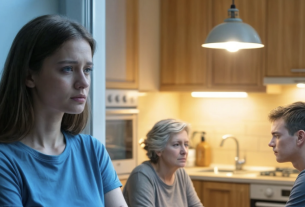
Four thick place cards lay on Zoya Fyodorovna’s kitchen table, each labeled that morning in her neat handwriting. On three of them, she had written the names of her son and grandchildren: “Roman,” “Yegor,” and “Varya.” The fourth remained blank, even though seven chairs stood around the table and eight guests were expected. Zoya Fyodorovna passed the cards several times, straightening the napkins and rearranging the saucers, but she never wrote a name on the empty one.
In her youth, she had managed the reading room at the district library and had grown accustomed to the idea that order began with small details. Books had their shelves, visitors had their library cards, and people had their proper places. When Roman was a boy, she personally made sure that he came home from school on time, changed his shirt before his extracurricular lessons, and ate his soup before it grew cold. After her husband packed a bag and left her for another woman, this habit became even more rigid: if she kept everything firmly under control, no one would be able to disappear without an explanation.
By noon, the apartment smelled of baked apples and cinnamon, and branches of rowan berries from the country garden stood on the windowsill. Zoya Fyodorovna had been looking forward to this Sunday. The telephone kept ringing, the guests asked what they should bring, and she answered that everything had already been prepared.
She liked it when people came to sit at her table and looked around, noticing the spotless windows, the old sideboard, and the embroidered table runner that her mother had once preserved for special occasions.
Roman arrived shortly after three, carrying a bag of mandarins and a large cardboard tube under his arm. Nine-year-old Yegor rushed into the hallway behind him, followed more cautiously by Varya, who was holding a box tied with a yellow ribbon. Lyudmila entered last, closed the door, wiped the children’s hands with moist wipes, and congratulated the birthday woman as she handed her a bouquet.
“The children and I made something for you,” she said. “You can open it when everyone has arrived.”
Zoya Fyodorovna accepted the box and placed it on the chest of drawers. She noticed Lyudmila glancing toward the living room, where the voices of Zoya’s former colleagues could already be heard.
Her daughter-in-law wore a simple dark dress, her hair smoothly pulled back, and the thin bracelet Roman had given her the previous winter. Nothing provocative, nothing festive. It was precisely this calm restraint that always irritated Zoya Fyodorovna. Lyudmila seemed not to understand that she was expected to make an effort in front of her.
Lyudmila noticed the place cards before she had even managed to take off her coat. Her name was missing, and beside the unassigned place stood a folding chair on which Zoya Fyodorovna had placed a stack of magazines.
A familiar thought flashed through Lyudmila’s mind: she could quietly tell Roman, ask him to intervene, and put the hostess in an uncomfortable position. She had already opened her mouth when she saw Varya holding the edge of her sleeve.
“Zoya Fyodorovna, should I bring a chair from the kitchen?” she asked instead.
“There’s no need,” her mother-in-law replied without even turning her head. “The children will sit beside you anyway. You’ll be comfortable together.”
Roman looked up from his phone, but Lyudmila shook her head. She did not want to ruin the children’s Sunday or hear later that she had caused a scene over a chair.
She sat on the edge of the sofa beside Varya instead, while Yegor settled on the carpet beside the coffee table and began examining the cardboard tube.
The first half hour passed almost peacefully. Zoya Fyodorovna poured tea for her guests, told them how an entire crate of rare editions had once been delivered to the library, and asked Yegor about school.
Then she called Varya over to the old piano by the window and asked her to play the short piece she had been practicing during her lessons. Varya looked at her mother first, then smoothed her dress and sat on the piano stool.
Her fingers trembled, but the melody came out clean and clear. When she finished, Zoya Fyodorovna applauded more loudly than anyone else and put an arm around her granddaughter’s shoulders.
“That’s our blood showing,” she said, looking around at the guests. “Roman was drawn to music when he was a child too. And Varya understands everything immediately. It is no accident that books have always been more important than television in our family.”
Lyudmila placed her cup on its saucer and noticed a thin stream of apple compote spreading across the tablecloth. Varya had accidentally nudged her glass with her elbow when she stood up. Lyudmila took out some napkins and began wiping the stain, glad to have something to occupy her hands.
“We work on her music almost every evening,” she said. “Varya chose the lessons herself.”
“Of course, dear,” Zoya Fyodorovna replied with a smile. “But children also need the right environment. They quickly sense where people are accustomed to reading, talking, and listening to one another. That is not something you can buy along with a music notebook.”
No one at the table responded. Their neighbor Antonina Pavlovna smoothed the edge of her napkin with one finger, while Roman rested his hand on the back of his son’s chair.
Yegor watched his mother and did not touch his pie, even though he had previously asked for two slices.
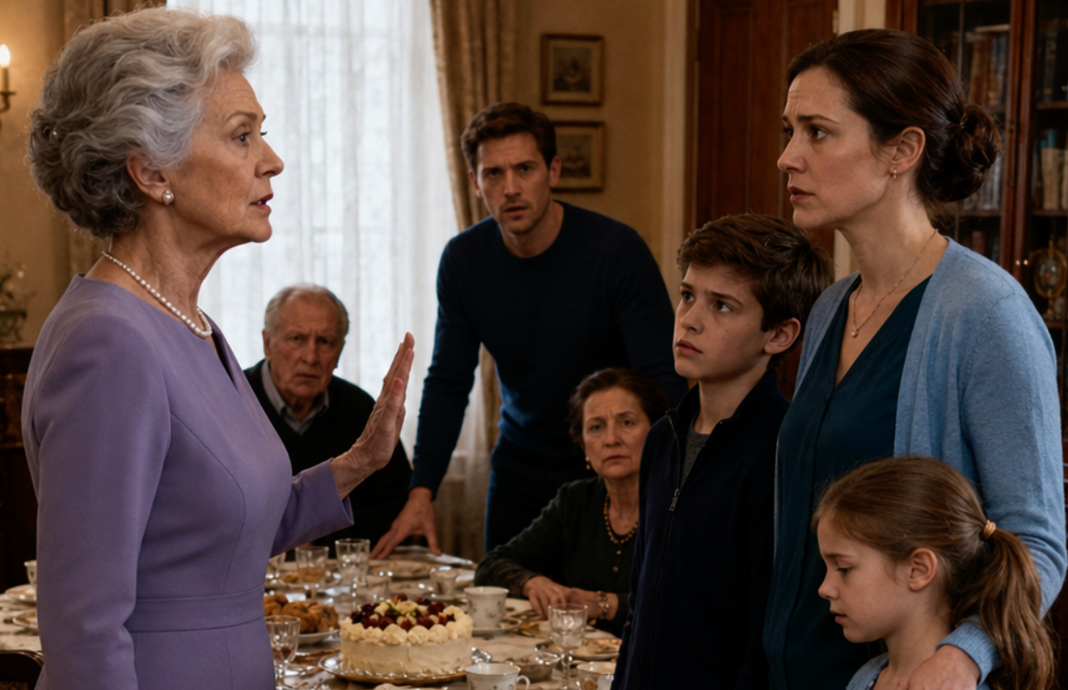
When the guests were called to the table, Lyudmila once again remained on the sofa with the children. Zoya Fyodorovna pretended not to notice. Then she glanced back over her shoulder.
“You can sit at the end. Just be careful. Arkady Semyonovich’s china is there, and it is very old.”
The words were spoken quietly, almost with concern. Lyudmila knew that tone. It was how her mother-in-law reminded her that everything valuable in the apartment belonged to someone else.
She stood, sat on the empty folding chair, and pulled a plate toward herself without touching the china service.
During the main course, Zoya Fyodorovna began talking about her country house. She had recently put the property documents in order and now considered it necessary to inform everyone sitting at the table.
“The house will eventually go to Yegor and Varya,” she said. “I want them to have a place of their own. Roman will look after it, of course, but the children will decide what to do with it when they grow up. That is only fair.”
Lyudmila slowly placed her utensils beside her plate. This was not about a house worth money. It was about her mother-in-law finding yet another way to describe her as temporary.
Roman frowned.
“Mom, why are you bringing this up now?”
“When else should I bring it up?” Zoya Fyodorovna looked at her son in bewilderment. “Adults are sitting around a table discussing important matters. I have to think about my grandchildren’s future, not about a stranger’s wounded feelings.”
Yegor lowered his head.
Varya pulled her chair closer to her mother, and the wooden legs scraped across the floor. The sound seemed louder than the words.
Lyudmila looked at the children, then at the guests, who immediately busied themselves with the breadbasket and their glasses of fruit drink.
“Do not call me a stranger in front of them,” she said.
Zoya Fyodorovna pursed her lips.
“I did not call you one. But since you brought it up yourself, I will speak plainly. Today I asked Roman to come with the children. I did not invite you. This is my day, and I have the right to decide whom I want to see in my home.”
For a moment, Lyudmila could not take her eyes off the blank place card at the edge of the table.
She remembered that she had left a pot of porridge in the sink that morning because she had been in a hurry to get the children ready and avoid being late to her mother-in-law’s birthday. The irrelevance of the thought almost made her laugh.
Then she stood, walked over to Varya, and fastened the girl’s cardigan.
“Yegor, get your jacket. Varya, do not forget the box,” she said. “We are going home.”
“There is no need to turn this into a performance,” Zoya Fyodorovna snapped. “The children can stay. They have nothing to do with this.”
Lyudmila turned toward her.
“That is precisely why they are coming with me. They should not sit in a place where there is no room for their mother.”
She did not raise her voice, but everyone heard every word.
Varya pressed herself against her mother’s side, while Yegor picked up the cardboard tube and stood beside them. The box contained what the children had spent two weeks making: a large family map with photographs, drawings, and short captions.
Lyudmila did not leave the gift on the chest of drawers.
“If you leave, do not bring them here again without an invitation,” Zoya Fyodorovna said. “And do not teach me how to communicate with my own grandchildren.”
Roman stood so abruptly that his glass wobbled, though it did not fall. He took one step toward his mother, then stopped.
Lyudmila saw his hesitation and, for the first time in many years, did not wait for him to find the right words.
“You do not need to follow us,” she said. “Decide for yourself where you are needed right now.”
On the staircase, Varya asked why Grandma had not wanted Mommy to sit at the table. Lyudmila fastened the children’s jackets and spent a long time struggling with the zipper on Varya’s sleeve, even though it had already been closed.
“Sometimes adults are so afraid of losing their own place that they try to take someone else’s away,” she answered. “But it is not your fault, and it is not Yegor’s.”
They went outside. Wet snow lay along the curbs, cars hissed over the dark road, and the children walked on either side of their mother, holding her fingers.
At the entrance to the building, Lyudmila took out her phone and sent Roman a single message:
“From now on, the children will not go to your mother’s on Sundays. Not until she tells them that I am their mother and part of the family.”
After sending it, she did not read it again.
Upstairs, the guests remained at the table for several more minutes.
Antonina Pavlovna was the first to place her napkin on her plate.
“Zoya, you invited the children to your birthday and then showed them that their mother was unwanted here,” she said. “How are they supposed to visit you now?”
“Do not interfere,” Zoya Fyodorovna replied. “These are my family affairs.”
“Exactly. And you have just made them the concern of everyone sitting here.”
One after another, the guests began preparing to leave. No one slammed a door or raised their voice, but the birthday table quickly emptied.
In the kitchen, the half-eaten cake, displaced chairs, and a heavy silence remained. In that silence, Zoya Fyodorovna could hear the old paint crackling on the radiator.
Roman left later.
Before going, he took the yellow-ribboned box from the chest of drawers and placed it inside his son’s backpack, which Lyudmila had accidentally left hanging in the hallway.
Zoya Fyodorovna called after him.
“Are you really going to let her take the children away from me?”
Roman did not zip up his jacket immediately. He looked at his mother as though he no longer saw the sideboard, the embroidered runner, or the bookshelves in her room, but something else—something he had known for a very long time.
“No, Mom. You are the one who decided you could see them without their mother. I am not going to pretend anymore that I do not hear what you say.”
During the first few days, Zoya Fyodorovna waited for Lyudmila to calm down.
On Monday, she bought Varya’s favorite ring-shaped biscuits. On Tuesday, she found an old sticker album for Yegor in the cupboard. On Wednesday, she called her son and said she would make cottage-cheese pancakes for the children on Sunday.
Roman answered that the children had other plans.
“Tell Lyudmila that I have no intention of apologizing to her,” Zoya Fyodorovna said. “I did not throw anyone out. She left on her own.”
“You told her she had not been invited,” Roman reminded her. “The children heard everything.”
“They are young. They will forget.”
Roman was silent, and that silence felt more unpleasant than any accusation.
“But we will not forget,” he said at last. “So first, you need to talk to Lyudmila.”
The following Sunday, Zoya Fyodorovna set the table for four.
She placed a vase of ring-shaped biscuits in the center, took out Varya’s favorite kitten mug, and spread the warm blanket Yegor usually claimed for himself when he watched cartoons over the sofa.
At half past one, she heard footsteps in the hallway outside and quickly straightened her back.
The footsteps passed her door.
Until evening, she went to the window several times. Then she put the cottage-cheese pancakes in the refrigerator.
The following day, when she arrived at the library club where her former colleagues gathered on Thursdays, Zoya Fyodorovna prepared to tell them about her grandchildren as usual.
But Antonina Pavlovna spoke first.
“Well, have you made peace with Lyudmila?”
Zoya Fyodorovna replied that young people liked to exaggerate.
The women exchanged glances, and the conversation immediately shifted to books. For the first time in many years, no one allowed her to become the main storyteller.
A week later, she arrived at Roman’s home without calling.
She carried a bag of supplies for the children’s lessons: notebooks, colored pencils, and new strings for Varya’s small guitar.
Lyudmila opened the door. The children’s voices could be heard behind her, but they did not come into the hallway.
“I brought them a few things,” Zoya Fyodorovna said. “Surely you are not going to forbid gifts too?”
“Gifts cannot replace words,” Lyudmila replied. “Last time, you wanted to speak to them without me. Today, you came to our home without warning. It is the same habit.”
“I am their grandmother.”
“Yes, you are. And you can be their grandmother. But not the kind who chooses which family members are given a place at the table and which are left outside the door.”
Zoya Fyodorovna tightened her grip on the bag handles.
She wanted to say that she had spent her entire life doing everything she could for her son, and that no one understood how frightening it could be to end up alone.
But Lyudmila was not obligated to listen to a story in which she had no place.
“All right,” Zoya Fyodorovna said. “What do you want from me?”
“Not from me. In front of the children, say what you would say if you respected them.”
That day, Varya was preparing for a school evening. Her class was presenting a short program about family stories, and each child was allowed to invite one adult.
Roman asked his daughter whom she wanted to see in the front row.
The girl spent a long time drawing a house with four windows on the invitation. Then she wrote her grandmother’s name.
Lyudmila did not try to dissuade her.
“We will deliver the invitation together,” she said. “After that, Grandma can decide for herself.”
Zoya Fyodorovna arrived at the school early.
The corridor smelled of chalk and damp jackets, and children’s drawings hung on the walls. Two rows of chairs had been arranged in front of the stage, and paper cards bearing the names of families lay on the seats in the first row.
One of them read:
“Varya, Mom, Dad, Grandma.”
Zoya Fyodorovna picked up the card, read it again, and returned it to the chair.
She heard Roman’s voice behind her.
“Mom, you came.”
“I came,” she replied. “I see there was room for everyone.”
Lyudmila stood beside her daughter. Varya held a sheet of paper containing her lines and nervously twisted its edge. Yegor was whispering something to her about the drawing on the backdrop.
Zoya Fyodorovna stepped closer.
She could have said again that all of this was unnecessary, that adults should not be forced to justify themselves in front of children, and that Lyudmila had turned an ordinary quarrel into a rule.
The words were already rising in her throat.
But Varya was looking at her mother the same way she had looked at her during the birthday dinner, when she had been waiting to see where she was allowed to sit.
“Lyudmila,” Zoya Fyodorovna said. “That day, I left you without a place. I said something in front of the children that I had no right to say. You are their mother, and you are part of our family.”
Lyudmila did not nod immediately.
Then she took Varya by the hand and led her toward the front row.
“Then sit beside us,” she said.
During the performance, Varya glanced into the audience several times. By the final verse, she had stopped twisting the edge of the paper, while Yegor stood straighter and began showing the audience the drawing of their house.
After the program, Zoya Fyodorovna approached her grandchildren and took the yellow box out of her bag.
“This belongs to you,” she said. “I never opened it.”
Varya untied the ribbon.
Inside was the family map: photographs, cutouts, children’s drawings, and four paper figures sitting around a large round table.
One of the figures had been glued on unevenly, with a crooked edge, and Zoya Fyodorovna recognized Lyudmila.
The following Sunday, she set the table again.
This time, four place cards lay beside the plates.
On the fourth one was written:
“Lyudmila.”
Zoya Fyodorovna placed her phone on the windowsill and dialed her son’s number. As the long ringing tones continued, she did not move a single card.