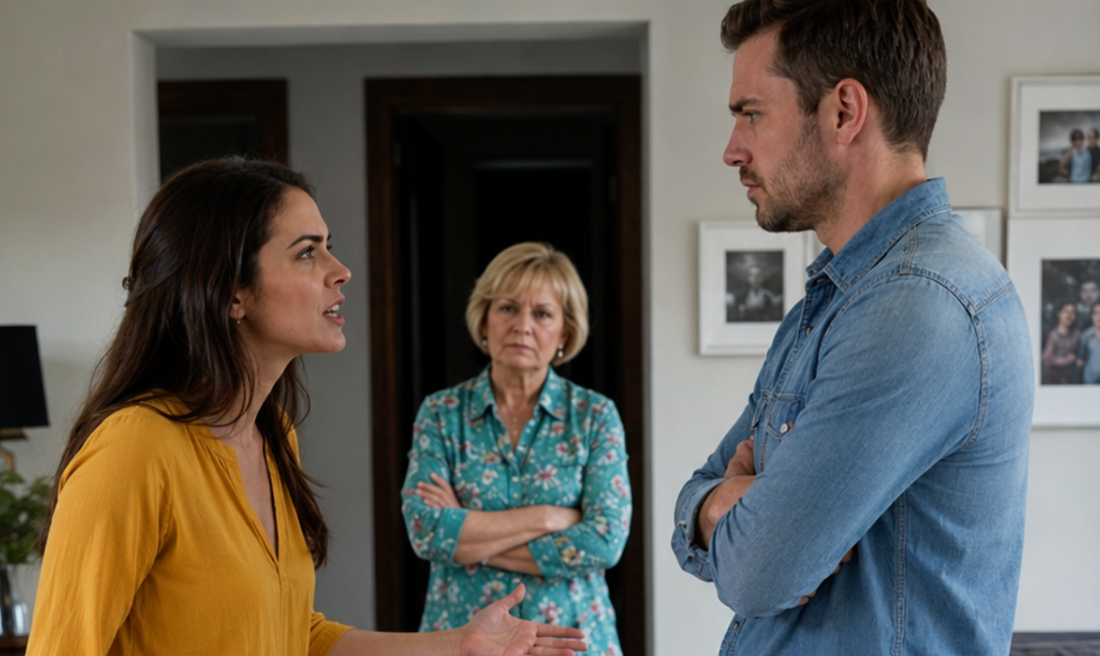
“I bought the apartment before we got married. Explain to me why your mother decided she has the right to act like the mistress of this place?” Olga asked.
She closed the front door without slamming it, yet the sound still felt heavy. The hot July stairwell smelled of dust, heated metal, and other people’s grocery bags. Olga had not even had time to take off her sandals before she noticed three plaid bags in the hallway, two sturdy bags stuffed with clothes, and an old folding stool that definitely did not belong to her.
Her mother-in-law’s voice came from the kitchen.
“Sergey, empty that narrow cupboard. I’ll put my winter things there. I don’t need space in the bedroom; you have your own belongings there. But the hallway will be convenient. And we should probably add a shelf for documents. I brought my folders with me.”
Sergey stood in the kitchen doorway, looking not guilty but irritated. As though his wife had not come home but had interrupted a perfectly normal household operation.
“Olya, don’t start the moment you walk through the door,” he said. “Mom is only staying for a little while.”
Olga slowly turned her head toward the bags.
“A little while means bringing a stool and folders?”
Sergey ran a hand over his face and lowered his voice.
“They’re renovating her house. There’s noise, dust, workers. It’s difficult for her.”
“Your mother’s house has been selectively under renovation for three years—whenever she needs an excuse to stay with us.”
“It’s not just your place. I live here too.”
Olga calmly removed her sandals, placed them on the mat, and walked farther inside. Her expression remained composed, but Sergey noticed the way she carefully placed her handbag on the cabinet and zipped it shut. He knew that gesture well. Olga did that when she was not preparing to argue, but to establish facts.
In the kitchen, her mother-in-law, Raisa Pavlovna, stood by the window examining the windowsill as though deciding where to put her jars. She was sixty-three but looked energetic: short haircut, bright blouse, sharp eyes. In her hand was a set of keys. A small plastic tag with the apartment number dangled from the ring.
Olga immediately looked at the keys.
“Good afternoon, Raisa Pavlovna. I see you’ve already let yourself in.”
Her mother-in-law turned around without embarrassment.
“What was I supposed to do, stand outside the door? Seryozha gave me the keys. I am his own mother, after all.”
“Sergey’s mother,” Olga clarified. “Not the owner of this apartment.”
Her mother-in-law narrowed her eyes slightly but maintained her smile.
“Oh, here we go. I haven’t even hung up my coat yet, and you’re already checking legal documents.”
“There’s no need to hang up a coat in July. But we really are going to look at the documents now.”
Sergey stepped forward sharply.
“Olya, enough. Mom is tired. Let’s talk this evening.”
“No. This evening you’ll say your mind is occupied. Tomorrow, you’ll say it isn’t the right time. A week from now, I’ll discover someone else’s clothes in my wardrobe, and I’ll be told everything has already happened and it’s too late to make a fuss.”
Raisa Pavlovna placed the keys on the counter and raised her eyebrows.
“What dramatic language. I came here to help you. Young people live as though they’re staying in a hotel. The refrigerator is almost empty, there are boxes on the balcony, and all that space in the hallway is going to waste. I’ll put things in order.”
Olga looked at her carefully.
“I don’t need help I never asked for.”
“But Seryozha asked.”
“Sergey cannot invite people to live in an apartment that I bought several years before our marriage and registered solely in my name.”
The kitchen fell silent. A car hummed beyond the open window, and somewhere in the courtyard, a child laughed and squealed while playing with water from a hose. Summer continued as though three people were not standing inside the apartment on the brink of a major scandal.
Sergey frowned.
“Are you deliberately phrasing it that way to humiliate me?”
“I’m deliberately phrasing it accurately.”
“Mom isn’t ‘people.’ Mom is family.”
Olga turned toward him.
“Family does not unlock my door with spare keys without my permission. Family does not bring bags into my home while I’m away. Family does not decide how to use my cupboards.”
Raisa Pavlovna laughed softly.
“‘Mistress of the house.’ What a grand expression. Like some landowner.”
“Not a landowner. The owner. There’s a significant difference, and it would be useful for you to remember it.”
Her mother-in-law went pale, not from fear but from anger. She was accustomed to something very different. Usually Olga listened, paused, responded calmly, and went about her business. Raisa Pavlovna mistook that for weakness. Sergey mistook it for agreement.
They were both wrong.
Over the past several months, everything had happened gradually. At first, her mother-in-law would visit for an hour: to bring berries or collect an old saucepan she herself had once given them as a gift. Then she began appearing on weekdays while Olga was working at the warehouse of a transport company and could not answer calls. Sergey explained it simply: his mother had been nearby and had stopped in to drop something off.
Then Raisa Pavlovna began leaving little things behind: a sweater, slippers, a bag of medication, a phone charger. Olga placed everything in a separate bag and asked her husband to take it back to his mother.
He never did.
A week earlier, Olga returned after meeting with a contractor and found the kitchen cabinets open. Raisa Pavlovna was searching for a container for cereal and complaining that everything in their kitchen was inconvenient. That was when Olga first asked where she had gotten the keys.
Her mother-in-law answered casually.
“Seryozha gave them to me. You never know what might happen.”
That evening, Sergey merely shrugged.
“I didn’t think it was a problem.”
Olga did not shout. She simply said:
“You’ll get the keys back.”
He nodded.
The next day, he said he had forgotten.
Then he said his mother had gone to her country house.
Then he said it would be awkward to ask for them back because she would be offended.
Olga silently remembered every excuse.
Today, everything became clearer.
This was no longer a spare key “just in case.” It was an attempt to quietly move someone else’s authority into her apartment.
Olga left the kitchen, went into the bedroom, and returned carrying a thin folder. Sergey immediately understood that this was not improvised. The folder had been kept ready at hand.
That meant his wife had already been preparing for this conversation.
She placed the purchase agreement, an official extract, and old payment documents on the kitchen counter.
“I bought this apartment before our marriage. Sergey is registered here because I agreed to it. You, Raisa Pavlovna, have no claim to this property. Neither legally nor domestically.”
“My son lives here,” her mother-in-law snapped.
“He lives here. But he does not control the property.”
Sergey gave a bitter laugh.
“So I’m nobody here?”
“You’re my husband when you behave like one. Not a courier delivering your mother and her belongings into someone else’s apartment.”
Sergey’s shoulders tensed. He was not a stupid man. He worked as an equipment engineer and knew how to negotiate with bosses, contractors, and clients. But at home, he was accustomed to a very simple arrangement: if his mother pressured him, his wife was supposed to understand; if his wife objected, then she was being too harsh.
That arrangement had saved him effort for years.
Today, it stopped working.
Raisa Pavlovna picked up the keys from the table.
“I’m not going to justify myself. I really am having renovations done. I’ll stay for two weeks and then leave.”
“No,” Olga said.
Her mother-in-law did not even understand at first what she had heard.
“What do you mean, no?”
“It means you take your bags and leave today.”
“Seryozha!” Raisa Pavlovna turned sharply toward her son. “Did you hear that?”
Sergey looked at his wife, his expression hardening.
“Olya, you’re going too far. Mom won’t end up on the street. Her house isn’t in proper condition right now.”
“She has a house. She has a sister in the neighboring district. She can rent temporary accommodation if the renovation truly makes the house unlivable. But she will not decide how my apartment is used.”
“You’re throwing my mother out?”
“I never invited her to move in. So I’m not throwing her out. I’m stopping an unauthorized move-in.”
Raisa Pavlovna picked up one of the bags, placed it closer to herself, and said defiantly:
“I’m not going anywhere. My son gave me permission.”
Olga took out her phone and placed it beside the documents.
“Then I’ll call the police and explain that there is a person in my apartment who refuses to leave after being directly instructed to do so by the owner. I’ll show them the property documents as well. Sergey can confirm that he gave you the keys without my consent.”
Sergey straightened abruptly.
“Have you lost your mind? Calling the police because of Mom?”
“No. Calling the police because someone is unlawfully remaining in my apartment after being directly told to leave.”
Raisa Pavlovna stared at the phone. For the first time, her expression showed not indignation but calculation. She was thinking quickly. She did not need a scandal involving the police. The neighbors would hear about it, her son would look bad, and most importantly, it would become obvious that she had absolutely no rights to the apartment.
“Olya,” Sergey changed his tone. “Let’s stay calm. I admit, we should have discussed it. But there’s no need to turn this into a circus.”
“I’m not starting one. I’m ending it.”
She turned to her mother-in-law.
“The keys.”
Raisa Pavlovna clenched the keyring.
“These are my son’s keys.”
“No. They are keys to my door.”
“Seryozha, say something to her!”
Sergey looked at his mother, then at his wife. For several seconds, he clearly hoped to find some compromise phrase that would allow everyone to save face.
But there were no such phrases left.
“Mom, give them back for now,” he said quietly.
“For now?” Olga tilted her head. “Interesting choice of words. No, not for now. Forever. If I ever need a spare set, it will be kept by my mother or by a neighbor of my choosing.”
Raisa Pavlovna threw the keys onto the counter. They struck the tiles with a sharp metallic clang.
“Take them. Choke on your apartment.”
“I won’t choke. I live in it.”
Sergey grimaced.
“Olga, enough. Stop kicking her when she’s down.”
“I haven’t even started.”
She picked up the keys, removed the plastic tag from the ring, put the keys in her pocket, and looked at her husband.
“Now yours.”
“What?”
“Give me your set.”
“You have no right.”
“I have every right to change the lock on my own door. But first I want to know how many sets of keys are circulating among your relatives.”
Sergey’s face changed.
He realized the conversation had gone much farther than he expected.
“I didn’t give them to anyone else.”
“Prove it through your behavior. The keys.”
“I live here.”
“Today, yes. After today, we’ll decide exactly in what capacity. But you have lost control over spare access to my door. You’ll surrender your apartment key for now, and if you need to leave, I’ll open the door for you. Tomorrow I’m calling a locksmith, and the lock will be changed. No formal complaints, no theatrics, just an ordinary locksmith doing his job. You will receive a new key only after we put the living rules in writing.”
Raisa Pavlovna gave a short laugh.
“A written agreement with your husband? How disgraceful.”
“What’s disgraceful is a grown man secretly giving his mother keys to his wife’s apartment.”
Sergey abruptly took his keys out of his pocket and placed them on the table.
“Happy now?”
“Not yet.”
Olga took his keyring, removed the apartment key, and returned the others.
“Now we pack the bags.”
Raisa Pavlovna stood motionless. Then suddenly, she calmly sat down on a chair.
“I don’t feel well. My blood pressure, probably. I’m not going anywhere right now.”
Sergey immediately moved toward her.
“Mom, do you need water?”
Olga opened a cabinet, took out the blood pressure monitor she kept at home after her father’s illness, and placed it in front of her mother-in-law.
“We’ll check. If the numbers are dangerous, we’ll call an ambulance. If not, we’ll call a taxi.”
Raisa Pavlovna looked at the device as though it had betrayed her.
“You don’t even believe this?”
“I believe numbers.”
Sergey wanted to say something, but Olga had already placed the cuff around her mother-in-law’s arm. Raisa Pavlovna sat with a stony expression. The monitor beeped and showed normal readings.
Olga turned the display toward her husband.
“She’ll live.”
“You’ve become so cruel,” her mother-in-law said quietly.
“No. I’ve simply stopped being convenient.”
They packed the belongings in silence.
Or rather, Raisa Pavlovna packed while Sergey carried the bags to the door. Olga stood nearby and made sure none of the unwanted belongings remained behind. She checked the hallway cupboard, the cabinet, the kitchen, and the balcony.
In one drawer, she found a rolled-up bag of medications and a small cosmetics pouch.
“Take these too.”
Her mother-in-law snatched the bag from her hands.
“Petty.”
“Observant.”
When the taxi arrived, Sergey reached for one of the bags.
“I’ll see Mom off.”
“Walk her to the car. Then come back. We need to talk.”
Raisa Pavlovna paused at the door and looked at her son.
“Seryozha, do you see how she talks to you?”
He remained silent.
Olga stood by the open door with her phone in her hand. She was not hiding it, not threatening anyone. She was simply making one thing clear: there was no more time for theatrics.
Her mother-in-law left.
Sergey carried the bags downstairs and accompanied his mother to the entrance. Olga waited until the elevator went down, locked the door, and walked through the apartment.
She inspected the kitchen, bedroom, and hallway.
Everything seemed to be in place.
Yet the feeling of intrusion remained—not because of the bags, but because of the audacity with which her home had already been mentally divided into spheres of influence.
Ten minutes later, Sergey returned.
Olga opened the door herself.
He entered, removed his shoes, and stopped in the hallway. Without a key, he looked different. Not like a guest, but no longer like the full master of the house he had grown accustomed to considering himself.
“You humiliated me in front of my mother,” he said.
“You humiliated yourself when you decided you could control access to my door.”
“I wanted to help.”
“No. You wanted to be a good son at my expense.”
He went into the kitchen, poured himself some water, and drank several gulps. Olga did not rush him. She knew how to wait.
At work, she often had to negotiate with drivers, clients, warehouses, and people who said one thing, meant another, and later tried to blame everything on misunderstanding. Long ago, she had learned that the first person to become agitated was usually the one who lost.
Finally, Sergey turned around.
“What is this written agreement you mentioned?”
“Simple. Your mother does not come here without an invitation. She does not have and will never have keys to my apartment. You do not give access to anyone. All guests come only by mutual agreement. If I ever discover another unauthorized entry, I won’t just change the lock. I’ll change the structure of our marriage.”
“Are you threatening divorce?”
“I’m informing you of the consequences.”
He gave a bitter smile, but it lacked confidence.
“And where am I supposed to go?”
“That’s a question you should have asked yourself before giving your mother keys.”
Sergey set the glass down and looked at his wife without his usual confidence.
“Are you really prepared to throw me out?”
“If necessary, yes. The apartment is mine. We have no children. This is not jointly acquired property. If you refuse to divorce peacefully, it can be settled in court. If you agree and there is nothing to divide, we can handle it through the civil registry office. But before that, I still hope to see an adult man rather than an intermediary between me and your mother.”
He remained silent for a long time.
Outside, evening was falling, but the heat remained. The kitchen was reflected in the darkened window: Olga standing upright, Sergey sitting opposite her, the documents and the key removed from his ring lying between them.
“You thought all this through in advance,” he finally said.
“No. I examined the facts in advance. Those are different things.”
“What facts?”
Olga opened the notes app on her phone and began reading without emotion.
“June twelfth: your mother entered without ringing while I was in the bathroom. June fifteenth: she unlocked the door with her own key in front of our neighbor and said she ‘had business here.’ June twenty-second: you refused to take the key back because it was ‘awkward.’ July third: she left a bag of her belongings here. Today, she brought more. This isn’t help. It’s territorial expansion.”
Sergey stared at her as though, for the first time, he was seeing not merely his wife but someone capable of assembling isolated events into a clear pattern.
“You kept records?”
“Of course. If a boundary is crossed once, it can be considered an accident. When it keeps happening, you need documentation.”
He leaned back in his chair.
“I didn’t think this was how you felt about me.”
“And I didn’t think this was how you felt about me.”
The words struck precisely.
Sergey rubbed the bridge of his nose, stood, and walked around the kitchen. He was not pacing dramatically or pretending to despair.
He was thinking.
Olga could see it, so she did not interrupt.
“Mom believes I’m obligated to help her,” he said after a pause.
“Then help her. With your time, your effort, your money, and your property. Not with my home without my permission.”
“She’ll be offended.”
“She will.”
“She’ll call.”
“Not me.”
He gave a bitter laugh.
“You’re made of iron.”
“No. I simply don’t want to wake up a year from now in an apartment where your mother decides when I cook, where I keep my documents, and who is allowed into my bedroom.”
Sergey sat back down. This time he looked not angry, but tired.
“I honestly thought you would get used to it.”
“That is exactly the problem. You didn’t think I would agree. You thought I would get used to it.”
He lowered his eyes.
There was nothing he could say.
The next day, Olga took the first half of the day off and called a locksmith. Sergey was at home. He watched as the locksmith removed the old lock and installed a new one.
No formal complaints. No permissions. No dramatic procedure.
Just ordinary work: tools, a box containing the new locking mechanism, a receipt, and two sets of keys.
When the locksmith left, Olga put one set into her organizer and placed the other in front of Sergey.
“This one is yours. No copies.”
“I understand.”
“I’m not sure you do. So I’ll repeat it. If your mother ever gets another key, you decide for yourself where you’re going to live next.”
He picked up the keys.
“I spoke to Mom yesterday.”
“And?”
“She said you turned me against her.”
“Predictable.”
“I told her that I was the one who gave her the keys and that I was the one at fault.”
Olga looked at him carefully.
He held her gaze.
“That sounds like the beginning of an actual conversation,” she said.
But Raisa Pavlovna had no intention of disappearing.
Two days later, she called Olga directly. Olga saw the name on the screen and turned on call recording. Not because she wanted to trap her, but because she had learned to protect herself when someone had already demonstrated their methods.
“Olga, I want to collect my medication,” her mother-in-law said coldly.
“You took all your belongings.”
“Not all of them. There was a bottle in the top drawer.”
“There are none of your things in the apartment.”
“I’ll check myself.”
“No.”
There was a pause on the other end.
“Are you forbidding me from visiting my son?”
“I’m forbidding you from entering my apartment without an invitation.”
“Is Seryozha home?”
“Ask Sergey.”
“You are deliberately destroying the relationship between a mother and her son.”
“No. I removed your keys from my door. Build your relationship wherever you like: in a café, at your home, on a bench in the courtyard. But not in my apartment without my permission.”
Her mother-in-law hung up.
That evening, Sergey came home looking gloomy. Olga immediately understood that his mother had already called him.
“She was crying,” he said.
“That was her choice.”
“She says you record conversations.”
“I record them when someone tries to gain access to my apartment using a bottle of medication that isn’t here as an excuse.”
Sergey sat down wearily.
“I found her an apartment for two weeks. Small place, near her house. Just until the workers finish the bathroom.”
Olga did not praise him.
He was not a child who deserved a medal for finding a reasonable solution.
“You’re paying for it yourself?”
“Yes.”
“Good.”
“You could say things more gently.”
Olga opened the refrigerator, took out a bottle of water, and poured herself a glass.
“I spoke gently for six months. The result arrived at your mother’s place in three bags.”
Sergey did not answer.
The following weeks became a test.
Raisa Pavlovna tried using pity, acquaintances, her son, and hints about poor health. Olga did not engage in long arguments.
Every attempt received a short response.
No, today is not convenient.
No, don’t come without warning.
No, there will be no spare keys.
Yes, Sergey can visit you himself.
At first, Sergey was irritated. Then he adapted to the new reality.
One day, out of habit, he said:
“Mom is coming over tomorrow.”
Olga looked up from her laptop.
“Are you asking or informing me?”
He stopped beside the table, thought for a moment, and corrected himself.
“Can Mom come over for an hour tomorrow? I’ll be home. She needs to collect some renovation documents from me.”
“At seven. For one hour. No bags.”
“All right.”
Raisa Pavlovna arrived at seven fifteen.
She had no bags, but her face was stormy. Olga opened the door herself and did not step aside until her mother-in-law greeted her.
“Good evening.”
“Hello, Raisa Pavlovna.”
The visit was cold but free of scandal.
Her mother-in-law tried to enter the bedroom, supposedly to check whether she had left a hairbrush there.
Olga blocked the doorway.
“You didn’t leave anything in there.”
Raisa Pavlovna looked at her son.
For the first time, Sergey did not pretend nothing was happening.
“Mom, the documents are in the kitchen. Come on.”
She turned around.
The tension in her back revealed how difficult that retreat was for her.
But she retreated.
After she left, Sergey remained standing near the door.
“I never noticed before how she does that.”
“You noticed. It was simply more convenient for you to consider it normal.”
He nodded.
He did not argue.
Summer slowly moved toward August. The heat softened, and the evenings grew darker. The apartment became calmer.
Olga restored the hallway to its previous state. She removed the foreign stool that Raisa Pavlovna had still tried to leave behind, threw away the empty bags, and checked the cupboards.
The space became hers again.
Not because Sergey was no longer in it, but because the rules were no longer being written behind her back.
One evening, they sat together in the kitchen. Noise drifted up from the courtyard, and someone was watering a flower bed by the building entrance.
Sergey turned his new key over and over in his hands for a long time, then placed it in front of himself.
“I thought that if I refused my mother, I would be a bad son.”
Olga looked at him.
“And being a bad husband was easier?”
He gave a joyless smile.
“Apparently.”
“Then decide which one matters more to you. But stop trying to solve the conflict at my expense.”
Sergey looked up.
“I want to fix things.”
“Things are fixed through actions.”
“I spoke to her. I told her she is not to come without an invitation anymore. And that she will never have keys.”
“What did she say?”
“That you changed me.”
“Convenient version.”
“I told her nobody changed me. I was just hiding behind her for a long time.”
Olga said nothing.
This was the first conversation in which Sergey did not try to shift the blame, soften everything, make a joke of it, or ask her not to “escalate.”
At last, he was speaking like an adult who understood the cost of his actions.
“We’ll see,” she said.
“You don’t believe me?”
“Trust is not given in advance after someone hands over keys to my apartment without asking.”
He accepted that.
He did not become demonstratively offended, slam a cupboard door, or leave the room.
He simply nodded.
At the end of August, Raisa Pavlovna tried to test the boundaries again.
She arrived without warning on a Sunday morning and rang the bell. Olga looked through the peephole, saw her mother-in-law holding a bag of apricots, and did not immediately open the door.
She called Sergey.
“Your mother. No arrangement.”
Sergey came over, looked through the peephole, and visibly tensed.
Then he opened the door but remained standing in the doorway.
“Mom, we didn’t arrange this.”
Raisa Pavlovna lifted the bag.
“I brought fruit. Is even fruit forbidden now?”
“You could have called first.”
“I’ll only be five minutes.”
“Today isn’t convenient.”
Olga stood a little behind him and listened.
She did not interfere.
This was his test, not hers.
Her mother-in-law tried to peer over her son’s shoulder.
“Is Olya home? Of course she is. She’s the one telling you what to do.”
Sergey did not raise his voice.
“I’m speaking for myself. Call tonight, and we’ll arrange another day.”
Raisa Pavlovna froze with the bag in her hands.
Then she shoved it at her son.
“Take it. Since your own mother is unwelcome even in the hallway now.”
“Thank you for the apricots. I’ll call tonight.”
He closed the door.
Not sharply.
He simply closed it.
Olga watched him for several seconds.
“Now that looks like action.”
Sergey leaned his shoulder against the door and exhaled.
“It’s unpleasant.”
“Boundaries rarely get applause when you establish them.”
He laughed briefly, easily, for the first time in a long while.
By autumn, the situation with his mother was no longer a daily battle.
Raisa Pavlovna remained offended, but she began to adapt. Sergey visited her himself, helped with the renovation, brought groceries, and handled issues with the workers.
Olga did not interfere.
How a son helped his mother was none of her concern as long as that help did not turn into an invasion of her home.
Sometimes, her mother-in-law still tried to make remarks.
“People used to live more simply.”
Olga would answer:
“People used to tolerate many things. I’m not obligated to continue.”
And that would end the conversation.
Several months later, Sergey himself suggested putting their family rules in writing—not through a notary and not as some dramatic legal document, but as an ordinary list they discussed together.
Who could have keys.
How visits would be arranged.
What counted as personal space.
Which decisions could only be made jointly.
Olga did not romanticize the moment. She did not believe a piece of paper could save a relationship.
But she knew that clear rules were better than vague hopes.
The most important thing was something else.
For the first time, Sergey no longer argued with the fact that Olga’s apartment was Olga’s apartment.
Not the family’s emergency landing ground.
Not an extension of his mother’s house.
Not a place where a relative could quietly be moved in while everyone waited for the owner to surrender.
One warm September evening, Olga was returning home from work. The air still carried remnants of summer, and she had a bag of peaches in her hands.
Raisa Pavlovna was sitting on a bench near the building entrance.
Olga noticed immediately that she had no bags with her.
“Hello,” Olga said.
Her mother-in-law stood up.
“Hello. Seryozha is running late. I brought him the keys to the shed at the country house. I’ll wait here.”
Olga could have invited her upstairs.
In the past, that was exactly what she would have done to avoid appearing rude.
But now, she chose honesty over appearances.
“All right. He should be here soon.”
Raisa Pavlovna nodded.
Then, after hesitating, she said:
“I was wrong back then. About the keys.”
Olga looked at her carefully.
Raisa Pavlovna said it as though pulling out a splinter: painfully, briefly, without embellishment.
“Yes,” Olga replied. “You were.”
“I thought my son had the right.”
“To his own life, yes. To my door, no.”
Her mother-in-law looked away toward the playground, where a boy was riding a scooter in circles.
“I understand now.”
Olga did not soften the moment.
She did not say, “It was nothing,” because it had been far from nothing.
She did not say, “Let’s forget it,” because forgetting something like that would be foolish.
She simply nodded.
“Then things will be easier from now on.”
Raisa Pavlovna gave a tired smile.
“Nothing is ever easy with you.”
“At least it’s clear.”
And that was how they parted.
Olga went upstairs to her apartment.
Raisa Pavlovna remained outside, waiting for her son.
Without keys.
Without bags.
Without the right to enter a place where she was not expected.
Later, Sergey came home with the keys to the country-house shed in his pocket and a jar of apricot jam from his mother.
He left the jar in the bag and asked:
“Should we keep it or return it?”
Olga looked at him and smiled faintly.
“The jam isn’t trying to take over a cupboard. Keep it.”
He laughed, and the tension that had once hung between them like thick summer air grew lighter.
But Olga did not deceive herself.
She knew that respect for boundaries was not proven by one conversation, but by dozens of small situations.
Today, someone asks.
Tomorrow, they give advance notice.
The day after that, they do not take something without permission.
A week later, they personally stop someone else who is pushing too far.
That is how trust returns—not through beautiful promises, but through repeated actions.
The apartment remained her home.
Not merely because the property documents were stored in a folder.
The documents mattered, but by themselves they could not stop someone else’s bags from appearing in the hallway or someone else’s key from turning in the lock.
A home is protected not only by legal ownership.
It is protected by the person who, one day, decides:
Enough.
Olga did not scream.
She did not leave.
She did not try to prove her worth or politely beg to be respected.
She simply took back the keys, removed the belongings, changed the lock, and forced everyone involved in that quiet family occupation to call things by their proper names.
Raisa Pavlovna wanted a second home.
Sergey wanted to be a convenient son.
And Olga wanted to live in her own apartment without an unwanted second mistress of the house.
And this time, it was not the loudest desire that won.
It was the most legitimate and the most resolute.