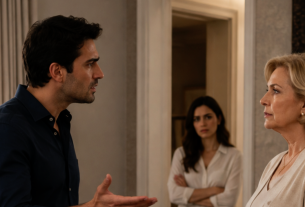
Timur placed a platter of sliced fruit on the table and smiled. Galina Petrovna had already been sitting in his kitchen for three hours. Inna fussed around her mother, refilling her tea as though she had just returned from an exhausting expedition.
“Timur, I saw a wonderful chair in a store,” Galina Petrovna said without looking up from her phone. “You know, one of those heated massage chairs. It’s on sale right now. Only eighty-seven thousand rubles.”
“Only?” Timur sat down across from her, trying to keep his expression under control. “Galina Petrovna, we have other expenses at the moment. Inna and I were planning to renovate the bathroom.”
“Your renovation can wait,” Inna said as she arranged the cups. “Her back hurts. You know that. She needs this chair.”
Timur looked at his wife and then at her mother. Both women were staring somewhere past him, as though they had already agreed on his answer without involving him. He exhaled and said calmly:
“All right. Let’s discuss it later.”
“What is there to discuss? The sale ends in three days.” Galina Petrovna finally raised her eyes and gave him an expression he had seen a hundred times before—one of deep, almost universal dissatisfaction.
“I said later.” Timur smiled, although forcing the smile took considerable effort.
When his mother-in-law left, he sat in the kitchen for a long time, staring at the remains of the fruit on the table. Inna walked her mother to the door and returned, her heels clicking against the laminate flooring.
“You could have been gentler,” she said without sitting down.
“Inna, I’ve been so gentle that I’m about to turn into a pillow. This is the fourth major request in two months. A television, a fur coat, a dinnerware set, and now a chair.”
“So what? She’s my mother. She’s alone. She needs help,” Inna said as though she were reading from a prepared script.
“She has a husband. Boris Andreyevich. He’s alive and healthy. Where exactly has he disappeared to in this equation?” Timur asked quietly.
“He can’t do anything. You know that.” His wife waved a dismissive hand.
“I know only one thing: every month, an amount large enough to feed a small village disappears from our budget.” Timur stood up. “I’m not refusing. I’m asking you to wait. ‘Later’ is a perfectly normal word. It isn’t an insult.”
Inna said nothing. She left the kitchen, and a minute later he heard the television switch on in the bedroom. Timur remained standing there with the plate in his hands, staring at the closed door.
Two weeks passed. The chair was purchased.
Not by Timur. Inna withdrew money from their joint savings account, and he found out through a notification from the bank.
“You transferred seventy thousand rubles without telling me?” Timur stood in the hallway, holding his phone with the banking app open.
“I put my salary into that account too, by the way,” Inna replied without turning away from the mirror as she adjusted her earrings.
“You contributed twenty thousand. I contributed one hundred and fifty. But this isn’t even about the amounts. You didn’t ask me. You simply took the money.” Timur’s voice became quieter, which was worse than if he had shouted.
“If I’d asked, you would have started bargaining and calculating how much everything cost. It was easier for me to do it this way.” Inna turned around, and there was not a trace of regret in her eyes.
“Easier this way. I understand. Stealing was easier.”
He put the phone in his pocket and went into the other room. He sat at the desk, opened his laptop, and closed it. Then he opened it again.
He typed a message to Artyom:
“We need to talk. Are you free today?”
The reply came a minute later:
“Meet me at the Baku Courtyard in an hour. I’ll be waiting.”
Artyom was sitting at a corner table and had already ordered thyme tea. Timur sat across from him, took off his jacket, and placed his phone facedown on the table.
“Tell me what happened.” Artyom leaned back in his chair. “You look like someone who just stepped on a Lego brick barefoot.”
“Inna withdrew money from the account. She bought her mother a chair. No discussion, no warning,” Timur said evenly, but Artyom could see the vein twitching at his temple.
“Was this the first time?” Artyom asked seriously.
“I wish. It was the sixth time in six months. I counted.” Timur took out a notebook and placed it on the table. “A television in March. A fur coat in April. Some kind of designer dinnerware set. Then two more transfers for ‘medical treatment’ that turned out to be a spa membership. And now the chair.”
“Wait, wait.” Artyom leaned forward. “And you kept quiet every time?”
“No. I spoke to her every time. Every time, she promised it wouldn’t happen again. And every time, she did exactly the same thing. Then my mother-in-law comes over and starts hinting about the next ‘necessity,’ looking at me as though I owe her something for giving birth to her daughter.”
“Timur, you’re my friend, so I’m going to tell you this directly: they’re milking you like a cow on a farm. At least a cow doesn’t understand what’s happening.” Artyom tapped the table with his finger.
“I understand. I just kept hoping Inna would understand too. That she would finally see what was happening. That she would feel uncomfortable or ashamed.” Timur gave a bitter smile. “Do you know what hurts the most? I don’t mind spending money to help someone. What bothers me is that nobody asks me. My opinion means nothing.”
“What does your father say?” Artyom asked.
“I haven’t told him yet. I didn’t want to worry him.” Timur looked away.
“Tell him. Viktor Sergeyevich is a wise man. He’ll give you sensible advice.” Artyom finished his tea and called the waiter over. “And listen, my friend. Hope is a wonderful thing. But when people are using you, hope turns into naïveté. And naïveté turns into stupidity. You’re not stupid. Put an end to this.”
Timur nodded. The conversation shifted something inside him. Something heavy and immovable had finally begun to move.
Viktor Sergeyevich listened to his son without interrupting. They were sitting on a bench in the park, and his father was holding a paper cup of coffee that had gone cold because he had forgotten about it.
“Six times, you said?” he asked again.
“Six. Maybe more. I might have overlooked some of the smaller things.” Timur stared straight ahead.
“Son, I raised you, and I’ve always tried not to interfere in your family. But I’m going to say something now. Whose name is the apartment you live in under?” Viktor Sergeyevich turned toward him.
“Mine. You know that. You helped with the down payment.” Timur frowned.
“Exactly. I helped, and you made the payments yourself. Inna didn’t contribute a single kopeck toward that apartment,” his father said calmly, like a man who had calculated everything long ago. “Now listen to me. You allowed that woman and her mother to behave as though you owe them for every breath they take. But you don’t owe them anything. You’re a husband, not an ATM.”
“I tried to speak gently,” Timur sighed.
“Gentleness is good with people who appreciate it. With people who mistake it for weakness, you need a different approach.” Viktor Sergeyevich took a sip of his coffee and grimaced when he realized it was cold. “You know what you need to do. You simply don’t want to do it because you love her. But love without respect is slavery, son. And you are not a slave.”
“I’ll talk to her tomorrow. Properly this time,” Timur said quietly, but there was something new in his voice. Something firm.
“Don’t talk. Act. You’ve been talking for six months. The result is several hundred thousand rubles gone and no respect whatsoever.” Viktor Sergeyevich placed a hand on his son’s shoulder. “I’m here. Artyom is here. You’re not alone.”
Timur returned home late that evening. Inna was lying on the sofa, scrolling through her phone. She did not even turn her head.
“Where were you?” she asked.
“With my father.”
“Oh,” she drawled, with so much indifference in that single sound that Timur clenched his teeth. “By the way, Mother called. She found a package for a health resort in the Caucasus. Twenty days, all-inclusive. The deposit has to be transferred by Friday.”
Timur stopped in the middle of the room and stared at Inna. She continued scrolling through her phone, either failing to notice his gaze or pretending not to.
“How much?” he asked.
“Sixty-five thousand for the package, plus ten thousand for transportation,” she said in the same tone someone might use to say, “Pass the salt.”
“No,” Timur said.
Inna finally looked up from her phone and stared at him in surprise, as though the family cat had suddenly started speaking.
“What do you mean, no?”
“No. There will be no transfer. There will be no health resort at my expense. There will be no more chairs, fur coats, or televisions.” Timur spoke slowly and clearly, like a man who had rehearsed these words and was finally saying them aloud. “Your mother has a husband of her own. Boris Andreyevich. Let him buy her everything she likes.”
“Have you completely lost your mind?” Inna sat up, and her phone fell onto the cushion. “You’re acting like a stranger. She’s my mother!”
“And I’m your husband. But for some reason, that seems to be a secondary role to you.” Timur did not raise his voice in the slightest. “Inna, for six months I have asked you to speak to me before spending our money. You didn’t listen once. That means words don’t work. Actions will.”
“What actions?” Fear appeared in her voice.
“I’m closing the joint account. I’ll transfer the money into my own account. You’ll manage your salary, and I’ll manage mine. We’ll split our shared expenses equally. End of discussion. And if you object, you can reimburse me for everything you transferred.” Timur turned and walked toward the door.
“You wouldn’t dare!” Inna shouted after him.
He did not turn around. Not because he had not heard her, but because he had heard “You wouldn’t dare” too many times before. Every time, it had meant the same thing:
“I’m certain you’re too weak to stand up to me.”
The following morning, Timur did exactly what he had said he would do. He closed the joint account, transferred the funds, and arranged for the apartment’s automatic payments to be taken only from his card. Artyom helped him sort through the documents and prepare the necessary paperwork in case the situation took the worst possible turn.
“Well done,” Artyom said as Timur signed another form. “You should have done this a long time ago.”
“How long ago?” Timur asked without smiling.
“The first time she withdrew money without asking. It was a test. You failed it, and they realized they could keep doing it.” Artyom was harsh but honest. “Never mind. You’re making up for it now.”
At two o’clock that afternoon, Galina Petrovna called Timur. He answered.
“Timur, Inna told me you closed the account. What kind of stunt are you trying to pull?” His mother-in-law sounded as though she were speaking to an incompetent subordinate.
“Galina Petrovna, this isn’t a stunt. It’s financial hygiene,” Timur replied evenly.
“Are you saying my daughter now has to beg you for money?” she demanded, raising her voice.
“Your daughter has her own income. She is an adult. But the fact that she was spending our shared money on your purchases without my consent is called disrespect, Galina Petrovna. More precisely, it is called theft. And I will no longer tolerate it.” Timur sat on a bench in the courtyard. His heart was pounding, but his voice did not tremble.
“How dare you speak to me like that! I’m older than you! I’m your wife’s mother!” his mother-in-law screamed.
“You have a husband of your own, Galina Petrovna. Let him buy you everything you like. I am not your sponsor, and I am not your wallet.” As Timur said the words, he felt something fall from his shoulders—something heavy and suffocating.
“You’ll regret this! Inna will leave you!” Galina Petrovna snapped.
“That will be her choice, and she has every right to make it,” Timur replied before ending the call.
That evening, Inna returned home with a suitcase—not to come back to him, but to leave him.
She packed her belongings silently and methodically, like someone carrying out another person’s orders. Timur stood in the doorway and watched.
“Are you sure?” he asked.
“This is what you wanted,” she said without looking at him. “Mother says it’s impossible to live with someone as greedy as you.”
“What do you say? You—not your mother. What do you say?” Timur stepped forward.
Inna froze for a second. Then she picked up her suitcase and walked past him toward the door.
“I say the same thing,” she forced out.
The door closed. Timur stood alone in the empty hallway.
He did not run after her. He did not call her. He sat down on a chair, took out his phone, and called his father.
“She left,” he said.
“I suspected she might,” Viktor Sergeyevich replied. “Artyom warned me this could happen. Come over. We’ll have dinner.”
“Dad, I’m not in the mood for dinner.”
“I’m not talking about the food. I’m saying you shouldn’t be alone tonight. Get in the car. I’ll be waiting.”
A month passed.
Timur did not call Inna, and she did not call him. Galina Petrovna remained silent as well, which was unusual. Timur put the apartment in order, finished the bathroom renovation he had postponed for six months, and began learning how to live in silence again—a silence that turned out not to be empty, but clean.
Artyom called him on Saturday morning.
“Listen, I have news. You’d better sit down,” Artyom said in an unusual voice.
“I’m standing. Just tell me,” Timur replied.
“Inna messaged me yesterday. Not you—me. She asked how you were doing. And what I managed to read between the lines almost made me drop my mug.”
“Be specific.”
“Galina Petrovna is deeply in debt. She took out installment plans for appliances, furniture, and some ridiculous trip. Boris Andreyevich—that husband of hers—found out about everything and left. He packed his belongings and went to stay with his sister in another city. He left a note saying he had endured it for thirty years, but he had finally reached his limit. Apparently, he also wants the apartment divided. That should be quite a spectacle.”
Timur remained silent.
“So now Galina Petrovna is sitting there alone with a mountain of monthly payments, no husband, no son-in-law acting as her personal ATM, and a daughter sleeping on her sofa who has no idea how to pay for all that magnificence either.” Artyom finished and waited.
“Inna is living with her?” Timur asked.
“Exactly. She returned to her mother, just as her mother had planned. Except Galina Petrovna expected Inna to come back with your money. Instead, Inna arrived with one suitcase. Now the two of them are staring at each other and trying to decide who is to blame.”
“And Boris Andreyevich? You said he left?”
“He did. And people say he looks happier than he has in years. One of his acquaintances told me he looks like a new man.”
Timur looked up at the ceiling.
“I never wanted any of this, Artyom. I wanted a normal family.”
“A normal family is one in which two people respect each other. What you had was one person paying while two people spent the money. That wasn’t a family. It was a business model.” Artyom paused. “She asked me to tell you to call her.”
“No.”
“That’s what I thought.”
Three days later, Timur received a long message from Inna. He read it twice. It was confused and disjointed, with numerous spelling mistakes.
She wrote that she had been wrong. That her mother had pressured her. That everything had finally become clear to her. That she wanted to come back.
Timur began typing a reply. He wrote for a long time, erased it, and rewrote it. Then he deleted everything and wrote three sentences:
“Inna, I don’t blame you. But I no longer trust you. And without trust, there is nowhere to return to.”
She read the message immediately. Timur saw the two blue check marks. No reply followed.
Viktor Sergeyevich visited him the next day. He brought homemade noodles in a container and fresh bread from a bakery.
“How are you?” his father asked as he removed his shoes in the hallway.
“I’m all right. It feels strange, but I’m all right.” Timur took the container. “Do you know what’s surprising? I don’t feel burdened. I felt burdened when I was tolerating everything. Now I feel light. A little empty, but light.”
“It’s the right kind of emptiness. Something new will grow out of it.” Viktor Sergeyevich sat at the table. “I never told you this, but I knew about Galina Petrovna. Not everything, but a great deal. Boris called me a couple of times. He was suffering too. You opened his eyes, by the way.”
“Me? How?”
“By leaving. He saw that a younger man wasn’t afraid to stand up for himself and thought, ‘What am I afraid of, then?’ He’s sixty-two years old, and for the first time in his life, he made a decision for himself.”
Timur smiled sadly but sincerely.
“Dad, thank you for not giving me advice after the fact.”
“What would be the point? You did everything correctly. By yourself. Quickly. Without any hysterics. I’m proud of you.” Viktor Sergeyevich took out the spoons and set the plates on the table. “Come on, let’s eat. The noodles are getting cold.”
Another week passed before Timur received a call from an unfamiliar number. He answered.
“Timur? This is Boris. Boris Andreyevich. Inna’s father.” His voice was uncertain but warm.
“Hello. I’m listening,” Timur replied calmly.
“I wanted to tell you something. It shouldn’t have taken me thirty years to understand it, but it did. You did the right thing. I regret only one thing—that I didn’t do the same sooner. Thank you for setting an example.”
“There’s nothing to thank me for, Boris Andreyevich. I’m not an example. I simply grew tired of being invisible,” Timur answered quietly.
“So did I. As for Galina… yesterday, she called everyone she knows and asked them for money. Nobody gave her any. Do you know why? Because for thirty years she told everyone how wealthy and successful she was. Now she’s embarrassed to ask, and there’s no one left to ask anyway. Inna is crying, but not because she regrets what she did. She’s crying because she’ll have to pay for everything herself.”
“I’m sorry to hear that,” Timur said, and he was telling the truth.
“So am I. But it isn’t your fault, and it isn’t mine. These are consequences. They always arrive—sometimes simply later than we would have liked.”
They said goodbye.
Timur placed the phone on the table and looked around his apartment—quiet, clean, and belonging only to him.
On the shelf stood a photograph of him and his father fishing, both wearing ridiculous sun hats and laughing. Beside it was a birthday card from Artyom with the words:
“A friend is someone who tells you the truth when everyone else is lying.”
Timur walked over to the window, opened it, and let the evening air inside.
Somewhere far away, in a small apartment on the other side of the city, Galina Petrovna sat in front of a pile of bills and, for the first time in her life, counted someone else’s money—the money she now owed.
Beside her, Inna sat on the sofa with her phone screen dark and a single unanswered message in her conversation with the man she had lost forever.
Timur took a breath and closed the window.
He felt good.
At last, he felt good.