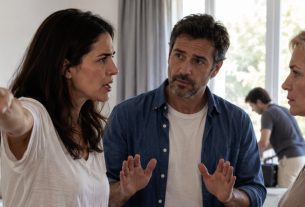
“Olga, are you deaf or what? Grab the watering can with your teeth and get to the garden beds! This isn’t a resort, and you’re not some pensioner!” her mother-in-law snapped.
“Have you completely lost your mind? I’m telling you for the third time: don’t just stand there like a post, take the watering can and go to the greenhouse!” Natalya Ivanovna shouted so loudly she drowned out even the neighbors’ radio, where a raspy voice was crooning something about summer cottages, love, and discounts on building materials.
Olga slowly straightened up, feeling as if someone had twisted her lower back with an old rusty wrench. Dirt clung to her gloves, her knees, her sneakers, even her cheek. She absentmindedly wiped her face with her hand and only smeared the dust more.
“I’ve been out here since morning without a break,” she said evenly, though she was already at the limit. “Can’t I sit down for just five minutes?”
“Sit down?” her mother-in-law snorted, sitting in the shade on the veranda with a fan and her phone. “Did you come here to отдыхать or to help? This isn’t a resort.”
On the old little couch by the window, Oleg was half-lying down. A phone in one hand, a glass of something cold in the other. He looked as though he wasn’t at his mother’s dacha, but recovering from a heroic shift in a coal mine.
“Olya, come on, don’t start, okay?” he tossed out lazily, not taking his eyes off the screen. “Mom’s already nervous as it is.”
Olga turned to him so sharply her sunhat slid sideways.
“Nervous? So I’m the one lying around right now, scrolling videos and being nervous?”
Natalya Ivanovna threw up her hands.
“Oh, spare me the drama. At your age I worked, kept house, and raised a child. But young people these days — they see a shovel once and suddenly it’s a nationwide tragedy.”
“I’ve been seeing that shovel since six in the morning,” Olga shot back. “And the buckets, and the hoe, and the hose that’s leaking in three places again. Only somehow this is everybody’s family dacha, and I’m the only one doing the backbreaking work.”
Oleg lazily propped himself up on one elbow.
“That’s because you’re better at it, that’s all. Why get worked up? You’re the capable one in the family.”
“Really?” Olga even gave a little laugh. “And what are you then? A decorative element? A garden statue in shorts?”
Natalya Ivanovna’s light eyebrows shot up.
“Now that is outright disrespect. I didn’t raise my son to be spoken to in that tone.”
“And what tone should I use with him?” Olga stepped closer. “Officially respectful? ‘Oleg Sergeyevich, would you be so kind as to tear yourself away from your phone and at least carry a bucket to the barrel?’”
Oleg sat up and let out a loud breath.
“Here we go again. I told you we shouldn’t have brought you with us. Mom, I knew from the start there’d be a whole performance.”
“Of course,” Olga nodded. “The most convenient arrangement of all: drag me out here so I can weed, wash, chop salads, marinate the meat, and then still listen to what an ungrateful person I am.”
Natalya Ivanovna stood up. Slowly. Pressing her lips tight.
“Olga, don’t twist things. No one is forcing you. If you don’t want to help, just say so. Only don’t be surprised later if the way people treat you changes.”
“How exactly could it change?” Olga spread her hands. “No one here treats me like a person as it is. I’m like some multifunctional mop — garden beds, dishes, kitchen, cleaning, everything.”
At last Oleg put his phone away.
“That’s enough. Go fill up some water instead. The barrels are empty.”
“You do it.”
“My shoulder’s acting up.”
Olga looked at him for a long moment.
“Your shoulder starts acting up the exact moment there’s work to do. But when it’s time to eat barbecue, you make a miraculous recovery.”
“Oh, stop it,” Oleg grimaced. “We were sitting here just fine.”
“Who was sitting?” Olga even laughed, but it came out angry. “You were sitting. I was working.”
Natalya Ivanovna was already opening her mouth for a new tirade when a car horn sounded at the gate. Sveta drove onto the property with her husband and kids. All of them clean, dressed up, carrying shopping bags, containers, blankets, and wearing the kind of expression that said they hadn’t come to a dacha, but to a photo shoot called Happy Rustic Family.
“Well, workers, still alive?” Sveta called cheerfully, taking off her sunglasses. “Mom, we bought meat, vegetables, juice for the kids, and your favorite cheese snacks. Olya, did you light the grill already?”
Olga slowly turned toward her.
“Of course. I chopped the firewood myself too, and gave birth to the coals while I was at it.”
Sveta blinked.
“Wow. Somebody’s in a mood.”
“And what did you expect?” Natalya Ivanovna immediately hurried toward her daughter, her voice suddenly so sweet you could have scooped honey out of it with a spoon. “My darlings are here, my treasures. Kids, wash your hands and go to the veranda. Everything will be ready in a minute. Olya will finish up outside and then take care of the table.”
Oleg was already striding briskly toward his brother-in-law as though five minutes earlier he hadn’t been dying from his “shoulder.”
“Hey! Great to see you. So, beer later?”
Olga looked at him, at Sveta, at her mother-in-law, at the children who instantly tore down the path, noticing neither the shovels nor the buckets nor the scattered bags of soil. Then she shifted her gaze to the pile by the gate. Thick, fresh, imposing. A pitchfork lay beside it.
“And what’s that?” she asked quietly.
Natalya Ivanovna actually seemed pleased by the question.
“Oh, that just got delivered. It needs to be spread around the property right away, before it dries out. I already told you — apparently you didn’t hear me.”
“You want me to spread all that by myself?”
“Well, who else?” her mother-in-law asked in genuine surprise. “The men are about to put the grill together, the children are hungry, Sveta is tired from the road. Why are you looking at me like I’ve just announced the end of the world?”
“Because this isn’t a garden plot, it’s some kind of seasonal labor camp,” Olga said. “Since morning it’s one thing, then another, then a third. And every single one of them is for me.”
Sveta set the bags on the table and snorted.
“Oh, here we go. Olya, don’t be so dramatic. We all help.”
“Really?” Olga turned to her. “Seriously? Last time your help consisted of bringing disposable plates and then spending two hours talking about how hard life is with a mortgage and a massage therapist who only has openings on Thursdays.”
“No need to get sarcastic,” Sveta said, offended. “I get tired too, you know.”
“I believe that. Probably from choosing filters for your stories.”
“You are completely overstepping now,” Natalya Ivanovna hissed.
Olga jerked her head up.
“Don’t use that word around me. Better answer honestly: do you people even understand that I’m not a robot?”
Oleg stepped toward her, lowering his voice.
“Olya, stop embarrassing me in front of the family.”
“And you’re not embarrassing me?” she shot back. “When you sit there while I haul water? When you let your mother order me around as if I came here for seasonal labor? When in the car on the way here you say, ‘Just put up with it, don’t start anything, or Mom will get upset’? Is it comfortable living without a spine?”
Sveta let out a snort into her palm.
“Oh wow, that was a good one.”
“And don’t you laugh,” Olga cut in. “You always show up when everything’s already done. I’m convenient for you too. You arrive and the table is already set, the kids are fed, the meat is marinated, the kettle is boiling. Beautiful. Then you can go home later and tell everyone what a warm, wonderful time it always is at Mom’s.”
Her mother-in-law stepped forward.
“That’s it. Conversation over. Take the pitchfork and go to the gate. Then go inside, change your clothes, and set the table. The guests have arrived.”
“Guests?” Olga repeated the word quietly. “So I’m not a guest here?”
“You’re family,” Natalya Ivanovna declared solemnly.
“No,” Olga smirked. “Family is when people have pity on each other. With you, I’m just a free service.”
Oleg raised his voice.
“How much longer is this going to go on? Just do what you’re told and stop putting on a show.”
“And what if I don’t?”
“Then you can go wherever you want.”
For a second the yard went so quiet even the children stopped making noise.
Olga looked at him carefully, as if checking whether he had really said that or whether the heat was making her ears ring.
“So you’re seriously telling me right now, in my own car, ‘If you don’t like it — leave’?”
“Yes,” Oleg muttered. “Because I’ve had enough of you already. You blow everything out of proportion.”
“Wonderful,” Olga said unexpectedly calmly.
She walked over to the pile, picked up the pitchfork, raised it with both hands, and with a sharp swing drove it not where her mother-in-law expected, but straight into the neat green lawn in front of the veranda.
“What are you doing?!” Natalya Ivanovna shrieked as if Olga hadn’t damaged the grass, but her bank account…
Continuation just below in the first comment.
“Have you completely lost all shame or what? I’m telling you for the third time: stop standing there like a post, grab the watering can, and go to the greenhouse!” Natalya Ivanovna shouted so loudly that she drowned out even the neighbors’ radio, where a raspy voice was singing something about summer cottages, love, and discounts on building supplies.
Olya slowly straightened up, feeling as if someone had twisted her lower back with an old rusty wrench. Dirt clung to her gloves, her knees, her sneakers, even her cheek. She automatically brushed a hand across her face and only smeared the dust even more.
“I’ve been out here since morning without a break,” she said evenly, though she was already at the edge. “Can I at least sit down for five minutes?”
“Sit down?” her mother-in-law snorted, sitting in the shade on the veranda with a fan and her phone. “Did you come here to relax or to actually do something? This isn’t a resort.”
On the old little sofa by the window, Oleg was half lying down. A phone in one hand, a glass of something cold in the other. He looked as if he weren’t at his mother’s dacha, but recovering from some heroic shift in a coal mine.
“Olya, come on, don’t start, okay?” he tossed out lazily without taking his eyes off the screen. “Mom’s already stressed enough.”
Olya turned to him so sharply that her sunhat slipped sideways.
“Stressed? So in your opinion, I’m the one lying around here, scrolling videos, and being stressed?”
Natalya Ivanovna threw up her hands.
“Oh, spare me the drama. At your age, I worked, ran a household, and raised a child. Young women nowadays see a shovel and suddenly it’s a tragedy of nationwide proportions.”
“I’ve been looking at a shovel since six in the morning,” Olya snapped. “And buckets, and the hoe, and the hose that’s leaking in three places again. Only somehow this is supposed to be everyone’s family dacha, and I’m the only one doing all the work.”
Oleg lazily propped himself up on one elbow.
“That’s because you’re better at it, that’s all. Why get worked up? You’re the domestic one.”
“Really?” Olya even gave a little laugh. “And what are you then? A decorative feature? A garden statue in shorts?”
Natalya Ivanovna’s pale eyebrows shot up.
“Now that is outright rudeness. I did not raise my son to be spoken to in that tone.”
“And what tone should I use with him?” Olya stepped closer. “Formal and respectful? ‘Oleg Sergeyevich, would you be so kind as to tear yourself away from your phone and at least carry a bucket to the barrel?’”
Oleg sat up and exhaled noisily.
“Here we go again. I said we shouldn’t have brought you along. Mom, I knew from the start—there’d be a performance.”
“Of course,” Olya nodded. “The most convenient arrangement: drag me out here so I can weed, wash, chop salads, marinate meat, and then also listen to how ungrateful I am.”
Natalya Ivanovna stood up. Slowly. Her lips pressed tight.
“Olya, don’t twist things. No one is forcing you. If you don’t want to help, just say so. Only don’t be surprised afterward if the way people treat you changes.”
“How exactly could it change?” Olya spread her hands. “No one here already treats me like a human being. I’m basically a multifunctional mop: garden beds, dishes, kitchen, cleaning.”
Oleg finally put his phone away.
“That’s enough. Go get some water instead. The barrels are empty.”
“You get it.”
“My shoulder’s acting up.”
Olya looked at him for a long moment.
“Your shoulder starts acting up precisely when there’s work to do. But when it’s time to eat barbecue, you make a miraculous recovery.”
“Oh, give it a rest,” Oleg grimaced. “We were sitting here just fine.”
“Who was sitting?” Olya actually laughed, but the laugh came out bitter. “You were sitting. I was working.”
Natalya Ivanovna had already opened her mouth for another tirade when a car horn sounded at the gate. Sveta arrived with her husband and children. All clean, well-dressed, carrying bags, containers, blankets, and looking as though they had come not to a dacha, but to a “Happy Family Rustic Style” photo shoot.
“Well, hard workers, still alive?” Sveta shouted cheerfully, taking off her sunglasses. “Mom, we bought meat, vegetables, juice for the kids, and your favorite cheese snacks. Olya, did you already light the grill?”
Olya slowly turned to her.
“Of course. I also chopped the firewood myself and personally gave birth to the coals.”
Sveta blinked.
“Wow. Someone’s in a mood.”
“What did you expect?” Natalya Ivanovna hurried to greet her daughter, her voice suddenly so sweet you could scoop the honey out of it with a spoon. “My dears, my precious ones. Kids, wash your hands and go to the veranda. Everything will be ready soon. Olya will finish up outside and then take care of the table.”
Oleg was already briskly walking toward his brother-in-law, as if five minutes earlier he hadn’t been dying from his “shoulder.”
“Hey! So, beer later?”
Olya looked at him, then at Sveta, then at her mother-in-law, then at the children who immediately ran down the path without noticing the shovels, the buckets, or the scattered bags of soil. Then she shifted her gaze to the pile by the gate. Thick, fresh, impressive. A pitchfork lay beside it.
“And what’s that?” she asked quietly.
Natalya Ivanovna almost seemed pleased by the question.
“Oh, that. They just delivered it. It needs to be spread around the yard urgently. Before it dries out. I already told you, but apparently you didn’t hear.”
“You want me to spread all that by myself?”
“Who else?” her mother-in-law asked in genuine surprise. “The men are about to put the grill together, the children are hungry, Sveta is tired from the drive. Why are you looking at me like I just announced the end of the world?”
“Because this isn’t a garden plot, it’s some kind of seasonal labor camp,” Olya said. “One thing in the morning, then another, then a third. And all of it—me.”
Sveta set the bags on the table and snorted.
“Here we go again. Olya, don’t be so dramatic. We all help.”
“Really?” Olya turned to her. “Seriously? Last time your helping consisted of bringing disposable plates and then spending two hours talking about how hard life is with a mortgage and a massage therapist who only has appointments on Thursdays.”
“You don’t need to be sarcastic,” Sveta said, offended. “I get tired too, you know.”
“I believe you. Probably from choosing filters for your stories.”
“You are going way too far,” Natalya Ivanovna hissed.
Olya jerked her head up.
“Don’t use that phrase around me. Better answer honestly: do you even understand that I’m not a robot?”
Oleg stepped toward her, lowering his voice.
“Olya, stop embarrassing me in front of my family.”
“And you’re not embarrassing me?” she shot back. “When you sit there while I haul water? When you let your mother order me around as if I came here as seasonal labor? When you tell me in the car on the way here, ‘Just put up with it, don’t start anything, or Mom will get upset’? Is it comfortable for you, living without a spine?”
Sveta burst out laughing into her palm.
“Oh wow, she really said it.”
“And don’t you cackle,” Olya cut her off. “You always show up when everything’s ready. I’m convenient for you too. You arrive—the table is already set, the kids are fed, the meat is marinated, the kettle is boiling. Wonderful. Then you can go home and talk about what a warm, lovely time it is at Mom’s.”
Her mother-in-law stepped forward.
“That’s enough. This conversation is over. Take the pitchfork and go to the gate. Then go inside, change clothes, and set the table. We have guests.”
“Guests?” Olya repeated the word quietly. “So I’m not a guest here?”
“You’re family,” Natalya Ivanovna said solemnly.
“No,” Olya said with a faint laugh. “Family is when people care about each other. With you, I’m just free labor.”
Oleg raised his voice.
“How much longer is this going to go on? Just do what you’re told and stop putting on a show.”
“And if I don’t?”
“Then you can go wherever you want.”
For a second the yard fell so silent that even the children stopped making noise.
Olya looked at him carefully, as though checking whether he had really said it or whether the heat had started ringing in her ears.
“So right now, in my own car, you’re seriously telling me, ‘If you don’t like it—leave’?”
“Yes,” Oleg muttered. “Because I’m sick of you. You blow everything out of proportion.”
“Wonderful,” Olya said unexpectedly calmly.
She walked over to the pile, took the pitchfork, lifted it with both hands, and with a sweeping motion drove it not where her mother-in-law expected, but straight into the neat green lawn in front of the veranda.
“What are you doing?!” Natalya Ivanovna shrieked as if Olya had damaged not the grass, but her bank account.
Olya took off her gloves. Slowly. Carefully. She dropped them beside the pitchfork.
“My shift is over,” she said. “Forever.”
“I beg your pardon?!” her mother-in-law turned crimson. “Where do you think you’re going?”
“Home.”
“And the table? The meat? The salads?” Sveta asked, bewildered.
“There are four adults here, each with two hands. You’ll manage.”
Oleg stepped toward her.
“Just try leaving now.”
“You said it yourself: I can go wherever I want.”
“I said that in the heat of the moment.”
“And I heard it very clearly.”
She walked past everyone into the house. Inside, it smelled of dill, dish soap, and dust from the old carpet. Her blouse hung over the back of a chair; her bag was on the windowsill. Documents, keys, wallet—everything was there. Olya grabbed the bag, went into the small room where she and Oleg sometimes spent the night, pulled out her charger and makeup bag. After thinking for a second, she opened the dresser drawer and took out the folder with the apartment papers.
Footsteps sounded behind her. Oleg appeared in the doorway.
“You’re serious?”
“Do you have any other kind of women?” she asked without turning around.
“This isn’t the time for jokes.”
“I’m not joking. I just suddenly realized that in your family you were raised with a brilliant principle: if there’s a woman nearby, that means she has to carry everything, while you lie around and supervise.”
“Don’t exaggerate. We’re a normal family.”
Olya turned around.
“Normal? The kind where your mother orders me around. Where you shut me up. Where my salary is ‘ours,’ but yours is somehow always ‘for important expenses.’ Where I buy groceries, pay utilities, and you keep telling me it’s just a difficult period.”
Oleg flinched.
“You’re bringing up money again?”
“What else should I bring up? Our heavenly love? Come on, Oleg, let’s list it out loud. Over the past six months, who paid for the apartment?”
“Well, you earn more.”
“Who bought you a winter jacket because your ‘bonus got delayed’?”
“Olya, not now…”
“Who paid the loan on your car while you were ‘between jobs’?”
He said nothing.
“And after all that, you lie on your mother’s sofa and tell me, ‘Don’t embarrass me’? You’ve humiliated yourself so thoroughly already that the only thing left is to walk around with a sign.”
Oleg clenched his jaw.
“So now you’re deliberately making me look like a nobody in front of everyone?”
“No. You’ve been working very hard at that for years.”
From the veranda came Natalya Ivanovna’s voice:
“Oleg! Why are you wasting time with her? Let her go! She’ll come crawling back.”
Olya raised her eyebrows.
“Heard that? What excellent family advice. So supportive.”
“Mom’s just emotional.”
“Your mother is always ‘emotional’ whenever she wants to order me around.”
She walked past him, stepped onto the porch, and said loudly:
“Don’t worry, I’m not planning to come crawling back.”
Natalya Ivanovna flared up.
“Who needs you with a character like that!”
Olya stopped on the step and looked at her almost with pity.
“Your son seemed to need me very much. Especially when it came to living in my apartment, eating my groceries, and pretending to be the head of the family.”
Sveta’s face went blank.
“What do you mean—your apartment?”
Olya turned to her sister-in-law.
“I mean exactly that. The apartment is mine. Bought before the marriage. The car is mine too. The only ‘shared’ things your brother and I have are his sneakers in the hallway and his habit of making beautiful promises.”
“What the hell are you talking about?” Oleg barked.
“The truth. Try listening to it for once.”
She ran down the steps, opened the car, and threw her bag onto the seat.
“Olya!” her mother-in-law shouted. “Just you dare come back here later!”
“I wouldn’t have come even now if I’d known you weren’t bringing me to a dacha, but to auditions for serfdom.”
Sveta laughed nervously.
“Mom, honestly, this is too much.”
“You be quiet!” Natalya Ivanovna snapped. “She’s turning you against us!”
“No one needs to turn me against anybody,” Sveta said dryly. “I can see for myself that Oleg didn’t even move a chair.”
Oleg wheeled around toward his sister.
“Stay out of it.”
“I am out of it. I’m just not blind.”
Olya got behind the wheel. Started the engine. Rolled down the window.
“Oleg, you have one hour. To pick up your things.”
“What things?”
“The ones you’ll take with you when you gracefully move back in with Mom. Or wherever it is you go when you suddenly remember that you’re a man.”
“Have you lost your mind?”
“Nope. Quite the opposite. I think I’ve only just come to my senses.”
She drove out through the gate without turning on any music. Her phone came alive almost immediately. First Oleg. Then Natalya Ivanovna. Then Oleg again. Then messages from Sveta: “Did you get there?” and a minute later: “Listen, I’m not on your side, but what happened there was seriously insane.” Olya smirked and tossed the phone onto the passenger seat.
By the time she reached the city, the air already smelled of evening asphalt, heat, gasoline, and something fried from the kiosk by the bus stop. At home it was quiet. So quiet that at first Olya could hardly believe it. No orders. No sighs of the kind that said, “A proper wife would have already…” No remarks about the way she sliced cucumbers.
She slipped off her shoes right in the hallway, went into the bathroom, and turned on the water.
“That’s it,” she said to her reflection. “Enough.”
Forty minutes later, in a clean T-shirt with wet hair, she sat in the kitchen with a glass of wine and her phone. Twenty-three missed calls.
Oleg: “Have you completely lost it?”
Oleg: “Come back and apologize to Mom.”
Oleg: “You’re humiliating me in front of my family.”
Oleg: “Either you come back right now, or we’re over.”
Natalya Ivanovna: “Ungrateful.”
Natalya Ivanovna: “We accepted you, and this is how you repay us.”
Natalya Ivanovna: “Oleg is too soft, that’s why you’ve become so unruly.”
Sveta: “Listen, you’re not answering. I’m not supporting the scandal, of course, but Mom really went too far.”
Olya called Sveta.
“Yes?” she answered at once.
“I got home,” Olya said.
“Well, wow. It’s a full-blown movie over here. Mom is screaming, Oleg is pacing in circles, Sergey is grilling the meat himself and has already asked three times where your salt is.”
“Your salt?”
“Oh, don’t nitpick. The salt was found. Listen, are you really kicking him out?”
“I really am.”
“Today?”
“What, should I keep him as a souvenir? A museum exhibit called ‘Husband, common variety, questionable usefulness’?”
Sveta snorted.
“You’re mean, you know.”
“I’m not mean. I’m tired. I just used to put up with everything silently, and now apparently I got overheated and started saying things out loud.”
“He’s furious because you told everyone about the apartment.”
“Was that a secret? Or was the family legend that he nobly rescued me and carried me off on a white horse?”
Sveta fell silent for a second.
“Honestly? That’s exactly how Mom always presented it. Like you wouldn’t have managed without him.”
Olya wasn’t even surprised.
“Of course. Apparently I wouldn’t have been able to open the fridge, pay the mortgage, and call a plumber on my own.”
“The mortgage?” Sveta asked warily.
“Already paid off. Before the marriage. Sveta, did you really not know?”
“No. He said you two were carrying everything together.”
“We were. I carried the finances, he carried the air.”
A short laugh came from the other end.
“Listen, I probably shouldn’t say this, but… that is very much Oleg’s style.”
“Thanks for at least being the one person in that family capable of honesty.”
“Don’t flatter yourself,” Sveta sighed. “I’ve just suspected it for a long time. All right. Hang in there. And yes… Mom says you’ll still come running back.”
“Tell your mother that I have a perfectly good floor at home. It’s much more comfortable to walk on it than to crawl.”
Olya ended the call, finished her wine, and went into the bedroom. She opened the closet. Took out large bags. She began packing Oleg’s things methodically, without hysteria. T-shirts, jeans, chargers, sneakers, headphones, razor, the fishing rod he had never once used but loved telling everyone made him a man of nature. Then she found a folder in the bedside table. Inside were papers for his car, several receipts, an old IOU, and utility slips. Olya sat on the edge of the bed and froze.
One receipt was from a jewelry store. Not for her. She remembered perfectly well that she had never received anything like it. The second was from an electronics store where he had supposedly “just stopped by to browse.” The third was a transfer to some woman named Lena.
“Well, well,” Olya muttered. “So apparently we’ve got not just laziness here, but amateur theatrics too.”
She took her phone and opened the banking app. The transaction history was short and very telling. Several transfers from her card to his—“until payday,” “for gas,” “for spare parts.” And a couple of strange withdrawals from the joint account he had access to. The sums weren’t huge, but they were regular. Neat. Quiet. As if he wasn’t stealing, just plucking a little here and there.
Olya leaned back and laughed. Quietly, bitterly, no longer surprised.
“Brilliant. Just brilliant. He lay around whining, talking about a difficult period, and all the while he was siphoning money off on the side. What an artist.”
The doorbell rang so sharply that she flinched. Then again. Then fists pounded on the door.
“Open up!” Oleg shouted from the landing. “I know you’re home!”
Olya calmly took her phone, switched on recording, and only then walked to the door.
“Why are you yelling?” she asked without opening it.
“Open the door, I said!”
“What for?”
“To talk.”
“You have a poor understanding of that word. Usually you don’t talk—you broadcast.”
“Olya, don’t piss me off!”
“Too late.”
He slammed his palm against the door.
“You’ve gotten completely out of line! Open up right now!”
Olya unlocked the door, but kept the chain latched. Oleg’s twisted face appeared in the gap.
“Well?”
“What kind of circus did you put on?” he hissed. “You made me look like an idiot in front of everyone, and now you’re packing my stuff? Who the hell do you think you are?”
“The owner of the apartment.”
“Don’t get smart.”
“That isn’t being smart. It’s a fact.”
“Take off the chain.”
“No.”
“Are you scared?”
“No. Protecting my property.”
He stared at the bags in the hallway.
“You’re serious?”
“Very.”
“You have no right to throw my things out.”
“Oh, I absolutely do. Especially after I saw the transfers to Lena.”
Oleg blinked.
“What Lena?”
“Don’t play dumb. I’m very tired right now, and tired women have a poor tolerance for cheap theater.”
He fell silent for a second, then shrugged.
“It was work-related.”
“You haven’t had a job for three months.”
“It was a side gig.”
“At a jewelry store?”
“It was for a client.”
“Oleg, either lie convincingly or don’t bother.”
His tone changed abruptly.
“All right. Even if it is true, what do you care? You ruined everything yourself.”
Olya looked at him with such calm that it unsettled him.
“There. Better. At least one honest sound all evening.”
“Go to hell,” he spat. “Do you think anyone wants you with a character like that? Always dissatisfied, always complaining, the house a mess, food only every other day…”
Olya didn’t even raise an eyebrow.
“A mess? In the apartment I clean by myself? And food only every other day—is that when I cook after work and you announce that ‘you weren’t in the mood for this’?”
He clenched his teeth.
“You’re just greedy and nasty.”
“And you’re lazy and dishonest. Look how convenient—it turns out we both had our eyes opened today.”
“I’m not going anywhere.”
“You are. Or I call the district officer right now and play him the recording of you banging on the door and yelling through the whole building. Your choice. A manly act, or yet another humiliating episode.”
Oleg looked at the phone in her hand, at the chain, at the bags. His fire visibly deflated.
“You’ll regret this later,” he muttered.
“Possibly. But definitely not today.”
“Mom was right. You’re ungrateful.”
“And your mother was convinced I was free too. That’s where she miscalculated.”
He grabbed one bag, snatched another, and headed toward the elevator.
“Leave the keys,” Olya said.
“Oh, choke on your keys.”
He threw the key ring onto the mat.
“And the card to the joint account.”
“Seriously?”
“Very.”
He pulled the card out of his wallet and tossed it after the keys.
“That all? Happy now?”
“No. But I do feel lighter.”
Oleg jabbed a finger at her.
“You’ll come crawling back to apologize.”
Olya smirked.
“What an astonishing faith your family has in other people’s humiliation. Must be hereditary.”
The elevator doors closed. Olya stood still for a couple of seconds, then removed the chain, brought the keys, card, and bags inside from the landing—only so she wouldn’t put on an exhibition for the neighbors—and shut the door.
Ten minutes later the phone rang again. Natalya Ivanovna.
Olya thought for a moment and answered.
“Well?” her mother-in-law asked in an icy tone.
“I’m listening.”
“Are you satisfied? You pushed your husband too far, upset everyone, and made a disgrace of yourself.”
“No, Natalya Ivanovna. A disgrace is when a grown man lives off his wife and still plays the master of the house.”
“How dare you speak about my son like that!”
“And how should I speak about him? Tenderly? To you he may be a genius. To me he’s an expensive misunderstanding.”
“You are nothing without him.”
“Strange. The utility bills somehow still get paid. The refrigerator still fills itself. And even the faucet, imagine that, gets repaired without your son’s involvement.”
“You were always calculating.”
“Of course. That’s exactly how I realized that supporting two adults—morally, you, and financially, him—is too much for one person.”
“You’ll regret your words.”
“I won’t bother recording them, don’t worry. I already have enough to remember.”
“Oleg will never come back to you.”
“And that, Natalya Ivanovna, is the best news I’ve had all day.”
She ended the call, turned off the sound, and for the first time in a very long while simply sat in silence. Outside, someone was arguing over parking. In the neighboring apartment, dishes clattered. Upstairs, a child was reciting a poem and mixing up the words. Real, living, ordinary city eternity. And in that simplicity there was so much peace that Olya suddenly felt like laughing and crying at the same time.
The next morning she woke up without an alarm. She lay there staring at the ceiling. Then she picked up her phone. There was a message from Sveta:
“Mom’s been telling everyone since morning that you’re hysterical. Oleg stayed at her place. Sergey said someone should’ve kicked him a long time ago. I didn’t write that.”
Olya gave a little snort and sent back:
“Tell Sergey he has my respect. A rare person who noticed the obvious.”
Then she opened her laptop. Found the folder with the documents. Printed out the bank statement, screenshots of transfers, the receipts. Booked an appointment with a lawyer. Then, after thinking for a second, she opened a chat with her friend Lena.
“Are you at work?”
The reply came immediately:
“Yes. What happened?”
Olya typed:
“I’m getting divorced. And I need a person who’ll first give me coffee and then say, ‘I told you so,’ but not in too triumphant a tone.”
Lena replied:
“Come over. I have coffee. I’ll find the right tone.”
Olya smiled, shut the laptop, and went to get dressed.
Already in the hallway, she stopped, looked around the apartment, and quietly said out loud:
“Well then, girl. Looks like your vacation is over. Normal life begins now.”
And for the first time in three years, that phrase didn’t sound like a threat. It sounded like a promise.