The monitor flickered with a cold light, picking out Alexei’s tired face from the gloom of the room. On the screen, clips appeared in chaotic succession: a wedding dance filmed with a trembling hand, followed by a fragment from some corporate party. Alexei rubbed the bridge of his nose. Being a freelance video editor meant constantly battling not so much with the footage itself as with the whims of clients who wanted him to turn three pixels into a Hollywood blockbuster.
From the next room, beyond a thin plasterboard partition, he could hear Zhanna’s voice.
“No, you don’t understand. The promotion begins at eight in the morning. If your promoters don’t report to their locations, the penalty will be deducted from your agency fee. Yes, I don’t care that they have exams. Everyone has exams.”
Zhanna entered the room where her husband was working and sank wearily onto the sofa, which was covered with children’s toys. Their five-year-old daughter, Dasha, was already asleep, and relative silence had settled over the apartment, disturbed only by the humming of the computer tower.
“Problems with the staff again?” Alexei asked without turning around.
“As always. Students are unreliable. Today they want to earn money, and tomorrow they’re distracted by romance or a rescheduled exam.” Zhanna stretched out her legs. “How are things going for you?”
“I’m nearly finished. They promised me a bonus if I submit this project by morning.”
Money was a razor-sharp issue in their family. They had been married for ten years, and throughout that time they had always lived in someone else’s property. First came the cheerful romance of their student years, followed by attempts to save money that repeatedly shattered against harsh reality. Things became more difficult after Dasha was born.
Then Alexei’s father fell ill.
Ivan Petrovich, a strong man of the old school, deteriorated in only six months. The diagnosis sounded like a death sentence, requiring an enormous amount of money—not to save him, but at least to provide him with dignified, pain-free care.
Without hesitation, Alexei and Zhanna moved into another rented apartment. It was worse and cheaper than their previous one, but it was in the building next to his father’s, allowing them to remain close. All the savings they had set aside for a mortgage down payment began disappearing at a frightening rate.
Medicine. Caregivers. Specialized beds.
Zhanna’s parents helped as much as they could, cutting back on their own expenses, but the pit seemed bottomless.
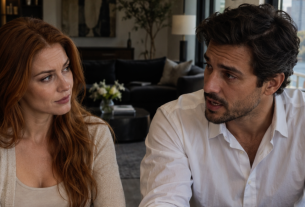
Alexei turned away from the monitor and looked at his wife. In her eyes, he saw exactly what he felt himself: savage exhaustion and anger. They were not angry with each other. They were angry at their circumstances.
“You know, today I remembered the time Dad asked me to register him on some website,” Alexei said suddenly, smiling as he tried to lighten the mood. “It was before he got sick.”
“Really? What happened?” Zhanna replied with a faint smile.
“Well, I was sitting there filling out the forms. I asked him, ‘Dad, let’s come up with a password. What should we use so you’ll remember it?’ He frowned, looked at me with this completely serious expression, and said, ‘Write this: idiot-2005-12-25.’
“I nearly fell off my chair. I asked, ‘Dad, why are you insulting yourself? Or is that supposed to be a message for me?’
“He waved his hand and grumbled, ‘Just write it. It’s so I won’t forget. You were born on that date. And “idiot” is there to remind me what I am, since I forgot the password to my old account and made my son create a new one.’”
“Your father knew how to joke with a perfectly straight face,” Zhanna chuckled. “December twenty-fifth. That’s right—your birthday.”
Their laughter quickly faded.
Ivan Petrovich had passed away quietly in his sleep three days earlier. The funeral was tomorrow.
And that meant Alexei would have to face the person he dreaded seeing most.
Not because he was afraid of her, but because she disgusted him.
Part 2. The Sorrowful Earth
The wind at the cemetery was piercing but dry. The trees stood bare like skeletons, stretching their branches toward the gray sky.
Only a small number of people had gathered: Alexei, Zhanna, Zhanna’s parents, a couple of neighbors, and several of his father’s former colleagues.
Everyone stood silently, staring at the fresh mound of earth covered with funeral wreaths. Zhanna held tightly onto her husband’s arm, feeling how tense his muscles were.
She knew whom he was waiting for.
That person did not keep them waiting for long.
A taxi pulled up to the cemetery gates. A woman stepped out wearing a black coat that looked expensive only until one examined the quality of the fabric. Her high heels sank into the dirt path, but she walked confidently, as though she were striding down a runway.
Marina.
Alexei’s older sister.
She had not visited their father for the past three years. Not a single phone call or message. Even when Alexei wrote to tell her that their father was dying and that they needed money for his medication, his messages were marked as read but remained unanswered.
Marina approached the grave, dramatically removed her dark glasses, and dabbed her completely dry eyes with a handkerchief.
“Well, that’s it,” she announced loudly, breaking the silence. “Dad’s suffering is finally over.”
Alexei clenched his teeth so tightly that the muscles in his jaw began to twitch. He did not want to cause a scene beside his father’s fresh grave.
Marina, however, did not appear to share his sense of respect.
The memorial gathering was held at a small café nearby. As it drew to a close and the guests began to leave, Marina approached her brother.
Zhanna stood beside him with her arms crossed over her chest.
“Lyosha, we need to talk.” Marina lit a slim cigarette and deliberately blew the smoke in Zhanna’s direction. “What’s happening with the apartment?”
“What apartment?” Alexei gave his sister a heavy stare. “We just buried our father. Do you have no conscience?”
“You can’t put your conscience in your pocket,” Marina scoffed. “I know Dad owned a two-bedroom apartment. I also know that I’m a first-priority heir, just like you. So let’s not create unnecessary drama. We divide it in half and go our separate ways. I need the money. I have a business project that’s in trouble.”
Zhanna saw that familiar cold fire ignite in her husband’s eyes—the kind that frightened even her.
It was not impulsive rage.
It was concentrated fury.
“Where were you for the past ten years? And now you’re demanding a share?” Alexei stared at his sister and could barely recognize her. Her facial features were the same, but her expression looked foreign and predatory. “When we were buying medicine, when I spent nights sitting beside his bed, where was your business project then?”
“Don’t try to make me feel guilty,” Marina said dismissively. “That was your choice. I was living my own life. Yes, our parents helped me once, but that was a long time ago. Now the law is the law. We wait six months, claim the inheritance, sell the apartment, and divide the money. Simple.”
She turned around, threw her cigarette butt into a bin, and headed toward the exit.
“I’ll call you in six months, little brother. Have the documents ready.”
“Marina!” Alexei called after her.
She turned around.
“The country house,” he said.
“What about the country house?” Her eyebrows rose.
“Have you forgotten about it?”
“That was a long time ago, and it didn’t happen the way you remember! Besides, it was a gift!” she shouted before quickly disappearing through the door.
Alexei remained standing there, watching her leave.
“She won’t get a single penny,” Zhanna said quietly. “I promise you. We are not going to be victims.”
“No, we aren’t.” Alexei nodded. “I know what to do.”
Part 3. An Apartment with a History
A week later, they went to their father’s apartment to begin sorting through his belongings.
The smell of medicine still lingered in the air, mixed with the scent of old books. It was a solidly built Stalin-era apartment with high ceilings. It needed renovations, but the construction itself was sound.
Zhanna was sorting through documents in an old writing desk.
“Lyosha, come here,” she called.
Alexei approached her. His wife was holding a folder filled with yellowed papers.
“Look. The sale agreement for the country house. It’s dated 2010. And the amount…” Zhanna gave a low whistle. “That was a very substantial sum at the time. There’s also a written receipt.”
“A receipt?”
“Yes. It says: ‘I, Marina Ivanovna, have received from my parents the full amount obtained from the sale of the country property as an advance payment of my share of the inheritance, and I will make no further claims in the future.’”
Alexei took the sheet of paper.
It was his sister’s handwriting.
“They sold the country house to pay off her debts after her first shop failed,” Alexei recalled. “Dad told her, ‘Marinka, consider this your dowry. We have nothing else except the apartment, and the apartment will go to Lyosha.’ She agreed. She swore she would never ask us for anything else.”
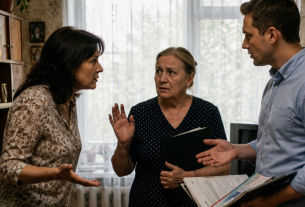
“Legally, this receipt is worthless to a notary unless there’s a will stating the same thing,” Zhanna observed. She worked with contracts and understood bureaucracy. “If your father didn’t leave a will, Marina is legally entitled to half of the apartment. The receipt only demonstrates what kind of person she is.”
“There was a will.” Alexei frowned. “Dad said he had written one in my favor.”
“A will can be challenged. She’ll claim that your father was sick, mentally incapacitated, and under the influence of medication. The legal proceedings could drag on for years. We need to take stronger action.”
Zhanna walked across the room. Her expression hardened.
She was no longer the exhausted woman who spent all day answering phone calls. The strategist inside her had awakened.
“Listen to me,” she said. “We aren’t going to wait for her to sue us. We’re going to use her own weapon against her—greed. Your father signed the apartment over to you as a gift one month before his death, remember? He did it when he realized he was dying. We simply didn’t have time to register the transfer of ownership before the funeral because we had more important things to deal with. But we have all the documents.”
“So what? The deed of gift is valid. I’m the owner.”
“Yes, but Marina doesn’t know that. She thinks she’ll be dividing an inheritance. We’ll be smarter than she is. You register your ownership now and become the apartment’s legal owner. Then…” Zhanna paused, and a predatory smile touched her lips. “Then you give the apartment to Dasha.”
“To our daughter?”
“Exactly. The apartment becomes the property of a minor. The guardianship authorities would fight tooth and nail before allowing anyone to sell or exchange the property if it worsened the child’s living conditions. But that isn’t even the most important part. The most important thing is the effect it will have.”
Alexei looked at his wife with admiration.
“You want to lure her into a trap?”
“I want to punish her for her betrayal. She abandoned your father. She took everything she could from your parents ten years ago. Then she came to his funeral looking for money. We aren’t going to defend ourselves or make excuses. We’re going to attack.”
Part 4. The City Café
The next six months passed slowly.
Alexei and Zhanna made cosmetic repairs to his father’s apartment and moved their belongings into it. Dasha began attending a new kindergarten nearby. The hole in their finances gradually started to close, and Alexei continued receiving a steady stream of work.
Marina did not appear.
She was waiting.
She was certain that time was working in her favor.
Exactly six months and one day later, the phone rang.
“Well, little brother, it’s time to divide the pie,” Marina said cheerfully over the phone. “I’m coming today. Be at home. I remember the address.”
“Come,” Alexei replied curtly.
They did not meet at home. Instead, they met at a nearby café. Zhanna had insisted that the conversation begin on neutral territory so that Dasha would not be frightened if anyone started shouting.
Marina entered and looked around the establishment with contempt. Over the past six months, she had grown thinner, and dark shadows had appeared beneath her eyes, but she had lost none of her arrogance.
“Did you bring the documents?” she asked, sitting down without greeting them.
“I brought the calculations.” Alexei placed a tablet in front of her.
“What calculations? I want half of the apartment’s market value. I checked. It’s currently worth around ten million. Five million belongs to me. Hand it over, and I’ll disappear.”
“Not so fast,” Zhanna interrupted. “Let’s do the math. Ten years ago, your parents sold the country house for three million. That was an enormous amount of money at the time. The dollar exchange rate was about thirty rubles. Today, that money would be equivalent to a very different sum.”
“What does the country house have to do with this?” Marina shrieked.
“It has everything to do with this because you took your share of the inheritance in advance,” Alexei continued calmly. “I calculated the bank interest that would have accumulated on half of that amount over ten years. Had the money been kept in a deposit account, even at a modest interest rate, it would now more than cover the value of your supposed share of the apartment. You owe us money, Marina. We don’t owe you anything.”
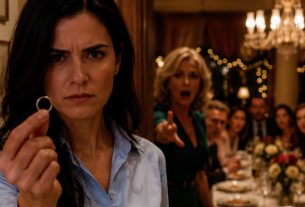
“Are you both insane?” Marina jumped to her feet. “I don’t care about your calculations! I’m going to a notary, I’m submitting my inheritance claim, and then we’re going to court! I’ll sue you for half the apartment, and if you refuse to buy me out, I’ll sell my share to a family of Gypsies!”
“Sit down,” Zhanna said quietly but authoritatively.
Obeying some inexplicable force in her sister-in-law’s voice, Marina dropped back into her chair.
“You aren’t going to the notary because there is nothing to divide.”
Zhanna took a copy of an extract from the Unified State Register of Real Estate out of her handbag.
Part 5. Their Father’s Apartment
The conversation did not end at the café.
In a state of agitation, Marina demanded that they take her to the apartment so she could confirm that they were living there and continue the argument inside.
Alexei agreed.
He wanted everything to end in the same place where it had begun.
They stood in the entrance hall of the apartment. Marina paced back and forth like a trapped animal.
“You had no right! It’s part of the inheritance!”
“It isn’t an inheritance,” Alexei said sharply. “Dad gave me this apartment while he was still alive. He knew you would come. He knew what kind of person you were, and he protected us.”
“A deed of gift?” Marina turned pale. “You forged it! He was sick!”
“He was of sound mind, and there is a video recording of the notarization in which a doctor confirms that he was mentally competent,” Alexei lied about the video, but his words sounded convincing. The notary really had been extremely thorough. “But that isn’t all.”
Zhanna stepped forward.
Her eyes burned with cold triumph. She was no longer afraid. The humiliation they had endured for years, their fear for the future, and her sister-in-law’s shameless behavior had all been transformed into pure energy for revenge.
“The apartment does not belong to Alexei,” Zhanna said, pronouncing every word distinctly.
“What?” Marina froze.
“Alexei registered the apartment in his name under the deed of gift. Then he immediately transferred it as a gift to our daughter, Darya—your niece.”
Zhanna handed her the document.
“The owner of the apartment is a minor. You can’t sue a child. You can’t reverse a chain of transactions based on the lawful decisions of the property owner. The transaction is clean. The apartment belongs to Dasha.”
The news hit Marina like a physical blow.
She stared at the documents as the meaning of what she was reading slowly sank into her mind.
“But…I need the money,” she whispered.
The mask of the successful businesswoman cracked and fell away, revealing the pitiful face of a frightened, aging woman.
“You don’t understand. I got divorced. The apartment belonged to my husband. My business failed. I have nothing. I’m living at a friend’s place, and she could throw me out at any moment. I was counting on this money. I’m…I’m your sister!”
Alexei and Zhanna remained silent.
They sat in the kitchen and watched her performance.
Did they feel sorry for her?
No.
They felt only a sense of completion.
“You received your share ten years ago,” Alexei said. “You wasted everything. You abandoned our parents. You didn’t come when Dad was dying. You thought we were fools you could keep squeezing money out of.”
“Lyosha, I have nowhere to live!” Marina wailed, dropping to her knees. “Lyoshka, you’re my brother!”
“Did we have somewhere to live when we were moving from one rented dump to another with a newborn baby?” Zhanna stepped toward her. “Get up. Stop humiliating yourself.”
Marina looked up at them, her eyes filled with tears and hatred.
“Damn you both!” she hissed as she rose to her feet. “I hope you choke on your precious concrete!”
“Close the door behind you,” Alexei said calmly.
Marina ran out of the apartment.
A moment later, they heard the entrance door to the building slam shut.
She had been completely defeated. She had been certain that she could appeal to their sympathy or frighten them with the threat of a lawsuit, but instead she had encountered a wall of cold calculation and fierce self-protection.
She had not expected anger.
She had expected obedience from her “little brother.”
Alexei walked over to the window but did not look down. Instead, he turned toward his wife.
“You were magnificent.”
“We are a family,” Zhanna said simply. “She is nothing more than a random fellow traveler from our past.”