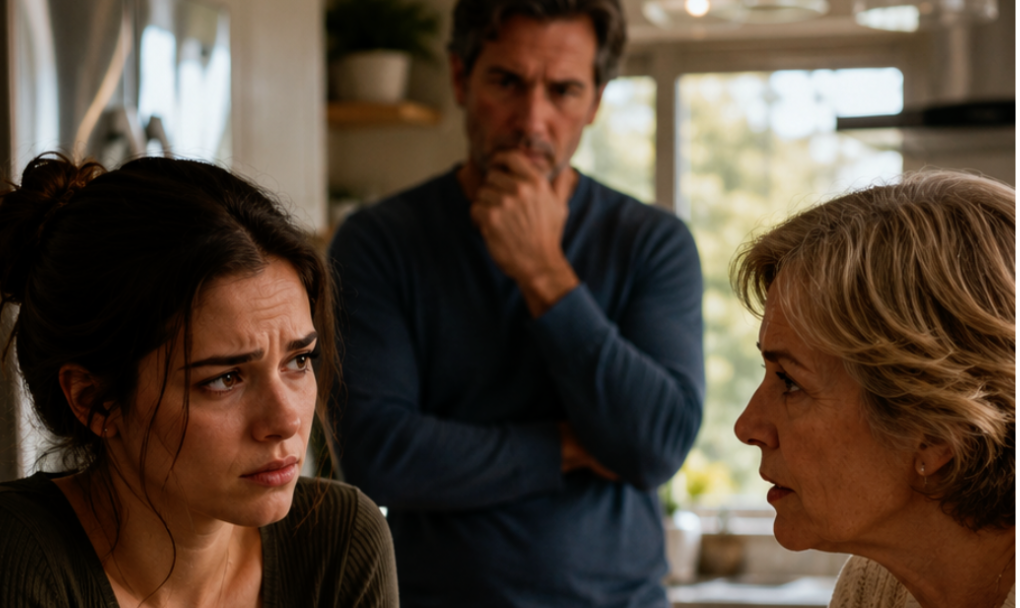
— Nina, hand over the keys to the dacha. The relatives have already decided to go there for the May holidays, — her mother-in-law ordered.
Nina had not even managed to take the bag off her shoulder. She stood in the hallway in a light jacket, a grocery bag in her hand, and looked at Valentina Sergeyevna as if the woman had suddenly started speaking a foreign language.
The day had already been difficult enough. In the morning Nina had gone to the service center to pick up the car, then stopped by her aunt’s place, then went to the hardware store for paint for the fence at the dacha, and then still managed to pick up an order with new hinges for the gate. She came home with one simple thought: to change clothes, eat, and finally sit down for at least ten minutes.
But her mother-in-law was waiting for her in the apartment.
Not her husband Pavel, not an ordinary note on the fridge, not a calm evening. Valentina Sergeyevna was sitting in their kitchen in her dark-blue coat, which she had not even taken off, and carried herself so confidently as if she had come not as a guest, but to an appointment in an office where everything had already been decided in advance.
“Hello, Valentina Sergeyevna,” Nina said, slowly walking into the kitchen. “Have you been here long?”
“Long enough,” her mother-in-law answered curtly. “Pavel opened the door and ran off on errands. I didn’t wait for him. I’ll settle it faster with you.”
Nina put the bag on the countertop, took off her jacket, and hung it on a hook in the hallway. She came back and only then noticed that there was already a sheet of paper on the table with some surnames, notes, and dates. Next to it lay a pen, her mother-in-law’s phone, and a small notebook.
Valentina Sergeyevna did not ask whether Nina was tired. She did not ask how things were going. She did not even pretend that she had come to talk calmly.
She was immediately looking at the bunch of keys sticking out of the side pocket of Nina’s bag.
“What keys?” Nina clarified, although she understood perfectly well.
“The keys to the dacha,” her mother-in-law raised her eyebrows. “Not to the mailbox, obviously.”
Nina silently took the package of hinges out of the bag and put it away in the cupboard. Her fingers moved carefully, but a little more slowly than usual. She did not want to answer right away. In moments like this, a sharp response often gave the other person an advantage. And that was exactly what Valentina Sergeyevna was waiting for: for her daughter-in-law to flare up, say too much, and then be accused of rudeness.
“For what purpose?” Nina asked.
Her mother-in-law gave a short laugh, as if the question were stupid.
“I already told you. The relatives have decided to go there for the May holidays. Sveta’s children have been asking to get some fresh air for a long time. Artyom and Lida also want to get away. Their apartment is small; they’re all cramped there. Pavel’s aunt also wanted to come, but she is still thinking about it. In short, there are many people, and everything needs to be prepared in advance.”
Nina slowly turned toward her.
“Sveta is your daughter, Artyom is Pavel’s brother, Lida is his wife. And what does Pavel’s aunt have to do with my dacha?”
Valentina Sergeyevna glanced at the sheet of paper for a second.
“Don’t start. The dacha is empty anyway.”
“It is not empty,” Nina replied calmly. “I go there.”
“To look at the grass for a couple of hours?” her mother-in-law waved her hand. “That doesn’t count. Normal people go to a dacha with family, with children, with a grill, with overnight stays. And you wander around there alone as if you’re guarding a museum.”
Nina smiled without amusement.
“Well said. I am guarding it.”
Valentina Sergeyevna did not catch the warning in her voice. Or pretended not to.
“So there’s no need to guard it from your own people. The weather will be good for the May holidays anyway. We’ve already divided up who is bringing what. Sveta will buy meat, Artyom will bring folding chairs, I’ll bring grains, canned food, and vegetables. Fresh air is good for children. You have two rooms there, a veranda, a kitchen. There will be enough space for everyone.”
“For everyone — meaning whom?”
Her mother-in-law readily looked at the paper.
“Me, Sveta with her two children, Artyom with Lida and their youngest. Pavel too, of course, if he doesn’t dig his heels in. And you, if you want. Although it will probably be more convenient for you to stay home.”
Nina gave her a brief look.
“So a guest list, menu, and sleeping arrangements have already been made for my dacha. And I’ve been included as an optional attachment?”
“Nina, don’t pick at words. You are an adult woman; you should understand that relatives need help.”
“Helping is when people ask. Not when they order you to hand over the keys.”
Valentina Sergeyevna straightened. Her face immediately hardened, her chin rose, and her fingers closed around the pen so tightly that her knuckles turned white.
“Don’t dramatize. Nobody is taking your dacha away from you. Just for a few days. From Friday to Tuesday.”
“From Friday to Tuesday,” Nina repeated. “And I’m finding out about it on Wednesday evening.”
“Because you complicate everything,” her mother-in-law tapped the pen on the paper. “First you have to talk to you, then wait a week for an answer, then it turns out that you need to think about it. And the May holidays are already almost here. We decided ourselves.”
Nina sat down across from her. Not because she was tired. It was just clear that this conversation was not going to be short.
The dacha stood in a settlement near the river. A small house with a solid roof, a narrow kitchen, two rooms, and a shed, which Nina had finally cleared of old junk last summer. The house had belonged to her grandmother, and after her grandmother died, Nina had inherited it after the required six months. The documents were in her name. The land was too.
Pavel had nothing to do with that dacha. He had been there several times: he had helped mow the grass, once fixed the gutter, and a couple of times grilled shashlik. That was all. He had not paid for its purchase, inheritance, paperwork, taxes, or repairs.
But Valentina Sergeyevna had an amazing ability to turn other people’s things into common property whenever it suited her.
At first she called the dacha “yours,” meaning both Nina’s and Pavel’s. Then “Pavel’s too.” Then one day, in front of Sveta, she let slip:
“The kids now have a place to take the children in summer.”
Nina had kept silent then because she had not wanted to spoil the family dinner. After the guests left, Pavel said:
“Mom just said that without thinking. Don’t pay attention.”
Back then, Nina still believed him.
Then Sveta sent a message: “Nina, can I come to your dacha with the kids for a couple of days in July? Pavel said it’s nice there.”
Nina replied politely: “I’ll be there myself in July. We’ll see after that.”
After that came a pause. Unpleasant, dense, full of hints. Whenever they met, her mother-in-law would say that the children were “withering in the city,” then mention that “good people don’t let dachas sit empty,” then sigh that “nowadays relatives are worse than strangers.”
Nina heard it all. She remembered it. But she had not yet drawn the boundary because nobody had tried to take the keys by force.
And now Valentina Sergeyevna was sitting in her kitchen with a detailed plan for occupying the May holidays.
“Does Pavel know?” Nina asked.
Her mother-in-law shrugged.
“Pavel is a soft man. He did say, of course, that it should be discussed with you. But I explained to him that there was nothing to discuss. The relatives aren’t asking to stay for a year.”
“Did he promise you the keys?”
“He said the keys were with you.”
“I’m asking something else. Did he promise you that I would give them to you?”
Her mother-in-law was silent for a moment. Annoyance flashed across her face.
“He said he would talk to you.”
“So he didn’t promise.”
“Nina, don’t conduct an interrogation. I’m not a little girl who has to report to you.”
“And I’m not a storeroom clerk who hands out keys according to your list.”
Valentina Sergeyevna inhaled sharply through her nose. Her gaze slid over the kitchen, the bag with the hinges, Nina’s purse, and the bunch of keys. She had clearly expected a different conversation: she had come, demanded, taken, and left victorious.
“Do you want to show your character again?” she asked more quietly. “In front of whom? Me? Pavel? Sveta’s children?”
“I want to understand at what point my property became a place people could reserve without my permission.”
“Property, property,” her mother-in-law mocked. “What big words you use now. People used to be simpler.”
“People used to understand where their own ended and someone else’s began.”
“Someone else’s?” Valentina Sergeyevna leaned forward slightly. “This is your husband’s family.”
“Exactly. My husband’s family. Not the owners of my dacha.”
For several seconds her mother-in-law looked at Nina as if trying to find a crack in her face. But Nina sat upright. She did not smile. She did not justify herself. She did not fuss.
Valentina Sergeyevna changed her tone.
“Nina, why are you so prickly? It would be good for the children. They spend the whole year within four walls. Sveta is raising two children alone; she needs a break too. Artyom and Lida haven’t gone anywhere in ages. I thought you would understand.”
“I can understand many things. But I still won’t give you the keys.”
“Why?”
“Because nobody asked me. Because there are more people than the house can comfortably take. Because there are no conditions there for a crowd. Because I’m preparing the plot for work, and I don’t need other people’s children near tools, a drainage pit, and an old well. Because I will be responsible for the order afterward. Because if someone breaks something, you will say, ‘They’re children.’ And if someone gets hurt, I will be the one blamed.”
Her mother-in-law waved it off.
“Oh Lord, what could possibly happen there? Children have been running around dachas all their lives.”
“On other people’s plots without the owners’ consent?”
“There you go again.”
Nina slowly stood up and took a glass from the cupboard. She poured water and took several sips. Her face remained calm, but red spots appeared on her cheekbones. She returned to the table.
“Valentina Sergeyevna, you are not asking right now. You have already decided everything. You even assigned the food. You came here not to negotiate, but to take.”
“Because there is no other way with you!” her mother-in-law snapped. “If people let you have your way, you’ll put everyone in their corners and sit alone at your dacha like a guard. Pavel got married, he has a family now, and you keep dividing everything: mine, yours, don’t touch, don’t go there. Marriages aren’t built that way.”
“My marriage is not built on distributing my property among relatives.”
“What a grand phrase! Property! It’s an old little house, a grassy plot, and a shed.”
“Then why is everyone so eager to go there for the May holidays?”
Her mother-in-law pressed her lips together, but immediately spoke again, now more harshly:
“Because people need rest. And you’re being stingy.”
“Yes. I am stingy with my dacha when it comes to people who believe they can dispose of it over my head.”
At that moment, a key turned in the lock. Pavel entered the apartment. He froze in the hallway when he saw his mother and wife at the table. His face made it clear that he had hoped the conversation would somehow end on its own. But the tension hanging in the kitchen was so thick that even he understood — it had not ended.
“Oh, have you already talked?” he asked uncertainly.
Nina turned her head.
“We have. Your mother is demanding the keys to my dacha because the whole family has already decided to go there for the May holidays. Did you know about this?”
Pavel took off his jacket too slowly, as if every hook had suddenly become a complicated task.
“Mom said she wanted to discuss it…”
“Not discuss it,” Nina interrupted. “Take the keys.”
Valentina Sergeyevna instantly perked up.
“Pavel, explain it properly to your wife. I’m telling her there is nothing terrible about it. Big deal — relatives will rest for a few days. And she is acting as if we came to crack open her safe.”
Pavel walked into the kitchen and stopped in the doorway. If he sat down, it would look like involvement. He remained standing, as if hoping to escape.
“Nina, well, maybe really… for a couple of days?” he began cautiously. “I understand that it’s your dacha, but Mom has already told everyone. It will look bad.”
Nina slowly turned fully toward her husband.
“Bad in front of whom?”
“Well… in front of Sveta, Artyom.”
“And did it look good in front of me?”
Pavel rubbed the bridge of his nose.
“Don’t get worked up. It’s just the May holidays. Everyone wants to relax.”
“I’m not getting worked up. I’m asking. Did you know that your mother had announced my dacha as a vacation spot for the entire family?”
“I didn’t think she had already told everyone.”
“But there was a conversation.”
He said nothing.
Nina looked at her husband attentively. Without shouting. Without tears. And that clearly made Pavel even more uncomfortable.
“Pavel, did you yourself offer them my dacha?”
“No.”
“Did you say I would give them the keys?”
“No. I said I would ask.”
“Then why didn’t you ask?”
“Because…” He exhaled. “Because I knew you would refuse.”
“So you knew my answer, but allowed your mother to come here and demand the keys?”
Valentina Sergeyevna clicked the pen loudly.
“Stop scolding him! That’s not how you treat a husband.”
“I’m not scolding him. I’m figuring out how my property ended up in someone else’s schedule.”
“Why do you keep repeating that!” her mother-in-law slapped her palm on the table. The sheet with the names trembled. “Pavel is your husband! That means the dacha isn’t foreign to him.”
“For him, it is a place he can come to with me by agreement. Not an object he can hand over to his relatives.”
“He has the right to invite his mother!”
“To invite his mother to my home, to my dacha, without my consent? No, he does not.”
Pavel frowned.
“Nina, you’re speaking as if I’m a complete stranger.”
“And you are behaving as if I have to prove my right to manage what belongs to me.”
He opened his mouth, but found no answer.
Valentina Sergeyevna stood up. Her fingers quickly gathered the sheet, then spread it out again, as if she could not decide whether to leave or continue pressing.
“Fine,” she said. “Let’s do it differently. You give me the keys, I’ll go tomorrow, check everything, air the place out, tidy up. The relatives will arrive on Friday. You don’t have to take part. We’ll handle it ourselves.”
Nina even smiled slightly.
“Do you really think that after all this, I will give you the keys?”
“I think you won’t disgrace Pavel in front of his relatives.”
“Pavel can deal with his own disgrace himself.”
Pavel sharply raised his eyes.
“Nina!”
“What?” She looked at him calmly. “Did I invite your mother here for the keys? Did I promise Sveta a vacation? Did I tell Artyom to collect chairs? Did I make this list?”
He clenched his jaw.
“No.”
“Then why should I be responsible?”
Valentina Sergeyevna turned to her son.
“Do you hear how she speaks to you? Humiliating you in front of everyone.”
“There is no everyone here,” Nina noted. “There is you, me, and Pavel.”
“Enough!” her mother-in-law jabbed a finger toward the bag. “Give me the keys. Then argue as much as you want.”
Nina took the bag, pulled out the bunch of keys, and placed it in her palm. There were three keys on the ring: to the gate, to the house, and to the shed. Her mother-in-law immediately leaned forward. Relief, almost triumph, flashed in her eyes. She had already decided that she had won.
Pavel also exhaled, as if the most unpleasant part of the conversation was over.
Nina looked at the keys, then at Valentina Sergeyevna.
“These?”
“Yes,” her mother-in-law said quickly. “Give them here.”
Nina closed her fist around the bunch and put it in the pocket of her house trousers.
Her mother-in-law blinked.
“What are you doing?”
“Putting away my keys.”
“Nina, don’t play with my nerves.”
“I’m not playing. I’m ending the discussion.”
Valentina Sergeyevna stood up so sharply that the chair scraped across the floor.
“Do you understand that I have already told people?”
“I understand.”
“Sveta promised the children!”
“Then Sveta will have to explain to the children that adults ask for permission first and make promises afterward.”
“Artyom bought groceries!”
“Let him cook them at home or take them somewhere he is expected.”
“Pavel’s aunt packed her things!”
“Let her unpack.”
Her mother-in-law stared at Nina in open bewilderment. The confidence on her face began to crumble in small pieces. She was clearly used to people giving in after she listed inconveniences. Used to other people’s awkwardness working like a key. Used to saying “children,” “family,” “it’s inconvenient,” “we already promised” — and having the person retreat.
Nina did not retreat.
Pavel finally sat down. His face had turned gray from exhaustion and shame. He understood that the conversation had gone somewhere from which it could no longer be pulled back with his usual “come on, we’ll sort it out later.”
“Nina,” he said dully, “maybe we could at least give them one day? Without staying overnight?”
“No.”
“Why so categorical?”
“Because if I agree to one day now after being ordered, next time they won’t come to me for keys — they’ll come with suitcases.”
Valentina Sergeyevna flared up.
“Nobody will come with suitcases!”
“You were just planning to go there for five days with overnight stays.”
“That is different.”
“No. That is exactly the same thing.”
Her mother-in-law grabbed her phone. She quickly opened the screen, wrote a message to someone, then looked at Nina again.
“Fine. Then I’ll call Sveta right now, and you can explain to her yourself why her children will be sitting at home because of your greed.”
“Call her. But put it on speaker. I’ll explain.”
Pavel raised his head.
“Nina, don’t.”
“Yes, Pavel. I should. Very much so. Because everything was already decided behind my back. Let them hear it directly now.”
Valentina Sergeyevna had not expected consent. Her finger hovered over the screen. For several seconds she sat motionless. Then she irritably locked the phone.
“Oh, please. As if I’m going to let you lecture Sveta.”
“Then don’t hide behind Sveta.”
Her mother-in-law abruptly put the phone into her bag.
“You have always had your own agenda. I saw it from the first day. You smile, you speak calmly, but inside you count everything: who ate how much, who sat where, who touched what.”
“I only count what concerns my money, my labor, and my property.”
“There! You said it yourself. She counts. Normal women create warmth.”
“Warmth is not created at the expense of someone else’s keys.”
Pavel said quietly:
“Mom, enough.”
Valentina Sergeyevna turned to him so quickly that her earring swung near her cheek.
“What do you mean enough? Are you afraid of your wife? Can’t you say that your mother asked for a normal thing?”
“You didn’t ask,” Pavel said. “You really did come to demand.”
His mother froze.
For the first time that evening, Nina looked at her husband with slight surprise. Not gratitude — no, they were far from gratitude. But Pavel had at least stopped hiding behind other people’s words.
“Pavel,” Valentina Sergeyevna’s voice became lower, “whose side are you on right now?”
“The side of common sense.”
“So common sense now has Nina’s face?”
“Mom.”
“No, answer me! I didn’t raise you so you could shuffle around in front of your wife and throw your mother out the door.”
Nina raised her hand.
“No one has thrown you out the door yet. But if you continue demanding the keys to my dacha, the conversation will end exactly that way.”
Her mother-in-law lifted her chin.
“You’ll throw me out?”
“Yes.”
Pavel sharply looked at Nina.
“Nina…”
“Yes, Pavel. If a person comes into my home and demands the keys to my property, I have the right to ask them to leave. If they don’t leave, I can call the police. I hope it won’t come to that.”
Valentina Sergeyevna turned pale with indignation. Spots appeared on her face, and her hand trembled when she reached for her bag.
“The police on your husband’s mother? Excellent. Now everything is clear.”
“Not on my husband’s mother. On a person who refuses to leave the apartment after the owners ask. But for now, I am asking calmly.”
“Is the apartment yours too?” her mother-in-law threw out sarcastically.
“It is ours, Pavel’s and mine, bought during the marriage. And that is exactly why I am not saying you have no right to cross the threshold. But the dacha is my inherited real estate. It is not divisible. It does not become common-use property just because your son finds it awkward to refuse his relatives.”
Pavel lowered his eyes.
Valentina Sergeyevna did not immediately find an answer. She did not like legal words. They interfered with her favorite game, where everything was decided through pressure, offense, and a loud voice.
“You say it like that on purpose, to humiliate me,” she finally said.
“I say it precisely so there is no confusion.”
“You create the confusion yourself. You should have warned us before the wedding that everything of yours is separate.”
Nina slowly smiled.
“Before the wedding, I did not think that several years later someone would come to me demanding that I hand over my dacha for the May holidays to my brother-in-law, sister-in-law, their children, and my husband’s aunt.”
Pavel ran a hand over his face.
“Nina, tomorrow I’ll tell everyone myself.”
“No,” Nina said. “Today.”
He raised his eyes.
“What?”
“Today you write in the family group chat that there will be no trip to my dacha because nobody received my consent. No phrases like ‘Nina changed her mind,’ ‘Nina didn’t allow it,’ or ‘Nina is being difficult.’ Honestly: the decision was made without the owner, so it is canceled.”
Valentina Sergeyevna suddenly laughed. The laugh came out short and unpleasant.
“Are you going to dictate the text to him too?”
“Yes. Because that is how there won’t be a new version later where I suddenly became guilty for other people’s fantasies.”
Pavel was silent.
Nina looked at him.
“Pavel, choose. Either you honestly fix right now what you allowed through your silence, or tomorrow I will write to Sveta and Artyom myself. Only I will no longer soften anything.”
His mother-in-law snapped first.
“You won’t write anything!”
“I will.”
“Don’t you dare drag Sveta into this!”
“Sveta has already been dragged in. She was promised my dacha.”
“You’re cruel.”
“No. I’m precise.”
A dense pause hung in the kitchen for several seconds. Outside the window, a car passed; the light from its headlights slid across the ceiling and disappeared. Pavel took out his phone. Valentina Sergeyevna immediately stepped toward him.
“Don’t even think about it.”
He raised his eyes to her.
“Mom, you should have asked Nina first.”
“You’ll let the family down because of her?”
“I’m the one to blame for not stopping you in time.”
His mother-in-law recoiled as if she had heard an insult. Her eyes shone, but not from weakness — from anger.
“So that’s how it is. Your mother is the one to blame.”
“Yes,” Pavel said quietly. “And so am I.”
Nina added nothing. An extra word right now would only spoil the moment. Pavel opened the family chat and began typing. Nina saw how slowly his fingers moved. He erased, typed again, erased again.
“Show me,” she said.
He handed her the phone.
On the screen was written: “The dacha won’t work out for the May holidays. Nina and I decided to postpone.”
“No,” Nina said. “That’s not true.”
Pavel exhaled tiredly.
“Nina…”
“Write honestly.”
He took the phone back. Valentina Sergeyevna stood nearby, clutching the handles of her bag with both hands.
A minute later, Pavel showed the screen again.
“Family, about the May holidays. There will be no trip to the dacha. I did not coordinate this with Nina in advance, although the dacha belongs to her. So please do not plan to go there. Sorry I didn’t say it directly right away.”
Nina read it twice.
“Send it.”
Pavel pressed the button.
The phone began vibrating almost immediately. One message. A second. A third.
Valentina Sergeyevna grabbed her own phone and saw the chat too. Her face changed. Now there was not only anger in it, but confusion as well. The scheme she had built was collapsing before her eyes. The relatives were already asking what had happened, Sveta was writing: “What do you mean there won’t be? We told the children.” Artyom sent a brief: “Understood.”
Pavel did not answer.
“Answer Sveta,” Nina said.
“What?”
“Tell her children should not be promised someone else’s dacha without the owner’s consent.”
“That’s already rude.”
“Then write it more gently. But keep the meaning.”
Pavel typed: “Sveta, I did wrong by not stopping the conversation immediately. Nina did not give her consent. I’m sorry.”
Nina nodded.
Valentina Sergeyevna noisily shoved her phone into her bag.
“Are you satisfied?” she asked. “You got what you wanted? Now everyone knows what kind of person you are.”
“What kind?”
“Cold. Greedy. Counting every nail.”
Nina stood up. Now she and her mother-in-law were almost facing each other. Nina was shorter, but in that moment it did not matter.
“You know, Valentina Sergeyevna, I really do count every nail. Because I bought them myself. I replaced the boards on the porch, paid for the sand delivery, called a roofer, handled the documents, cleared the shed, hauled away the trash, treated my hands after nettles and paint. I remember where the ground on the plot sinks after rain. I know which step on the porch is weak. I know that there are tools in the shed that children must not go near. I know that more than four adults are uncomfortable sleeping in the house, and you planned to bring a crowd there. And after all that, you come to me not with a request, but with an order.”
Her mother-in-law opened her mouth, but Nina did not let her insert a word.
“You did not ask whether I could. You did not ask whether I wanted to. You did not ask whether it was safe for children there. You simply decided I would swallow it. Because I usually speak calmly. Well, a calm voice is not consent.”
Pavel looked at his wife as if he were hearing for the first time everything she had been storing up for more than one month.
Valentina Sergeyevna was silent for several seconds. Then she abruptly snatched the sheet from the table and folded it in half, but so nervously that the edge tore.
“I’m leaving,” she said.
“I’ll see you out,” Nina replied.
“You don’t need to see me out.”
“I do.”
Nina walked into the hallway. Valentina Sergeyevna put her bag on her shoulder, adjusted the collar of her coat, and turned to her son.
“Pavel, you will regret letting her speak to me like that.”
Pavel stood up.
“Mom, I’ll call you tomorrow.”
“Don’t bother. Rest at your precious dacha together. Just make sure there’s a place left for you there.”
Nina opened the front door.
“Goodbye, Valentina Sergeyevna.”
Her mother-in-law stopped on the threshold and looked back.
“You think you won?”
“I think the keys stayed with the owner.”
The phrase hit its mark. Valentina Sergeyevna’s nostrils flared, but she did not answer anymore. She stepped out onto the landing, and Nina closed the door.
The lock clicked.
Pavel remained in the kitchen. Nina did not return immediately. She stood by the door, checked the pocket where the keys lay, then walked to the table and put the package with the hinges into the cupboard.
“Nina,” Pavel said, “I really didn’t think it would go this far.”
“You thought I would give them the keys and everyone would be happy.”
He was silent.
“Pavel,” Nina turned to him, “I am not against your relatives. I am against being presented with a fait accompli. And against you staying silent when your mother finds it convenient to dispose of what is mine.”
“I understand.”
“No. You don’t yet. You will understand when next time you immediately say: ‘That is Nina’s, I don’t decide.’ Not after a scandal. Not when I’m already defending myself. Immediately.”
He nodded.
“I’ll say it.”
“And one more thing. Do you have a duplicate key to the dacha?”
Pavel raised his eyes.
“Yes. In the car.”
“Bring it.”
“Nina…”
“Bring it.”
He wanted to object, but changed his mind. He went into the hallway, took the car keys, and returned a few minutes later with a small bunch. It held copies of the gate key and the house key.
Nina held out her palm.
Pavel placed the keys in her hand.
“I wasn’t going to give them to Mom,” he said.
“Now you won’t be able to do it accidentally either.”
He smiled weakly, but immediately realized the joke was inappropriate.
“You don’t trust me?”
“Today — no.”
Those words were heavier than shouting. Pavel lowered his head.
Nina put the duplicate into the drawer with the documents and locked it with a small key. Then she took out her phone and wrote to her dacha neighbor, Yegor Stepanovich, who lived in the settlement permanently.
“Good evening. If anyone comes to my plot during the May holidays without me and says they were allowed in, don’t open. I gave no one permission.”
The reply came quickly:
“Understood, Nina. I’ll keep an eye on it. If anything happens, I’ll call.”
Nina showed Pavel the message.
“Just in case.”
He nodded.
“I understand.”
“Tomorrow I’ll go and change the cylinder on the door. No statements, no spectacle. I’ll just call a locksmith.”
“You think it’s necessary?”
“After today — yes.”
Pavel sat at the table and covered his face with his hands. Nina did not comfort him. There was no cruelty in that. It was just that an adult had to face the consequences of his softness himself when that softness turned into betrayal.
The next day Nina really did go to the dacha. The weather was clear, the road dry, and the fields along the highway were already turning green. Usually this trip calmed her. This time she drove focused, without music, with a locksmith who had agreed to come around lunchtime.
The house greeted her with the smell of wood, sunlight on the floor, and its familiar silence. Nina opened the windows, walked through the rooms, checked the locks, the shed, and the gate. Near the porch lay the new hinges for repair. Grass was already breaking through on the plot, and in the corner by the fence the buds on the old currant bush were swelling.
She stood in the middle of the yard and suddenly clearly understood why she had reacted so sharply the day before.
It was not only about the keys.
This dacha had been left to her by her grandmother, who had said all her life: “Hold on firmly to your own corner. Not because people are bad, but because someone else’s convenience quickly becomes your obligation.”
Nina used to think that was just old-age caution. Now she heard experience in those words.
The locksmith arrived on time. He changed the cylinder, checked how the key turned, and gave her two new copies. Nina paid him, wrote down his number in case of future repairs, and hid the old bunch separately. Then she called Pavel.
“I changed the lock.”
“Good,” he said quietly. “Mom called this morning.”
“And?”
“She said Sveta is offended. Artyom seems to have taken it calmly. Pavel’s aunt wasn’t even planning to go, apparently. Mom just added her to make it sound more impressive.”
Nina smiled.
“I’m not surprised.”
“I told Mom that I won’t discuss your dacha without you anymore.”
“And what did she say?”
“She said you turned me against her.”
“A convenient version.”
“Nina, I really am guilty.”
“Yes.”
He was silent for a moment.
“Will you come home tonight?”
“Of course. It’s my home too.”
“I thought you might stay at the dacha.”
“No, Pavel. I’m not leaving my home because of someone else’s insolence. I’m solving the problem where it arose.”
After those words, he was silent for a long time, then said:
“I understand.”
Nina put the phone away. She stayed on the plot for another hour: screwed one new hinge onto the gate, moved the old boards to the shed, and checked the water. Then she locked the house with the new key and looked at the door for several seconds. Now she was calmer.
That evening, when Nina returned to the apartment, Pavel met her in the hallway. He did not rush to hug her and did not make grand speeches. He simply took the heavy bag of tools from her.
“I made dinner,” he said. “No trick. Just dinner.”
“All right.”
Everything in the kitchen was neat. Plates, forks, and napkins lay on the table. Nina noted it automatically and almost smiled. For the first time in a long while, Pavel looked not like a person trying to slip between two women, but like a man who had finally understood that silence was also a choice.
They ate almost without talking. Then Pavel said himself:
“I removed Mom’s access to our spare apartment key. She doesn’t have one anyway, but sometimes she asked for it ‘just in case.’ I said there will be no more ‘just in case.’”
“That’s right.”
“And also. I wrote to Sveta separately. I explained that Mom had no right to promise. Sveta was offended at first, then said she understood. Artyom replied that they would figure something out themselves.”
“So they’ll survive the May holidays.”
Pavel smiled tiredly.
“They’ll survive.”
Nina looked at him carefully.
“Pavel, I do not want to fight with your mother. But if she comes again for my things, my keys, or my money, I will answer the same way. No discount for kinship.”
“I won’t give her a reason again.”
“Don’t promise loudly. Just do it.”
He nodded.
The conversation could have ended there. But of course, the story did not end right away.
Two days later, Valentina Sergeyevna still tried to approach from another angle. She called Nina herself. Nina saw the name on the screen and looked at it for several seconds, deciding whether to answer or not. Then she put it on speaker. Pavel was sitting nearby and heard everything.
“Nina,” her mother-in-law’s voice was dry, “I thought about it. Let’s not hold grudges. I don’t need the keys. But you could go with us yourself. Then everything would be under your supervision.”
Nina exchanged a glance with Pavel.
“No.”
“Why no right away? I’m making a concession.”
“You are not making a concession. You are trying to preserve the trip by changing the packaging.”
“What kind of person are you?” Valentina Sergeyevna could not hold back. “It’s impossible to come to an agreement with you.”
“It is possible to come to an agreement with me if you start before promising everyone everything.”
“So it’s absolutely no?”
“Absolutely.”
“Not even for one day?”
“No.”
“Can the children at least come and look?”
“Valentina Sergeyevna, my dacha is not a sightseeing attraction.”
Her mother-in-law exhaled loudly.
“Fine. Live as you know.”
“That is exactly what I’ll do.”
Nina ended the call. Pavel said nothing. And that was the right thing to do.
The May holidays arrived a few days later. On the morning of the first, Nina woke up early, made coffee, opened the kitchen window, and looked out into the yard for a long time. Outside, someone was already loading bags into a car, children were laughing, and neighbors were discussing the weather. The holiday bustle went on as usual.
Pavel came into the kitchen sleepy but calm.
“Shall we go to the dacha?” he asked.
Nina turned to him.
“We?”
“Yes. Just us. If you want. I’ll help with the gate and the grass.”
She studied his face for several seconds.
“We’ll go. But first we agree: we don’t pick anyone up on the way, we don’t send the address to anyone, and if your mother calls, you answer.”
“Agreed.”
They arrived around lunchtime. Nina opened the new lock, and Pavel noticed it, but said nothing. The plot was quiet. Yegor Stepanovich waved to them over the fence.
“All quiet, Nina! Nobody tried to break in.”
“Thank you, Yegor Stepanovich.”
Pavel mowed the grass near the gate; Nina worked on the porch. They worked without unnecessary conversations. Sometimes Pavel asked where to put a tool, and Nina answered. Everything was simple, almost peaceful.
Toward evening, Pavel’s mother called. He looked at the screen and turned on speaker only after glancing at Nina.
“Mom?”
“Well, are you satisfied?” Valentina Sergeyevna asked without greeting. “We’re sitting at home. Sveta went to a friend’s with the children, Artyom ran off fishing altogether. Everyone scattered. The holiday is ruined.”
Pavel looked at Nina, then answered:
“The holiday was not ruined because Nina didn’t give the keys. It was ruined because you promised everyone someone else’s dacha.”
“You’re taking her side again!”
“I’m taking the side of the truth.”
Angry breathing was heard on the other end.
“Fine. Enjoy yourselves.”
The call ended.
Pavel put the phone away.
“Before, I would have started making excuses,” he said.
“I know.”
“And now it’s actually easier.”
Nina nodded.
“Because the truth is usually shorter than excuses.”
They stayed at the dacha until evening, but did not spend the night. Nina locked the house, checked the gate, and put the keys in the inner pocket of her jacket. Pavel saw the gesture. And he was no longer offended. At least, he did not show it.
When they returned home, the entrance smelled of dust and wet asphalt. Nina went up to her floor and suddenly remembered that evening: Valentina Sergeyevna at the table, the sheet with names, the outstretched hand, the confident order.
Now it no longer weighed on her. On the contrary, something almost funny had appeared in that scene. A person had come for someone else’s keys so confidently, as if the world were obliged to adjust itself to her list.
And the world did not adjust.
The next day, Valentina Sergeyevna sent Pavel a short message: “I understand. I won’t ask again.”
Nina did not know whether that was true. Most likely, it was not. People like that rarely change after one refusal. They simply look for a new approach. But now Nina had the most important thing — a clear boundary spoken out loud. And a husband who, at least once, chose not to hide.
A week later, Sveta wrote to Nina herself.
“Nina, I didn’t know Mom hadn’t agreed it with you. She said you didn’t mind. I’m sorry.”
Nina did not answer right away. Then she typed:
“I understand. Next time, ask me directly. Then there won’t be awkward situations.”
Sveta sent: “All right.”
And that was enough.
Valentina Sergeyevna did not come over for a long time. Pavel visited her a few times himself, returned thoughtful, but did not drag Nina into those conversations. Once he said:
“Mom still thinks you acted too harshly.”
Nina placed the receipt for the delivery of materials for the dacha on the table and calmly replied:
“Harsh is coming into someone else’s home and ordering them to hand over the keys. I simply didn’t hand them over.”
Pavel looked at her and nodded.
“Yes. You’re right.”
Nina did not gloat. Victory in a family is rarely beautiful. More often, it looks like an unpleasant conversation after which you have to rearrange the chairs around one table again — not in the room, but in the relationship. Who sits where. Who is responsible for what. Who has the right to decide. Who no longer hides behind someone else’s pressure.
But this time Nina was satisfied that she had not given in.
Because if she had taken out the keys back then and placed them on the table, the May holidays would have been only the beginning. Then there would have been Sveta’s June weekends. Then a week for Artyom. Then a request to leave an old mattress “for the relatives.” Then a spare key “just in case.” Then someone else’s things in the shed. Then the phrase that Nina hardly ever went there anyway.
She saw that road in advance. And blocked it at the very beginning.
And it all began that evening when she came home, tired, with a grocery bag in her hand, and heard an order instead of a greeting.
“Nina, hand over the keys to the dacha. The relatives have already decided to go there for the May holidays.”
Back then, Valentina Sergeyevna walked into the kitchen and sat down at the table as if the matter had already been settled. She began listing who would go, who would bring what, where the children would sleep, what time it would be better to leave so they would not get stuck in traffic. She spoke confidently, quickly, with the tone of an owner, as if she were talking about her own dacha.
Nina listened silently. She did not interrupt. She only watched as her mother-in-law laid out other people’s plans for her plot on a sheet of paper.
Then Valentina Sergeyevna stretched her hand forward and repeated:
“Give me the keys. I still have to call Sveta.”
The room became so calm that even Pavel, standing by the entrance, stopped breathing loudly. Nina looked at her mother-in-law for several seconds. The woman was waiting for the bunch of keys to fall in front of her as confirmation of her power.
But Nina took out the keys, closed them in her palm, and calmly put them into her pocket.
“At what point did people start booking my dacha without my permission?” she asked.
Valentina Sergeyevna fell silent. The confidence left her face so quickly as if someone had turned off the light.
And at that very moment, it became clear: the May holidays would have to be planned somewhere else.