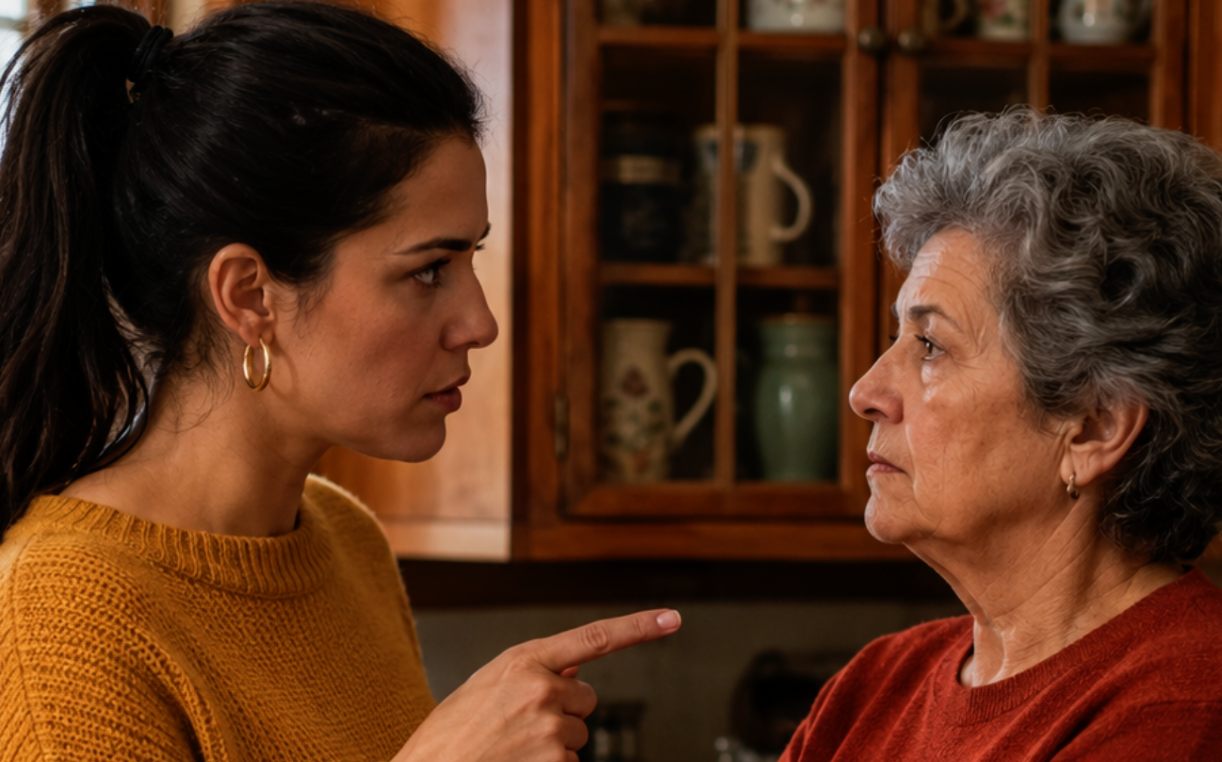
“Finally, you’ve shown up! Take your junk and get out of my son’s apartment!”
The mother-in-law’s voice rolled through the stairwell, bounced off the peeling walls, and came echoing back. Marina stopped on the final step, still clutching a heavy grocery bag.
There were boxes standing on the landing beside her door. Her winter boots in a bag. A folder containing documents. Even the very box of Christmas decorations she carefully put away on the top shelf every year.
Beside them stood Lyudmila Petrovna, hands planted on her hips, flushed and triumphant, wearing a robe she had clearly thrown on in a hurry.
Marina slowly—very slowly—lowered the bag onto the concrete floor. She straightened up and looked her mother-in-law directly in the eyes, without anger or surprise, almost with curiosity.
“Take everything back inside,” she said evenly. “This is my apartment.”
Lyudmila Petrovna blinked. She opened her mouth, then closed it again.
For a moment, the stairwell became so quiet that they could hear water dripping from a faucet in the neighboring apartment.
Marina had bought this apartment before she was married—a two-bedroom place on the fifth floor, purchased with money she had saved for eight years while working as a systems analyst at a major bank.
Every kopeck had been accounted for. Every decision had been checked three times. That was simply the way she was: notebook, spreadsheet, a column marked “pros,” another marked “cons.”
Igor was her complete opposite.
When they first met, that very carelessness had attracted her to him. He lived as though the world were somehow obligated to smile at him.
“Marishka, just imagine it,” he would say, pacing around the kitchen. “Signature drinks, our own coffee roasting. I’ve already come up with the name—‘Klimov and the Bean.’”
A month later, he dragged home a professional coffee machine that had cost two hundred thousand rubles.
“It’s an investment,” he brushed her off when she opened her notebook. “There you go again with your numbers.”
The coffee machine had been gathering dust in the kitchen for six months.
Then came the idea of reselling electronics. After that, an online course on “personal effectiveness,” despite Igor having very little personal effectiveness himself.
Once, he spent three hours trying to persuade her to invest their savings in some cryptocurrency project.
“And explain to me how it works,” Marina asked, opening her notebook.
“Well, there’s… blockchain, tokens… basically, it’s profitable.”
She closed the notebook.
Two weeks later, Igor had forgotten all about the project.
Another time, he decided to repaint the bedroom wall himself “in a fashionable dark green.” It came out blotchy, with streaks running down toward the baseboards.
Marina had to call professional painters.
And every Sunday, they went to Lyudmila Petrovna’s house for dinner.
She would pile a second helping of cutlets onto her son’s plate and chirp:
“My Igoryosha has such a brilliant mind. He’s a businessman. What he needs is support, not all that… shuffling papers around that you do.”
“I’m actually an analyst,” Marina would quietly reply.
“Same thing. Papers,” her mother-in-law would snap, pushing the salad closer to her son.
Igor said nothing.
Igor always said nothing.
At first, they were small things.
An unpaid internet bill—“I forgot, things got hectic.”
Then two months of unpaid utilities.
Then Marina accidentally saw a message on his phone:
“Man, at least pay back five thousand. I’ve got a kid.”
Marina didn’t make a scene.
She rarely made scenes at all. She considered them unproductive.
But increasingly, Igor began talking about taking out a loan.
“Marishka, the apartment belongs to you. They’ll give us a good amount if we use it as collateral. Once I get the business going, we’ll pay it all off in six months.”
“No,” she answered every time.
And every time, he sulked for three days.
That night, Marina was once again sitting in the kitchen in her robe, staring at her laptop.
Her tea had long since gone cold.
On the screen was a spreadsheet: her salary, his rare and irregular income, their expenses.
The numbers were merciless.
For a year and a half, she had been carrying everything alone—the food, the mortgage on her parents’ country house, his “business expenses,” his lunches, his gasoline.
Her phone vibrated.
Unknown number.
“Marina? This is Denis Vorobyov, Igor’s friend. Sorry it’s so late. Listen… he borrowed three hundred thousand from me back in August. He promised to repay it by November. He hasn’t answered me for a week. My wife is about to give birth, and I really need the money.”
Marina slowly put down her cup.
“How much did you say he borrowed?”
“Three hundred thousand. And I know he borrowed two hundred from Sasha too. And something from Kostya.”
She thanked him, promised she would look into it, and ended the call.
And suddenly, she felt a strange calm.
Not anger. Not hurt.
Something cold and clear, as though a switch had clicked inside her.
It was the feeling you got after staring at a column of numbers for a long time and finally seeing the total.
The trust was gone.
And there was nowhere left from which to recover it.
That evening, she took a large suitcase out of the storage closet and opened the wardrobe.
She packed methodically, the way she did everything in life: shirts folded into a neat stack and sorted by color, jeans separately, socks in the side pocket.
For some reason, she took one pale blue, thinly striped shirt off its hanger and ironed it.
She ran the iron over the collar twice, then over the sleeves.
She didn’t even understand why.
At the bottom of a drawer was a photograph.
The two of them in Sochi, six years earlier. Igor had his arm around her shoulders. He was laughing, the wind blowing through his hair.
Marina rested her fingers on the photograph for a moment.
Then she carefully placed it on top of the shirts and closed the suitcase.
When the lock clicked in the entryway, she was already sitting in an armchair facing the door.
Igor saw the suitcase and snorted.
“What’s this performance supposed to be?”
“I filed for divorce today. The documents are with my lawyer. You’ll have to repay the money you owe your friends yourself.”
He laughed.
Then he stopped laughing.
“Are you out of your mind? Over some money?”
“It’s not about the money.”
“Marishka, come on… I mean… we’ve been together for so long…”
She looked at him calmly, the way she would look at a figure in a spreadsheet.
He stood there for a moment.
Then he grabbed the suitcase handle and left.
He went to his mother.
Marina could only guess what Igor told Lyudmila Petrovna that night.
But the following morning, when she climbed the stairs carrying that unfortunate bag of groceries, she understood everything without anyone having to explain it.
“This is my son’s apartment! We bought it! I gave him money for it myself!”
Lyudmila Petrovna’s voice rang throughout the landing.
Marina did not answer.
She silently walked around her mother-in-law, stepped over the box of decorations, unlocked the door with her own key, and went inside.
From the top drawer of the desk, she took out a blue folder—the same one in which she had kept everything for years: contracts, statements, receipts.
She returned to the landing and opened the folder on top of one of the boxes.
“Here is the ownership certificate. Look at the date—two years before the wedding. Here is the purchase agreement. And here is a fresh extract from the property register, issued last week. My name is the only one listed, Lyudmila Petrovna. Everywhere.”
Her mother-in-law snatched the document.
She brought it close to her eyes, then held it farther away.
Her hands began to tremble slightly, making the paper rustle.
“That can’t be… Igoryosha said… he said you bought it together…”
She suddenly lowered herself heavily onto a small stool she had brought along “to make supervising the process more convenient.”
Her robe slipped from one shoulder, but she didn’t notice.
“But I… I gave him money for this apartment… five hundred thousand… money from his father, after the funeral… He said it was for the down payment…”
Marina remained silent.
Inside her head, the numbers quietly began falling into place: the coffee machine, the failed course, the cryptocurrency scheme, the debts to Denis, Sasha, and Kostya.
Her mother-in-law’s five hundred thousand rubles had disappeared into the same black hole.
Lyudmila Petrovna sat there for another minute.
Then she slowly stood up, picked up the stool, and, without looking at her daughter-in-law, began walking down the stairs.
Her steps were quiet, uncertain, suddenly old.
Marina was left alone in the middle of her belongings.
The apartment doors around the landing closed, the echo in the stairwell faded, and she could hear a television playing somewhere one floor below.
A door on the third floor creaked open.
Her neighbor, Nina Vasilievna, appeared holding a tiny garbage bag—mostly as an excuse to come out.
“Oh, Marinochka, what’s all this?” she sang, studying the boxes.
“Doing some cleaning,” Marina replied calmly.
The neighbor nodded, stood there for a few seconds, then pursed her lips in disappointment and slowly went downstairs.
The show had failed to materialize.
Marina bent down to pick up a bag filled with books.
The bottom, damp from spilled milk, gave way.
Old books tumbled onto the stairs, along with two winter scarves, mittens attached by a string, and a photo album.
She crouched down and gathered everything with her hands.
Without hurrying, she carried the boxes back inside one by one and lined them up against the hallway wall.
The last thing she brought in was the box of Christmas decorations—light and softly rustling.
She closed the door.
Turned the lock.
The apartment smelled of her perfume, her coffee, her books.
The silence wasn’t empty.
It belonged to her.
For the first time in many years, she did not feel loneliness.
She felt something simple, something she had almost forgotten.
Relief.
Several weeks passed.
On the very first weekend, a locksmith came and replaced both locks.
Marina paid him, closed the door behind him, and stood there for a long moment, listening to the unfamiliar click of the new lock.
Then she began clearing out the apartment.
She carried things out in bags: old cables, Igor’s battered magazines about “personal growth,” torn sneakers he had always refused to throw away.
She sold the coffee machine for a third of its original price.
A young man came to collect it that same evening and carried it away in his arms like a baby.
On Monday morning, Marina sat by the window with a cup of coffee.
No alarm clock.
No one else’s sulking.
No conversations about loans.
Outside, the first snow was falling.
Her phone rang.
It was her old friend Olya.
“Marinka, how are you? I heard Igor was at Sasha’s birthday party, going on about some new startup again. Something about breakfast delivery…”
“Let him talk,” Marina said with a smile. “Just without me this time.”
“You sound like you’ve completely blossomed.”
“I just got some sleep. For the first time in five years.”
She ended the call and took another sip of coffee.
Her blue folder lay on the windowsill in its usual place.
Trust, Marina realized, was more important than love, more important than habit, more important than shared photographs from Sochi.
And sometimes putting your life back in order begins with the simplest thing:
Closing the door behind someone.
And never opening it for them again.