I was carrying the cake box down the stairs.
“Inga! Inga, where are you taking it?” my mother shouted from above, leaning over the railing. “You brought it here! It was already on the table!”
“It was. Now it isn’t.”
“People are watching!”
A neighbor was smoking on the third-floor landing. He was watching, yes. I nodded to him and kept walking.
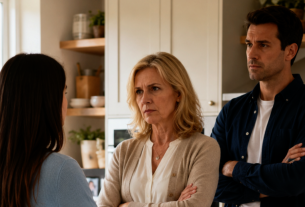
Twenty minutes earlier, we had been sitting in my parents’ kitchen. It was cramped and yellow, with the same plastic tablecloth I had bought them the year before last. My father was pouring compote. My mother was cutting the cake I had brought and placing slices on saucers. I got the piece without a frosting rose.
“Dina, eat,” my mother said. “You’re eating for two now.”
My sister ate. She was twenty-seven, I was thirty-nine, and that twelve-year age difference had served as an excuse our entire lives.
She’s the little one. Things are hard for her. It isn’t her fault.
“You can see the situation she’s in,” my father began, without looking at me. “That Artyom moved out. Her landlady is selling the apartment. She’s due in March.”
“I see.”
“So?”
“So nothing,” I said. “I’m listening.”
My mother put down the knife.
“You have four rooms.”
“Three.”
“All the more reason. You’re alone in a three-room apartment while your pregnant sister has to drift from one stranger’s place to another.”
“Mom, I work in those three rooms. One is full of packaging supplies. The other has my desk and paperwork.”
“Paperwork!” She almost sounded delighted to hear the word. “Paperwork is more important than a child.”
Dina finally looked up from her saucer.
“I don’t need to live with you,” she said with dignity. “I need a place of my own. I can’t keep moving from rental to rental with a newborn. Do you have any idea what that’s like?”
“I do. I found eight of those rentals for you.”
“Then take out a mortgage,” my mother said casually, as though she were asking me to pass the salt. “They’ll approve you. Your business has good turnover. Buy a one-room apartment on the outskirts. What difference would it make to you? Or sell your car. It’s expensive, and all you do is drive it to the store.”
My father coughed and began concentrating very carefully on pouring a second round of compote.
“Dad, what do you think?”
“I think a family should stick together,” he said into the saucepan.
I took out my phone, opened my calendar, and turned the screen toward my mother.
“Look. This is my offer. It is the only one, and it is final. I will pay for Dina to rent a one-room apartment near you. Six months in advance. The lease will be in my name, and I will make the payments directly to the landlord. I’ll also buy a stroller, a crib, and a chest of drawers. Send me the receipts, and I’ll cover them. That is all. After that, she supports herself, or you support her.”
My mother looked at the screen as though I had shown her something obscene.
“A rental? Another rental? So they can throw her out again six months from now?”
“Then they’ll throw her out of that apartment, not mine.”
“She needs a place of her OWN,” my mother said, pronouncing each syllable. “Her own, do you understand? Somewhere no one can evict her from.”
“I understand. Her own means buying it. Buying it means I pay.”
“Who else?”
I set down my cup. The compote had been made from the same jars as ten years earlier. My father made it every August, and every August he announced that this would be the final year.
“Mom, I’m not doing it.”
“Not doing what?”
“Any of it. I’m not registering her at my address, letting her move in, or buying her an apartment. I came here for dinner. Let’s have dinner.”
The silence was brief but dense. Dina stared at her saucer and licked her spoon.
“Inga,” my father said. “She’s your sister.”
“I know. I picked her up from kindergarten while you were working. I taught her algebra. I found her eight apartments in nine years.”
“There, you see?” my mother said happily, as though I had just made her argument for her.
That was when I stood up.
At home, in the bottom drawer of my desk, there was a gray folder held shut by an elastic band. It contained rental agreements. Eight of them, all in my name, because not one landlord had been willing to sign a lease in Dina’s name.
Eight apartments I had rented for her and that she had lost.
Sometimes a landlord asked her to leave early. Sometimes the neighbors filed complaints. Sometimes she simply moved out and abandoned her things, leaving me to negotiate over the security deposit afterward.
I did not count the money. I had stopped counting it long ago. The figures were too ugly.
I counted the agreements.
There were eight of them, and there was still room in the folder for a ninth.
That was what frightened me.
“Thank you for the compote,” I said, picking up the cake box.
“What are you doing?” My mother half rose from her chair.
“Taking it back. I brought it, so I’m taking it away. It has almonds in it. None of you are supposed to eat them anyway.”
“Inga!”
I went into the hall, put on my shoes, and opened the door. Behind me, I heard my father say, “Let her go.”
Then Dina said, “She’s always like this.”
Downstairs, outside the building, I placed the box on the hood of my car and stood there for a while. The cake had cost a little over four thousand rubles, and I had no intention of eating it.
The next morning, I gave it to the delivery girls at my bakery. They were delighted.
My phone vibrated as I drove out of the courtyard.
My mother had written:
“You’ll regret this. We’ll find another solution.”
They did.
Aunt Lyusya was the one who told me about the deed of gift.
Not my mother, my father, or my sister, but my mother’s cousin, who lived in the neighboring building and learned everything before the local police officer did.
“Do you know they transferred the apartment to Dinka?”
I was accepting a flour delivery at the time. Fifteen sacks. The driver was waiting for my signature while I stood with the phone pressed to my ear, staring at the invoice.
“When?”
“They finalized it last week. Zoya is telling everyone. She says at least the baby will have a roof over its head now.”
“Where are they going to live?”
“With Dinka, of course. They kept one room for themselves, the one at the back.”
I signed the invoice. The driver left.
The arrangement was simple and almost elegant, viewed from the outside.
The apartment went to Dina because everyone felt sorry for Dina.
My parents would live with Dina because where else would they go?
And their old age, medication, caregiver, health retreats, dental work, and repairs to the roof of the country house would, naturally, be Inga’s responsibility.
Inga would never abandon them.
Inga had a bakery, two locations, and a car.
Inga had always paid.
I called my mother that evening.
“Mom, I heard about the apartment.”
“From whom?” she asked instantly.
“What difference does it make? Is it true?”
“It’s true.” Her voice became calm and rehearsed. “And don’t look at me like that through the phone. We decided to settle everything while we’re still alive, so the two of you won’t tear each other apart later.”
“We wouldn’t have.”
“You would have thrown her out.”
That, at least, was honest. I respect moments like that.
“Fine,” I said. “It’s your apartment. You have every right. But let’s establish one thing immediately. Since the apartment goes to Dina, your old age goes to Dina as well.”
Silence.
“What kind of thing is that to say?”
“I’m being perfectly clear. You gave her everything you had. That means the obligations go to her too. I’m not inheriting the apartment, and I’m not inheriting responsibility for you. It comes as one package.”
“We raised you!”
“You did. And I’m not asking for an apartment in return. So don’t ask for me in return either.”
She hung up.
I sat down at my computer and did three things.
I canceled the automatic payment for their utility bills. It had been active since 2019, six and a half years, on the fifth of every month.
I canceled the payments for my father’s phone and internet.
Then I sent my father a message telling him to bring the car he had been driving for the past two years to the bakery by Saturday. It was leased through my company, and I was transferring it.
My father arrived on Saturday. He handed me the keys without a word.
He stood for a moment, looking at the display case where the girls were arranging cinnamon rolls.
“You’re going to give your mother a heart attack,” he said.
“Dad, she isn’t having a heart attack.”
“She will.”
He walked to the bus stop with his shoulders hunched, deliberately moving slowly so I would see him.
I saw him.
Then I went back behind the counter and spent the rest of the day counting the revenue.
Dina came on Wednesday.
She came into the bakery at the busiest time of day, when the line stretched all the way to the door and two girls were working the registers.
“I need to talk to you,” she called over everyone’s heads.
I took her out to the service stairwell.
“I need a crib,” she said immediately. “And a stroller. And a chest of drawers. About eighty thousand.”
“All right.”
She actually looked confused.
“What do you mean?”
“Exactly what I said. Send me links to the ones you’ve chosen. I’ll pay for them and have them delivered to your address. I won’t give you cash.”
“You don’t trust me?” Her voice began to rise. “I’m not a stranger, you know.”
“Dina, there’s a folder in my desk containing eight rental agreements. Every one of them is in my name. You didn’t make it to the end of a single lease.”
“Are you going to remind me of that for the rest of my life?”
“Only when someone asks me for money again.”
She stood on the stairs, beautiful, her belly visible beneath a loose sweater, and looked at me with almost scientific curiosity, as though I were a newly discovered kind of human being.
“Mom is right,” she said. “You’re greedy. You have everything, and you still keep count.”
“I do keep count. Send the links by Friday.”
She sent them that same evening.
A crib, a stroller, a chest of drawers, and a clothes-drying rack, which I paid for too. Artyom later sold it, but that is another story.
That night, I ordered an extract from the property register. I simply wanted to know exactly what they had done: whether it was a gift or a sale, and whether there were any liens or restrictions.
It arrived by email three days later.
I opened the file in my car, in the parking lot outside the tax office, barely paying attention as I moved between two errands.
Gift transfer.
Dina owned the entire apartment outright.
Everything was exactly as Aunt Lyusya had said.
Except for one detail.
The date the ownership transfer had been registered was September 12.
The dinner with the compote and cake had taken place on October 3.
I counted the three weeks between the dates and read it again.
By September 12, the apartment had already stopped belonging to my parents.
Yet on October 3, they had sat across from me and asked what I intended to do about my sister, who was due to give birth in March and supposedly had nowhere to live.
They had not invited me there to ask my opinion.
They had invited me to see whether I would agree to pay for something that had already happened.
The performance had been staged for an audience of one.
And the sole member of the audience had left carrying the cake.
Two weeks later, it was my father’s birthday. He was turning sixty-four, not a milestone, but my mother invited everyone: Aunt Lyusya, Uncle Slava, our cousins, and their neighbor Valentina.
The celebration was held in Dina’s new apartment, naturally.
The same apartment where I had once done my homework beside the same radiator.
I arrived carrying a box. Inside was the same almond cake. I am a woman of principle.
My mother did not even wait until the hot food was served.
“And here is our eldest daughter,” she announced loudly as she poured the drinks. “Our eldest is a businesswoman now. She refused to help her own pregnant sister. Wouldn’t even give her a corner to sleep in. And she cut her parents off financially. Can you imagine? She even disconnected her father’s phone.”
Our relatives froze over their salads.
“Zoya, don’t,” Uncle Slava said.
“Why shouldn’t I? People should know what kind of daughter we raised.”
I wiped my hands on a napkin and took out my phone.
“Mom, since people should know. Aunt Lyusya, Uncle Slava, listen. This won’t take long.”
Then I read it aloud.
The registry entry number.
The registration date: September 12.
“The apartment was transferred to Dina on September 12. On October 3, Mom and Dad sat in the kitchen and asked whether I was prepared to take my sister into my home. The apartment had already been given away. Everything had already been decided. They did not invite me there to help. They invited me to agree that I would finance their old age, since they had given away the property that could have paid for it.”
My father stared at his plate.
“Gena, say something to her,” my mother demanded.
“What am I supposed to say?” my father asked.
“Tell her that isn’t true!”
“Zoya.” He put down his fork. “It is true.”
Aunt Lyusya gasped aloud. Valentina began examining her napkin with great concentration.
Dina sat with her hands resting on her belly and suddenly burst into tears—loud, wailing tears, exactly as she had when she was a child and got scolded for breaking a cup. Within two minutes, she would transform herself into the main victim.
“You’ve ruined my celebration,” she sobbed. “I’m not supposed to get upset!”
“I wasn’t reading it for you,” I said.
“Inga, why did you have to do this in front of everyone?” Aunt Lyusya hissed. “Couldn’t you have discussed it privately?”
“We discussed it privately on October 3. No one listened to me.”
I picked up my bag.
At the door, I turned around.
“Happy birthday, Dad. The cake has almonds in it. You aren’t supposed to eat it, but you’ll eat it anyway.”
I went down to the courtyard and sat in my car.
The courtyard was the same: the poplar tree, the bench, the garages, and the hopscotch grid I had drawn in chalk in 1993.
I sat holding the steering wheel. My hands were perfectly steady, while inside me it was quiet and empty, like an auditorium after everyone has gone home.
For twenty years, I had been the cash register in that family.
I stopped being one in a single evening, and the world did not collapse.
The poplar tree was still standing.
The kitchen light was still on.
Inside, they were cutting my cake.
I started the car and drove home to sleep.
A month later, Artyom moved back in with Dina.
Permanently, with a suitcase and a gaming console.
My parents lasted until the end of January.
Aunt Lyusya told me what happened, one installment at a time, with the grave intonation of a military briefing.
First, Artyom asked them to vacate the back room because it was going to become the nursery.
Then he said my father’s television would ruin the baby’s sleep.
Then Dina informed my mother that she was washing the floors incorrectly.
Finally, the family held a meeting, without me, naturally, during which Dina said:
“Mom, why don’t you and Dad stay at the country house for now? We’ll see what happens in the summer.”
The country house stood on six hundred square meters of land in Kuzminskoye. The wooden cottage was twenty-four square meters.
My father had been planning to build a masonry stove since 2011. Every spring he said, “This will be the year.”
He never built it.
There was a little cast-iron stove, water from a pump two hundred meters away, and an outdoor toilet.
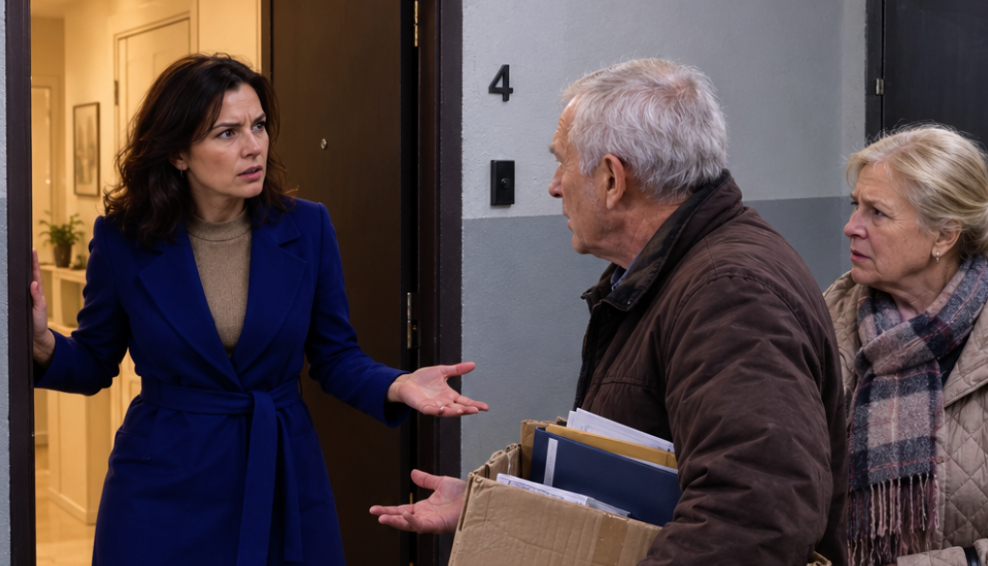
They came to my apartment on January 29 at nine in the evening, carrying two bags and a box of documents.
I opened the door.
My mother stood there in her coat with the fur collar. My father stood behind her on the landing, holding the bags without setting them down.
“We’ll stay for a couple of weeks,” my mother said. “Until we sort things out with Dinka.”
I stood in the doorway and did not step aside.
“No.”
“What do you mean, no?”
“You are not staying with me. Not for two weeks and not for two days.”
My father put down the bags.
For the first time that evening, he looked me in the face.
“Inga, it’s eighteen degrees below zero outside.”
“I know. I checked the forecast.”
“You’re sending us out into the cold?”
“I’m not sending you anywhere. You are already out there.”
My mother began talking about how she had given birth to me at Hospital Number Seventy-Three, how she had always given me the last of everything she had, and how all the neighbors would find out about this.
I let her finish.
Then I took an envelope from my pocket. It had been there since lunchtime because I had known this evening was coming.
“There are one hundred and twenty thousand rubles in here. It will cover three months’ rent and the security deposit on a one-room apartment in Proletarka. I called already. The apartment is available. The landlady’s name is Nina Sergeyevna, and her number is inside. After that, you manage on your own. I’ll transfer twelve thousand a month for your medication, on the first of every month. That is all you will receive.”
My mother stared at the envelope as though it were a filthy rag.
“We don’t need money! We need to stay with our daughter!”
“You have a daughter with a three-room apartment. Go to her.”
“She threw us out!”
“Yes.” I took hold of the door. “But she took the apartment.”
My father reached for the envelope first.
My mother snatched it from his hand and threw it onto the floor, onto the mat inside my hall.
My father bent down, picked it up, brushed it off, and placed it in the inside pocket of his coat.
“Gena!”
“Zoya, be quiet,” he said.
My mother told me I was not human and that she would curse the day I was born.
I listened while standing in the doorway.
Then I closed the door and turned the lock twice.
They did not leave for half an hour.
Through the door, I could hear my mother making phone calls. First to Dina, then to Aunt Lyusya, then to Dina again.
Dina did not come.
Aunt Lyusya called them a taxi to Kuzminskoye and paid for it herself, because my mother refused to take so much as taxi fare from me, while my father had become too exhausted to keep refusing.
The next day, my father came alone.
They had forgotten the box of documents in my hall.
I made him tea. He sat on a stool without unbuttoning his coat and warmed his hands around the cup.
“She honestly thought you would let us stay,” he said.
“And you?”
“I knew you wouldn’t.” He blew on his tea. “I told her in the car, while we were on our way here. She said I didn’t know you.”
“Dad, why did you sign the deed of gift?”
He was silent for a long time.
“She said Dinka would be lost otherwise.” He set down the cup. “But you wouldn’t be. You were never lost, Inga. You haven’t needed anything since you were twelve.”
“I did need things.”
“You never said so.”
He finished his tea, stood up, took the box, and left.
At the elevator, he turned around.
“You’ll never forgive us for this as long as we live.”
“I won’t,” I agreed.
They did not go to Proletarka.
They went to the country house because it belonged to them, while the Proletarka apartment would have come from me. After everything that had happened, my mother could not accept housing from me.
Pride is pride.
My father kept the money, however, and he was right to do so.
They kept the cast-iron stove burning around the clock.
Aunt Lyusya brought them potatoes.
I did not visit.
On February 1, I transferred twelve thousand rubles.
On March 1, I transferred another twelve thousand.
My father replied the same way each time:
“Received. Thank you.”
Dina gave birth to a girl in March.
I found out through the general family chat, which they had forgotten to remove me from.
In May, Dina called me.
It was the first time she had contacted me since our father’s birthday.
“Inga, hi. Listen, we have a situation.”
The situation was this.
Back in December, as soon as the apartment transfer had been fully finalized, Dina and Artyom had taken out a loan of 2.8 million rubles secured against it.
The money was for a business. Artyom was opening a tire-repair shop, while also placing some kind of bets on the side, though Dina did not mention the gambling until our third conversation.
The tire shop survived for four months.
They made two payments.
Then they stopped.
“Inga, you understand. I have a baby.”
“I understand.”
“We only need to clear the overdue payment. It’s just ninety thousand. You earn that much in a single day.”
I did not earn that much in one day.
But I saw no point in explaining reality to someone who had spent nine years living inside an imaginary film about my life.
“No.”
“Are you serious? You’re still angry about the apartment?”
“Dina, the apartment is yours. The debt is yours. Everything is fair. Everything is exactly the way all of you wanted it.”
“You’re a monster,” she said with genuine astonishment, as though she had noticed it for the first time.
Two weeks later, my mother called.
She did not say hello.
“You knew?”
“Knew what?”
“That she had mortgaged the apartment! You knew and said nothing!”
“I found out in May. From her.”
“You were obligated to do something!”
“Mom, you signed the deed of gift yourself. After that, it was her property. She did what she chose to do with it.”
My mother began to cry.
It was the first time in many years that she had truly cried in front of me—ugly, uncontrolled crying.
“Ingochka. Ingochka, we’ll sell the house, the country place. We’ll give everything we have. You only have to put in the rest. There’s a baby involved.”
“No.”
They did not save the apartment.
In the summer, Dina, Artyom, and the baby moved in with his mother in Volokolamsk. According to Aunt Lyusya, Artyom disappeared from there in August.
The apartment where I had once done my homework beside the radiator was sold at auction in October.
I sold the bakery in September.
Both locations, the equipment, and the brand—all as a single package to a man who had been pursuing me with an offer for ten years.
The money was good.
I moved to Kaliningrad and bought a ground-floor commercial space for a pastry shop and an apartment with windows overlooking a linden tree.
My parents are spending their second winter at the country house.
My father finally built the stove last autumn, by himself, at the age of sixty-five.
Aunt Lyusya sent me a photograph. The brickwork was slightly crooked, but the stove drew properly.
The twelve thousand rubles still go out on the first of every month.
My father writes, “Received.”
My mother writes nothing.
She told the relatives that she no longer has an eldest daughter.
Before moving, I carried the gray folder out to the garbage containers.
Eight rental agreements, eight strangers’ signatures, nine years.
The movers assumed it was trash.
They were right.
Tell me honestly: it may have been a victory, but was it worth the price?
Every morning, I open the pastry shop at half past six, and the first thing I smell is cinnamon.
No one here invites me to dinner.