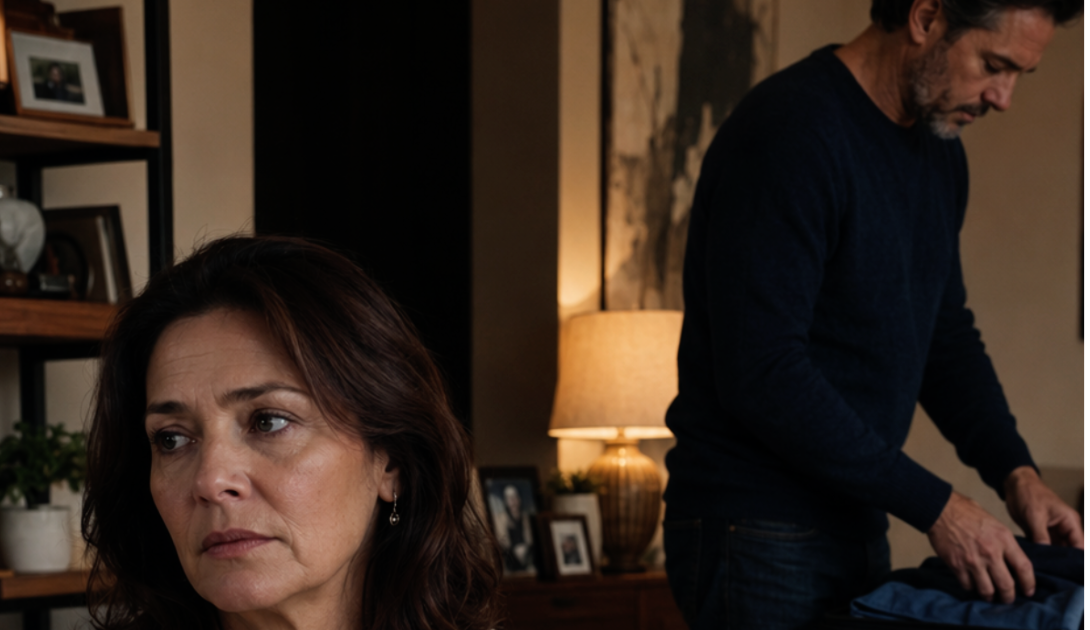
My husband was packing his things on Saturday morning, and that alone felt hurtful—he was doing it far too calmly and methodically, as though he were leaving on a business trip.
I stood in the bedroom doorway and watched Gena fold his shirts. He had never folded them in his life. Usually, he stuffed them into the wardrobe in a crumpled heap, and I rehung them afterward. But now he was arranging them neatly in a stack.
“I’m taking the laptop charger,” he said without turning around.
“Take it.”
“And the documents from the bottom drawer.”
“Take them.”
He zipped up the suitcase, straightened, and looked at me. His expression was solemn. Truly solemn, like a man standing at a podium.
“Marina, I don’t want to lie to you. I’ve met someone. I’m fifty-two years old, and for the first time, I feel like I’m truly alive…”
He said it as though he had spent a week rehearsing in front of a mirror.
“I’m not blaming you. You’re a good person. It’s just that we became… well, more like roommates a long time ago.”
Twenty-one years of marriage. A daughter at university. A mortgage I had paid off with my bonuses. Three operations for him, two for me. His mother’s illness, when I slept in a chair at the hospital for a week because he was at home with a fever.
Yes, we were quite the roommates.
“Her name is Zhanna,” he added for some reason. “She teaches yoga.”
I nodded silently because if I had opened my mouth, something would have come out that I would later have been ashamed of—and he would not.
He quietly picked up his suitcase and left.
For the first three days, I did not cry. Instead, I washed every window in the apartment—in November.
Lyuda leaned out from her balcony, watched me wiping the outside of the frame, and shouted:
“Marina, what are you doing?”
“They were dirty.”
“In November?!”
I did not bother explaining.
Then I cleared out the storage cupboard and made ten jars of apple preserves from the apples Gena had brought back from the country house and dumped in the hallway before leaving. They had already started to rot, and the apartment smelled sour and sweet at the same time.
On the fourth day, my daughter Nastya called.
“Mom, Dad texted me.”
“Mm-hmm.”
“He said he ‘found himself.’ What is that supposed to mean?”
“It means he left me for a woman who teaches yoga, sweetheart.”
Nastya fell silent.
“Yoga? Dad? He can’t even lift his foot up to his knee.”
“That’s exactly what I was thinking.”
We both snorted, and it was the first thing in four days that felt remotely like normal life.
“Mom, how are you?”
“I’m making preserves.”
“How many jars?”
“Ten.”
“So you’re doing badly.”
Nastya knew me better than I knew myself. When I felt terrible, I did not drink, eat chocolate, or sob on the sofa. I cooked endlessly. The worse things were, the more food I made.
When Gena’s father died, I made three hundred dumplings in two days and froze them. Gena ate them for the next two months.
“Should I come home, Mom?” Nastya asked.
“No, you have exams.”
“Mom!”
“Nastya, I’m serious. I’m managing.”
In reality, I was not managing at all, but my daughter did not need to know that.
A week later came the first greeting from Gena’s new life.
He deleted all our shared photographs from social media and cleaned up his entire page. The sea, the country house, Nastya when she was little, Nastya when she was older, New Year’s dinners, his birthday when I baked him a cake shaped like a guitar because he had played when he was young.
All of it disappeared.
New photographs appeared instead.
Gena in a white linen shirt. Gena standing in front of candles. Gena with his eyes closed and his palms pressed together in front of his chest.
The caption read:
“I thank the universe for every new day.”
I read it three times.
My Gena, who had not once used the word “universe” in twenty-one years. The most gratitude he had ever shown was thanking a cashier at Pyaterochka for giving him his change. He hated candles because, according to him, they “smelled like a wedding.”
Lyuda called twenty minutes later. She had also seen Gena’s new social-media style.
“Marina, are you sitting down?”
“I’m standing.”
“Then sit down. He posted a video of himself doing the tree pose.”
“What kind of tree?”
“You know, standing on one leg. Wearing harem pants.”
I finally cried that day.
It was because of a kind of humiliation I could not properly define. It was as though our twenty-one years together had been so unbearable that he had needed to turn into a completely different person in order to escape them.
It was not enough simply to leave. He had to erase everything—his shirts, his vocabulary, even the way he held his body.
I was not a wife he had left for another woman.
I was an illness from which he had recovered.
At work, I held myself together like the chief accountant of a construction company. It was the end of the year: closing the accounts, reconciliation statements, four contractors delaying their paperwork, and one subcontractor who had disappeared altogether.
There was no time to cry or fall apart.
But during lunch, Ira from Human Resources sat down beside me with her food container.
“Marina, I don’t want to interfere, but you’ve been eating nothing but cookies for three days. Is everything all right?”
“I’m not hungry. I can’t swallow anything.”
“Do you not want to eat, or do you not want to live?”
I looked at her.
Ira was as blunt as a water pipe. She was thirty-eight and had been divorced twice.
“Eat,” I said.
“Then eat my meat patties. Come on.”
I ate two patties and felt treacherously better.
“Who did he leave you for?” Ira asked without looking up from her buckwheat.
“A yogi.”
“A what?”
“A yoga instructor. Zhanna, I think.”
Ira put down her fork.
“Zhanna? A redhead? Does she have a studio on Komsomolskaya Street?”
My stomach turned cold.
“I don’t know. Maybe.”
“If she’s a redhead and the studio is on Komsomolskaya, my friend Svetka used to go to her. She said that in three months, Zhanna sold her eighty thousand rubles’ worth of courses and some kind of meditation sticks.”
I did not know what to do with that information.
So I remembered it and pushed it to the back of my mind.
Then came two weeks of silence.
Gena did not call or write. He replied to Nastya’s messages cheerfully and briefly, like a tourist sending updates from a holiday.
“Everything is wonderful!”
“Dad is happy!”
“See you soon, daughter!”
Daughter.
He had never called her “daughter.”
She had always been Nastya, Nastyukha, kiddo, or child. Now she was “daughter,” as though he were speaking in a stage play.
I caught myself monitoring his page. I hated myself for it, but I kept checking anyway.
Every evening, it was like picking at a wound.
New pictures appeared regularly: a smoothie in a tall glass, a yoga mat embroidered with his initials, a book titled The Path to Your True Self lying on a windowsill beside a crystal.
This was the same Gena who laughed at horoscopes and who once gave me a multicooker for my birthday, saying:
“At least it’s useful.”
Under every photograph were comments from women whose usernames contained flower emojis.
“You’re so authentic!”
“You can see that your energy has begun to flow!”
“You’re glowing!”
He really did glow in his white shirt, tanned and smiling.
I even wondered whether he truly was happy. Perhaps I had kept him in a cage for twenty-one years, and he had simply been too gentle to tell me.
On the twenty-sixth day—and yes, I was counting like an idiot—something happened that I had not expected.
It was Sunday, eight in the morning.
I was drinking coffee in the kitchen and staring at a stain on the ceiling that Gena had promised to paint over three years earlier.
My phone rang.
My husband’s number appeared on the screen.
“Hello.”
“Hi, Marina.”
His voice sounded different. It was no longer solemn or cheerful. It sounded ordinary, even slightly hoarse.
“Hi.”
“How are you?”
“Fine.”
There was a pause.
He breathed into the phone, gathering his courage, and I recognized the sound. It was how he breathed when he asked my mother for money, when he admitted he had scratched my car, and when he confessed that he had forgotten another parent-teacher meeting.
“Marina, I have… a situation.”
“What kind of situation?”
“A financial one.”
I slowly placed my mug on the table.
“A financial situation,” I repeated.
“Yes. You see, Zhanna is going through a period of expansion. She’s opening a second space. A hall for spiritual practices. She invested all of her money, and mine too, and…”
He stopped.
“And?”
“They’re short of money. Significantly short.”
I listened.
My coffee was getting cold. The stain on the ceiling looked like a map of an unknown continent.
“Marina, I’m uncomfortable asking you.”
“But you’re asking anyway. Can you even hear yourself?”
“One hundred and twenty thousand. You have it. I’ll pay everything back in two months. Zhanna says the second space will pay for itself in…”
I started laughing.
It was a nervous, breathless laugh, and I could not stop. The phone lay on the table with the speaker turned on, and Gena’s silence came from it.
“Marina?” his voice said. “Marina, what’s wrong with you?”
I wiped my eyes and caught my breath. It took nearly a minute.
“Gena.”
“What?”
“You left me a month ago. You deleted our photographs. You wrote to our daughter that you had found yourself. You post videos of yourself standing on one leg in harem pants. You thank the universe. And now, one month later, you call me at eight o’clock on a Sunday morning to ask for one hundred and twenty thousand rubles for a yoga studio.”
Silence.
“Can you at least hear how that sounds?”
“Marina, it isn’t what you think. Zhanna isn’t just…”
“Gena, I’m not giving you any money.”
“But…”
“This conversation is over,” I said, and ended the call.
My hands were shaking with something new, something I could not name.
Perhaps it was anger that I had finally allowed to escape. Perhaps it was clarity.
Or perhaps it was simply the fact that, for the first time in a month, I had said exactly what I thought and had not apologized afterward.
Two days later, Nastya called.
“Mom, did Dad ask you for money?”
“Yes.”
“He asked me too. Fifty thousand. For some kind of ‘space.’”
“Did you give it to him?”
“Mom, my scholarship is eleven thousand.”
“So you didn’t.”
“I told him he had completely lost his mind. Only I used a different word.”
I smiled.
“Mom, how are you doing? Honestly.”
“Nastya, I still don’t know. But I ate an entire proper lunch at work.”
“Oh, progress.”
“And Ira from HR invited me to go swimming with her on Tuesdays.”
“You hate swimming.”
“I do, but she promised there’s a snack bar that sells pastries.”
Nastya laughed, and I felt a little better.
A week later, Gena sent me a long message.
I read it twice because the first time, I could not believe it.
He wrote that I was “trapped in low vibrations” and that my refusal to help was “a manifestation of the ego.”
He said he held no resentment toward me because “every person is at their own level of development.”
He also said that Zhanna had conducted a “forgiveness session” for him, during which he had mentally released me “with love and light.”
For twenty-one years, I had washed his socks, made his doctors’ appointments, paid the utility bills when he was unemployed, and renovated the bathroom with his brother because Gena himself was afraid of the hammer drill.
And now he was releasing me during some sort of session.
I blocked his number, thought for a moment, and unblocked it because of Nastya. Something important might happen.
But I stopped looking at his social-media pages.
Instead of replying, I went swimming with Ira.
The pool was cold and smelled of chlorine. But the pastries at the snack bar were filled with cabbage and egg. They were hot, with crisp pastry.
We sat in plastic chairs, wet and wearing bathrobes, and ate them.
“Good?” Ira asked.
“Good.”
“Then keep living.”
It was blunt and badly timed, but somehow, it struck exactly where it needed to.
Then, at the beginning of December, something else happened.
An unfamiliar woman called me. Her voice sounded young and nervous.
“Is this Marina? Gennady’s former wife?”
“Yes. Who is this?”
“My name is Olesya. I… I worked as an administrator for Zhanna. At her studio. I quit yesterday.”
I became cautious.
“And?”
“I thought you should know. Zhanna… this isn’t the first time she has done this with a man. She finds a certain type of man—men who believe they are unhappy and become enthusiastic easily. Your husband is the third one in two years.”
I sat down on the small stool in the hallway.
“The third?”
“The first was Dmitry, a businessman. He invested four hundred thousand in the studio. When his money ran out, she released him, as she put it, ‘with gratitude for their shared journey.’ The second was Andrei, from the Moscow region. He sold his car. Your husband… I don’t know how much he gave her, but I heard her discussing an apartment with someone on the phone.”
“What apartment?”
“I’m not certain, but she said that an ‘asset’ would soon become available. She said that ‘Gena would offer it himself.’”
I ended the call.
Then I called her back.
“Olesya, why are you telling me this?”
“Because Dmitry had a wife and two children. When he was left without money, his wife filed for divorce. They divided the apartment through the courts, and the children are still living with their grandmother. I kept quiet that time, but I don’t want to remain silent again. I think it’s right that you should be warned.”
She hung up.
I sat on the stool in the hallway and stared at the wall where our photograph had once hung.
The apartment was registered in my name.
We had bought it in 2009. I had invested the entire inheritance I received from my grandmother, and we registered the property in my name.
Gena had not objected at the time.
“It’ll make you feel more secure,” he had said.
I had also paid off the mortgage with my bonuses.
Now I truly did feel more secure.
Even so, something tightened inside me when I realized what a simple and revolting scheme was being used on the man I had known for twenty-one years.
I called a lawyer to clarify the situation and ask about the apartment.
The following day, I filed for divorce myself.
Gena found out a week later and called me immediately.
“Marina, what are you doing?”
“Getting divorced.”
“But we could have… handled it peacefully.”
“We are getting divorced peacefully.”
“I thought we would talk and divide everything like adults.”
“Divide what, Gena? My apartment?”
There was a pause.
“What makes you think…”
“Gena, I don’t care anymore. You made your choice, and I wish you happiness.”
Then I hung up.
In January, after the New Year, Nastya came home for the holidays.
We sat in the kitchen eating pancakes.
“Mom, Dad wrote to me.”
“What did he say?”
“He said Zhanna turned out to be ‘the wrong person.’ He’s ‘disappointed but grateful for the experience.’”
Nastya showed me their messages.
Gena wrote that he was now staying with his friend Seryoga and sleeping on a folding bed. Zhanna had taken all the money he transferred for renovating the studio.
She had registered the studio in her own name, and he now “felt empty.”
“Did he ask to come back?” I asked.
“Not directly. But he hinted that he ‘needed the support of those closest to him.’”
Nastya looked at me.
“Mom, what are you going to do?”
I tore off a piece of pancake.
“Nothing.”
“What do you mean?”
“Exactly what I said. It’s his life, Nastya. He is a grown man. He made his choice, and now he can deal with it.”
“But what if he…”
“If he comes to me and says he has nowhere to live, I’ll give him a real-estate agent’s phone number. If he asks for money, the answer is no. If he asks for forgiveness, I’ll accept his apology, but it won’t change anything.”
I am not an object that can be placed on a shelf and then taken back when the new shelf becomes uncomfortable.
Nastya chewed her pancake and stared at me for a long time.
“Mom, you’ve really changed.”
“No. I just stopped pretending that any of this was normal.”
In February, I ran into Gena by chance at Pyaterochka.
He was standing in line with a basket containing a packet of frozen dumplings, bread, and kefir.
He had lost weight. His shirt was wrinkled, and it was not white.
He saw me and froze.
I approached him myself, though I do not know why.
“Hi.”
“Hi, Marina.”
He did not look miserable. He simply looked rumpled and sleep-deprived, like someone returning from a business trip.
“How are you?” he asked.
“Fine.”
“Is everything all right at work?”
“Yes.”
He shifted from one foot to the other, the way he always did when he wanted to say something but could not bring himself to do it.
“Gena, don’t.”
“Don’t what?”
“Don’t say whatever you’re about to say.”
He lowered his eyes.
“I only wanted to say that you were right.”
“I know.”
I paid for my kefir and left.
It was cold outside, and the wind blew into my face. I walked home quickly because I still needed to make dinner.
And also because if I had walked more slowly, I would have started thinking about him standing alone in that queue, wearing a wrinkled shirt and holding a packet of frozen dumplings.
I would have thought about the fact that he was still the person I had loved for twenty-one years, and that love had not simply disappeared.
It was merely lying in a place inside me where I tried not to look anymore.