Polina zipped up the empty suitcase and set it in the hallway, right against the wall, like a flag planted in newly claimed territory. The three-room apartment still smelled of fresh paint. There was hardly any furniture yet, but echoes wandered through the rooms like a contented guest. Eva ran from corner to corner, shouting that she had found the perfect place for her “mermaid bed.”
“We bought this place three weeks ago, and I still get confused about where the bathroom is,” Artyom said as he came out of the hallway.
“To the left of your pride and to the right of my exhaustion,” Polina replied. “You can’t miss it.”
“Very funny.”
“I try. Humor is the only thing in this house we got for free.”
Artyom placed a folder of documents on the windowsill, and they both looked at it the way people look at something important that has already been settled. The apartment was registered in Polina’s name. Artyom himself had insisted on it—back when her father had inherited property from her grandfather, sold the old village house, and given all the money to his daughter.
“Valery Dmitrievich called,” Artyom said. “He wanted to know whether we bought Eva a swim ring.”
“We did. Pink, with ears. She sleeps with it.”
“Your father is one of a kind. He gave you every last penny and never once asked what we did with it.”
“He asked once,” Polina said with a smile. “‘Did you pay off the mortgage?’ I said we had. He said, ‘Good.’ Then he hung up. Conversation of the century.”
Eva rushed into the room holding a sheet of paper covered with a crooked blue sea and a yellow sun that took up half the sky.
“This is for us,” she announced. “We’re going there in eight days.”
“Nine,” Artyom corrected her.
“Eight. I counted on my fingers. Fingers don’t lie.”
Artyom’s phone buzzed on the windowsill. He looked at the screen, and his expression changed as if someone had suddenly switched off half the lights in the room.
“Inna Arkadyevna,” Polina said, without asking.
“Her.”
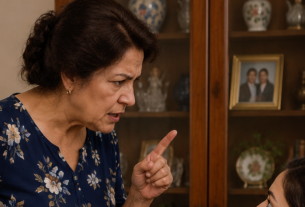
Inna Arkadyevna came over the next day while Artyom was out. She walked in, looked around the bare walls, and ran her palm over the doorframe as though checking whether it was real.
“So, a three-room apartment,” she said. “You moved fast.”
“Fast is when something takes one day,” Polina replied. “For us, it took six years, a mortgage, and one sacrificed vacation. By human standards, that’s a turtle sprint.”
“Speaking of vacations. Artyom said you’re going to the seaside.”
“We are. Eva even drew the route.”
Inna Arkadyevna sat on the only chair and folded her hands in her lap as though preparing to announce a verdict on the weather.
“Polina, just think about it. Just think. Alina is stuck inside four walls with two children. Summer is almost over. Those children have never even seen the sea.”
“I sympathize. I really do.”
“So what would it cost you? Give her the money. Let her go away with the children, get some rest, catch her breath. You’re young. You’ll have a hundred more chances.”
Polina slowly placed a jar of paintbrushes that Eva had left behind that morning on the windowsill.
“Inna Arkadyevna, let me make sure I understand you correctly. We’re supposed to return our tickets, unpack our suitcase, tell our five-year-old child, ‘The seaside is canceled,’ and hand the money over to your daughter?”
“Why do you have to put it so harshly?”
“I’m not being harsh. I’m being precise. Harsh is when people dress it up nicely while meaning exactly the same thing.”
“You have to understand me, woman to woman!” Her voice trembled and rose. “She’s having a hard time! She’s alone! She’s exhausted!”
“And who said we have to sacrifice our plans for your daughter’s children?” Polina replied with a smirk.
Inna Arkadyevna straightened so abruptly that the chair creaked.
“What?”
“I’ll repeat it if you like. The money for this vacation came from the sale of my grandfather’s house. My grandfather’s house, inherited by my father, and my father gave the money to me. Tell me, where exactly does Alina appear in that chain? I can draw you a diagram if necessary. We have pencils.”
“How can you even bring yourself to count things like that?”
“Quite easily. Counting is useful. It’s how apartments appear.”
“You’re greedy! You’re simply greedy people!”
“Greedy is when someone refuses to give away what belongs to them. Someone who demands what belongs to other people is called something else, but I promised my husband I wouldn’t use bad language in the new apartment. The walls are still fresh.”
Inna Arkadyevna stood up, grabbed her handbag, and headed for the door without saying goodbye. She closed the door carefully—and somehow that carefulness felt colder than if she had slammed it.
Twenty minutes later, Artyom received a call. He listened for a long time, standing in the middle of the street and shifting from foot to foot like a man who was cold in August.
“Mom, stop,” he finally said. “Say that again, slowly. What exactly are we supposed to do?”
“Take Alina and the children with you! Or give her the money! Artyom, she’s your sister!”
“Mom, we have three tickets, not six. Not five, either. And in general, our arithmetic works differently.”
“Can you hear yourself? You’re talking about tickets while your own flesh and blood is suffering!”
“I can hear myself perfectly well. What’s worse is that I can hear you.”
That evening, sitting on the floor of a room that still had neither a sofa nor a rug, he told Polina about the conversation.
“She was here,” Polina said. “This afternoon. Almost word for word. Even the intonation was the same.”
“So she came at us from both sides.”
“Like an experienced professional. First pity, then shame, then the bill for daring to have a life at all.”
Artyom rubbed his knees with his palms.
“You know what really got to me? She said, ‘You can afford it.’ Not ‘Please help,’ but ‘You can afford it.’ As though having the ability automatically turns something into an obligation.”
“A classic,” Polina nodded. “If you own an umbrella, apparently you’re obligated to get soaked out of solidarity.”
“Are you angry?”
“I’m packing. It’s more productive.”
“Polina.” He looked at her seriously. “I’m not giving up our vacation. And I won’t let anyone touch the apartment. Everything is registered exactly as it should be, and that’s the end of it.”
“I know,” she said. “Sometimes it’s just nice to hear it said out loud, without music or fireworks.”
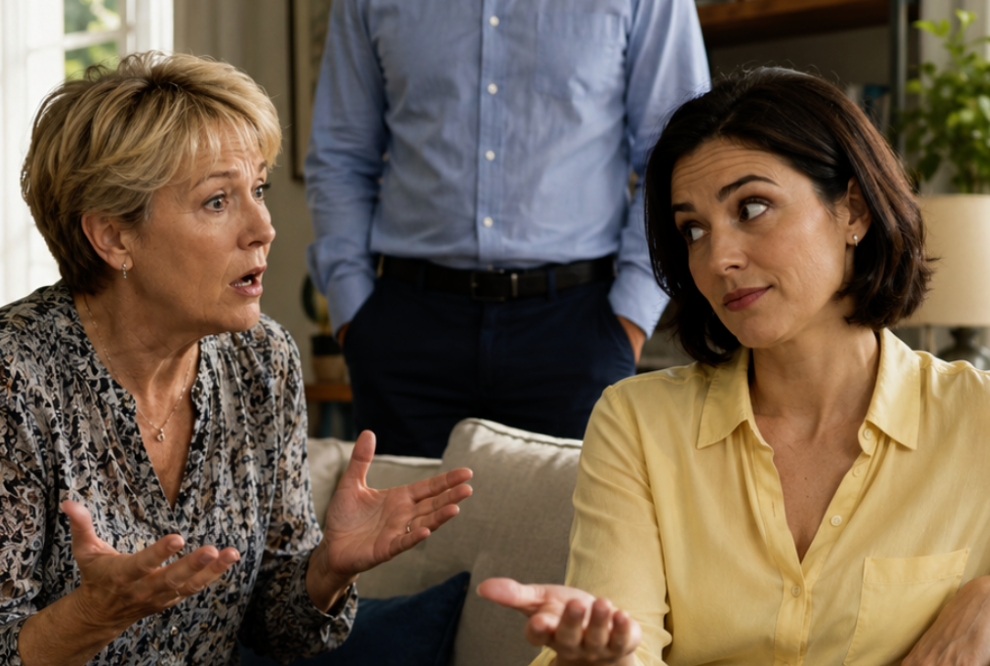
Inna Arkadyevna came again on Thursday, five days before their flight. This time Artyom was home. She entered the room and started talking before she had even taken her handbag off her shoulder.
“I’ve decided everything. You’re giving the money to Alina. She’ll go with the children, and you can go next year.”
“Hello,” Polina said. “I’m happy to see you too. Thank you, everything’s fine, the renovation is coming along nicely.”
“Stop clowning around! I’m talking to my son!”
“Then I’ll be quiet and admire the dialogue from the sidelines. It’s my second favorite pastime.”
“Mom,” Artyom said, stepping between them. “Sit down. Or stand, whatever you want. But listen to me all the way through once, because I’m not going to say this a second time.”
“Artyom…”
“First. Alina had a husband. She filed for divorce herself, packed her things herself, and moved back in with you herself. You chose to take her in. Those are her decisions and your decisions. Ours are nowhere on that list.”
“How can you talk about your sister that way?”
“Second. Her ex-husband pays child support regularly. He hasn’t missed a single month. Alina could have found a job a long time ago—the children aren’t babies. But she lives on that money and on yours. That’s a choice too.”
“She’s struggling!”
“Everyone struggles. I struggle sometimes too, but for some reason I don’t go to her house demanding that she give me her summer.”
Inna Arkadyevna jerked her shoulder, her lips trembling.
“You’re her brother!”
“Third,” Artyom continued evenly. “I gave her two hundred thousand for her wedding. It wasn’t a million, but it was everything I had at the time. In six years she has never helped me with anything, not once. I’m not holding it against her. I’m simply putting things in their proper places, since we’ve decided to talk about fairness.”
“She put you up to this!” Her voice broke. “You were never like this before!”
“Fourth. Polina’s father inherited her grandfather’s property, sold the house, and gave the money to us. We paid off the mortgage. Then we sold our two-room apartment and bought this one. Everything we have came from that side of the family. What came from your side were demands. Unfortunately, the cashier doesn’t accept those as payment.”
“Fifth,” Polina added quietly. “We’re planning to have a second child. And before that, we want to take our daughter to see the sea, which she has only ever seen in pictures. This isn’t a whim. It’s something we’ve been waiting six years for.”
Inna Arkadyevna opened her mouth, but Artyom raised his hand.
“And lastly. I will help my sister. With groceries, clothes, and I can look after the children on weekends. But I will not destroy my family’s plans for someone else’s plans. Not for her children and not for your peace of mind.”
“So they’re strangers now,” she whispered. “Listen to yourself.”
“My family is here,” Artyom said, nodding toward the room where Eva’s footsteps could be heard. “The others are relatives. Those are different words, Mom. There’s a reason they exist.”
Eva came into the room holding a sheet of paper in both hands like a tray.
“Grandma, look! This is the sea! Here’s me, here’s Daddy, here’s Mommy, and here’s a dolphin, except it came out looking like a cucumber.”
Inna Arkadyevna looked at the drawing. She didn’t take it. She moved her granddaughter’s hand aside as though pushing away a curtain and walked toward the exit.
“Grandma, you didn’t finish looking at the dolphin.”
The door closed.
Out on the landing, Inna Arkadyevna called her daughter before she had even started walking downstairs.
“He refused. Flat-out refused.”
“What do you mean, refused?” Alina’s voice rang through the phone. “Did you explain about the children? Did you tell him I’m alone?”
“I told him everything. He just stood there and laid everything out point by point. First, second, third.”
“It’s her! It’s all her! He used to be normal! She controls him. She’s turned him against us!”
“Polina just stood there smiling. So calm. And she had an answer for everything.”
“I want to go to the sea too!” her daughter’s voice rose into a scream. “Why do they get to go and I don’t?! They have money—I know they do! They’re just greedy. They’ve always been greedy!”
Inna Arkadyevna fell silent, staring at the number marking the floor.
“She said to me, ‘Who said we have to sacrifice our plans for your daughter’s children?’”
“And you just took that?!”
“I left.”
“Mom!”
Inna Arkadyevna ended the call. She descended the stairs slowly, with two thoughts fighting inside her. One of them admired her daughter-in-law for defending what was hers like a fortress. The other was furious because the money had been so close—and now it was slipping away.
Back in the apartment, Polina pulled the suitcase into the middle of the room and flipped open the lid.
“Eva, bring your swimsuit. And the swim ring.”
“The ring won’t fit!”
“Then it’ll travel separately, like an important guest.”
Artyom stood in the doorway, watching his wife arrange the clothes in neat piles.
“You holding up okay?” he asked.
“Me? Great. I actually like it when everything ends with a suitcase.”
“Mom probably won’t call for a month now.”
“So we get a month of vacation and another three weeks of peace and quiet. Generous summer.”
He walked over, took a folded towel from her hands, and placed it in the suitcase himself.
“I’m not worried, if that’s what you mean. My sister has her own family. I’ll help her—but in my own way, and when I decide it’s appropriate. Right now we have something else to think about.”
“What?”
“Our vacation,” Artyom said. “Eight days. Or nine. Apparently there’s some disagreement about that in this family.”
“Eight!” Eva shouted from the hallway, waving the pink swim ring. “The sea! The sea! We’re going to the sea soon!”
Polina zipped the first compartment of the suitcase and winked at her husband.
“You heard her. Fingers don’t lie.”