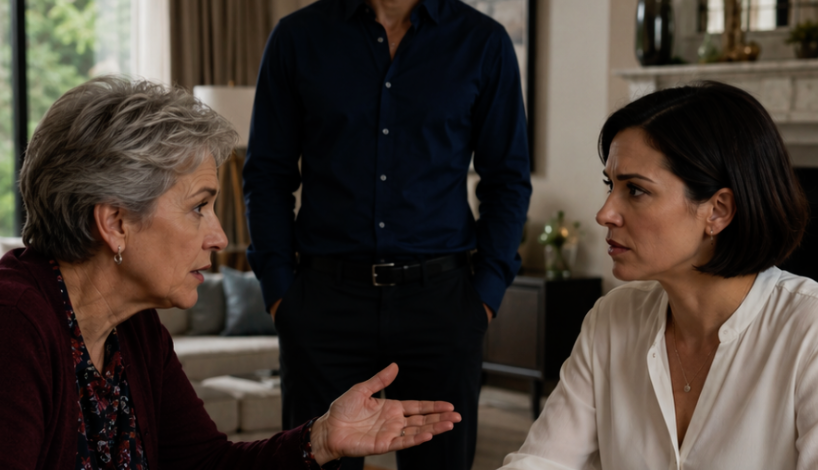
Galina Petrovna paced the clinic corridor as though every step could somehow stop time. Kirill sat on a hard bench, leaning his back against the wall. He was only sixteen, but right now he looked twenty-five.
“Mom, stop pacing,” Kirill asked quietly. “Watching you go back and forth is making me dizzy.”
“Please, don’t talk,” Galina Petrovna stopped and pressed a hand to her chest. “Save your strength.”
The office door opened slightly, and the face of the doctor, a middle-aged man, appeared. Galina Petrovna took a step forward, but her legs almost refused to obey her.
“Please, one of the relatives come in,” the doctor said.
“Maxim,” Galina Petrovna turned toward her older son, who was standing a little farther away. “You go in. I won’t be able to hear it.”
Maxim silently nodded. He entered the office and closed the door behind him. Galina Petrovna sat down on the bench beside Kirill and took his hand. It was cold, almost weightless.
“Mom, I’m not stupid,” Kirill said without looking at her. “I can see the way you’ve been looking at me these past few weeks.”
“I look at you because you’re my son,” Galina Petrovna’s voice trembled. “And because I love you.”
“You look at me as if you’re saying goodbye,” he turned toward her and smiled weakly. “But I’m not planning on going anywhere yet.”
Maxim came out twelve minutes later. Galina Petrovna had counted every single one. He was holding several sheets of paper covered in small print. His face was gray.
“What?” Galina Petrovna stood up. “What is it?”
“Mom, let’s step aside,” Maxim took her by the elbow and led her toward the window at the far end of the corridor. “Kirill doesn’t need to hear this yet.”
“Tell me,” she said, digging her fingers into his forearm.
“Stage four,” Maxim said evenly, though everything inside him was burning. “The oncologists say too much time has been lost. Only palliative care is possible.”
His mother made a sound like the moan of a wounded animal. She clutched her son’s shirt and began sobbing violently, her entire body shaking.
“Find a way,” she whispered through her tears. “I’m begging you. You’re the eldest. You have to. Find a way.”
“Mom, quieter,” Maxim embraced her, though he himself could barely remain standing. “Quiet. Kirill will hear you.”
Svetlana opened the door before Maxim even turned the key—she always recognized his footsteps on the stairs. Being seven months pregnant made it difficult for her to move quickly, but she still managed to meet her husband in the hallway.
“Well?” Svetlana searched his eyes. “What did they say?”
“Cancer,” Maxim took off his jacket and hung it on a hook. “Terminal stage. There’s nothing they can do.”
Svetlana placed both hands over her belly and began crying silently. She had known Kirill since the day she became part of the family. He was a teenage boy who only recently had been racing around the courtyard on a scooter.
“Maxim, maybe there are other doctors? Other hospitals?”
“I asked. They gave us a referral for a medical consultation, but the doctor was honest. He said there’s nothing to hope for.”
“And Galina Petrovna?”
“She’s crying. She keeps asking me to find a way out. As if I’m a magician.”
They sat opposite each other in the kitchen. Svetlana covered his hand with hers. Maxim stared at one spot—the photograph on the refrigerator showing the three of them on the embankment: him, Svetlana, and Kirill.
“We’ll think of something,” Svetlana said. “We will.”
The next morning, Galina Petrovna called. Her voice had changed. It was hard and businesslike, with no trace of tears.
“Maxim, take your wife and come over. Now. It’s urgent.”
“Mom, it’s difficult for Svetlana to travel. She’s seven months—”
“I said now!” Galina Petrovna interrupted. “My son is dying, and you’re talking to me about convenience?”
Maxim drove Svetlana across the entire city. She remained silent throughout the journey, resting one hand on her belly. The baby kicked, unaware of everything happening around him.
Galina Petrovna met them at the door. Kirill wasn’t home—she had sent him to a neighbor’s apartment. Printed documents lay spread across the table.
“Sit down,” she said, pointing toward the sofa.
“Mom, what happened?” Maxim sat beside his wife.
“I found a clinic in Germany,” Galina Petrovna stood in front of them with her hands folded. “They take cases like his. The treatment costs eight million rubles.”
Silence followed. Svetlana exchanged a glance with her husband.
“Where are we supposed to get that kind of money?” Maxim asked.
“That’s exactly what I want to talk about,” Galina Petrovna raised her chin. “You need to sell your apartment and your car.”
Svetlana flinched. Maxim slowly leaned back against the sofa.
“Say that again,” he said.
“You heard me. The apartment is worth about six million, and the car another two and a half. That will be enough for the treatment and the flight.”
“Mom, do you realize what you’re saying?” Maxim leaned forward. “We just finished paying off the mortgage. We paid it for five years. Our baby will be born in two months.”
“And my son will be dead in six months!” Galina Petrovna’s voice rose to a scream. “Are you really prepared to bury your own brother because of a few square meters?”
“Wait,” Svetlana raised a hand. “Galina Petrovna, what about your apartment? Your three-bedroom apartment?”
Her mother-in-law stared at her as though Svetlana had said something unimaginable.
“My apartment is Kirill’s home,” she said sharply. “When he gets better, he’ll need somewhere to live.”
“And our son?” Svetlana held her gaze. “Where is our newborn baby supposed to live? At the train station?”
“You’re young! You’ll earn it all again! Kirill is sixteen years old, and he’s sick!”
“Galina Petrovna,” Svetlana spoke gently, with patience that demanded an enormous effort from her. “I understand your pain. I truly do. But you want to put a family with a newborn baby out on the street. Is that fair?”
“Fair?!” Galina Petrovna stepped toward her. “You’re going to lecture me about fairness while my child is rotting alive?! You greedy, calculating woman—that’s what you are!”
“Mom!” Maxim stood between them. “Stop it.”
“Stop what?! She’s manipulated you, hasn’t she? She’s sunk her teeth into that apartment and won’t let go! She doesn’t care about Kirill! She doesn’t care about your mother!”
“That isn’t true,” Svetlana said quietly but firmly. “I do care. But I will not allow my child to be thrown onto the street just so you can keep your three rooms.”
Galina Petrovna gasped with outrage. She turned around and stormed out of the room. The front door slammed so hard the glass rattled.
Maxim found his mother sitting on a bench outside the apartment building. She was staring at the ground, twisting a handkerchief in her hands. He sat beside her.
“Mom, let’s talk calmly.”
“Calmly?!” she snapped. “You expect me to be calm?! Do you have any conscience at all?”
“I do. That’s exactly why I’m here. Listen to me.”
“There’s nothing to listen to!” Galina Petrovna struck her knee with her fist. “You chose that woman over your own brother!”
“I didn’t choose anyone. I’m looking for a solution. But selling the apartment isn’t a solution. It would be a catastrophe for everyone.”
“A catastrophe is burying a sixteen-year-old boy,” her voice dropped to a whisper. “Can you even imagine that?”
“I can,” Maxim clenched his teeth. “I imagine it every night. But Mom, our oncologists said it’s stage four. The German clinic could take our money and still achieve nothing. Do you understand that?”
“A chance! At least it’s a chance!”
“Mom, what if the chance is zero? What if we sell everything and Kirill still…” He couldn’t finish the sentence. “Then what? My wife, my newborn son, and I will be on the street. No money, no home, no car. Would that satisfy you?”
Galina Petrovna turned sharply toward him. Her face twisted.
“You’re a monster,” she hissed. “You’re counting money while your brother is dying!”
“And you’re only thinking about one son,” Maxim replied quietly, but every word landed like a stone. “You have two sons. And you’re about to have a grandson. But for you, only Kirill has ever existed.”
“That’s not true!”
“It is, Mom. It’s always been Kirill. The best piece of food went to Kirill. A new phone—to Kirill. Summer camp—to Kirill. And Maxim? Maxim is older, he’ll manage. Maxim can wait. Maxim doesn’t need anything.”
His mother remained silent. For the first time during their conversation, she had nothing to say.
“I love Kirill,” Maxim continued. “And I’ll do everything within my power for him. But not at the expense of my family. Not at the expense of my son who hasn’t even been born yet.”
“Then I don’t know what to do,” Galina Petrovna covered her face with the handkerchief.
“I do. There are charities. There are social networks. People raise millions for medical treatment. We’ll start a fundraiser.”
“Beg strangers for money?!” she pulled the handkerchief away. “Humiliate ourselves?”
“It isn’t humiliation. It’s common sense.”
“No! I won’t beg! Better for you to—”
“Mom,” Maxim stood up. “I’m not selling the apartment. That’s my decision.”
“You’re a traitor,” Galina Petrovna whispered. “A traitor and a coward.”
Maxim looked at her for a long moment without blinking. Then he turned and walked toward his car.
That same evening, Maxim returned to his mother’s apartment. He rang the bell, but she didn’t open the door. He took out his own key and entered. The kitchen light was on. Galina Petrovna sat at the table with a stack of papers in front of her.
“Mom, I need to talk to you.”
“I don’t want to see you,” she said without lifting her head.
Kirill came out of the room. He was wearing pajamas, thin and hollow-eyed, but standing straight.
“Maxim,” he called. “Wait.”
“Kirill, you need to be lying down.”
“I heard what you were talking about this morning,” Kirill leaned against the doorframe. “The walls are thin, in case you hadn’t noticed.”
Galina Petrovna jerked upright.
“You were eavesdropping?!”
“Mom, don’t,” Kirill raised his hand. “I’m not deaf or blind. I know my diagnosis. I looked it up online using the examination number.”
Galina Petrovna turned pale.
“You… you knew?”
“Of course I knew. I’ve known for a week,” Kirill walked to the table and lowered himself heavily onto a chair. “And I don’t want Maxim to sell his apartment because of me.”
“Kiryusha, don’t say such foolish things…”
“Mom,” the teenager looked at her with eyes that seemed far older than sixteen. “Listen to me. Maxim is going to have a son. My nephew. He needs a home. He needs a father with a car who can drive him to kindergarten in the mornings and later to school. You can’t take that away from him.”
“You can be cured!”
“We can try. But not at that price.”
Maxim sat down beside his brother and placed a hand on his shoulder.
“Kirill, I promise we’ll find the money. There are charities and fundraisers. I contacted three organizations today already.”
“There,” Kirill turned toward his mother. “You hear that? He isn’t refusing to help. He’s looking for another way.”
Galina Petrovna looked at her sons, and something inside her broke. Not in a good way. Not the way spring ice breaks and frees a river. She broke differently—the way a person breaks when they have grown accustomed to the world obeying their will.
“You’re both against me,” she said in a lifeless voice. “Both of you.”
“We’re not against you,” Maxim leaned toward her. “We’re for Kirill. And for Alexander, who hasn’t been born yet. For everyone.”
“Alexander?” his mother blinked. “You’ve already chosen a name?”
“Yes,” Maxim smiled for the first time that day. “Svetlana suggested it. After Grandpa.”
Galina Petrovna closed her eyes. For a minute she sat completely still. Then she opened them.
“All right,” she said. “Write to your charities. Do whatever you want. But if nothing works, I’ll sell my apartment.”
Kirill quietly placed his hand over hers.
“It’ll work out, Mom. It has to.”
That very night, Maxim created a fundraising page. Svetlana wrote the text—honest and straightforward—and included Kirill’s photograph and medical records. The first donations came in by morning. Within a week, they had raised more than a million rubles.
But Galina Petrovna did not calm down. The following morning, she called Svetlana.
“Listen to me, daughter-in-law,” her voice dripped with venom. “Do you think you won? That you managed to defend your precious little apartment?”
“I don’t think anything,” Svetlana tried to keep her voice steady. “I just want Kirill to receive help.”
“You want to be comfortable. You’ve been like this from the very beginning—cold, calculating, always looking out for yourself. You’ve got my son wrapped around your finger.”
“You’re being unfair to me.”
“I’m a mother! I’ll always be unfair to anyone who stands between me and my children!”
“Your older son is your child too. And your grandson is your own flesh and blood. Why can’t you see that?”
“Don’t lecture me, girl,” her mother-in-law said and hung up.
Svetlana looked at the phone and slowly lowered it onto the table. Her hands were trembling. The baby kicked hard, almost as if he had sensed something.
“Everything will be all right, little one,” she whispered, stroking her belly. “Daddy won’t let anyone hurt us.”
Three days later, Galina Petrovna showed up without warning. The doorbell rang, and Svetlana opened the door.
“I need to speak with Maxim,” Galina Petrovna declared from the doorway.
“He isn’t home.”
“Then I’ll speak to you,” she walked inside without waiting for an invitation.
Her mother-in-law went into the kitchen and sat down at the table. Svetlana remained standing in the doorway, instinctively keeping her mother-in-law within sight.
“Svetlana, do you understand that the money from the fundraiser is nothing? We need eight million, and you’ve only raised one and a half.”
“In one week. That’s good progress.”
“Progress?!” Galina Petrovna slapped her palm against the table. “My son doesn’t have time for ‘progress’! Every day is another day he’s losing!”
“I understand. But selling the apartment would—”
“Enough!” her mother-in-law stood up. “Stop hiding behind pretty words! You’re selfish, and you know it!”
“Don’t you dare call me that,” Svetlana straightened. “I’m carrying your grandson while spending every evening writing fundraising posts. I’ve called twelve charities. I can’t sleep at night because I do care.”
“You don’t care!” Galina Petrovna stepped right up to her. “You never cared about him. Kirill, me—anyone except yourself!”
And then Svetlana—seven months pregnant, exhausted, her back aching and her feet swollen—did something Galina Petrovna had not expected. She stepped forward and slapped her mother-in-law across the face. The sound was sharp and dry.
Galina Petrovna staggered backward, clutching her cheek. Her eyes widened.
“You…” she gasped.
“Listen to me carefully,” Svetlana spoke quietly. “I will not allow you to humiliate me anymore. Not once. You may hate me as much as you want—that’s your right. But you will not come into my home and insult me. Ever.”
Galina Petrovna stood with her hand pressed against her burning cheek and said nothing. For the first time, she was completely and absolutely silent.
“Now leave,” Svetlana said. “And only come back when you’re ready to speak to me like a human being.”
Her mother-in-law left without saying a word. The door closed quietly behind her—for the first time ever.
The fundraiser reached the required amount in six weeks. Eight million two hundred thousand rubles—money donated by thousands of strangers who had been willing to give some of their savings to help a sixteen-year-old boy.
Svetlana gave birth to Alexander—a healthy, loud baby with chubby cheeks and blue eyes. Maxim picked them up from the maternity hospital in his car, the very same car his mother had demanded that he sell.
Kirill and Galina Petrovna flew to Germany. Before departure, the teenager hugged his older brother tightly at the airport, as strongly as he could.
“Thank you,” he said. “For everything.”
“When you come back, I’ll introduce you to your nephew,” Maxim smiled, though his throat tightened. “He takes after you. Just as loud.”
Kirill laughed. Galina Petrovna stood off to the side and didn’t approach them. She never even looked at Svetlana.
Six months passed.
At first, calls from Germany came once a week, then once every two weeks, and eventually less and less often. Maxim called them himself. Kirill answered in a weak voice, but he always joked.
“How’s my nephew?” he would ask.
“Growing. He’s already smiling. Yesterday he grabbed my finger and wouldn’t let go.”
“Strong little guy,” Kirill coughed. “Tell him about his uncle someday, okay?”
“I will. But you’ll tell him yourself when you come back.”
Kirill never came back.
He passed away quietly in his sleep, six months after treatment began. The German doctors had done everything they could, but the disease was stronger.
Galina Petrovna returned to Russia alone. She looked much older, silent, carrying an empty suitcase and a framed photograph of Kirill.
Maxim met her at the airport. She looked at him and began to cry—not angrily, not demandingly. She simply cried.
“You were right,” she said. “He couldn’t be saved. Even Germany couldn’t help.”
“We did everything we could, Mom.”
“No. I didn’t do everything I could. I could have been different. I could have avoided screaming at Svetlana. I could have stopped demanding the impossible.”
“Mom…”
“Let me finish,” she pulled away and wiped her face. “If you had listened to me back then and sold your apartment, Kirill would still have died. Only you would have been left without a home as well. With a baby. With nothing.”
“You don’t need to talk about this now.”
“I do. Because I want you to tell Svetlana that I’m asking for her forgiveness. For everything I said. For calling her greedy. For calling her selfish. For everything.”
Maxim remained silent. Then he took out his phone and called Svetlana.
“Sveta, I’m giving the phone to Mom.”
Galina Petrovna took the phone with trembling hands.
“Svetlana…” her voice shook. “Forgive me. You were right. You were protecting your family. Your son. I had no right…”
Svetlana remained silent for several seconds on the other end.
“Come over, Galina Petrovna,” she finally said. “Alexander still hasn’t met his grandmother. It’s time.”
Her mother-in-law sobbed and nodded, even though Svetlana could not see her.
On the drive home, Maxim switched on the navigation system out of habit, even though he knew the route by heart. Galina Petrovna sat in the back seat, staring ahead.
“Maxim,” she said quietly. “Kirill asked me to tell you something. Just before the end.”
“What?”
“He said, ‘Tell Maxim that he is the kind of older brother a brother should be. The very best kind.’”
Maxim tightened his grip on the steering wheel and was unable to say anything for a long time.
When they arrived, Svetlana stood in the doorway holding Alexander in her arms. The little boy stared at the unfamiliar woman and suddenly reached out one chubby hand toward her.
Galina Petrovna carefully took her grandson into her arms—and realized that life had not ended.
It had become different. Harder, more painful—but it had not ended.
And on the wall in Maxim and Svetlana’s apartment already hung a photograph of Kirill—smiling, alive, sixteen years old. Beside it was a picture of Alexander in his cradle.
Two boys who would never meet in life, but who would remain side by side forever.