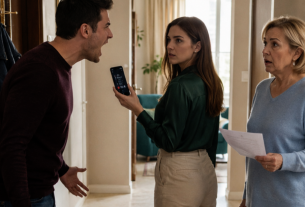
“Are you out of your mind, Misha? Or was this all your mother’s idea?” My voice was calm, almost cold, but inside I was burning. If I’d had an axe within reach, there might have been one newly single widower and one very liberated woman by the end of the day.
I was standing in the middle of the kitchen in an old sweatshirt with stretched-out sleeves, sweatpants, and hair I hadn’t washed. I’d decided to have a Friday without video calls or people. You know the kind: dumplings straight from the pot, hair in a ponytail, and true-crime shows under a blanket. It hadn’t worked out.
It began when Mikhail left his phone at home. He’d gone to the store “for chicken,” as he put it, and left his phone charging. The idiot didn’t even have a lock on it. Why would he? He wasn’t cheating. He was honest. He was “not the kind of person who could betray anyone.”
Right.
I hadn’t meant to snoop. Honestly. But he’d been acting strangely for the past two weeks, hiding his calls and abruptly changing the subject whenever I entered a room. Then his phone pinged. I glanced at it and saw a message from his mother, Alla Sergeyevna—the woman who “only ever wants what’s best” and “never interferes in your marriage, but since you asked…”
I had never asked. She interfered anyway. The message said:
“You haven’t forgotten to get her to sign the power of attorney, have you? We need to see the notary by Wednesday. He goes on vacation after that!”
I read it three times. Then I scrolled up through the chat. Yes, I know it was unethical, but when someone is digging a pit right under your feet, ethics leave the house in their slippers.
It was all there. A plan, step by step. Misha was supposed to persuade me to sign a power of attorney—“for the accounting,” “so you don’t have to waste your time,” “you trust me anyway.” Then, just like that, the business would be in his name. The apartment would come next, through the courts. He was my husband, after all, so he had rights. And his mother, a “former lawyer,” had apparently “thought of everything.”
I sat at the table and stared out the window for about ten minutes. Children were riding scooters in the courtyard. A neighbor in a purple sweater was walking her horribly bald dog. Everything looked painfully ordinary. Inside me, though, something was cracking, like an old mirror splitting from within.
By the time Misha came back with the chicken and a guilty look on his face—he already knew I’d read the messages; it was written across his eyes like a scrolling sign—I was boiling. But I wasn’t shouting. Yet.
“Vika, it’s not what you think…” he began, setting the grocery bag on the floor.
“It isn’t?” I raised an eyebrow. “So there’s no power of attorney for my business? No attempt to trick me out of my apartment? Is this some kind of joke? Do you and your mother celebrate April Fools’ Day every day?”
He lowered his eyes, like a boy caught with a stolen pastry.
“I didn’t want to… It’s just… You said yourself that you were tired, that things were hard. I thought if I helped with the paperwork, it would make things easier for you. And Mom… Well, Mom’s just worried.”
“Misha. I said things were hard,” I repeated slowly. “I didn’t say I’d lost my mind and was ready to sign over everything I own to you and your dear mother. And she’s worried? You know who else gets worried? Financial-crimes investigators, when they find out what you two have been doing.”
He sat down on a stool and buried his face in his hands. He said nothing.
“Tell me straight,” I said, moving closer. “Was this your idea or Alla’s?”
“She… she suggested it. And I thought maybe… maybe it was the right thing to do.”
“The right thing?” I laughed. “You think taking your wife’s business, her apartment, her life is the right thing to do?”
“But we’re family…” he mumbled.
That was when I exploded. I swore and slammed cupboard doors. I opened a kitchen cabinet, took out a can of beans for no reason, put it back, and slammed the door. Then I opened it again.
“What kind of family, for God’s sake? You, me, and that snake of a woman who wants me to hand over everything I’ve earned ‘out of kindness’ and then pay her alimony too? Is that your family?”
He didn’t answer. He knew the answer. He was disgusted with himself; I could see it.
“Do you even know how hard I worked for all this? When you were unemployed for a year and a half, who kept us going? Who paid the mortgage, the office rent, your therapy bills?”
He jerked his head up.
“That was uncalled for.”
“The truth is uncalled for?” I stepped closer. “I can lay it out item by item. Would you like it in an Excel spreadsheet? I know how much you love those.”
He stood up and grabbed his jacket from the hook.
“I’d better go. Give you time to cool down.”
“Go,” I said with a nod. “And take your mother with you. No—first explain why, in this damned plan, I’m just a ‘source of assets.’ Why didn’t you even try to say, ‘No, Mom, that’s a rotten thing to do’?”
He was quiet for a moment. Then he exhaled.
“Because I was afraid.”
“Of what?”
“Of you. That you’d leave. That you’d realize you didn’t need me.”
For a second, that threw me. He looked sincere, like a puppy caught making a puddle on the floor. But sincere or not, my documents could have vanished. My business could have been transferred. My apartment could have been sold. All behind my back.
“Now listen carefully, Misha.” I switched to the tone I usually reserved for my most difficult contractors. “From today on, you don’t touch a single document connected to me. You don’t sign one, look at one, or discuss one. I’m calling a lawyer. I’m checking everything. If I find even one copy of a power of attorney with my signature on it—just one—you’ll be out of here like a cork from a champagne bottle. Understood?”
He nodded silently and left.
I stayed in the middle of the kitchen, feeling as though I’d survived a bombardment. Everything was still standing, but inside, there was nothing but rubble.
Alla Sergeyevna called that evening.
“Hello, Vika. What’s all this fuss you’ve caused now?”
“Alla Sergeyevna.” I held the phone between two fingers, as if it were something sticky. “Are you calling to apologize?”
“No. I’m calling to remind you that family isn’t only about rights; it comes with obligations. You wouldn’t have the life you do without Misha’s support.”
“He betrayed me, with your encouragement. Do you know what happens next? Neither of you will get the apartment or a penny from my accounts. If either of you so much as touches my documents, I’ll report you for fraud. I have screenshots of the entire conversation. My lawyer already knows.”
Silence. Then a brief laugh.
“You really are a bitch, Vika…”
“A bitch with an apartment,” I said, and hung up.
And that was how the day ended.
“So, are you happy now?” Mikhail stood in the hallway looking like a schoolboy unfairly deprived of recess. “You didn’t even give me a chance to live normally. Straight to lawyers, screenshots, accusations…”
“What did you expect?” I glanced over my shoulder without stopping packing his things into a travel bag. “That I’d faint, cry, and beg you not to take my life away? What TV show did you see that in?”
He moved closer, hesitantly, as though I might throw an iron at him. I might have. But I didn’t have an iron in my hands. I had his trousers—the ones he wore to “job interviews.” He’d spent years “finding himself,” and just as many years “going to interviews.” At one point I’d even come to think of those trousers as a symbol: a talisman of unemployment.
“You said you loved me…” he whispered, with so much reproach in his voice that I stopped.
“I did love you, Misha,” I answered wearily. “Until I realized you weren’t a husband. You were a project I’d made a bad investment in.”
He froze as if I’d hit him. Maybe I had, with words. Experience suggests those can hurt more.
“I didn’t sign anything. I wouldn’t have.” He sat down on the little bench by the door and stared at the floor. “Yes, it was Mom’s idea. But I… I was afraid you’d leave me. You’re always so strong. You do everything yourself. And I’m… well, I’m me. I was trying to prove that I mattered too.”
“Prove it?” I turned toward him, holding his tie—the one he’d worn twice in three years, to a friend’s wedding and his uncle’s funeral. “By deceiving me? By committing fraud? Sneaking around behind my back with your mother?”
He was silent. Then, almost casually, he said, “You knew I was weak.”
And that was when I realized: yes, I had known. I’d hoped he would grow up, see things clearly, finally stand beside me as an equal. Instead, he’d climbed onto my shoulders, dangled his feet, and started plotting with his mother.
I left. Quietly, without another argument. In the morning, I put my suitcase in the trunk, set my keys on the hall table, and drank one last cup of coffee in my apartment. There was a sticky residue at the bottom of the cup and the bitter taste of humiliation in my mouth.
“I’ll come back when you’ve cleared out,” I told him, looking him in the eye in the hallway. “The apartment is mine. My grandmother left it to me before we were married. The lawyers confirmed it. The business is mine too. Your name isn’t on anything, and you haven’t invested a penny. So don’t even start talking about marital property.”
He stood there, pale as plaster.
“You’re cruel,” he said. “You really are cruel.”
“And you’re pathetic.”
I slammed the door.
At first I stayed with my friend Lida, a former classmate who had been divorced for ten years and lived by a simple motto: “A man in the house is like a dog. A good one guards it; a bad one makes a mess.”
“Vika, you really gave him hell!” she laughed as she poured semi-sweet wine into our glasses. “You should’ve shoved that power of attorney where the sun doesn’t shine.”
“Yeah,” I muttered darkly. “And then been arrested for inflicting a paper injury.”
We sat in her kitchen, cluttered with jars of pickles and mugs bearing slogans like Don’t Bring Out My Inner Bitch, and talked about what to do next. I kept working. Fortunately, my business was online, my team ran smoothly, and I didn’t need to go into the office much. But I had no intention of returning home while Misha was there with his mother on speed dial.
“Right. Let’s make a list.” Lida pulled out a sheet of paper and a pen. “First: do you have a lawyer?”
Read more
business
Document templates
Business and industry
“Two already. One for property, one for the divorce.”
“That’s what I like to hear. Second: what about the documents?”
“Everything’s been checked. I have copies on a flash drive and in the cloud. I’ve changed the passwords, frozen the accounts pending review, had the cards reissued, and removed Misha from every position of authority.”
“Nice work. Are you sure he couldn’t have come up with this on his own?”
“Positive. Alla Sergeyevna is the brains. He’s just the messenger.”
“Well, then…” Lida raised her glass. “To a new life. No meddling mother, no ‘what if you don’t need me,’ no pitiful looks, and no pretending to be a doormat.”
We clinked glasses. Inside me, the storm was still raging.
A week later, a letter arrived by registered mail. White envelope. Official seal.
Alla Sergeyevna had filed a lawsuit. It wasn’t for the business—she hadn’t managed that. She was claiming the apartment. Supposedly, she had “contributed money toward renovations.” Supposedly, there had been “verbal agreements.” Supposedly, she had given me money, and now I was being ungrateful.
I read it and laughed.
Then I burst into tears. How much must someone hate you to keep going after all that had happened?
I called Misha. He picked up on the third try.
“Misha, tell your mother that if she doesn’t withdraw the lawsuit, I’ll publish a post with all the details. I have twenty-five thousand followers, including lawyers, business owners, and real estate agents. I’ll attach screenshots of your messages. Her ‘reputation as a lawyer’ will collapse in two days.”
He said nothing.
“And tell her that if she tries anything else, I’ll file a counterclaim for emotional distress and pursue every penny. Her pension is sixty-six thousand a month, right? It could take her a long time to pay.”
“Vika…” His voice was quiet, almost childlike. “I don’t know how it got to this point. Everything got out of hand.”
“No, Misha. Everything was in hand. You just handed over control.”
Read more
Residential property rentals
business
business
Two days later, another letter arrived. The lawsuit had been withdrawn.
A week after that, Misha sent me a message.
“I’m going to Tver. Mom is ill, and I need to be with her. Forgive me if you can.”
I didn’t reply.
I went out and bought a new lock for the door.
“So you’re completely on your own now?” the notary asked. She was young, with an unnaturally smooth face and the voice of a call-center operator. “Just to confirm: no relatives who might be entitled to a share?”
“Only exes.” I gave her a faint smile. “But their rights are limited by common sense and the courts. All the paperwork is in the folder.”
The notary nodded and stamped the documents. For a second, a solemn hush settled over the office, like the exhale that follows crossing a finish line. I had just finished putting the business in my name all over again. Legally, it had already been mine, so I hadn’t needed to. But I wanted to cut even the tiniest threads connecting it to Mikhail. I wanted everything cleaned up.
Oddly enough, I wasn’t sad.
Two weeks later, I returned to the apartment.
No fanfare. I simply opened the door with my new key, took off my shoes, and walked barefoot across the floor Mikhail and I had once chosen together. Now it belonged to me alone. And damn it, it was warm.
His shaving foam in the bathroom, a pair of socks under the bed, and a cup with dried coffee in it brought nothing more than a faint smile. In the past, I would have snapped, “Why didn’t you clean up after yourself?” Now I just threw it all away.
My sense of peace didn’t last long.
On the third day, the bank called.
“Hello, Viktoria Sergeyevna. We’re calling to confirm a loan application submitted by Mikhail Grigoryevich, secured against a share of your business. Do you authorize it?”
I nearly dropped the phone.
“Excuse me… which Mikhail Grigoryevich?”
“Mikhail Grigoryevich…” The operator slowly read out his surname. “He states that he is a co-owner and has provided documents.”
“What documents?”
“Company registration documents bearing your signature.”
I knew it was impossible. Everything had been checked and put in order. Even so, a chill ran through me.
“Please stop the transaction. Immediately. This is fraud. I’ll come in tomorrow with my lawyer.”
The next day, I sat in a bank office across from a lawyer, a security officer, and Mikhail.
Yes, Mikhail himself. Wearing the coat I’d bought him for his birthday and looking like a cartoon cat about to say, “I didn’t mean any harm.”
“I don’t understand.” I looked him straight in the eye. “Have you lost your mind?”
He spoke with studied gentleness.
“Vika, you used to say the business was like our child. You wouldn’t take a child away from its father, would you?”
“What kind of father are you? You couldn’t even provide enough toilet paper to count as child support.”
He flushed. The lawyer beside me gave a quiet snort, then quickly composed himself.
“Viktoria Sergeyevna,” the bank representative said gently, “the documents presented do bear your signature. But our preliminary examination suggests it may have been forged. We need to investigate.”
I looked up at Mikhail.
“Was this Alla Sergeyevna’s work? Or did you draw the signature yourself?”
He said nothing.
“You can’t even be a proper criminal. You’re a mistake in a gray coat.” I stood up. “Report it as a crime. That isn’t my signature. And no, I’m not taking the ‘child away from its father.’ I’m calling the police about forged documents.”
Mikhail was detained a week later. He had three forged powers of attorney, a flash drive containing scanned documents, and a printout of my passport. They were all old copies. None was current. All had been stolen before the divorce.
As they took him to the station, he still managed to shout, “You’ll end up alone anyway! Who would want you, with your issues and your business?”
I smiled. Not at him. To myself.
“At least I’ll be rid of you pests.”
The court hearing was a month later.
At first he tried to claim it had been a mistake. Then he said he hadn’t known the documents were forged. Then he said someone had “talked him into it.” Alla Sergeyevna didn’t appear. They said she had high blood pressure. I suspect she’d realized she might get caught up in the case herself.
The judge, a woman in her sixties with a tired face and quick handwriting, summed it up.
“The documents are forged. The signature is not yours. The false entry will be removed from the register, and a criminal case will be opened. Your former husband will be held accountable under the law.”
I thanked her and left.
Outside, the sun was shining—that obnoxious, scorching July sun. But for the first time in a long while, I felt like living. Really living. Without fear, without checking someone’s phone, without constantly wondering what he might do next.
I went home, sat on the sofa, and said nothing.
Silence is a luxury. Especially after living with people who never stopped talking when they thought their words might hurt you.
I didn’t know whether there would be another love, another man, another family.
But I knew one thing for certain: what was mine would stay mine.
And that was a victory.
The end.