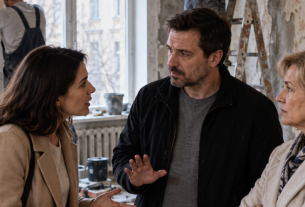
For the May holidays, the entire family prepared to leave with the air of people who were leaving behind not a son with an injured leg, but an old refrigerator that simply needed to be left untouched until they returned. The hallway was crowded with bags, packages of food for the road, folding chairs, and a new insulated cooler bag that her mother-in-law had bought especially for the trip to the holiday resort. Nadia had wiped the floors that morning, cooked porridge for her husband, found a clean towel for his compress, and still felt guilty, because in this house they knew how to make her feel guilty even for the weather.
Her husband was lying in the small room beside the kitchen. In the past, they had kept the ironing board there, boxes of Christmas decorations, and her father-in-law’s old magazines. But after the wedding, the room had been cleared out, a sofa had been installed, and everyone announced that the young couple had been given almost separate living quarters.
Almost—because every day someone walked through their room to fetch jars, tools, the mop, or spare light bulbs. Leonid regarded this way of life with weary sarcasm. At first, Nadia tried not to notice it. Then she grew accustomed to keeping quiet. And eventually, she began to understand that in this house, silence was not taken for patience. It was taken as permission to apply even more pressure.
“Nadezhda, listen carefully,” her mother-in-law said, zipping up her light jacket. “Medicine in the morning and evening. Don’t disturb his leg. Give him warm food. And don’t you dare drag him around to doctors unless it’s necessary. Your fuss only makes things worse for everyone.”
Her mother-in-law’s name was Zoya Pavlovna. She spoke softly, but after hearing that softness, you felt like washing your hands.
Her father-in-law, Grigory Stepanovich, stood in front of the mirror adjusting the strap of his travel bag. The eldest son, Fyodor, was already sitting in the car, while the middle son, Makar, was checking the gate. Both had arrived the previous evening and loudly discussed the vacation, meat on the grill, fishing, and, strangely enough, not once had they asked Leonid how he was feeling.
“Don’t worry, brother,” Fyodor said, peeking into the room and smiling as though he were doing Leonid a favor. “I’ll bring you a souvenir magnet from the resort. You can look at it and imagine you were on vacation too.”
“Better bring back a conscience, if they sell them along the highway,” Leonid replied without lifting his head. “And buy the family-size package.”
Makar snorted but quickly turned away. Grigory Stepanovich frowned, and Nadia immediately tensed. In this house, Leonid’s jokes were considered insolence. The older brothers’ jokes were considered personality.
“You’d be more useful if you talked less,” his father said. “You’re lying there while your wife runs around taking care of you, and you’re still baring your teeth at everyone. No gratitude. No sense.”
Leonid said nothing. Nadia saw his hand tighten beneath the blanket.
His leg was held in a rigid splint from the knee to the ankle, wrapped with neat white bandages. The day before, he had fallen from a leaning ladder while climbing up to inspect a leak above the summer kitchen.
The paramedic Zoya Pavlovna had called had spent a long time feeling Leonid’s shin, shaking his head, and then declared that it looked like a fracture. Leonid needed rest, he said, and an X-ray after the holidays if the swelling did not subside.
Leonid had merely smirked and asked whether he was at least allowed to breathe without written permission from the family.
When the car finally drove out through the gate, the silence brought no relief.
Nadia cooked soup, brought her husband a mug of water, and adjusted his pillow. Leonid hardly ate. He stared at the ceiling and thought about something he refused to discuss. She was angry with him for that silence, but she still felt sorry for him.
Two years of marriage had taught her one simple thing: her husband could argue with his relatives, snap back at them, and stubbornly hold his ground, but every word spoken by his father or mother pierced him far more deeply than he ever showed.
Leonid was the youngest.
From childhood, the eldest, Fyodor, had been introduced to the right people. The middle son, Makar, was forgiven for his cunning and endless tricks. Leonid was assigned the role of the difficult one.
He had started working young. First, he carried boxes in a warehouse. Later, he repaired refrigerated display cases, scales, and checkout counters, until eventually he opened his own small commercial-equipment repair service.
He had started with a garage and a used car, but five years later, he had employees, contracts with stores, and a waiting list of clients stretching a week ahead.
His family had never accepted his success.
They had simply begun treating it as shared property.
During the past few months, Zoya Pavlovna had become especially affectionate. One day she would bring him a casserole. The next she would ask questions about his revenue. Then, casually and apparently by accident, she would ask where he kept the company’s documents, just in case he ever needed help.
Grigory Stepanovich summoned Leonid into his office and lectured him about brotherly support.
Fyodor and Makar had opened a chain of small retail kiosks, but the merchandise was sitting unsold, rent continued piling up, and suppliers were calling more and more often.
Leonid refused to give them money.
After that, a new, sticky tension settled over the house.
By evening, Nadia was so exhausted that she felt as though she herself had spent the entire day trapped in a splint. She settled into a folding armchair beside the sofa, closed her eyes, and slipped into an uneasy doze.
She woke to a faint clicking sound.
At first, she thought her husband was asking for water. Then she saw Leonid sitting on the sofa, calmly unwinding his bandage.
“What are you doing?” she whispered, jumping to her feet.
He sharply raised one finger to his lips and pointed toward the shelf above the wardrobe.
Between a small vase and a sewing box, a tiny red light glowed.
Nadia did not immediately understand what it was.
When she did, her palms turned cold.
In this room, she had changed clothes. She had cried after family dinners. She had whispered things to her husband that were never supposed to leave those walls.
Leonid leaned so close to her that their faces nearly touched.
“A camera. And not just one. I found the recorder in the storage room and learned how to freeze the image for twelve minutes. Right now, they can see me lying down and you sleeping in the chair. So get dressed quietly.”
“You don’t have a fracture?”
“I have a bad bruise and a sprain. The paramedic said what they expected him to say. I already got an X-ray yesterday evening from a real doctor, when I supposedly went out to buy medicine. Sorry I didn’t tell you. I needed them to leave without suspicion.”
Nadia watched him remove the splint.
His leg was swollen, with a dark bruise around the ankle, but he could stand.
Awkwardly, carefully, leaning against the wall—but he could stand.
Anger and fear tangled so tightly inside her that she could not immediately find the words.
“I fed you soup with a spoon.”
“The soup was good.”
“Leonid.”
“I know. Yell at me later. Right now, we need to get what they arranged all this for.”
He took a small key from beneath the mattress.
Nadia followed him barefoot through the corridor, trying to step closer to the walls where the floorboards creaked less.
Without the relatives, the house did not feel empty.
It felt alert.
Leonid did not open his father’s office, as Nadia expected. Instead, he went to the old sewing machine in the corner of the living room.
Zoya Pavlovna kept it there for decoration, covered with a lace cloth.
Leonid removed a side panel, pried up a wooden strip with a screwdriver, and pulled out a flat package.
Inside were copies of contracts.
Nadia read slowly, tracing the lines with her finger.
According to the documents, Leonid was transferring the equipment belonging to his repair business to Fyodor and Makar under a lease-to-own agreement.
Next came an agreement transferring some of his client contracts to their new company.
Then there was a spouse’s consent to the transaction.
Leonid’s signature was already there.
The line reserved for Nadia’s signature remained blank.
“They couldn’t do this without me,” she said.
“No. They couldn’t. That’s why they need you. Tomorrow they were supposed to come back, find Mom’s earrings and Dad’s old stamp in your bag, hold a family trial, and give you a choice: either sign the consent or they’ll report you for stealing from the house and drugging me into a serious condition.”
Nadia wanted to object, but Leonid took out his phone and played a recording.
On the screen, Zoya Pavlovna opened the hallway wardrobe, removed a small velvet box, and slipped it into the pocket of Nadia’s jacket.
Then she placed the old stamp with its worn handle into the same pocket.
They had installed the cameras themselves and, accustomed to believing everyone else was simpler than they were, had forgotten that recordings could work against their owners.
“Who sent you this?” Nadia asked.
“Liza. Makar’s wife. She stayed home with the child. They only took her to the resort for appearance’s sake. They wanted to drag her into this too, but she gave me access to the family’s cloud storage. She said she’s not going to answer for someone else’s loans and someone else’s greed.”
That was the first new piece of truth that made the story about more than just Leonid.
It turned out they were not the only people being pressured in this family.
For years, Liza had smiled at the dinner table, endured Zoya Pavlovna’s barbed remarks, and pretended Makar was merely having trouble finding his path in life.
Then she found a conversation between Makar and Fyodor on his phone. They were discussing Nadia’s signature, the planted earrings, and the paramedic who, in exchange for an old favor, had agreed to write the medical conclusion they wanted.
Leonid put the package back into the hiding place but kept the flash drive.
Then he opened the storage room and showed Nadia the recorder.
The screen displayed feeds from all the cameras: the kitchen, the corridor, their room, the yard, and the hallway.
Beside the machine was a sticker from the installer with a phone number.
Leonid smirked.
“Dad always said I didn’t know how to think ahead. And then he ordered the cameras from my former apprentice. The guy kept quiet at first, but then he called me and said, ‘Leonidych, they’re filming a very strange movie in your house.’”
The next morning, Zoya Pavlovna called by video.
She was wearing a brightly colored sweater, and behind her stood the wooden wall of a cabin at the resort.
Her voice was as sweet as icing on a cake.
“How’s our poor sufferer? Did he eat the cottage cheese I left for him?”
“He’s barely eating,” Nadia answered. “We’re keeping his leg still.”
“Make sure you don’t mix up the pills. Otherwise, later you’ll say nobody warned you.”
Leonid lay beneath the blanket with his eyes closed and hoarsely asked for water.
Nadia held the phone so her mother-in-law could see him looking exhausted.
It was difficult to play the obedient daughter-in-law, but she managed it.
Zoya Pavlovna asked twice whether anyone had come to the house.
The third time, she could not restrain herself.
“Has anyone gone through the pockets of your jacket?”
“Why would they?”
Her mother-in-law smiled too quickly.
“Oh, no reason. I’m just checking that everything is peaceful over there.”
After the call, Liza arrived.
Not through the gate, but across the neighboring property where the fence had sagged after the winter.
She entered the kitchen wearing a simple gray coat, her face pale, holding a bag of children’s cookies as though she were visiting acquaintances rather than coming to witness a family collapse.
Leonid seated her at the table.
Nadia made tea, though no one touched it.
“Makar thinks I’m at my mother’s,” Liza said. “If he finds out I’m here, he’ll scream. But I’m tired. They dump their debts onto everyone around them. First they wanted to put a commercial loan in my name. Now they’re after you, Nadia. Then they said Leonid would get himself out of trouble anyway—he has his service business, clients, golden hands. That’s exactly what they say: he’ll get himself out. As though a person is obligated to survive after every one of their schemes.”
She handed over a flash drive containing messages, voice recordings, and a file in which Fyodor asked a lawyer to backdate the contracts.
There was no single dramatic confession.
Instead, there were many small, sticky phrases:
“We already have the youngest one’s signature.”
“We’ll deal with the wife.”
“Mother will plant the earrings.”
“Father will pressure her with the police report.”
The casualness of it was more frightening than shouting.
No one wrote about committing something terrible.
They discussed Nadia as though she were merely a missing checkmark.
By evening, Leonid called his lawyer, a woman named Rimma Borisovna.
She had handled the legal affairs of his repair business from the very first contract and knew his family well enough not to be surprised.
Rimma Borisovna arrived without drama, wearing a dark coat and carrying a folder and a small recorder.
She listened to Liza, watched the videos, examined the contracts, and said the family should be allowed to finish their performance.
Only now, the stage would no longer belong to them.
The relatives returned the next day before noon.
Officially, it was because Leonid had taken a turn for the worse.
In reality, Liza had already warned them: Fyodor noticed that some files in the family cloud had been opened during the night and decided they should return.
They entered noisily, displaying exaggerated concern.
Zoya Pavlovna immediately rushed toward the sofa.
Grigory Stepanovich remained in the doorway.
Fyodor walked to the hallway and discreetly checked the pocket of Nadia’s jacket.
The velvet box was there.
So was the stamp.
“Nadezhda,” he said loudly. “What’s this doing in your pocket?”
He pulled out the box and raised it for everyone to see.
Zoya Pavlovna gasped.
Makar went pale.
Grigory Stepanovich lowered himself heavily onto a chair, as though he found the entire situation unpleasant but felt duty-bound to fulfill his responsibilities as head of the family.
“So that’s how it is,” he said. “We welcomed you into our home, gave you a roof over your head, entrusted our son to you, and you’re stuffing other people’s belongings into your pockets.”
Nadia looked at Leonid.
He lay quietly with his eyes closed.
Fyodor placed the papers on the table.
“Sign the consent to transfer the equipment, and we’ll settle this as a family. No one has to go anywhere. We’ll say you got confused and took something that wasn’t yours. It happens.”
“And if I don’t sign?”
“You understand perfectly well.”
Zoya Pavlovna stepped closer and grabbed Nadia by the arm.
Her fingers were dry and strong.
“Don’t be stubborn. You’re a girl with no one to rely on. Your husband is bedridden, his father is angry, his brothers are offended. It would be better for you to be obedient.”
At that moment, Leonid sat up.
Not suddenly.
Not theatrically.
He moved heavily, like a man who had grown tired of lying inside someone else’s lie.
He pushed away the blanket, unfastened the straps of the splint, and began unwinding the bandage.
The white strip fell to the floor.
Zoya Pavlovna released Nadia’s arm.
Makar stepped backward toward the wardrobe.
For several seconds, Fyodor stared at his brother, trying to understand exactly when their plan had stopped being a plan.
Leonid stood up.
His leg supported him uncertainly, but he was standing on his own.
“It would be better for you to be obedient,” he repeated quietly. “Good phrase, Mom. You should frame it and hang it beside the family photographs.”
Rimma Borisovna entered the kitchen.
Behind her came Liza, pale but standing straight.
The lawyer placed a tablet on the table and started playing recordings.
Zoya Pavlovna planting the earrings in Nadia’s jacket.
Fyodor checking the hiding place containing the contracts.
Makar urging his brother in a voice message to hurry because the suppliers were demanding payment.
Grigory Stepanovich saying that the youngest son was obligated to save the family anyway, now that he had risen higher than the rest of them.
Then Rimma Borisovna opened the contract file and pointed to the line where Leonid’s forged signature had already been placed.
“The local police officer and a representative from the bank are on their way here now,” she said. “I would advise everyone not to tear up anything, hide anything, or start telling stories about family misunderstandings. A misunderstanding is when someone puts salt in something instead of sugar. Here we have documents, surveillance cameras, and an attempt to coerce a spouse into signing.”
Makar was the first to sit down.
He perched on the edge of a chair, lowered his head, and began saying that he had been dragged into the whole thing.
Fyodor told him to shut his mouth, but it was too late.
Makar spoke quickly and incoherently, jumping from the debts to his father, from his father to his mother, from his mother to Liza.
Liza listened without crying and without interrupting.
Suddenly, Nadia realized she was not the only person in that room who had spent years learning how to remain silent.
Grigory Stepanovich tried to stand, but Leonid stopped him with a look.
“Sit down, Dad. Try not to give orders for five minutes. All my life, I’ve listened to you talk about how you built this house, this family, this order. But your kind of order is simple: rescue the older sons, milk the youngest one, and trap women against the door until they sign whatever paper you need.”
“You’re speaking to your father,” Grigory Stepanovich said grimly.
“I’m speaking to the man who kept a contract for my business and a police complaint against my wife in his safe.”
Suddenly, Zoya Pavlovna began to cry.
Not loudly.
Neatly, as though even her tears had to look respectable.
She approached Leonid and reached out her hands, but he stepped half a pace backward.
That was enough.
Her face changed.
The mother disappeared.
What remained was an offended mistress of the house who had just had the keys snatched away from under her nose.
“You’ll regret this,” she said, all sweetness gone. “Family doesn’t forgive things like this.”
“A family doesn’t plant earrings in its daughter-in-law’s pocket,” Leonid replied. “And it doesn’t sell a son’s life’s work while he’s lying behind the wall listening to them write him off as an expense.”
When the local police officer and bank representative arrived, the conversation became dry and procedural.
The papers were placed into a folder.
The flash drives were packaged.
The recordings were copied.
Fyodor continued talking about temporary difficulties and brotherly assistance, but no one supported him.
Makar stared at the floor.
Liza gave a written statement.
So did Nadia.
Leonid sat beside her with one hand resting on his knee, occasionally grimacing when pain pulled through his leg.
They left the house that evening.
Quietly.
Without slamming doors.
Without dramatic words at the threshold.
Nadia packed two bags: documents, clothes, her husband’s laptop, her notebooks filled with recipes, and a small photograph of herself and Leonid standing beside the first sign outside his repair business.
Liza remained by the gate waiting for a taxi, and Nadia hugged her tightly without making unnecessary promises.
Both women understood that there would still be conversations, paperwork, trips, and difficult attempts by the family to force everything back to the way it had been.
But the first knot had already been cut.
Leonid walked slowly, leaning on Nadia’s arm.
Beside the gate, he stopped and looked back at the house.
Lights were burning in almost every window.
Once, he had dreamed of proving to those people that he deserved their respect.
Now he understood that respect you had to beg for on your own doorstep would always turn out to be counterfeit.
“There’s only one thing I regret,” he said. “I spent too long thinking that if I made myself useful enough, they would finally accept me.”
Nadia adjusted the bag on her shoulder.
“They did accept you. As a wallet.”
He smirked, but there was more exhaustion than amusement in the expression.
Then he nodded toward the road.
“Let’s go. Tomorrow one of my technicians is waiting for me at the warehouse, Rimma Borisovna is preparing the documents, and you promised to yell at me for making you feed me soup with a spoon.”
“I did. And I’m going to yell for a long time.”
“Fair enough.”
They walked toward the car without looking back.
Behind them remained a house where kinship was measured in profit and care was replaced with traps.
The road ahead would not be easy.
But at least there would be no cameras along it, no planted earrings, and no one demanding obedience as the price of being considered one of the family.