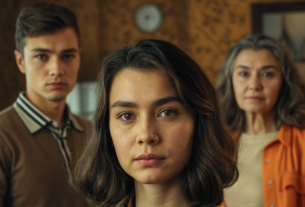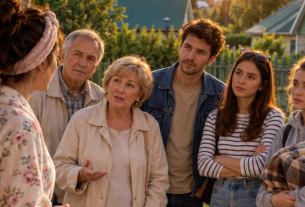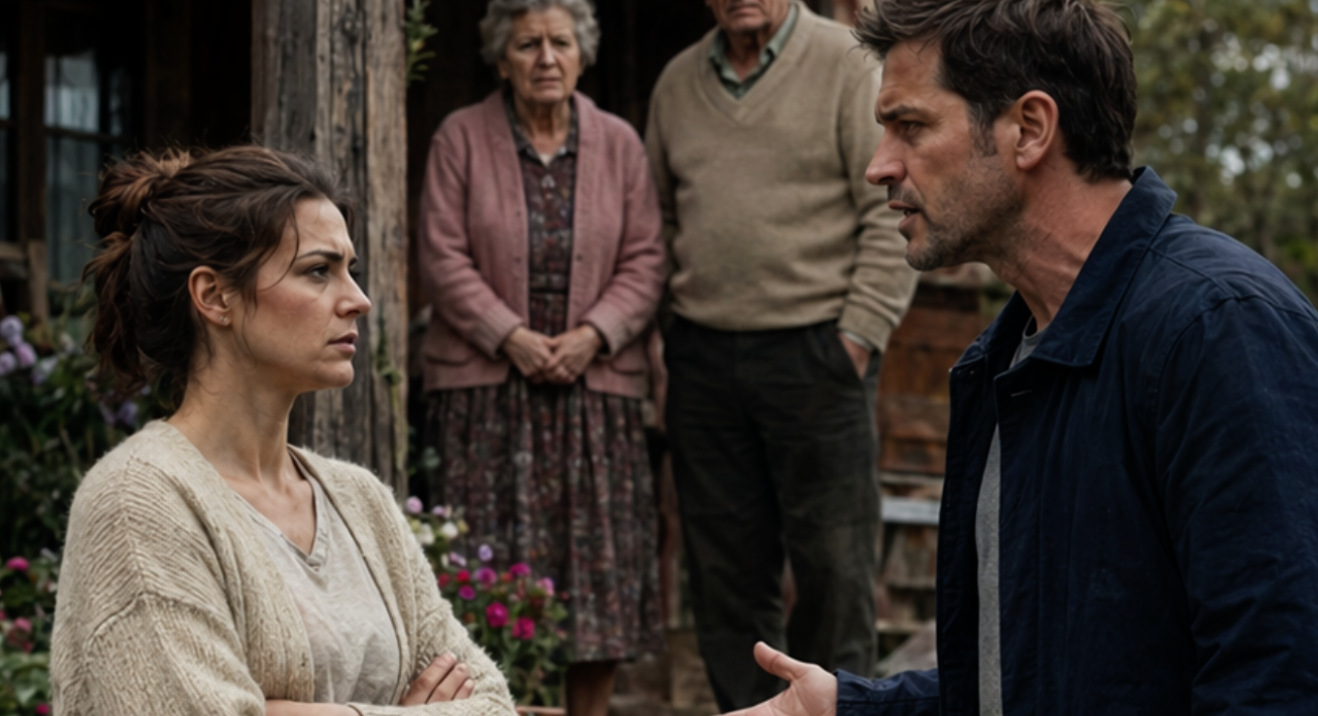
“So tomorrow they’re going to drag all their bundles and bags in here? Ira, have you lost your mind?”
Sergey stood in the middle of the living room, nervously tugging at the cuff of his sweater. In nine years, Irina had never learned to read his mood from the back of his head—and now she realized there was no reason to.
“Seryozha, there was a fire. The wiring failed, and the roof collapsed. They have nowhere else to go.”
“We have a two-room apartment.” He turned around, and his face bore the expression of disgust he usually reserved for conversations about money. “My study is my workspace. That’s where I conduct negotiations and manage my investments. I can’t work while living in some kind of communal apartment.”
“It’s only temporary.”
“And how exactly are we going to pay for this ‘temporary’ arrangement?” His voice grew quieter, which was worse than shouting. “You promised to invest one hundred thousand in my new service this month. If your old folks start living off us, we can forget about everything.”
She said nothing. The hundred thousand would have been her money—earned by working twelve-hour days as an architectural restoration specialist. She had been financing his “investments” for three years already.
He went into the bedroom. Ten minutes later, he emerged with a large suitcase—the same one they had taken on vacation three years earlier. She had paid for that vacation too.
“I’ll stay with Stas for a while,” he said without looking at her. “Call me when you’ve sorted out this circus.”
“But they have no one else to turn to.”
“You’ll figure something out.” He smirked. “You’re the strong one in this family.”
The door slammed shut. Outside, the autumn rain whispered against the windows.
Irina stood there for a moment, then took out her phone and called her friend Vera.
“You see?” Vera said after listening to her. “I warned you three days ago not to rush into telling him about the inheritance. First, you needed to see how he would behave.”
“You were right.”
“Go to Karelia. The house is there, the documents are there, and you’ll be able to clear your head.”
Irina called her parents—alive and perfectly well, drinking tea in their apartment—and told them she was leaving for a month. She packed in an hour: her laptop, clothes, and documents.
The journey to the village took almost an entire day. When the car turned onto a forest track, Irina saw the lake—vast and leaden gray beneath the gloomy sky, with the cold light on the water that existed only there, in the north.
Aunt Klavdia’s house stood at the edge of a cliff. It was large, built from darkened timber, with a carved porch and a weather vane on the roof. The inside was clean. As Irina later discovered, a neighbor came by once a week.
The neighbor, a short, thin woman named Zoya, visited the following morning.
“Klavdia told me to keep an eye on the place in case anyone came. I thought her niece would be just like her—hard as stone. But you have kind eyes.” She paused. “If you need any help around the house, my Oleg can lend a hand.”
Oleg arrived after lunch. He was tall and broad-shouldered, with quiet gray eyes. He inspected the porch, tightened the hinges, and checked the wiring. He showed her how to use the stove—there was a trick involving the damper, without which smoke would pour into the room.
“Thank you,” Irina said as he was leaving.
“It was nothing.” He hesitated slightly in the doorway. “You’re running low on firewood. Let me know, and I’ll bring some.”
She watched him cross the yard and could not understand what he expected in return.
It turned out he expected nothing.
He had simply offered to bring her firewood.
In the mornings, she worked. A client in the capital was waiting for a restoration project for an old country estate, and the deadline had not disappeared. In the afternoons, there was the lake, the gulls, and pebbles beneath her feet.
Oleg stopped by about three times a week. He delivered firewood, once brought fresh fish, and repaired a shutter that squeaked at night. They drank tea on the veranda, wrapped in blankets. He told her about the forest—how animals moved before the snow and how to read signs on the water. She told him about old houses—how masonry could reveal the century in which a building had been constructed and how wood retained warmth differently from stone.
They did not talk much, but they never spoke without meaning.
One evening, she found a basket in the entryway. Inside, wrapped in an old sweater, slept a black puppy with a white patch on its chest.
“His mother is my dog, Naida,” Oleg explained when he came by the next day. “I promised Klavdia a puppy, but I didn’t manage to give her one in time. Let him stay with you. A house needs a dog, after all.”
Irina named him Buran.
A month later, Sergey called.
“Hi, Ira. Listen, I’ve been thinking. We’re adults—there’s no point in sulking. I miss you. I’ll come tomorrow.”
“Don’t.”
“Oh, come on. By the way, some investors are interested in my project. We need to discuss your investment. You understand—this is the perfect moment.”
“I’m filing for divorce, Seryozha.”
There was a long pause. Then came a laugh—forced and deliberate.
“And what are you going to live on? The pennies you earn drawing plans? Expect me tomorrow.”
He arrived at noon. A white foreign car stopped by the gate, and Sergey climbed out, carefully avoiding the puddles. Then he froze when he saw the house.
“Well, would you look at that,” he said with a whistle.
He was already surveying the property like its owner, calculating its potential value.
“Here’s what we’ll do. We’ll sell the house. They want to build a holiday resort around here, so the land must be worth a lot. We’ll invest the money in the startup and move somewhere civilized. Well done, Irka. You were hiding quite an ace up your sleeve.”
He tried to climb the porch steps.
Buran growled.
“I lied to you about my parents, Seryozha. There was no fire. I wanted to see what you would do.”
His face turned blotchy.
“It was a misunderstanding. I wasn’t myself—”
“You behaved exactly the way you wanted to behave.” Irina looked down at him from the porch. “Leave.”
“Property acquired during marriage is jointly owned!” His voice cracked as his mask fell away completely. “I’ll sue you for half the house and every penny in your accounts! You’ll be left here in poverty with your dog!”
“Inherited property isn’t divided,” Oleg said calmly.
He was standing around the corner of the house. He had come to replace a rotten board on the veranda. He held an axe in his hands and wore an old padded jacket. He looked entirely ordinary.
“The law won’t allow it. Property received without payment belongs solely to the person who received it. I may be a carpenter, but I know how to read. Now get in your car.”
Sergey looked at him. Then at Buran.
Something inside him seemed to deflate, as quickly as a punctured balloon. He muttered something, stumbled over a root, and almost ran back to his car. The wheels sprayed mud, and the vehicle disappeared around the bend.
Irina exhaled.
“You heard everything?”
“I wasn’t eavesdropping,” Oleg said. “That board wasn’t going to replace itself.”
She laughed—briefly and freely, in a way she had not laughed for a very long time.
Winter took over the village in a single day. It rained in the morning, and by evening the ground was covered in snow. Ice spread across the lake, and the forest turned white and silent.
Irina did not leave.
One evening, while the stove hummed and a blizzard raged outside, Oleg sat across from her repairing a cabinet hinge. Buran slept at their feet, occasionally twitching one paw.
They were silent.
Not because they had nothing to say, but because nothing needed to be said.
“I’m going into town tomorrow,” Oleg said without lifting his eyes from the hinge. “You can come with me, if you like. You could visit your parents while we’re there.”
“I’d like that,” she said.
The snowstorm continued outside. The fire crackled in the stove.
Nothing more was needed.
“I’m sorry, but I can’t give up my seat—it’s difficult for me to stand,” he said quietly.
The crowd decided that he was pretending.
No one knew that six months earlier, those same legs had held up a collapsing ceiling above a pregnant stranger.
It will bring you to tears…