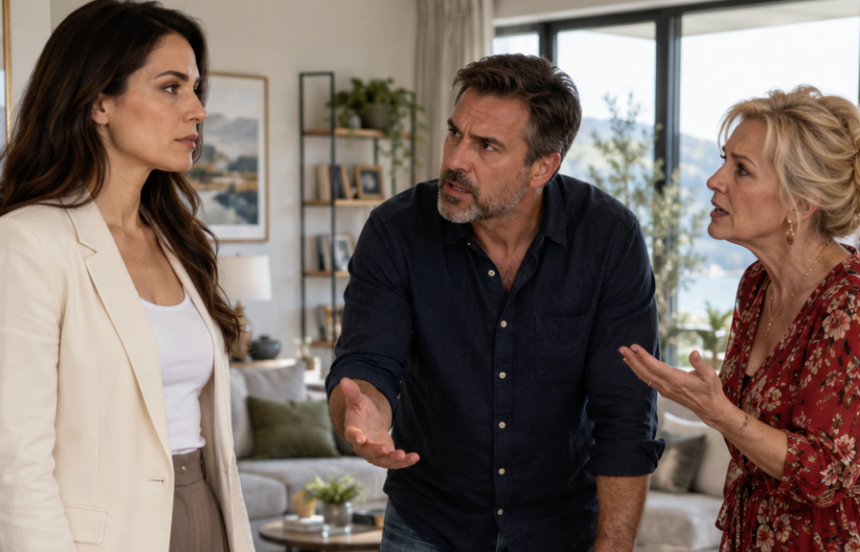
“Listen, are you out of your mind?! Tell me—are you actually sane?!”
Igor stood in the middle of the living room on Friday evening, staring at Marina as though she had just suggested that they move to the Moon.
Marina sat on the sofa with her legs tucked beneath her, scrolling through her phone. Or rather, pretending to scroll. In reality, she had been staring at the screen for three minutes without seeing a single word.
“Igor,” she said calmly, “I only asked whether you could have warned me in advance that we were going to visit your mother tomorrow.”
“Exactly! Warned you!” he mocked her tone with almost childish delight. “I have to warn you?! She’s my mother! Mine! Do you even understand the difference between your mother and mine?”
Marina understood. The difference was enormous—but not in the way Igor meant.
Her mother, Lyudmila Sergeyevna, lived in a small two-room apartment on the other side of the city. She had worked as an elementary school teacher her entire life, now lived on her pension, and never asked anyone for anything. Never. Not once during Marina and Igor’s three years of marriage had she called her son-in-law with a hint or a complaint.
Galina Petrovna was a different matter entirely.
Galina Petrovna Voronova—a loud, heavyset fifty-eight-year-old woman—believed that life owed her something. Deeply, seriously, and irrevocably. She had raised her son alone, and that was the trump card she played at every opportunity. The fact that Igor had actually grown up with his grandmother while Galina Petrovna traveled to health resorts and visited friends was never mentioned in the family mythology.
It wasn’t exactly that Marina’s mother-in-law hated her. She simply failed to notice her, the way one might ignore a piece of furniture that happened to be the wrong color.
“Igoresha, sweetheart, have you eaten?” was her standard question whenever she called. Igor was thirty-three years old, but in Galina Petrovna’s eyes, he remained an eight-year-old boy who needed to be fed and pitied.
Marina had long since grown accustomed to being the unnecessary third side of their triangle.
She woke early on Saturday morning. She had an urgent project with a deadline for a client in Yekaterinburg. Igor was still asleep, sprawled across the bed like a man who had no worries in the world. Which, essentially, was true.
Marina poured herself some coffee, opened her laptop, and out of habit checked her banking app. She merely wanted to see whether the advertising payment had gone through.
She read the figures on the screen three times.
The savings account showed a balance of twelve thousand four hundred rubles.
For three seconds, she sat perfectly still, staring at the screen. Then she opened the transaction history. Yesterday at 11:47 a.m., a transfer of 1,800,000 rubles had been made. The recipient was Igor Alexandrovich Voronov.
She had spent three years saving that money. Every month she had put something aside—sometimes thirty thousand, sometimes fifty thousand when she landed a particularly good project. She had saved quietly, telling no one except her husband.
The money was meant to buy her mother a small house outside Moscow, somewhere she could step out onto her own little piece of land instead of suffocating between concrete apartment walls.
“Igor,” she said in a perfectly level voice when she entered the bedroom, “explain what happened to the account.”
He opened his eyes, stretched, and yawned. And this was the truly strange part: he wasn’t surprised. Not in the slightest.
“Oh, that.” He sat up in bed and looked at her as though they were discussing some minor household inconvenience. “I bought Mom a car for her birthday. A Chery. It’s good and reliable. She’s wanted a crossover for a long time.”
Marina felt something cold run from the back of her neck all the way down to her heels.
“You took my money,” she said slowly. “The money I spent three years saving for my mother, and you used it to buy a car for yours?”
“Our money,” he corrected her emphatically. “We’re married, Marina. Or weren’t you aware of that?”
“Igor.”
“What do you mean, ‘Igor’?” He got up and straightened his T-shirt. “Mom has spent her entire life riding buses. Her entire life! She deserves it. Your mother can keep living in her apartment—the ceilings are fine and the neighbors are quiet. She’ll manage without a present. And so will you.”
He said it so calmly and with such conviction that, for a moment, Marina wondered whether he could even hear himself.
“I’ll pay the money back,” he added generously as he left the bedroom. “Someday. Don’t start worrying ahead of time.”
The family group chat exploded at noon.
Galina Petrovna sent a photograph of a white Chery Tiggo with a red bow on the hood. Dressed in a colorful dress, she held the keys in both hands and laughed at the camera.
“Now that’s what I call a son!! The best present of my life!!!! 🚗🎉🎉”
Three aunts and Igor’s cousin immediately showered the message with hearts and exclamation marks. Marina sat in the kitchen, reading it again and again.
Then she put down her phone and opened her laptop.
She found the number of the insurance company where Igor had taken out comprehensive insurance that morning. It was easy to discover because he had paid for the policy from their joint account, so she had received the notification too.
She called and introduced herself as a co-owner of the account from which the insurance payment had been made. Calmly, she explained the situation: the payment had been processed without her consent, and she was disputing it.
The operator asked her to wait, then transferred her to a senior manager. Marina explained everything again, just as evenly and without unnecessary emotion. She provided the account details and confirmed her identity.
Twenty minutes later, the policy was canceled.
She closed her laptop and looked out the window. Beyond the glass, the September wind rustled through the trees, driving the first yellow linden leaves along the sidewalk. The sky was pale and milky—not gloomy, merely tired in the way it often was at the beginning of autumn.
When Igor came crashing into the hallway, shouting, “Marina, get ready! We’re going to congratulate Mom—and don’t you dare wear that sour expression,” she was already standing in front of the mirror, fastening an earring.
Her expression wasn’t sour.
It was perfectly calm.
Galina Petrovna’s country house was located in a garden cooperative outside the city—forty minutes along the highway, followed by a narrow dirt road between fences.
Marina drove their old Škoda. Igor sat beside her, scrolling through his phone and chuckling occasionally, apparently reading the comments beneath his mother’s photograph.
“She’s so happy,” he said, not addressing Marina but simply speaking aloud to himself. “These are the moments you live for.”
Marina remained silent.
About twelve guests had already gathered at the property—neighbors and relatives. Tables had been carried out into the garden, and plates of cold cuts and homemade preserves stood on plastic tablecloths.
Flushed and boisterous, Galina Petrovna greeted her son at the gate and threw herself around him so enthusiastically that Marina found herself wondering whether the woman had even noticed that someone else was standing nearby.
She hadn’t.
“Sweetheart!” Galina Petrovna laughed, patting him on the shoulder. “You’re worth your weight in gold, do you hear me? Pure gold! This car is a dream—I’m telling you, it’s been my lifelong dream!”
Marina placed the cake they had bought along the way on the table and quietly stepped aside.
The celebration continued. There were toasts and laughter, and one of the neighbors told a story about her vegetable garden. Galina Petrovna drank champagne and kept gazing tenderly at the white Chery parked beside the fence as though it were a living person.
Then, about an hour later, she stood and clapped her hands.
“All right!” she announced in a voice that allowed no objections. “I want to take it for a drive!”
The guests applauded. Igor smiled broadly. He always smiled when his mother was in high spirits.
“Mom, maybe you’ve had a little too much—” he began.
“What do you mean, too much?!” Galina Petrovna was already walking toward the car and picking up the keys as she went. “I can handle it! Igoresha, sit beside me and give me directions!”
Marina stood beneath an apple tree and watched.
Igor dropped into the passenger seat with the air of a man who couldn’t be bothered to argue. Galina Petrovna settled behind the wheel, adjusted herself and repositioned the mirror, looking as businesslike as though she had been driving an automatic her entire adult life.
In reality, the last time she had driven had been about fifteen years earlier, in an old manual Lada. Even then, she had not driven for long; she had given up after putting the first scratch on the bumper.
But who would bring up such details at her birthday celebration?
The guests crowded around the gate. Someone had already pulled out a phone to record the event. Their neighbor, Aunt Raya, clasped her hands to her chest in delight. The atmosphere was festive and full of anticipation.
Marina did not move.
The engine started on the first try, quietly and almost soundlessly. Galina Petrovna clicked her tongue in admiration.
“Do you hear how it purrs?” she shouted through the open window.
“Mom, the accelerator is sensitive,” Igor began. “Don’t press it too hard—”
“I know how to drive!”
The car lurched forward more sharply than intended. Galina Petrovna gasped, and the guests near the gate stepped back. Then the Chery slowly and majestically crawled out onto the narrow lane—two tire tracks running between wooden fences, barely wide enough for two cars to pass.
Marina looked down the road.
The lane was treacherous. Long-term residents of the cooperative knew that near the end, just before the chairman’s property, the road narrowed. The fence there was made of brick—a solid structure built back in the nineties—and a drainage ditch lined with concrete rings ran beside the shoulder. It was deep, almost a meter. They had been planning to cover it for years but had never gotten around to it.
Everyone who had lived there for more than one summer knew about it.
Galina Petrovna had owned the country house for eight years.
At first, everything went reasonably well. The car moved slowly, swerving slightly, while Igor spoke quietly and gestured, apparently giving her instructions. The guests moved closer to the gate and craned their necks.
Then Galina Petrovna decided to turn around.
She chose the narrow section in front of the chairman’s fence—the one place where she absolutely should not have attempted it.
Marina saw the white Chery swerve sharply to the right. Then the engine roared. Galina Petrovna had clearly confused the pedals.
Instead of reversing, the car shot forward—straight into the brick fence.
The impact was unexpectedly loud.
There was a second of silence, and then everything happened at once: bricks cracking, metal grinding, a scream from inside the car, and gasps from the gate.
With its front end buried in the collapsed section of the wall, the Chery slid sideways until its right wheel dropped into the ditch. It came to rest at an angle, looking absurd and hopeless, like a large white animal caught in a trap.
Aunt Raya covered her mouth with her hand.
Some of the guests were already running toward the car.
Marina didn’t run. She slowly stepped into the shade of the apple tree, took out her phone, and ordered a taxi.
Igor climbed out first. He was pale, his hair disheveled and his legs stiff. He examined the front of the car, crouched down, stood up, and examined it again. His face made it seem as though the ground beneath his feet had turned out to be made of cardboard rather than solid earth.
Galina Petrovna remained in the driver’s seat, crying. Not quietly or with restraint, but loudly and dramatically, both hands pressed to her cheeks.
“My car! My beautiful little car! Oh God, what has happened?!”
The chairman of the cooperative, Viktor Stepanovich, was already emerging from the neighboring property. He was about sixty-five and wore the expression of a man who had been awakened at the wrong time, even though he had not been asleep.
He looked at his fence. Then at the car. Then at Igor.
“Call the traffic police,” he said curtly before going to get his phone.
Igor turned around and saw Marina.
She stood beside the gate with her bag over her shoulder, calm and upright.
“Where are you going?” he asked. For the first time that day, there was neither command nor condescension in his voice. He was simply a bewildered man who desperately needed someone to support him.
“I ordered a taxi,” she replied.
“Marina, wait. The traffic police are coming. We need to sort this out—”
“Then sort it out.”
She said it without anger or triumph. She was merely stating a fact.
“Did you take out comprehensive insurance?” she asked, looking him in the eyes.
He nodded automatically, still unaware of the trap.
“Check the policy,” Marina advised. “Check it right now.”
Something in her tone stopped him. He took out his phone and opened the insurance app. Marina watched his expression change—first confusion, then disbelief, and finally dawning comprehension.
“How…” He looked up. “What does it mean, ‘policy canceled’?”
“The payment came from our joint account,” Marina said. “Without my consent. I disputed it this morning.”
He stared at her as though he were seeing her for the first time.
“The car is registered in your name,” she continued. “That means the loan is yours. The cost of repairing the fence is yours too. The traffic police, the report, and everything else—you handle it yourself.”
“Marina…”
“And one last thing.” She zipped her bag and looked at him with perfect calm. “On Monday, I’m filing for divorce and division of marital property. You knew what that money was being saved for. You made your choice. Now I’m making mine.”
Galina Petrovna began sobbing again inside the car. Some of the guests tried to comfort her. Viktor Stepanovich stood beside the hole in his fence looking like a man whose patience had run out twenty years earlier.
The taxi arrived four minutes later.
Marina got into the back seat, closed the door, and asked the driver to leave. As the car pulled away, she saw the scene one final time through the window: the tilted white Chery, Igor standing there in confusion with his phone in his hand, her sobbing mother-in-law, and the ruined brick fence.
Then the trees hid everything from view, leaving only the road ahead.
Marina leaned back against the seat and looked out the window. September fields, rust-colored and weary, flew past beyond the glass. The sky above them was high and cold.
She decided that she would call her mother that very evening.
Lyudmila Sergeyevna answered after the second ring. She always answered quickly when her daughter called.
“Marinka? Is everything all right?”
Marina sat beside the window in her apartment. Igor hadn’t returned. He was apparently dealing with the traffic police, the chairman, the tow truck, and what remained of a birthday celebration that had turned into something entirely different.
His phone was silent. There had been no messages and no calls.
“Mom,” Marina said, “I want to tell you something.”
She spoke for a long time—calmly, without tears, and in order. She told her mother about the money, the car, and what had happened at the country house.
Lyudmila Sergeyevna listened silently, occasionally sighing under her breath. When Marina finished, there was silence on the other end of the line for several seconds.
“How are you?” her mother finally asked.
Not “How could you?” or “I told you so.” Simply: “How are you?”
“I’m all right,” Marina replied. “Honestly, Mom. I’m all right.”
And it was true. It felt strange and slightly empty, but it was true.
Igor came home late that night.
Marina was still awake, sitting with her laptop and finishing her client’s project. When she heard the lock click, she didn’t turn around.
He entered the living room, sat on the edge of an armchair, and remained silent for a long time.
Then he said, “The tow truck took the car away. The assessor said it was a total loss. It can’t be repaired.”
Marina nodded without looking away from her screen.
“The fence will cost about eighty thousand,” he continued. “The chairman has already prepared an estimate, as though he’d been waiting his entire life for this.”
“Maybe he had,” Marina said.
Igor rubbed his face with his hands.
“Are you really going to file on Monday?”
“Yes.”
“Marina, can we just talk about this properly?”
“We’re talking properly right now.” She closed her laptop and looked at him. “Calmly, without shouting. What do you want to say?”
He opened his mouth, but apparently he didn’t know. The familiar words—“You’re exaggerating,” “We’ll sort it out,” and “I already explained everything”—wouldn’t come.
Perhaps it was because Marina was looking at him without anger or tears, and without the confusion he had always been able to use to his advantage. She merely looked at him evenly and wearily.
“You spent three years saving that money,” he finally said, something trembling in his voice. “I know.”
“Yes, you do,” she agreed.
“But Mom…”
“Igor,” she interrupted gently, “your mother is a grown woman. Mine is a grown woman too. I worked for three years so she could have a small piece of land. Not a yacht or a villa—just a little house. You knew that, and you still did what you did. Then you said she could manage without it.”
He remained silent.
“Well, now I’m saying the same thing,” Marina added as she stood. “I’ll manage without you.”
Monday arrived quickly, the way anticipated days always do.
Marina had made an appointment with a lawyer on Sunday evening. A friend had recommended her—a family-law specialist with an office in a nearby business center.
That morning, Marina got dressed, took the folder of documents she had calmly and methodically assembled throughout Sunday, and left the apartment.
The day was gray but dry. September was living out its final days. The trees along the avenue were half yellow and half green, as though they had not yet decided whether they were ready to surrender.
The lawyer was a precise, no-nonsense woman of about forty-five who had a habit of asking short, direct questions. She immediately took a liking to Marina because she had arrived with all the necessary documents, spoke without hysterics, and knew exactly what she wanted.
“Marital property, deposits, movable assets,” the lawyer listed as she made notes. “The car your husband purchased—is it registered in his name?”
“Yes.”
“The funds were withdrawn from your savings account?”
“Yes. I have the statement.”
“Good.” The lawyer made another note. “That will be useful.”
Marina left the office an hour later with her folder of documents and a clear plan.
Outside, she stopped and raised her head. The sky was white and high, the way it often was at the end of September when summer was already gone and true autumn was only beginning.
She took out her phone and wrote to her mother:
“I’m coming over. We need to talk. It’s something good.”
Lyudmila Sergeyevna opened the door before Marina had time to ring the bell. She had apparently been waiting beside the window, as she always did.
“Come in. I’ve put the kettle on.”
Her mother’s apartment was small, but it was so lived-in and unmistakably hers—with geraniums on the windowsill, crocheted doilies, and the aroma of fresh baking—that Marina always relaxed slightly whenever she came there, like someone taking off a heavy coat.
They sat in the kitchen, and Marina told her about the lawyer, the documents, and what would happen next. Lyudmila Sergeyevna listened with both hands wrapped around her cup. Marina could see how hard her mother was trying not to show how deeply it all hurt her—not for herself, but for her daughter.
“Mom,” Marina said, “I want to show you something.”
She opened a saved page on her phone. It was a listing for a small house forty kilometers outside the city. A sturdy one-story house with a plot of land, several apple trees, and a little veranda visible in the photograph.
“I have some money,” Marina said. “Not all of it, but part of it. The lawyer says I’ll receive compensation when the property is divided. And I have a little more in another account—I didn’t keep everything in the same place.”
Lyudmila Sergeyevna stared at the screen.
“Marinka…”
“Look at the veranda,” Marina said. “Your geraniums would look perfect there.”
Her mother laughed unexpectedly, almost through her tears. Marina laughed too, and they sat together in that little kitchen beneath the September sky. It was a little funny and a little bitter, but also deeply genuine.
Galina Petrovna called on Wednesday.
Marina saw the name on the screen, waited a second, and answered.
“So you’ve decided to destroy the family after all,” her mother-in-law began without any greeting, speaking like someone who had prepared her speech in advance. “I knew it. I told Igoresha that you weren’t one of us, that you were an outsider—”
“Galina Petrovna,” Marina interrupted calmly, “how are you feeling after the accident?”
There was a pause.
“I’m fine,” her mother-in-law replied, thrown off balance. “Well, mostly fine. My arm hurts a little—”
“I’m glad to hear that. Get well soon.”
Marina ended the call.
Then she sat quietly for a moment, looking out the window. Branches swayed beyond the glass as the wind drove broken clouds across the sky and tore the last leaves from the trees. October was already on the doorstep.
Marina opened her laptop, found the listing for the house with the veranda and apple trees, and wrote to the real estate agent to arrange a viewing that weekend.
Then she leaned back in her chair and, for the first time in several days, felt something resembling lightness.
It wasn’t joy yet. It wasn’t complete relief.
It was simply open space ahead—clean, empty, and entirely her own.
For now, that was enough.
Marina and her mother viewed the house during the first weekend of October.
The real estate agent—a young man with a tablet and a habit of calling everything “an excellent option”—opened the gate and let them enter first.
The plot was small and a little neglected, with three old apple trees and garden beds that had long been waiting for someone’s care. The house was a sturdy one-story building with the same veranda shown in the photograph. The wood had dried and cracked slightly, but the windows were good.
Lyudmila Sergeyevna stepped onto the veranda and stood silently for a long time, looking out at the garden.
“We’ll take it,” she finally said.
Marina smiled.
The divorce was finalized in November. There were no scandals and no court hearings. Igor didn’t fight it. Perhaps he was tired, or perhaps he had simply realized that there was nothing left to argue about.
Marina received the full amount of compensation. Her lawyer handled everything flawlessly.
Igor moved in with his mother. People said Galina Petrovna had welcomed him with open arms—her darling son had returned, and now they would live happily together.
Of course, the loan for the wrecked Chery and the debt owed to the cooperative chairman had not disappeared. How they managed those problems was no longer Marina’s concern.
Not at all.
They moved her mother into the house in January. Marina arrived with two friends and her mother’s former neighbor, who kindly lent them his vehicle.
There weren’t many belongings: Lyudmila Sergeyevna carried her geranium on her lap for the entire journey; there were several boxes of books and a rocking chair that hadn’t fit into the elevator and had to be carried down the stairs by four people amid general laughter.
Her mother immediately arranged the flowerpots on the veranda.
The geranium stood exactly where Marina had said it would.
In the spring, Marina visited every weekend. She and her mother worked in the garden, painted the veranda, and argued over which color curtains would look best in the small room.
In the evenings, they drank tea and listened to the young leaves rustling outside the window.
One day, her mother asked casually while looking into the garden:
“Do you regret it?”
Marina considered the question honestly. Not for a second—she truly thought about it.
“No,” she replied.
And once again, it was the truth.