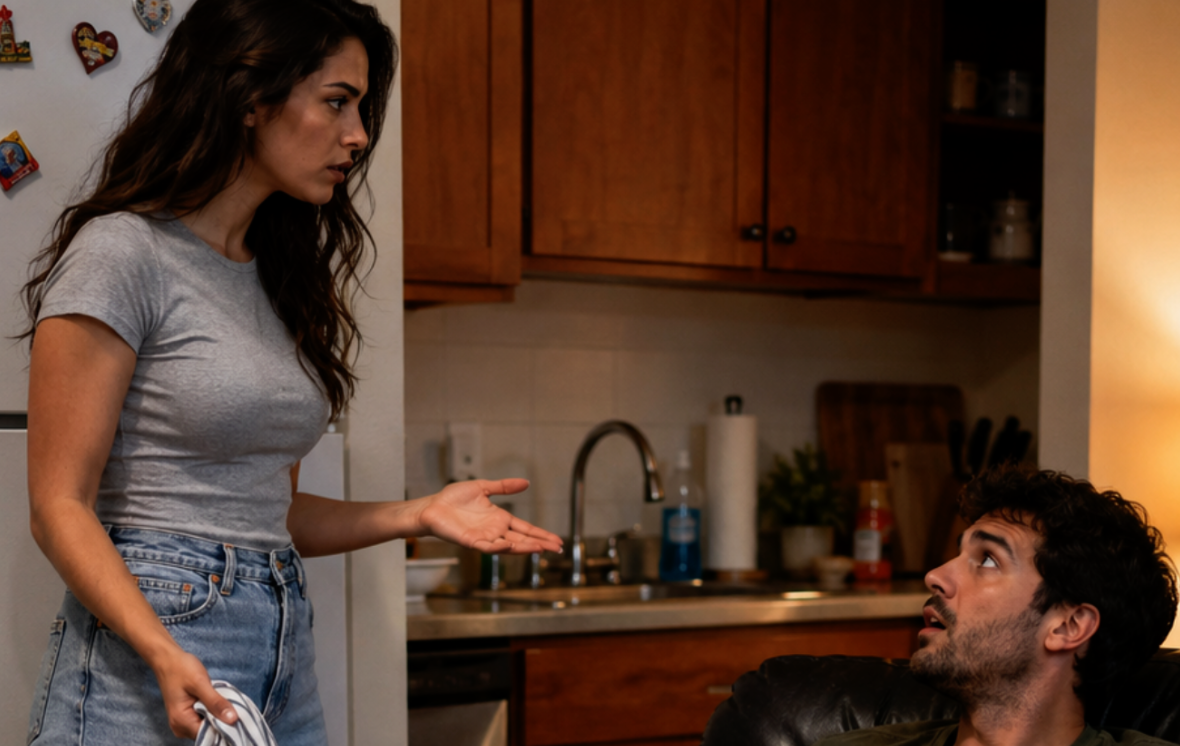
“Viktor!” Nadezhda’s voice cut through the evening silence of the apartment like a sharp knife. “Why haven’t you paid the electricity bill again? I’ve asked you a hundred times!”
A grunt came from the other room, followed by a dull thud. Nadya knew that sound well—Viktor had dropped the TV remote again while sprawling on the sofa.
image
“Oh, Nadya, why are you starting again? I forgot. I’ll pay it tomorrow, first thing in the morning.”
Standing in the middle of the kitchen with the bills in her hands, Nadezhda felt the familiar wave of irritation rising from deep inside her.
“Your ‘tomorrow’ has already lasted a whole week! Have you forgotten that last time they came to disconnect the electricity?” She walked over to the living-room doorway and saw him stretched out on the sagging sofa, crumbs from potato chips scattered across his T-shirt.
“Why are you shouting?” Viktor lifted his head. His sleepy, slightly glazed eyes stared at his wife. “I told you, I’ll do it tomorrow. Or transfer me some money and I’ll pay it online right now.”
Nadezhda sighed heavily. Money. Of course. She always had to give him money, even for his own minor expenses. She worked two jobs just to make ends meet, while he… he simply existed.
“I don’t have any money, Viktor. And you know that perfectly well. And even if I did, what would you spend it on? On another one of your ‘tomorrows’?”
“Nadya, enough already. I’m tired. I worked all day. I have the right to rest.” He turned back toward the television, making it clear that the conversation was over.
Nadezhda turned away, clenching her teeth. She wanted so badly to tell him everything that had accumulated inside her over the years of their marriage. All those little things that had been eating away at her piece by piece. But she knew it was pointless. He didn’t hear her. Or perhaps he simply didn’t want to.
She returned to the kitchen to put the kettle on. She needed to make something for dinner, but as usual, the refrigerator was almost empty. More precisely, it was empty for her and Marina, their daughter. Somehow, there was always something in it for Viktor.
Nadezhda and Viktor had met in a small town where she had moved after graduating from technical college. Nadezhda was young, hopeful, and very naive. At first glance, Viktor seemed to be her complete opposite—self-confident, with a slightly rough, masculine manner. He knew how to speak charmingly and how to court a woman.
At the time, she worked as a sales clerk in the local department store, while he worked at a factory. He didn’t stay at the factory for long, though. He changed jobs more often than he changed his socks, constantly complaining about unfair bosses or low wages.
But Nadezhda wasn’t bothered by that. She believed these were only temporary difficulties and that with her love and support she could help him find his place in life.
Their relationship developed quickly. Six months later, they were already living together, and after a year they got married.
Nadezhda’s parents, simple and hardworking people, did not approve of her choice. Her father immediately recognized Viktor’s instability and lack of determination.
“Nadya,” he used to say, “look at him. He’s like a tumbleweed. Here today, somewhere else tomorrow. You don’t need a man like that.”
But Nadezhda was in love. She believed love could overcome any obstacle.
The first years of their marriage were like a roller coaster. Periods of relative stability were followed by complete poverty. Whenever Viktor did work, he spent his wages on himself—questionable gatherings with friends, repairs to his old car that constantly broke down, expensive cigarettes.
Nadezhda had to take cleaning jobs after finishing her regular work just to buy groceries and pay the utility bills.
She didn’t complain. She believed everything would eventually get better.
When Marina was born, Nadezhda stopped working for a while. That was the hardest period of all.
Viktor got a job as a taxi driver, but instead of bringing money home, he often disappeared for several days and then returned with ridiculous stories about the car breaking down or some urgent fare taking him out of town.
Nadezhda had to borrow money from neighbors and ask her parents for help.
One day, when Marina was about two years old, Nadezhda came down with the flu. Her temperature rose to forty degrees Celsius, and she lay in bed completely exhausted.
Marina was crying because she was hungry, while Viktor… Viktor was asleep on the sofa.
Nadezhda barely managed to crawl into the kitchen to make some porridge for her daughter, and that was when she realized things could not continue like this.
“Viktor!” she croaked, trying to wake him. “Marina is hungry. Make her something to eat.”
He grunted irritably and turned toward the wall.
“I want to sleep. Make it yourself.”
At that moment, Nadezhda felt something inside her break.
It wasn’t anger. It wasn’t even hurt.
It was emptiness.
The realization that she was alone.
Completely alone with her problems and her child.
After that incident, Nadezhda decided she would no longer depend on Viktor. She went back to work and enrolled Marina in kindergarten.
Gradually, she learned to live as though Viktor wasn’t there at all. He became like background noise, like a piece of furniture.
Present, but never involved.
Remembering all of this, Nadezhda felt bitterness rise in her throat. She put the kettle on and took the leftover chicken from the refrigerator. Somehow, she would have to make it last for two days.
Suddenly Viktor’s loud voice came from the living room.
“Nadya! There were some potatoes in the refrigerator.”
Nadezhda froze.
The potatoes.
She had bought them yesterday so she could make mashed potatoes for Marina.
“There were,” she called back. “Why?”
“Well, I ate them. Yesterday. Forgot to tell you.” He appeared in the doorway, chewing something. “Why didn’t you even boil them? I had to do it myself.”
Nadezhda walked toward him, struggling to control her anger.
“Viktor, those were the last potatoes! I wanted to make mashed potatoes for Marina tomorrow!”
“Oh, come on. Big deal. You’ll buy more.” He waved his hand dismissively. “I was hungry.”
That was too much.
Potatoes.
Such a small thing.
But that small thing became the final straw.
“You’re always hungry!” Nadezhda raised her voice. “You don’t care what we’re going to eat tomorrow, do you? You don’t care about Marina?”
Viktor stared at her, genuinely confused.
“What’s the big deal? I wanted something to eat. So what?”
“The point is that you live only for yourself!” Nadezhda felt her voice trembling. “You never think about anyone else! Not Marina, not me!”
Viktor smirked.
“Oh, come on, Nadya. You always make a mountain out of a molehill. What am I, not your husband anymore?”
“Husband?” Nadezhda laughed bitterly. “You haven’t been a husband for a long time. You’re just a tenant. A tenant who eats, sleeps, and does nothing!”
Silence fell.
For what seemed like the first time in years, Viktor looked at her without indifference. Something resembling hurt flashed in his eyes.
“Well, you know, I’m not obligated to—”
“Not obligated?” Nadezhda interrupted. “You’re not obligated to work? Not obligated to take care of your family? Not obligated to pay the bills? What exactly are you obligated to do, Viktor?”
He turned away, rubbing the back of his head.
“I’m tired of your accusations.”
“And I’m tired of your laziness! Your irresponsibility! I’m tired of carrying everything on my shoulders!”
At that moment Marina came out of her room.
“Mom, Dad, what happened? Why are you shouting?”
Nadezhda immediately calmed herself and tried to smile at her daughter.
“Nothing, sweetheart. Everything’s fine. Go wash your hands. Dinner will be ready soon.”
Seeing Marina, Viktor softened as well.
“Yes, sweetheart, everything’s fine. Mom is just a little tired.”
Marina nodded and went to the bathroom.
Nadezhda felt all the energy drain out of her. She knew the conversation would lead nowhere.
Viktor hadn’t understood anything.
Or he simply didn’t want to understand.
Nothing changed after that conversation.
Viktor continued living according to his usual routine. He could spend an entire day lying on the sofa watching television or playing computer games. When he had a job, it brought in very little money, and even that disappeared immediately.
Nadezhda felt exhaustion building inside her.
She tried talking to him, explaining, pleading, but nothing worked.
His answers were always the same.
“Yes, yes, Nadya, I understand. I’ll change. Tomorrow I’ll start a new life.”
But that “tomorrow” never came.
She began to notice that more and more often she caught herself thinking she would be better off alone.
Without his endless excuses.
Without his bottomless appetite.
She had to hide food so he wouldn’t eat everything in one sitting. She began buying groceries in small quantities so there would never be anything extra left in the house.
Marina also began noticing her father’s behavior.
One day, while Nadezhda was preparing lunch, Marina approached her.
“Mom, why does Dad eat so much?” she asked, watching Viktor devour his portion without paying attention to anyone else.
Nadezhda didn’t know what to say.
She hugged her daughter.
“He just really likes eating, sweetheart.”
“But then there’s nothing left for us,” Marina said quietly.
Nadezhda felt a stab in her heart.
Her daughter.
She had to endure this attitude toward food. She had to watch her own father eat food that should have been shared with her and her mother.
Evenings became unbearable.
In the past, Nadezhda had at least tried to create the appearance of a family dinner. Now she simply placed the food on the table in silence and tried to finish the meal as quickly as possible.
Viktor, meanwhile, devoured whatever he saw without showing much interest in whether anyone else had eaten.
Nadezhda began thinking about divorce.
The thought came to her more and more frequently.
But she was afraid.
Afraid of being left alone with a child.
Afraid of being judged.
Afraid of change.
Besides, she felt sorry for Viktor.
He wasn’t an evil person.
He was just… the way he was.
Neglected. Undisciplined.
Maybe she could still change something?
But how?
She had tried everything she could think of.
Conversations, persuasion, arguments.
Nothing helped.
She began staying late at work more often simply to avoid returning to the oppressive atmosphere waiting for her at home.
After Marina went to bed, Nadezhda would sit alone in the kitchen, drinking plain tea and thinking.
Thinking about her life.
Thinking about how she had ended up like this.
Eventually, Nadezhda decided to see a psychologist.
She found the contact details of a free crisis center online. She hesitated for a long time, but finally made herself go.
It was her last chance.
She hoped the psychologist would give her some advice, some kind of tool that would help her change the situation.
The first few sessions were a revelation.
She talked about her life, about Viktor, about Marina.
The psychologist listened carefully and asked questions.
“Nadezhda,” the psychologist said during one session, “you’re describing a life in which you constantly give, while your husband only takes. Do you understand that this is not a partnership?”
Nadezhda nodded.
She understood.
But what was she supposed to do?
“He won’t change, Nadezhda,” the psychologist continued. “You can spend your entire life trying to change him, but it won’t produce results. Only someone who genuinely wants to change can change.”
“But it’s not his fault that he’s like this,” Nadezhda said, barely believing her own words.
“Perhaps,” the psychologist replied. “But you are not obligated to live with someone who does not value or respect you. You are not obligated to sacrifice your life for him.”
Those words struck Nadezhda like a bolt from the blue.
She had never thought about it that way.
She had always believed family was sacred, that you had to endure, that you had to keep fighting until the very end.
“What should I do?” Nadezhda asked.
“You need to make a decision,” the psychologist said. “Either you continue living the way you do now and accept all the consequences, or you change your life. And that will not be easy.”
Nadezhda left the psychologist’s office with a heavy heart.
She understood that she was about to make the most difficult decision of her life.
For several days, Nadezhda walked around as if in a fog.
She thought about everything she had been told and analyzed her life.
She looked at Viktor, still lying on the sofa as always, and realized she couldn’t do it anymore.
She simply couldn’t live like this anymore.
The decision was extremely difficult for her.
She knew it would be hard on Marina, but she also understood that remaining in such a situation would be even worse for her daughter.
Marina saw everything.
She saw how her father treated her mother.
She saw how he behaved.
Nadezhda did not want her daughter growing up in that kind of atmosphere.
She began gathering documents.
She researched divorce procedures and the division of marital property.
Money was tight, but she believed she could manage.
One evening, while Viktor was once again dozing on the sofa, Nadezhda sat down across from him.
For a long time, she looked at his sleeping face.
There was no cruelty in it.
No aggression.
Just… emptiness.
“Viktor,” she said quietly, “we need to talk.”
He mumbled something incomprehensible and opened one eye.
“What happened?” he asked sleepily.
“I want a divorce,” Nadezhda said.
Viktor sat upright immediately.
He looked at her as though she had lost her mind.
“What? Are you joking?”
“No, Viktor. I’m not joking. I can’t live like this anymore.”
He stood and approached her.
“Nadya, what are you talking about? We’re a family! We’ve been together for so many years!”
“A family?” Nadezhda gave a bitter laugh. “What kind of family is this, Viktor? One person works for two while the other only consumes? One carries everything on their shoulders while the other does nothing?”
“But I… I’m trying!” He attempted to hug her.
Nadezhda stepped away.
“No, Viktor. You’re not trying. You’ve never tried. You live only for yourself.”
“It’s all because of those… psychologists of yours!” He waved his hand dismissively. “They’ve filled your head with nonsense!”
“No, Viktor. It’s not the psychologists. It’s me. This is my life, and you’ve turned it into a nightmare.”
He fell silent.
Panic flashed in his eyes.
“Nadya, listen… I’ll fix everything! I’ll get a job! I’ll help!”
“It’s too late, Viktor,” Nadezhda said. “I don’t believe you anymore. I’ve heard those promises hundreds of times.”
Silence descended.
Heavy, suffocating silence.
Viktor lowered his head.
“What about Marina?” he asked quietly.
“Marina will stay with me.”
He looked up at her.
There was pleading in his eyes.
“Nadya, don’t do this. Please. I’ll change. I really will!”
Nadezhda looked at him.
There was no sincerity in his voice.
He was simply afraid of being left alone.
“No, Viktor. I’ve made my decision.”
The next several days passed in tension.
Viktor tried to persuade her. He promised her everything imaginable, but Nadezhda remained firm.
She understood that this was the only way out.
She filed for divorce.
The process began.
At first, Viktor was furious.
He shouted and blamed her for everything he could think of.
But Nadezhda was prepared for it.
She listened to his shouting in silence and then simply walked away.
After a while, Viktor accepted it.
He realized her decision was final.
He began looking for somewhere else to live and packed his belongings.
On the final evening before Viktor was supposed to leave, Nadezhda made dinner.
She tried to remain calm, but inside everything felt painfully tight.
Marina stayed in her room.
Viktor sat at the table eating silently.
For the first time in years, he did not throw himself at the food. Instead, he ate slowly, as though savoring every bite.
Suddenly he looked up at her.
“Nadya,” he began, “do you remember how we met? You were still working at the department store then, and I used to come in every day and buy candy from you.”
Nadezhda nodded.
“I remember.”
“And do you remember our first kiss? In the rain, outside your house.”
Memories flooded over her.
She remembered how happy she had been then.
How strongly she had believed he was her destiny.
“I remember,” she said quietly.
“And Marina…” Viktor looked toward his daughter’s room. “She’ll grow up to be a good girl. I know she will.”
Nadezhda felt tears gathering in her eyes.
“Yes, Viktor. She will.”
He fell silent and finished his dinner.
Then he stood up.
“Well, I should go.”
Nadezhda stood to see him out.
At the door, he turned around.
“Nadya, forgive me if I did anything wrong.”
Nadezhda nodded.
She couldn’t speak.
Viktor stepped outside and closed the door behind him.
Nadezhda stood in the middle of the hallway, listening to the sound of his footsteps fading into the distance.
Silence.
The apartment had suddenly become unusually quiet.
She went into the kitchen to clear the table.
Then her eyes fell on the refrigerator.
The door was open.
And inside…
“Vitya! Where are Marina’s sausages?” Nadezhda’s voice echoed through the empty apartment.
The shelf where Marina’s favorite sausages had been—the ones Nadezhda had been saving as a treat for her the next morning—was empty.
The sausages were gone.
Nadezhda closed her eyes.
A deep breath.
Then an exhale.
And suddenly she felt a smile appearing on her lips.
A small, almost imperceptible smile.
“Well, Viktor,” she whispered. “You’ll never change. Never.”
For the first time in many years, she felt relief.
Real, complete, overwhelming relief.
She had finally freed herself from the heavy burden she had been carrying.
Now she could begin a new life.
Her own life.
And that felt good.
Very good.