The money disappeared for the first time on Thursday.
Diana did not notice it right away—not because she was careless, but because she had not expected it. The small box had been sitting on the bedroom shelf for three years, ever since Diana had developed the habit of keeping part of her cash separate from her bank card. Not because she distrusted banks—simply because it was convenient. Small repair expenses, household purchases, sometimes flowers for herself, just to lift her mood. The money in the box was a working tool, not a safe.
That Thursday, Diana opened the lid and counted the bills. Then she counted them again. Then she set the box aside and tried to remember—maybe she had taken the money herself and forgotten? Three thousand was not a disaster. Maybe she had bought something and failed to write it down.
She convinced herself. Closed the lid.
She and Timur lived in an apartment Diana had inherited from her aunt before the wedding. It was a two-room apartment in an old building with high ceilings, in a good neighborhood—property like that would cost a fair amount on the market, and Diana understood that. She had done the renovations herself, little by little, saving from her salary. She worked as a senior accountant at a trading company and earned seventy-four thousand plus annual bonuses.
Timur worked as a logistics manager and earned around fifty-five thousand, though not consistently. Diana covered the apartment expenses—utilities, repairs, household needs. Timur gave money for groceries and sometimes for things they did together for fun.
They had been married for five years. The first two years had been good—Timur was simple, but dependable; he knew how to lift her mood and rarely argued. The problem was called Yevgenia Arkadyevna, and she appeared around the third year.
Yevgenia Arkadyevna was Timur’s mother—a sixty-two-year-old woman, large, talkative, with that special kind of confidence that required no justification. She simply knew what was right. How a kitchen should look, how borscht should be cooked, how a son’s wife ought to welcome guests, how family life should be arranged. Yevgenia Arkadyevna generously shared this knowledge during every visit.
The visits were frequent and always unannounced.
Diana tried several times to hint to Timur that she would like to know in advance when her mother-in-law was coming. Timur agreed and said he would tell his mother. Then either he did not tell her, or he did, and Yevgenia Arkadyevna did not consider it necessary to change her habit. And so it went: Diana would open the door, her mother-in-law would be standing on the threshold with bags, and the visit would begin.
Taisiya was Timur’s younger sister, about twenty-eight. Unmarried, she worked at some marketing agency and lived with Yevgenia Arkadyevna. She appeared either with her mother or separately—always with the same ease as someone entering her own home. She could come when Diana was not there, sit with Timur, eat something from the fridge. Diana often learned about these visits only afterward.
“Timur,” Diana said one evening, “I’m asking you for one thing. When your mother or Taisiya wants to come over, let them call me first. Not you—me. This is my apartment.”
“Diana, come on,” Timur grimaced, like someone who had been asked an uncomfortable question. “They’re family, not strangers.”
“Family also calls before coming over.”
“It’s awkward for Mom to ask every time. She says it makes her feel like a guest.”
“She is a guest,” Diana said. “This is not her apartment.”
“Don’t start.”
Diana did not start. She simply went silent and made a note somewhere inside herself—one more thing decided without her.
When the money disappeared for the second time, the amount was no longer three thousand—it was seven. Diana counted the money in the box twice, then went into the room where Timur was watching television.
“Timur, money has disappeared from the box again.”
Her husband glanced in her direction.
“Are you sure you counted it?”
“I’m an accountant. I know how to count.”
“Maybe you took it yourself and didn’t write it down?”
“I would remember seven thousand.”
“Then maybe last time you took it too and forgot. Diana, why do you immediately think of my mother?”
“I didn’t say anything about your mother.”
“But you’re thinking it,” Timur muted the television and turned toward her. “Listen, enough already. Mom comes over, Taisiya comes over—they’re not doing anything bad. You’re always looking for a problem where there isn’t one.”
“Seven thousand is not my imagination.”
“Maybe you spent it yourself and don’t remember. Or maybe your husband took it—you probably have those thoughts too, admit it.”
Diana looked at her husband for a second. Then she returned to the bedroom, closed the box, and put it back on the shelf.
She did not argue. She simply began to think.
The solution came the next day—at lunch, while Diana was sitting at her desk reviewing documents. The thought was simple and entirely practical: words would prove nothing. Any conversation would end the same way—Timur would say she was mistaken, Yevgenia Arkadyevna would be offended, Taisiya would say something sharp. She needed facts that could not be denied.
After work, Diana stopped by an electronics store. Not a big shopping mall, but a small shop where there was only one salesman and he did not ask unnecessary questions. She bought two small cameras—the kind that are about the size of a coin and disguised as different objects. One looked like a small charger, which she plugged into the hallway outlet. The second was a black cube, like a decorative item, which she placed on the shelf opposite the box in the bedroom.
She set them to record on motion. Checked the viewing angle. Made sure the box was visible in the frame.
She told Timur nothing.
Not because she wanted to set a trap—rather because she understood: if she told him, the cameras would become useless. Either Timur would warn his mother and Taisiya, or he would start another conversation about Diana being paranoid and not trusting the family. Either way, there would be no truth.
For three days, nothing happened. Diana reviewed the recordings in the evening—empty, only she herself entered the bedroom, and the hallway remained empty. On the fourth day, Timur left on a two-day business trip—to Kostroma, a planned visit, he had said the day before.
On the fifth day, the hallway camera recorded movement at 11:43 in the morning.
Diana watched the footage that evening, sitting at her laptop in the kitchen. First, the hallway. The door opened. Yevgenia Arkadyevna entered—in a coat, with a bag, businesslike, as if she were entering her own place. She took off her shoes and walked down the hallway. Then into the bedroom.
The bedroom camera showed the rest. Yevgenia Arkadyevna approached the shelf, opened the box, and looked inside. She stood there for several seconds. Closed it. Left.
Diana pressed pause. Looked at the timestamp. Rewound a little forward.
At 12:17, the front door opened again. This time—it was Taisiya. Also with her own key—quickly, habitually, without a second’s hesitation. She walked into the hallway, without even taking off her shoes, straight into the bedroom. Opened the box. Took several bills—not in a hurry, not even counting them. Closed the lid. Adjusted the box so it stood straight. Left.
Diana watched the recording to the end—nothing else happened.
Then she closed the laptop and sat in silence for some time. It was already dark outside; one lamp above the table was on in the kitchen. Diana looked at her hands folded in front of her and did not think about the money. The money was simply a number. She thought about the keys. About the fact that Yevgenia Arkadyevna and Taisiya had a key to her apartment. Not Timur’s apartment—her apartment, which she had received before marriage and where she had lived for seven years. Who gave them that key? Timur, obviously. Had he asked Diana? No.
And no one had considered it necessary to explain.
Diana stood up and put the kettle on. While the water boiled, she opened the laptop again and copied the recording onto a flash drive. Then onto her phone. Then to the cloud. Three copies—just in case. She was an accountant and knew very well that documents needed to be stored in several places.
Timur returned from his business trip on Friday evening. Diana greeted him normally—there was dinner, there was conversation. Not a word about the cameras, not a word about the recording.
On Saturday morning, Diana called Yevgenia Arkadyevna.
“I’d like to invite you for lunch,” she said. “On Sunday. Timur will be here, you and Taisiya too—as a family. It’s been a while since we sat down properly together.”
Yevgenia Arkadyevna was surprised—just barely, at the edge of her voice. Then she said they would come.
Diana spent Sunday calmly. She prepared lunch—soup, a main course, sliced appetizers. She set the table properly. She placed her phone in the center of the table, as if that was where it belonged—no one paid attention.
Yevgenia Arkadyevna arrived at one in the afternoon, with Taisiya right behind her. They sat down and ladled soup into bowls. Yevgenia Arkadyevna immediately started talking—first about the weather, then about the neighbors, then smoothly moved on to the fact that Diana had been somewhat nervous lately.
“I notice it,” her mother-in-law said. “You’ve become closed off. Unwelcoming. We come over, and you look at us as if we’re bothering you.”
“Yevgenia Arkadyevna,” Diana said, “I’m glad when you come over. I just prefer to know in advance.”
“We’re not strangers!” Yevgenia Arkadyevna said it with such conviction that she seemed to believe it completely herself. “Why all these formalities between family?”
“Well, Mom is right,” Timur added. “Diana sometimes goes overboard with this.”
“I’m not going overboard with anything,” Diana said evenly.
“Oh, come on,” Taisiya smirked, setting her spoon aside. “You make a scandal out of every little thing. You lost your money and blamed us.”
“I didn’t lose anything.”
“Sure,” Taisiya spoke with the ease of someone who was confident she would face no consequences. “You went to Timur and complained that money had disappeared from the box. Maybe you just count badly?”
Yevgenia Arkadyevna smirked. Timur looked down at his plate.
Diana picked up her phone.
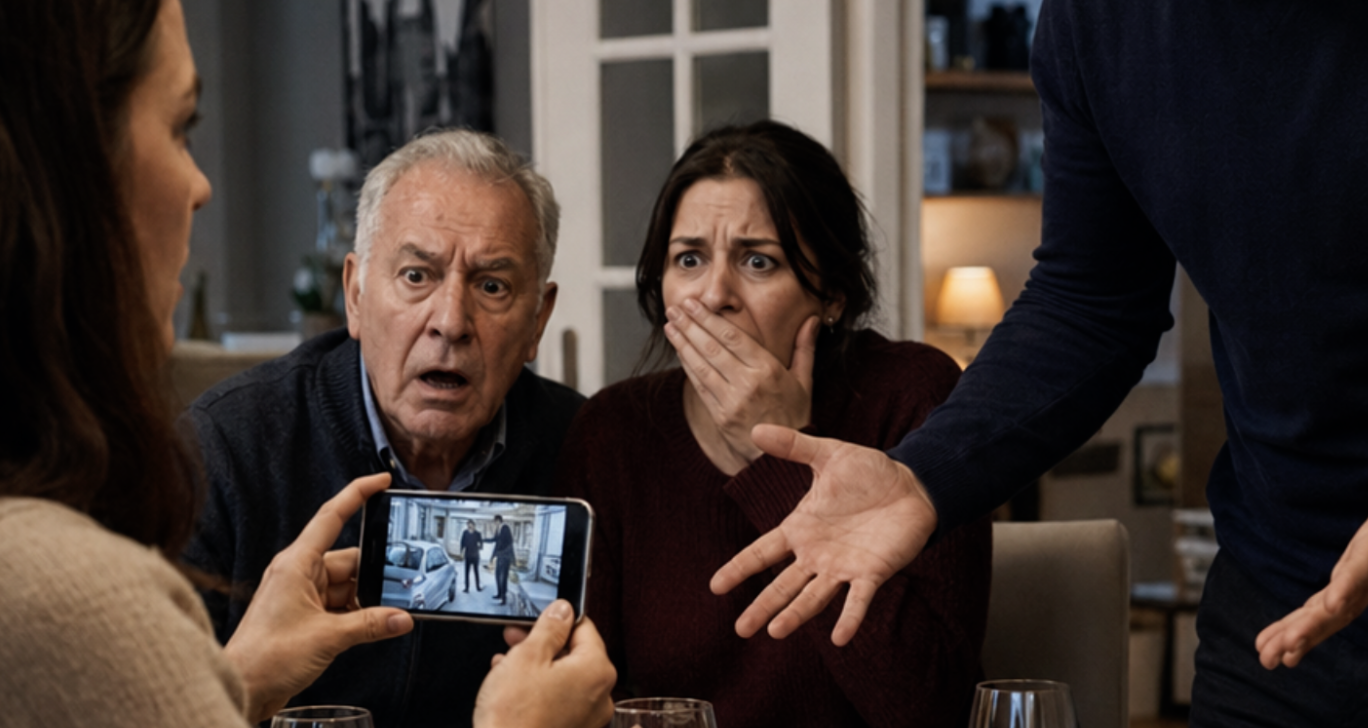
“I installed a camera,” the wife said calmly. “Would you like to see who took the money?”
For a second, the table went silent—the special kind of silence when everyone understands at once that something has changed, but does not yet know exactly how.
Taisiya was the first to try to recover.
“What, you were spying on us?”
“I was watching who entered my apartment and took my money,” Diana held the phone steadily, without rushing. “Those are different things.”
“Diana,” Timur began cautiously, “what is this…”
“Watch.”
Diana pressed play. She placed the phone screen in the middle of the table so everyone could see.
The hallway. The door opened. Yevgenia Arkadyevna entered—in the same coat she had come in today. She took off her shoes. Went into the bedroom. Opened the box.
The table was completely silent.
Then—Taisiya. The same door, the same key, the same confidence. Bedroom, box, bills, the lid neatly placed back.
Diana pressed stop.
Yevgenia Arkadyevna stared at the table. Taisiya looked away. Timur looked at Diana, and in his gaze there was something Diana had never seen before: not anger, not defensiveness, but something like the confusion of a person caught between two truths, not knowing which side to stand on.
“This…” Yevgenia Arkadyevna began.
“Wait,” Diana interrupted. “First I want to ask a question. Who gave you the key to my apartment?”
A pause.
“Timur gave it to me,” Yevgenia Arkadyevna finally said. “Just in case. You never know.”
“Timur,” Diana turned to her husband, “you gave them a key to my apartment without my knowledge?”
Timur was silent.
“Did you ask me?”
“Diana… Mom… it was for emergencies…”
“That is not an answer.”
“No,” Timur said quietly. “I didn’t ask.”
“Good,” Diana nodded. “Now the second question.” She looked at her mother-in-law. “Yevgenia Arkadyevna, you entered my apartment with my key, a key you had no right to have, went into my bedroom, and opened my box. Why?”
Yevgenia Arkadyevna straightened.
“I was checking whether everything was all right. You’re always busy, you don’t have time, so sometimes I check.”
“In the box?”
“Well, you never know.” Her mother-in-law’s voice became a little firmer—this was her transition into defense. “I didn’t take anything. This is all Taisiya’s idea, that…”
“Mom!” Taisiya sharply raised her head.
“On the recording,” Diana said evenly, “you open the box. Taisiya takes money. Both of you used your own keys. This is not an invention.”
“You filmed us on purpose!” Taisiya slammed her glass down on the table. “You were spying! That’s illegal!”
“Recording inside your own home is legal,” Diana said. “But entering someone else’s apartment without permission, and especially stealing, is not.”
“Stealing?!” Taisiya stood up. “Did you just say stealing?!”
“I said what happened.”
“Diana, maybe there’s no need to put it like that,” Timur reached out his hand, almost touching his wife’s shoulder. “Let’s be calm. We’re still family.”
“Timur,” Diana looked at her husband, “you just saw the recording. You saw your mother open my box. You saw your sister take money from it. And you’re saying, let’s be calm?”
“They didn’t mean any harm…”
“Whether they meant harm or not is not the point,” his wife leaned back in her chair. “The point is that money has been disappearing from me for months. I told you. You said I was mistaken. That I was losing it myself. That I was wrong to suspect family.” Diana paused. “Did you know?”
“What?” Timur turned pale.
“Did you know they were taking it?”
“No! Diana, I swear…”
“Then you simply didn’t believe me.” His wife looked at him without anger—she was merely stating a fact. “Five years of marriage, and you chose not to believe me, but to believe that I was mistaken about my own box.”
Timur did not answer. He looked at the tablecloth—at the place where his soup stood, which no one had finished.
By then, Yevgenia Arkadyevna had gathered herself.
“Listen, Diana,” her mother-in-law began in that special softness which, in strong personalities, always comes before an attack, “we’re family. Things happen. Maybe Taisiya took a little—she’ll return it, what’s the big deal? Why turn it into a performance? These cameras, this recording…”
“Yevgenia Arkadyevna,” Diana interrupted, “how many times have you entered my apartment without warning over the past six months?”
“Well… several times.”
“And each time with your own key. A key that was given to you without my knowledge.”
“Timur is my son!”
“The apartment is not Timur’s.” Diana said it clearly, without raising her voice, but with such finality that the table fell silent again. “This is my apartment. I received it before the marriage. The mortgage is in my name. The renovations were paid for with my money. Keys are given out with my permission. Only with my permission.”
“So you treat your own husband like a tenant?” Taisiya found her voice again; there was mockery in it, but it had already cracked.
“I keep my home in order and want to know who enters it,” Diana replied. “That is normal.”
“You humiliated us!” Taisiya stepped toward the table. “You supposedly invited us for lunch, but you had the camera ready! That’s low!”
“Taisiya,” Diana looked directly at her, “you came into someone else’s apartment with someone else’s key and took someone else’s money. Do you really want to talk about what’s low?”
Taisiya fell silent.
Yevgenia Arkadyevna began saying something about family values, about how young people today did not understand what it meant to stick together, about how people did not behave like this in her day. The words flowed in their familiar stream—loud, confident, forceful. Diana listened silently, looked at the table, and waited until it ended.
“Yevgenia Arkadyevna,” Diana said when a pause finally appeared, “I am asking you and Taisiya to leave.”
“What?!”
“Leave the apartment. Now.”
“You’re throwing us out?!” Yevgenia Arkadyevna looked at her son. “Timur, do you hear this?!”
“Timur,” Diana turned to her husband, “and I’m asking you for the keys too. From all three of you. Right now.”
Timur looked at his wife. His face held such a mixture of shame, confusion, and something like an attempt to still build a compromise that Diana almost felt sorry for him. Almost.
“Diana, let’s not…”
“The keys, Timur.”
“Are you serious?”
“Absolutely.”
Timur took the keys out of his pocket. Removed the right one from the key ring and placed it on the table. Yevgenia Arkadyevna demonstratively rummaged through her bag for a long time, then put down her key with the look of someone doing a favor. Taisiya threw hers onto the table without a word.
Diana gathered all three.
“Thank you,” the wife said. “Now leave.”
Yevgenia Arkadyevna left with the air of a person who had been insulted undeservedly and unfairly—it was audible in how loudly her footsteps moved through the hallway. Taisiya did not say goodbye. The door closed.
Timur remained at the table.
“Should I leave too?” the husband asked quietly.
“Yes,” Diana said.
“Diana…”
“Timur. You didn’t believe me. For several months I told you money was disappearing—you said I was wrong. You gave a key to my apartment without my permission. And just now you sat at this table and asked me not to blow things out of proportion when you saw the recording.” Diana looked at her husband. “What exactly do you want to explain to me?”
“I didn’t know they were taking the money.”
“You didn’t know. But you didn’t believe they were taking it. There is a difference, isn’t there?”
Timur was silent. Then he slowly stood up.
“Where should I go?”
“To your mother,” Diana said. “They seem to understand you well there.”
It was said without malice—simply as a fact they both had known but had not spoken aloud for five years.
Timur left. The door closed a second time—more quietly than the first.
Diana sat at the table for another ten minutes. Then she got up, cleared the dishes, and covered the pot of soup with a lid. She went into the hallway and looked at the three keys in her hand. She put them in the dresser drawer—temporarily, until the lock was replaced.
On Monday morning, before work, Diana stopped by a hardware store. She chose a new lock—a good one, with recoding. The locksmith came at lunchtime and replaced everything in forty minutes.
That same evening, Diana called a lawyer. Not because she wanted to sue—simply because she wanted to understand what options she had and what legal significance the incident carried. The lawyer listened calmly and asked several questions. She said that the video recording was strong evidence, and if Diana wanted to proceed officially, there were grounds. She also explained property division in the event of divorce—the apartment, acquired before marriage, was not subject to division.
Diana thanked her. She wrote several figures and terms in her notebook. Closed the notebook.
Timur called often during the first few days. He sent messages—first offended ones, then conciliatory ones, then offended ones again. Yevgenia Arkadyevna wrote several times too—briefly, with reproach: you destroyed the family. Taisiya did not write.
Diana replied rarely and briefly. Not because she wanted to punish them with silence—there was simply nothing to add to what had been said at the Sunday table.
Two weeks later, she filed for divorce. Without unnecessary explanations, without attempts to have one final conversation. She simply made an appointment, went, and filed.
Timur received the notice and called that same evening.
“Diana, maybe we shouldn’t rush like this? Let’s at least talk.”
“Timur, we talked for five years,” Diana said. “I think we talked enough.”
“I’ll change. I’ll talk to Mom, to Taisiya…”
“That’s good. Talk to them.” Diana said it without sarcasm. “Really. But this is no longer about us.”
“Why?”
“Because for several months you told me I was wrong. That I was inattentive. That I had lost it myself. You chose their truth over mine. That is not the kind of mistake you fix by talking to your mother.”
Timur was silent for a while.
“You won’t give me a chance?”
“I gave you one for five years.”
She never returned to the subject again.
The divorce was finalized after the required waiting period. There was practically no property to divide—the apartment was Diana’s, and they split the belongings without a scandal. Timur moved in with his mother.
Diana removed the box from the bedroom—not because she was afraid, but simply because there was no point in keeping cash in plain sight. She set up another storage system, a simpler one. She left the cameras—not out of suspicion, but because a new lock plus a recording meant order. An accountant’s habit: document what happens. Then you will not have to prove it later.
Several months passed. Life settled into the quiet rhythm that comes when you stop spending energy on something that has not worked for a long time. Diana went to work, occasionally met with friends, and finally started working on the balcony—she had long wanted to turn it into a proper reading space, but had never gotten around to it.
One evening, she was sitting on that balcony with a book. It was warm and quiet; someone was walking a dog in the courtyard. Diana read a page, then looked out into the yard, then read again.
Her phone lay beside her on the small table, screen down. Not because she wanted to hide from the world—there was simply nothing urgent, nothing that required immediate attention.
For the first time in a long while, the apartment was simply quiet. Not empty—quiet. Her own.
Diana turned the page and continued reading.