Ulyana was coming home with two bags in her hands from the hardware store, where she had bought baseboards, silicone sealant, and a couple of door handles for the second apartment. Small things, but it was exactly those small things that created the feeling that everything was going according to plan. The tenants were supposed to come the day after tomorrow, she had printed out the contract yesterday, and she had checked the meters last week. All that remained was to tidy up a few details, and they could sign.
She went up to her floor, opened the door, and put the bags down in the entryway. Andrey was sitting in the living room with his phone and did not even turn around.
“I bought the baseboards,” Ulyana said, taking off her shoes. “Tomorrow I’ll go install them, and that’s it — the apartment will be ready.”
“Mm-hmm,” her husband replied.
Ulyana went into the kitchen and put the kettle on. She looked at the refrigerator, at the little magnet with a view of Saint Petersburg that they had brought back from a trip three years ago. Three years — and yet it felt like it had been only recently. Back then, everything had been a little different.
She poured herself some tea and stood thinking as she looked out the window. It was already getting dark outside; October was taking over.
Before Ulyana bought the second apartment, no one in the family had been particularly interested in what she did in her free time outside her main job. Her husband, a sales manager at a wholesale company, earned about seventy thousand a month. He would come home, eat dinner, and watch something on TV. Maria Pavlovna, her mother-in-law, lived in a nearby district and called every two days to talk about her blood pressure, the weather, and how Andrey had been such a good boy when he was little.
Ulyana worked as an accountant at a small transport company, earning sixty-five thousand, and also took on clients for remote bookkeeping, which added an average of twenty to twenty-five thousand a month. She worked steadily, without overexerting herself, but without unnecessary spending either. She saved carefully, in a separate account that Andrey had no access to. Not because she was hiding anything — it was simply more convenient that way, and he had never shown much interest.
The apartment they lived in belonged to Ulyana. She had bought it five years before the wedding, back when she was working for her first employer and saving literally every spare thousand. At the time, she had been alone, without help from her parents: her mother had died early, and her father had long ago moved to another city with another family. It was a two-room apartment in a panel building, not exactly close to the center, but it was hers. Ulyana had cried right there in the notary’s office when she signed the documents — not from sadness, but from relief.
When they got married, Andrey moved into Ulyana’s apartment. He treated it as his own: he invited friends over, rearranged furniture, and once, without discussing it, glued some shelves onto the balcony wall. Ulyana did not make a scandal out of it. Marriage was marriage, she decided. Let him feel at home.
The dream of a second apartment appeared about two years after the wedding. Not as a whim, but as a calculation. Ulyana had done the math: if she rented out a one-room apartment for thirty-five to forty thousand a month, that would be almost half a million in additional income per year. She could give up some of her remote clients, stop exhausting herself so much, and have a financial cushion in case anything happened.
When Ulyana first told Andrey about it over dinner, he looked up from his plate and snorted.
“Where are you going to get that kind of money?”
“I’m saving little by little. And I’ll look for a cheaper option.”
“Sure, sure,” her husband said and went back to eating.
Maria Pavlovna found out about the idea a week later — Andrey mentioned it during one of their family tea visits. Her mother-in-law set her cup down and looked at Ulyana with the expression Ulyana had learned to read over the years of married life: polite condescension.
“Ulyanochka, why would you need a second apartment? It’s such a headache — tenants, repairs, scandals. Live peacefully.”
“I’ll manage, Maria Pavlovna.”
“Of course,” her mother-in-law smiled. “There’s no harm in dreaming.”
Andrey had stayed silent then, but it was clear from his face that his mother’s words had not offended him. Quite the opposite — he nodded, as if agreeing with something obvious.
Ulyana did not answer. She simply remembered that expression.
For the next two and a half years, she saved methodically. She gave up unnecessary expenses — she did not go on vacation farther than the region, did not update her wardrobe unless necessary, did not go to restaurants. Andrey was sometimes surprised by her thriftiness, but he never looked into the details. He had his own life: sports bars with friends on Fridays, a new phone every year, fishing in the summer.
The inheritance came unexpectedly. A distant relative — a second aunt on her mother’s side, whom Ulyana had seen maybe three times in her life — passed away and left her a small sum. The notary called on an ordinary Tuesday, and for several minutes Ulyana could not understand what he was talking about. Then she understood. The amount was modest — a little under eight hundred thousand — but combined with what Ulyana had already saved, it suddenly became enough.
She did not tell her husband right away. First she went to the notary, then to a realtor, and then spent three months looking at options. She found a one-room apartment in a residential district — not a new build, but a clean building, in good condition, with decent neighbors on the floor. The price was slightly below market because the previous owners were in a hurry. Ulyana bought it.
That evening, when she received the keys, she entered the empty apartment, turned on the light, stood in the middle of the room, and thought: here it is. No tears this time. Just quiet, firm joy.
She told Andrey over dinner, simply and briefly:
“I bought an apartment. I’m going to rent it out.”
Andrey raised his head.
“Seriously? You said you were still short.”
“It was enough. The inheritance helped.”
“Oh,” her husband said. “Well, that’s good.”
No excitement, no surprise. Just — well, that’s good. Ulyana nodded and put the plate in the sink. In truth, she had not expected any other reaction.
Maria Pavlovna, however, reacted much more energetically. She called the next day.
“Andryusha told me you bought an apartment. Well done, of course. Imagine that, you managed it.” A pause. “Is it big?”
“One room, Maria Pavlovna.”
“I see. Well, that’s good. Matvey just needs something like that.”
Matvey was Andrey’s younger brother, twenty-six years old. He worked here and there, lived with his mother, occasionally tried to change something, but somehow none of his attempts ever led anywhere. Ulyana did not know him very well — they saw each other at family celebrations and talked about nothing in particular.
“Matvey?” Ulyana repeated.
“Well, he’s already an adult. He needs to live separately.”
“I bought the apartment to rent out, Maria Pavlovna. I already have interested people.”
“But he’s family,” her mother-in-law said in the tone people use when stating the obvious. “That’s better than strangers anyway.”
Ulyana said goodbye and hung up.
That same evening, she said to Andrey directly:
“Did your mother talk to you about Matvey?”
“Well, she mentioned it.” Andrey was watching TV.
“I bought the apartment to rent it out. It’s my money, my inheritance, my goal. Matvey is not moving in there.”
“Oh, come on, nobody has decided anything,” her husband replied and changed the channel.
Ulyana returned to her papers and decided that, for now, the conversation was closed.
Over the next few weeks, she worked on the apartment. She replaced one outlet, fixed the kitchen faucet, painted the windowsills, and installed the baseboards. She wrote an ad, posted it on several sites, and answered the first calls. She set the price at thirty-eight thousand a month, plus utilities. Surprisingly quickly, she found a couple — young people around thirty, quiet, with steady jobs, who immediately asked about a long-term lease. Ulyana scheduled a viewing.
Meanwhile, Maria Pavlovna kept going. Sometimes she would say in front of Andrey that the apartment was sitting empty while Matvey had nowhere to live. Sometimes she called Ulyana directly and talked about how family was the most important thing. Once she said it outright:
“Ulyana, what would it cost you? Matvey will pay the utilities and live neatly. He’s not a stranger.”
“Maria Pavlovna, the rent is thirty-eight thousand. If Matvey is ready to pay, he can move in.”
Her mother-in-law fell silent for a second.
“Are you serious? Taking money from relatives?”
“I am not a charity,” Ulyana replied calmly. “The apartment was bought for income.”
The conversation ended, but things did not become any easier. That evening, Andrey was somewhat cold — not rude, just a little more distant than usual.
“Listen,” he said over tea, “you could have been a bit softer with my mother.”
“I was perfectly polite.”
“She isn’t used to being refused like that.”
“Andrey, this is my apartment. I didn’t ask her to help me save for it.”
“This is family.”
“I know,” Ulyana said. “And that is exactly why I’m saying it now, not later: Matvey will not move in there for free. This matter is closed.”
Andrey turned away and did not bring up the subject again. At least, not out loud.
The evening of the viewing came on Thursday. Ulyana came home from work, changed clothes, printed the contract in two copies, and placed it in a folder. Then she went to the small cabinet in the entryway where the keys were usually kept — she had a habit of leaving them in a little ceramic bowl that a friend had given her. In the bowl were her main set, her car keys, and the spare set for the first apartment. The keys to the second apartment were not there.
Ulyana checked her jacket pockets. Then her bag. Then the drawer in the entryway. Then her bag again.
“Andrey,” she called toward the living room.
“What?”
“Have you seen the keys to the second apartment? I always put them in the bowl, and they’re not there.”
A pause.
“I took them.”
Ulyana stopped in the doorway of the living room.
“What?”
“I took the keys.” Andrey was sitting in the armchair, looking at her calmly. “Matvey is moving in next week. I said I’d solve the issue.”
“You said,” Ulyana repeated slowly.
“Ulyana, he’s my brother. Not some stranger from an ad. He’ll live carefully. He needs it.”
“Andrey, the viewing is the day after tomorrow. I have the contract right here,” she raised the folder. “People are coming specifically for this. And you’re telling me now that you took the keys to my apartment and already promised it to someone?”
“Family is more important than some tenants.”
“You took keys from my belongings without my permission. Do you understand what that even means?”
“I’m your husband.”
“That does not give you the right to dispose of my property.”
Andrey stood up. He did not raise his voice — he spoke evenly, which was almost worse than if he had shouted.
“Ulyana, this is called helping family. My brother lives with Mother, Mother is tired, he needs to move out. There is an apartment. Why are you so obsessed with money?”
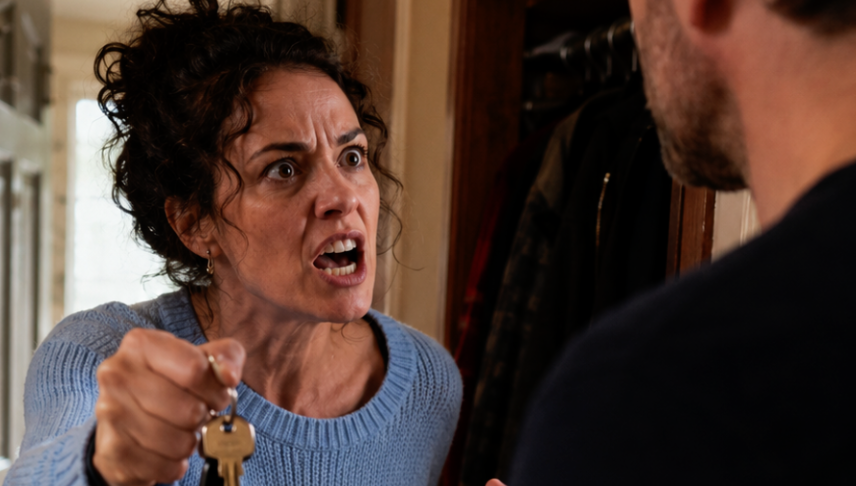
“Give back the keys to the second apartment!” Ulyana looked her husband straight in the eyes, her voice flat and hard. “I didn’t buy it for your relatives!”
“You’re greedy,” Andrey said. “I’ve noticed it for a long time. You count everything, write everything down.”
“Greedy,” Ulyana repeated. Not as a question, but more as if she were rolling the word around in her mouth, testing its taste. “Do you know how long I saved? That I didn’t go on vacation, didn’t buy anything unnecessary because I was putting money aside? Do you remember how Maria Pavlovna laughed and said I was fantasizing?”
“Mom didn’t say anything bad.”
“Andrey, she said there’s no harm in dreaming. Right in front of you. And you said nothing.”
Andrey looked away.
“That’s not the same thing.”
“You took the keys to someone else’s property without asking,” Ulyana said slowly and clearly. “You made a decision for me without informing me. You promised an apartment that does not belong to you. Is that normal?”
“It’s what family does.”
“What family does is ask.” Ulyana held out her hand. “The keys. Now.”
Andrey looked at her for several seconds. Then he smirked — unpleasantly, with the kind of irritation people let out when they cannot argue on the merits.
“Ulyana, you’re making a mountain out of a molehill.”
“The keys, Andrey.”
“Matvey has nowhere to live.”
“That is not my responsibility,” Ulyana said. “Matvey is an adult. Let him rent an apartment like everyone else does. Or let Maria Pavlovna help him — he is her son. But the apartment that I bought with my own money and my own inheritance, I am not giving to anyone for free. Not to relatives, not to anyone else.”
“So family means nothing to you?”
“Family means something to me when people in the family respect what belongs to another person.” Ulyana looked him in the eyes. “You took my keys secretly. That is not respect. That is doing whatever you want because you’re the husband.”
Andrey shoved his hand into his pocket and pulled out the keyring. He tossed it onto the cabinet beside the bowl — a little more sharply than necessary.
“Take them, then, since that’s how it is.”
Ulyana took the keys and put them in the bowl. Then she picked up the folder with the contract.
“The day after tomorrow at seven in the evening, the tenants will come,” Ulyana said. “I will sign the contract, they will pay the deposit, and from the first of the month the apartment will be rented out. That is all I wanted.”
Andrey did not answer. He walked past her into the kitchen, opened the refrigerator, and took out some water. Ulyana heard the door slam shut.
The evening passed in silence. Ulyana made herself scrambled eggs and ate in the kitchen, looking at her phone. Later, Andrey took something from the refrigerator himself. They did not speak.
That night, Ulyana lay awake staring at the ceiling. She was not angry — rather, she was taking apart what had happened piece by piece. Andrey had taken the keys to her apartment. He had not asked, had not suggested discussing it. He had simply taken them because he had decided. Because, apparently, he had long believed he had the right to do so. And the strangest thing was that he did not understand why she objected. To him, it really did sound like something done “as family.”
That was the real problem. Not the keys — but the fact that her husband sincerely did not see the boundary between himself and someone else’s property if that property belonged to his wife.
The next day, Andrey left for work without coming in to see her. In the evening, he returned restrained. At dinner, he said:
“Ulyana, I called Matvey. I told him it wouldn’t work.”
“Good.”
“Mother is upset.”
“I understand.”
“You could have at least met them halfway a little.”
Ulyana put down her fork.
“Andrey, I want to ask you something,” his wife said, looking at him. “Would you take the keys to someone else’s car to let your brother drive it without asking the owner?”
“That’s different.”
“How?”
Andrey did not answer right away. Ulyana could see from the pause that he was thinking something over.
“An apartment is still a family thing,” he finally said.
“No,” Ulyana said calmly. “The apartment was bought with money you have nothing to do with. The first apartment too. This is not family property. It is mine.”
“You say that as if I’m a stranger.”
“No. But you should ask. Like any person asks before taking something that belongs to someone else.”
Andrey got up from the table and carried his plate away.
“Fine,” he said from the kitchen. “I understand you.”
The viewing took place on Thursday, exactly as planned. The couple turned out to be pleasant — Yegor and Vika, working in the same field, looking for an apartment long-term. Ulyana showed them around the apartment, explained the meters, and showed where everything was. They signed the contract right there, and Vika transferred the deposit that same evening.
When Ulyana came home, the apartment was quiet. Andrey was asleep — or pretending to be. Ulyana took off her shoes, went into the kitchen, and poured herself some water.
She thought about everything that had happened over those few weeks. About Maria Pavlovna and her “there’s no harm in dreaming.” About Matvey, who had never called her himself — not once — and had simply waited for his mother and brother to arrange everything for him. About Andrey, who had taken the keys and considered it normal.
And behind all of that, something older. The way Andrey had rearranged her furniture without discussing it. The way he had never been interested in how much Ulyana was saving or why. The way he treated her apartment as his own, and her plans as something that could be put on hold for the needs of the family.
Another two weeks passed. On the surface, life evened out — conversations over dinner, shared chores, the usual rhythm. But something had changed. Ulyana felt it not as sharp pain, but as a quiet, gradual realization: she had long been living with a person who did not see her as a separate individual with separate rights. A person who respected her only as long as she had nothing to defend.
One evening, Andrey started the conversation himself. He sat across from her and folded his hands on the table.
“Ulyana, I think we need to talk properly.”
“I’m ready,” his wife said.
“I understand that what I did with the keys was wrong,” Andrey said. “I should have asked. I admit that.”
“Good.”
“But you also have to understand: it’s hard for me when you divide things like that — mine, yours. We’re family.”
“Andrey,” Ulyana said, “did you help me save?”
A pause.
“Well, I also pay for shared expenses.”
“We split food and utilities, yes. But the savings for the apartment were only my money and my labor. Five years. You never once asked how it was going, never offered to help. Not because you’re bad,” she spoke without anger, evenly. “You simply weren’t interested. But when the result appeared, suddenly it turned out to be family property.”
Andrey was silent. This time the pause was longer.
“Do you think I did it on purpose?” he finally asked.
“No. I think you’re used to seeing things that way. And that is more difficult than if you had done it on purpose.”
“So what now?”
Ulyana was silent for a moment.
“I don’t know, Andrey. I want both of us to understand that respect is not just a word. It means asking before taking. It means showing interest before deciding for someone else.”
“I hear you,” her husband said quietly.
“Good.”
They sat in silence together, and in that silence there was a lot — exhaustion, something unresolved, and something that perhaps could still be resolved. Or perhaps not anymore. Ulyana did not know. She knew only one thing: saying it out loud was no longer as frightening as staying silent.
On the first of the month, Yegor and Vika moved into the apartment. Ulyana received the first payment, deducted the utilities, and transferred the net income to a separate account. The very same account she had opened five years ago, the one no one but her could access.
The money arrived quietly, without celebration — just a notification on her phone. Ulyana looked at the number, put the phone in her pocket, and went to make dinner.
The goal they had once laughed at was working.
And that was enough.