— My mother eats first. Then you and your son can eat.
I froze with the plate in my hands. Hot soup spilled over the rim and burned my fingers, but I did not even flinch. Andrei stood in front of me, blocking the way to the table. Behind him was the fussy, worn face of his mother, Lidia Petrovna. She had already picked up her spoon and bent over her portion as though nothing had happened. As though she had not seen my five-year-old Dima pull up a little chair and reach his small hands toward the soup. I had stayed at the stove for five extra minutes.
“Andrei, he just wanted to sit at the table,” I said quietly. “Let him sit down.”
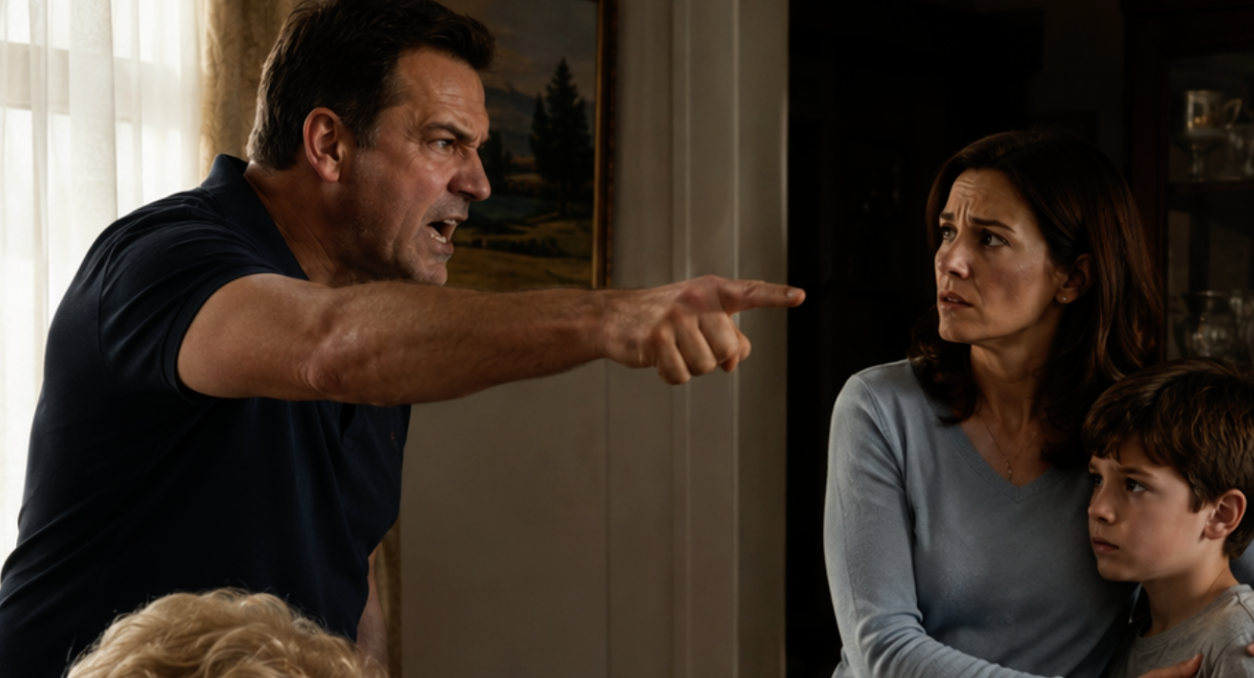
“I said,” he barked so loudly that Dima flinched and hid behind my skirt, “my mother eats first.”
Lidia Petrovna lifted the spoon to her mouth and sighed contentedly. I saw her tightly pressed lips and the faint, victorious smile. She always won. In this house, at this table, in this life. I had spent four years helping build that victory for her.
Four years ago, I married Andrei, a widower with a thirteen-year-old son named Pasha. Before our marriage, Pasha had been raised by Andrei’s mother.
I was naive. I thought I could become someone Pasha could rely on, that my love would heal things, that I would fit into this family. I did not have children of my own, and I wanted to have a baby. I wanted to feel a tiny life growing inside me, to hold my own child in my arms.
Andrei did not want that.
He always brushed me off.
“Later, Lena. Later. We still haven’t gotten our household settled.”
We spent four years getting our household settled.
I got up at six in the morning and cooked breakfast for everyone. Andrei left for work, and I drove his son Pasha to school. He was moody and spoiled. He called me “that woman” and demanded that his clothes be ironed every day.
Then I went to my own job.
Afterward, I came home, took Pasha to his tutors, bought groceries, cooked dinner, and washed the dishes.
Lidia Petrovna lived one floor above us and came downstairs every evening. She considered it her duty to make sure I cooked borscht correctly. She checked how I made her grandson’s bed. She opened the refrigerator and shook her head.
“Andryusha, your little wife is no homemaker,” she would say right in front of me.
Andrei remained silent. He watched television and pretended not to hear.
And I smiled.
I kept telling myself, “She’s old. She has a bad heart. She lost her husband. She needs care. I can handle it. I love him.”
In the fourth year of our marriage, I gave birth to Dima.
My boy.
I named him after my grandfather, the only person in my life who had ever loved me unconditionally.
While I was in the maternity hospital, Andrei came to see me on the third day. He brought flowers bought from a street kiosk on the way and said:
“Mom thinks we need help. She’ll move in with us for a couple of months.”
She moved in permanently.
It was her apartment. A three-bedroom apartment.
She took over the living room, and Pasha occupied the second bedroom. The very room I had dreamed of turning into a nursery for Dima.
Andrei, tiny Dima in his cradle, and I squeezed ourselves into the bedroom.
I did not sleep at night because Dima cried, while Lidia Petrovna banged on the wall and shouted:
“Make your child stop! He’s having hysterics!”
Andrei slept with headphones on.
He said he needed proper sleep for work.
One month after giving birth, I was standing at the stove making porridge. Pasha woke up, stormed into the kitchen, and demanded an omelet.
“Pasha, wait five minutes. I just need to finish cooking for Dima.”
He threw a tantrum.
Lidia Petrovna rushed out of the living room.
“Lena, what are you doing? The child is hungry! Make him an omelet immediately!”
“But Dima is crying. He wants to eat.”
“Pasha is your older son,” she said firmly. “He is more important.”
I made the omelet.
Pasha poked at it with his fork, made a face, and said:
“Too salty.”
He did not eat it.
Dima’s food went cold, so I heated his porridge for the second time.
Andrei walked into the kitchen and kissed his mother on the cheek.
“Mom, you’re worth your weight in gold. You hold this whole family together.”
I looked at him.
He did not even look at me.
New Year’s Eve.
I set the table. I had bought Dima a little bunny costume, and he was thrilled. I had bought Pasha the expensive phone he had asked for.
Lidia Petrovna took her pills out of her handbag—Validol, Corvalol, blood-pressure medicine—and arranged them in a visible place.
Yellow blister packs.
She always put them on the table.
“What if something happens to me and I can’t reach them in time?”
They were her weapon.
I poured the champagne.
Andrei stood up to make a toast.
“To you, my women. And to Mom—she is the backbone of our family.”
Pasha received his phone, shouted, “Thanks, Grandma!” and rushed off to his room.
I gave Andrei a sweater.
I had secretly spent two months knitting it late at night.
He examined it and grunted.
“Mom does it better. You should learn from her.”
Dima reached for the salad. I gave him a slice of cucumber.
He beamed.
Lidia Petrovna leaned toward me and whispered:
“You shouldn’t give him adult food yet. His tummy hurts. I can tell.”
“He’s already two. He eats everything.”
“You’re a bad mother, Lena. You only think about yourself.”
Andrei heard her.
He drank his champagne and stared at the television.
Pasha’s birthday.
Sixteen years old.
I spent three hours baking a cake. Baking it, decorating it, working with fondant.
I wanted him to be happy.
I bought him a present—an expensive baseball cap he had wanted.
When I came out with the cake, Pasha did not even turn around.
He was looking at his phone.
The one I had bought him.
Lidia Petrovna said:
“What kind of cake is that? Did you put yeast in it? Pasha can’t tolerate yeast.”
“There’s no yeast in it. I made it myself.”
“Don’t lie to me. I can smell it.”
Andrei picked up a knife, cut the cake, broke off a piece, and handed it to his mother.
“Mom, try it. If it tastes bad, I’ll eat it.”
He did not offer me any.
He did not say thank you.
That evening, he said:
“You’re useless with your hands.”
I locked myself in the bathroom and cried.
Dima knocked on the other side of the door.
“Mommy, open the door.”
I wiped away my tears and smiled at him.
I could not let my son see my weakness.
Today.
Sunday.
I got up at six because Dima was sick. He had a fever and a cough. I called the doctor and gave him medicine.
Andrei slept until eleven.
Lidia Petrovna got up at ten and immediately started complaining that I had not made soup.
So I made soup.
I put it on the table.
I called Dima over. He could barely stand, but he wanted to be near me.
“Dima, sit down. I’ll pour you some soup.”
Andrei walked in.
He saw me pulling Dima’s chair closer to the table so he could reach his plate. He saw his mother groaning as she picked up her spoon.
He did not ask, “How is Dima?”
He did not ask, “What’s his temperature?”
He said:
“My mother eats first. Then you and your son can eat.”
And he shoved Dima away from the table.
My son.
My sick, exhausted son.
He was only hungry.
Andrei pushed him away like a naughty kitten.
Dima fell.
He did not cry.
He stared at Andrei with wide-open eyes, and I saw fear in them.
A child’s helpless fear.
And I looked at my hands.
At the red burn from the soup.
At the spoon clenched in my hand.
Something clicked inside my head.
I could almost hear the sound—a branch snapping, a string breaking.
Something inside me that I had protected for four years suddenly stopped hurting.
Stopped hoping.
Stopped making excuses.
“Get your son out of my kitchen,” Andrei said.
I picked Dima up.
He pressed himself against me, warm, sick, burning with fever.
I turned toward the table.
Lidia Petrovna was slowly eating her soup.
Smiling down into her plate.
She did not turn around.
She felt like a winner.
“Andrei,” I said.
My voice was calm.
I was not crying.
He raised his eyebrows.
“What?”
“I’m leaving.”
He laughed.
A short, nervous laugh.
“Have you lost your mind? This is my mother’s apartment. Where are you going to go? You don’t even have a proper job. You just sit around with that…”
He nodded toward Dima.
“…and that’s all you do.”
“I’ll find a job.”
“Who needs you with a child? You should be grateful I put up with you. Mom, do you hear this? She says she’s leaving!”
Lidia Petrovna raised her head.
She wiped her lips with a napkin and said:
“Then get out. You’ve only ever been in our way. Andrei, my bag is in the closet. Give it to her.”
I went into the bedroom.
I packed Dima’s things into a backpack: a couple of T-shirts, trousers, his favorite teddy bear, and fever medicine.
I did not take any of my own belongings.
Nothing.
Andrei stood in the doorway with his arms crossed.
He was no longer laughing.
“You’re not coming back,” he said.
It was not a question.
It was a statement.
“No.”
I left.
I carried Dima in my arms.
Exhausted, he fell asleep, his hot breath against my neck.
Our neighbor, Aunt Nina, was standing on the landing.
She always greeted me and always smiled at Dima.
“Aunt Nina, may I use your phone to call my sister?”
“Of course, Lenochka. Come in.”
I entered her apartment and dialed the number of my younger sister, Katya.
She lived in a nearby city, three hours away by train.
She had always told me:
“Lena, leave him. Come to me. I’ll take you in.”
“Katya,” I said.
And that was when I started crying.
“Katya, I’m coming to you. With Dima.”
“What happened?”
“Nothing. I just don’t want to be last anymore.”
Three hours later, I was sitting on a train.
Dima slept on the lower bunk, hugging his teddy bear.
I looked out the window.
Trees, utility poles, and gray houses flashed past outside.
I did not know what would happen next.
How I would work.
Where we would live.
Whether I would find a babysitter.
I knew nothing.
But I knew one thing.
I would never again allow anyone to call my son “your son” as though he were some stranger.
As though he did not belong.
As though his hunger mattered less than someone else’s.
I would never again tolerate it, make excuses, or wait for things to change.
A month later, we were renting a tiny room in Katya’s apartment.
She helped me take care of Dima while I worked remotely at two jobs.
I was exhausted. I hardly slept.
But I smiled.
Dima stopped being afraid.
He started laughing again.
He would reach for me and say:
“Mommy, you’re the best mommy in the world.”
I stopped making excuses.
I stopped hoping Andrei would call.
He never did.
Six months later, I happened to hear from mutual acquaintances that Lidia Petrovna had died.
I did not go to the funeral.
I simply deleted every phone number connected to that family from my contacts.
Whenever I see yellow blister packs of pills in a pharmacy, something inside me turns cold.
But I do not cry.
I take Dima by the hand and keep walking.
He asks:
“Mommy, why don’t we live with Daddy anymore?”
I stop.
I look into his eyes.
“Because, sweetheart, we are us. We are not ‘you and your son.’ We are a whole family. And anyone who thinks otherwise has no right to be part of our lives.”