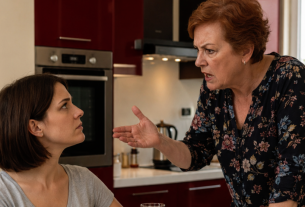
— Sign right here, and the apartment will become shared property. My son asked me to tell you that this would be the right thing to do.
Marina froze in the doorway of her own kitchen, holding two grocery bags. Her mother-in-law was sitting at her table, papers spread out before her like playing cards, calmly holding out a pen as though they were discussing nothing more important than a shopping list.
The bags quietly slipped to the floor. Tomatoes rolled out and scattered across the linoleum.
— What apartment? — Marina’s voice sounded foreign even to herself.
— Yours. This one, — Tamara Petrovna gestured toward the walls that Marina and Oleg had painted with their own hands three years earlier. — You’re a family, so everything should belong to everyone. I’m his mother. I have a right to know what my son has and what he doesn’t.
Marina slowly took off her jacket. Her heart was pounding so hard that her ears were ringing. She searched for her husband with her eyes, but Oleg wasn’t there. There was only her mother-in-law, the papers, and that outstretched pen.
— Where’s Oleg?
— He was held up at work. But he knows about this, don’t worry. He and I have discussed everything.
Those words — he and I have discussed everything — cut deeper than anything else.
Marina walked over to the table and looked at the documents. A deed of gift. Her share of the apartment. The very apartment they had bought together, fifty-fifty. Marina had invested the money from selling the room she’d inherited from her grandmother—everything she had.
— Tamara Petrovna, Oleg and I bought this apartment together. Half of it is mine. I paid for it with money from my grandmother’s inheritance.
— Well, I’m not a stranger either, — her mother-in-law pursed her lips. — I gave you money for your wedding. I bought that refrigerator over there. Doesn’t that count?
The refrigerator had cost thirty thousand rubles.
Her grandmother’s room had been worth eight hundred thousand.
Marina put the papers aside. Her hands were trembling, but she managed to keep her voice steady.
— I’ll think about it.
— What’s there to think about? — her mother-in-law stood and gathered the papers back into the folder. — A family should be one whole. But with you, it’s always mine, mine, mine. Some daughter-in-law you are. I’m your mother-in-law, but I treat you like my own daughter.
She left, leaving behind the scent of her perfume and a heavy, sticky feeling in the air. Marina sank onto a chair and stared at the tomatoes scattered across the floor for a long time.
Oleg came home that evening. Tired, he gave her his usual quick kiss on the cheek and opened the refrigerator.
— Did Mom come by?
— She did. — Marina watched him carefully. — With papers.
He froze for a second.
Only a second, but she noticed.
— Oh, that. Well, yes. Mom wanted everything to be fair. Like a family should be.
— So you knew.
— Marina, don’t start. She’s my mother. She’s worried about us. She just wants us all to live peacefully together.
Marina looked at her husband and, for the first time, understood with absolute clarity: he had known.
He had known and said nothing.
He had given his mother the key, given her the papers, and sent her there alone so that he wouldn’t have to explain himself. So that he could remain the good guy in both women’s eyes.
— Oleg. Do you understand that she’s asking me to give away my half of the apartment?
— Not give it away. Put it in the family’s name. Those are different things.
— What family? Her?
— Mom. She’s not going to live forever. Eventually, everything will come back to us.
Marina laughed—a short, unpleasant laugh.
— Eventually it’ll come back. Of course. And until then, I’ll live in an apartment where even my half isn’t mine.
— You’re making this too complicated.
He walked into the living room and turned on the television.
Conversation over.
As always.
Oleg had a talent for ending uncomfortable conversations. He simply walked away from them as if they’d never happened.
Marina remained in the kitchen. She gathered the tomatoes, washed them, and put them away. Her hands moved automatically while one thought kept circling through her mind:
He knew.
They had met eight years earlier. Oleg had seemed reliable, calm, a family man. Only later, after they were married, did Marina realize that his calmness wasn’t strength.
It was a lack of backbone.
Oleg never argued with anyone. Not with his mother, because she was his mother. Not with his boss, because he was his boss. Not with Marina, because it was easier to give in and forget about it.
And his mother sensed this weakness.
Tamara Petrovna always sensed vulnerable spots the way a predator smells blood.
It had started with little things.
She came over without calling because she had a key and she was his mother. She rearranged things in the kitchen because it was «more convenient.» She commented on Marina’s cooking, her clothes, and the way she was raising little Kiryusha.
— A daughter-in-law should be gentler, — she would say over tea that she herself poured from someone else’s teapot. — In my day, I never said a word against my mother-in-law.
Marina endured it.
For Oleg.
For their son.
For peace in the family.
She remained silent when her mother-in-law criticized her borscht. She remained silent when Tamara Petrovna taught her how to swaddle newborn Kiryusha the way babies had been swaddled thirty years ago.
Silent.
Silent.
Silent.
And all that silence had led to papers being placed on her kitchen table.
That night, Marina couldn’t sleep. She lay listening to her husband’s steady breathing and thinking.
She had a shift at the library in the morning—a quiet job among books that she loved. But today, even the thought of work brought her no comfort.
Her mother-in-law called at eight in the morning.
— Well? Have you made up your mind?
— Good morning, Tamara Petrovna.
— Yes, yes, good morning. So what about the papers? Oleg said that you’re basically willing to agree.
Marina tightened her grip on the phone.
Oleg had said that.
Of course he had.
— I haven’t decided anything.
— Marinochka, — her mother-in-law’s voice became syrupy, the kind of sweetness that made Marina’s teeth hurt. — You have to understand. I’m not young anymore. I need peace of mind. And how can I have peace when everyone in the family is pulling things in their own direction? Think about Kiryusha. Think about keeping peace in the family.
— Kiryusha is exactly who I’m thinking about.
— Good. Then we’ll come to an agreement.
She hung up without waiting for an answer.
Her mother-in-law always ended calls first.
It was her habit.
Her way of showing everyone who was in charge.
At lunchtime, Marina didn’t go to the cafeteria. She sat among the bookcases, surrounded by shelves of worn book spines, and dialed a number.
Not Oleg’s.
Not her mother-in-law’s.
— Hello, notary office? I’d like to schedule a consultation regarding ownership of an apartment.
The voice at the other end was calm and professional.
— Of course. Would tomorrow at four work for you?
— Yes.
Marina put away her phone.
Her heart was pounding, but for the first time in a long while, it wasn’t despair she felt.
It was something else.
Something like solid ground beneath her feet.
That evening, Oleg brought up the subject again in his usual gentle way.
— Marina, Mom is upset. She says you spoke to her coldly.
— I spoke normally.
— You know what she’s like. She needs attention. Maybe you could just sign the papers after all? Then everyone could calm down.
Marina looked at him for a long time.
— Whose side are you on, Oleg?
— I’m not on anyone’s side. I’m stuck between you. Have you thought about how hard that is for me? My wife on one side, my mother on the other.
— It must be very hard for you, — she nodded. — Poor thing.
He either didn’t notice the irony or pretended not to.
— See? You understand. So will you sign?
— No.
One simple word.
For the first time, she said it directly, without qualifications, without saying, I’ll think about it.
Oleg frowned.
— That’s selfish, Marina. Family means compromise.
— Compromise is when both sides give something up. Here, I’m the only one who gives in. I’ve been doing it for eight years.
He waved his hand dismissively and walked away.
Again, he closed the conversation.
But this time, Marina wasn’t left standing there with a lump in her throat.
She went to Kiryusha’s room to read him a bedtime story, and for the first time, her voice didn’t tremble.
The next day at four, she sat in the office of a female notary in her fifties with tired but attentive eyes.
— Tell me more. How is the apartment registered?
— We each own half. My husband owns half and I own half. I invested money from the sale of an inheritance.
— Do you still have the purchase documents? Proof of payment?
— Yes. Everything.
The notary nodded and made notes.
— Then let me explain the situation. Your share is your personal property, purchased with your personal funds. No one can force you to give it away or transfer it. Neither your husband nor, especially, your mother-in-law. A deed of gift can only be signed voluntarily. If you don’t want to sign, no one has the right to force you.
Marina listened, and with every word, it felt as though a burden that had pressed on her shoulders for years was being lifted.
— Could they somehow do something through the courts? Or some other way?
— On what grounds? It’s your property. A refrigerator and wedding gifts don’t give anyone the right to half an apartment. — The notary smiled for the first time. — Honestly, I see this often. Parents of adult children try to get their hands on the property of young families. The main defense against that is knowing your rights. Now you know yours.
Marina stepped out of the office into the warm evening.
The city continued with its life—people hurried past, cars honked.
And Marina stood on the steps, breathing deeply as though she were breathing freely for the first time in eight years.
A surprise awaited her at home.
Her mother-in-law was sitting in the kitchen.
With Oleg.
And another folder of documents.
— Ah, here’s our Marinochka, — Tamara Petrovna sang. — We’ve been waiting for you. Oleg, take them out.
Oleg avoided meeting his wife’s eyes as he took out the documents.
— Marina, Mom and I were thinking. If you don’t like the deed of gift, let’s simply transfer your share to Mom. Temporarily. And she’ll leave everything to us in her will. Completely fair.
Marina slowly took off her jacket and hung it on the hook.
She walked to the table and sat down opposite her mother-in-law.
— Tamara Petrovna. Tell me honestly. Why do you want my half of the apartment?
Her mother-in-law was momentarily taken aback by the direct question.
— What do you mean, why? So there can be order in the family.
— No. Tell me the truth.
— Why are you interrogating me?! — her mother-in-law snapped, and the sugary mask cracked. — I’m his mother! I have a right to know what my son has! You’re living here, but what happens if something goes wrong? You’ll still have your half while my Olezhenka ends up in the street!
There it was.
Finally, the truth.
— So you’re afraid I’ll leave and take what belongs to me.
— And wouldn’t you? I know women like you these days. One little problem and you’re gone. And then you divide up the apartment.
Marina nodded.
Now everything made sense.
— I went to a notary today.
The kitchen fell silent.
Oleg looked up.
His mother pursed her lips.
— And? — she forced out.
— And everything was explained to me. My share is my personal property. It was purchased with money from my grandmother’s inheritance. No one—not you, not even Oleg—can force me to give it away or transfer it. That’s the law.
— How dare you… — her mother-in-law began.
— I’m not finished.
Marina spoke calmly, and that calmness made Tamara Petrovna fall silent.
— For eight years, I’ve kept quiet. I tolerated you coming here without calling. I tolerated you rearranging my belongings. I tolerated your comments about how I cook, how I dress, and how I raise my son. I thought that was what being a good daughter-in-law meant. Staying silent and enduring everything.
She turned toward her husband.
— And you, Oleg. You knew about those papers from the very beginning. You gave your mother the key. You let her sit at my table and hold out a pen to me. You hid at work so that you wouldn’t have to explain anything yourself. So that you could remain the good guy for everyone.
Oleg opened his mouth, but Marina raised her hand.
— I’m not finished. I will not sign any papers. No deed of gift, no transfer of my share. My half will remain mine. And there’s something else.
She took a folded document from her bag.
— I asked the notary for certified copies of the documents related to the purchase of the apartment. So there won’t be any arguments in the future about whose money was invested.
Her mother-in-law stared at her.
For the first time, Marina didn’t see superiority in her eyes.
She saw confusion.
Tamara Petrovna was accustomed to a soft, compliant daughter-in-law.
Now, another woman sat before her.
— Oleg, — Tamara Petrovna hissed. — Do you hear how she’s talking to me? Say something to her!
Oleg remained silent.
He looked from his mother to his wife and back again.
Caught between two fires, as always.
Except this time, the fire could no longer be extinguished by silence.
— Mom, — he finally said quietly. — Maybe we really should forget about… the apartment.
His mother spun toward him.
— What?!
— Well… Marina is right. It was her money. Her grandmother’s money.
— I raised you! I gave you everything! And now you’re taking that woman’s side?!
— Tamara Petrovna, — Marina spoke again, her voice unwavering. — Oleg isn’t taking «that woman’s» side. He’s taking the side of fairness. Maybe for the first time in his life.
Her mother-in-law jumped up and grabbed her folder.
— Well, really! I came here with an open heart! And this is how you treat me! I will never set foot in this apartment again!
— Please leave the key, — Marina said calmly. — The key to our apartment. When you’d like to visit, call first. The way normal people do before going to someone’s home.
Tamara Petrovna almost choked with outrage.
But under her daughter-in-law’s calm gaze, something inside her seemed to break.
She took the key from her purse, threw it onto the table, and stormed out, slamming the door behind her.
The apartment became quiet.
Only Kiryusha’s voice could be heard from his room. He was playing with his toy cars, unaware of the storm that had just passed.
Oleg sat with his shoulders slumped.
— Why did you have to treat Mom like that?
— How should I have treated her, Oleg? Should I have silently signed the papers? Given away my half and been left with nothing? — Marina rubbed her temples tiredly. — I’m not against your mother. I’m against being treated like furniture for eight years. Convenient. Quiet. Voiceless.
He said nothing.
— Tell me honestly. Are you ever on my side about anything?
Oleg raised his eyes.
For the first time that evening, he looked directly at her.
— I panicked, Marina. Mom pressured me, and you stayed silent. I thought it would be easier just to agree so everyone would calm down.
— And I’m tired of staying silent for everyone else’s peace of mind. It never brought me any peace.
For a long time, he sat staring at the table.
Then he said:
— I’m sorry. I really did give her the key. And I knew about the papers. I thought it was no big deal. You’d sign them, and we’d forget the whole thing. I didn’t think about what it would mean to you.
— It means I’m not considered a human being in my own home.
— I understand. — He ran a hand over his face. — I understood too late. But I do understand now.
Marina was in no hurry to forgive him.
Too much had accumulated over the years.
But that I’m sorry was the first genuine thing he had said all evening.
Maybe the first in years.
— Do you know what the notary told me? — Marina said. — She said she sees situations like this all the time. Parents trying to take control of their adult children’s property. And she said the greatest weapon is knowing your rights. I know mine now, Oleg. And I’ll never blindly sign anything again.
— I’m not asking you to sign anything.
— Then what are you asking?
He was silent for a moment.
— For you to stay. For us to… start doing things differently. I’ll talk to Mom. Really talk to her. I’ll set boundaries.
Marina smiled slightly, but without bitterness this time.
— You? Boundaries?
— I’ll try. Honestly. I’m tired of hiding.
The following weeks weren’t easy.
Her mother-in-law didn’t call. She was genuinely offended.
Oleg was nervous, but he stood his ground.
One day, Marina overheard him speaking to his mother on the phone.
— Mom, no. You’re welcome to come visit. We’re happy to see you. But call first. And forget about the apartment. This is Marina’s and my decision. It’s final.
His voice trembled.
But he said it.
For the first time in his life, he had told his mother no.
When he hung up, Marina approached him from behind and wrapped her arms around him.
— Hard?
— Very. But right. — He placed his hands over hers. — I’m sorry it took me so long to notice. I’m sorry I hid behind you.
A month passed.
Eventually, Tamara Petrovna called.
Dryly and briefly.
She asked about her grandson.
Then she called again.
Gradually, the ice began to melt.
Now her mother-in-law came to visit only after calling first. She sat properly and barely made any comments. Maybe she had understood that her old methods no longer worked.
Or maybe she simply missed her grandson.
One autumn day, they were drinking tea in that same kitchen.
After a long silence, her mother-in-law said:
— Maybe I really did ask for too much, Marinochka. With that apartment. — The words were difficult for her. — I’m old now. I’m frightened. I keep imagining someone will hurt my Olezhenka or leave him with nothing.
— No one is going to hurt him, Tamara Petrovna. We’re a family.
— A family, — her mother-in-law repeated.
And for the first time, there was no authority in the word.
Only exhaustion and something resembling a plea.
Marina poured her more tea.
Not out of obligation.
Not through clenched teeth.
But because the person sitting across from her was simply an aging woman who was afraid for her son and didn’t know how to express that fear except through control.
That evening, after putting Kiryusha to bed, Marina stepped out onto the balcony.
Oleg came and stood beside her.
— You know, — he said, — I used to think that being a good person meant pleasing everyone. Mom, you, everybody. But it turns out that by trying to please everyone, I betrayed you.
— At least you’re learning now, — Marina said, resting against his shoulder.
— I’m learning. A little late, at thirty-five. But I’m learning.
They stood in silence, looking at the city lights.
Cars moved somewhere below.
A dog barked.
Passersby laughed.
An ordinary autumn evening.
Marina thought about how much had changed in those few months.
Not because her mother-in-law had become an angel—she hadn’t.
And not because Oleg had suddenly become a completely different person.
It was because Marina herself had stopped being silent.
She had stopped waiting for someone else’s permission to be herself, defend what belonged to her, and say no.
That deed of gift was never signed.
Her share of the apartment remained hers.
And most importantly, she had learned one simple truth that, for some reason, she hadn’t understood during those eight years.
Respect cannot be begged for through patience.
You can only earn it when you finally begin respecting yourself.
— Are you cold? — Oleg asked.
— A little.
— Let’s go inside.
She nodded, took one last look at the city lights, and followed her husband into the warm kitchen.
Her kitchen.
In her home.
In her life.
The life she had finally chosen for herself.