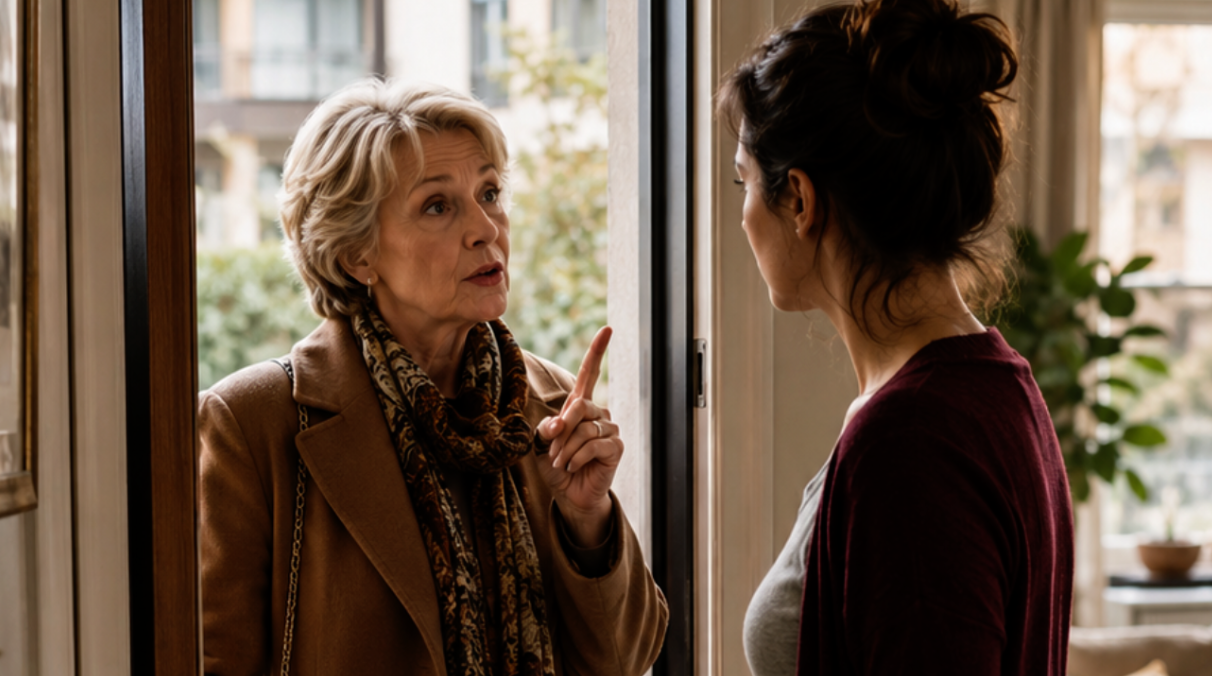
— Allochka, open up! I’ve come to save my son!
The voice behind the door sounded so triumphant that you might have thought Frosya Pavlovna had arrived not from Kaluga in a second-class sleeper car, but on a white horse. Alla stood in the hallway with a wet rag in her hand because she had been mopping the floor, and her first thought was not about her mother-in-law, but about the fact that the linoleum was about to be trampled all over.
She opened the door.
Frosya Pavlovna stood on the threshold in an autumn coat, with a single handbag over her shoulder. A tiny, theatrical sort of bag. The kind that could hold a compact, a handkerchief, and the keys to someone else’s apartment.
— Frosya Pavlovna, where are your things?
— What things, Allochka? I’m not here on vacation. I’ve come on urgent business.
Alla looked at the handbag. Then at her mother-in-law. Then back at the handbag.
— Does your toothbrush fit in there?
— We’ll buy one here, — Frosya Pavlovna waved dismissively and confidently stepped over the threshold without even taking off her shoes.
That was when Alla realized that “here” meant for a long time.
Sergey came home from work at seven, as usual. He took off his jacket, hung it on a hook, walked into the kitchen, and saw his mother sitting at the table, drinking tea from his favorite mug that said “Best Husband” and eating the pies Alla had baked for the next day.
— Mom?
— Seryozhenka!
Frosya Pavlovna stood up and hugged her son so tightly that you might have thought he had just been pulled from a burning building. She even gave a little sob. She did not let go of the pie in her hand.
— Mom, what happened? You called on Saturday and everything was fine.
— Seryozha. Sit down. I need to talk to you.
Alla stood in the doorway drying her hands on a towel. She already knew what the conversation would be about. Not because she was psychic, but because after twelve years of marriage she had seen enough.
— Seryozha, I came because Alexander called me.
Alexander was Sergey’s younger brother. He lived in St. Petersburg and worked either in logistics or marketing; Alla could never remember which. He rarely called, but when he did, it was memorable.
— And what did Alexander say?
— He said you were unhappy.
Sergey blinked. Then blinked again. He looked at Alla, who stood there with a perfectly calm expression because by now she was actually curious.
— Mom, yesterday I was watching football and shouting “Goal!” so loudly that the neighbors started banging on the wall. In what way am I unhappy?
— Seryozhenka, you simply don’t understand it yourself. Alexander explained everything to me.
Alla hung the towel on its hook, sat on a stool, and prepared to listen. She knew that when Frosya Pavlovna said, “Someone explained everything to me,” only a fire alarm could stop her. And even that might not work on the first try.
The story Frosya Pavlovna told was magnificent in its construction. Apparently, Alexander had called Sergey two weeks earlier, and Sergey had supposedly complained that he was “not appreciated” at home.
— He said you eat pasta three times a week.
— Mom, I like pasta.
— Seryozha, that is a cry for help. You’ve simply gotten used to it.
Alla remained silent. Yes, she cooked pasta. But she also made soup, stewed chicken, prepared casseroles, and every Sunday baked the very same pies her mother-in-law was now finishing.
— And Alexander also said that Alla controls you.
Sergey looked at his wife. Alla raised an eyebrow.
— Controls me? What do you mean?
— Svetlana said that you don’t let Seryozha go fishing.
Svetlana was Alexander’s wife. Alla had seen her twice in her life: once at their wedding and once when Uncle Kolya left town. Both times, Svetlana had mainly talked about herself and her problems with high blood pressure.
— Frosya Pavlovna, — Alla said quietly, because whenever she spoke quietly, Sergey knew things were serious. — Sergey doesn’t go fishing because worms make him sick. They have since childhood. You told me that yourself.
Frosya Pavlovna fell silent for one second.
Only one.
— That’s not important. What matters is that my son is unhappy, and I came to help him.
The first evening passed relatively peacefully. Frosya Pavlovna took over the sofa in the living room, covered herself with the blanket Alla had brought back from Turkey four years earlier, and fell asleep with the television volume set to twenty-two. Sergey sat in the kitchen staring at the wall.
— Seryozha, did you really tell Alexander you were unhappy?
— Alla, I told him my back hurt because of the new chair at work. Maybe that’s how he interpreted it.
— And the pasta?
— I told him you make amazing pasta with cheese. Maybe he only heard the word “pasta.”
Alla poured herself some tea. The special tea from the tin box that she bought from a little shop on Pokrovka and that cost four hundred rubles per hundred grams. It was her personal ritual: when the world went crazy, she drank expensive tea from a beautiful cup and felt human again.
— Seryozha, how long is she staying?
— I’ll ask in the morning.
— You’ll ask now.
— She’s asleep.
— She’s watching a police series and eating my pies. That’s not sleep. That’s an occupation of territory.
Sergey sighed and went into the living room. Alla heard him saying something quietly, Frosya Pavlovna answering loudly, and the television switching to a channel playing music from the eighties. Then Sergey came back.
— She said, “As long as necessary.”
— And how long is “as long as necessary”?
— She didn’t specify.
On the second day, Frosya Pavlovna began “saving” him.
In the morning, she rearranged all the spices in the kitchen. She explained that basil should not stand next to red pepper because “it’s like housing people together—you have to consider their personalities.” By lunchtime, she had re-ironed all of Sergey’s shirts, even though Alla had already ironed them. She re-ironed them on principle, folded them again, and arranged them differently.
— Allochka, I’m not criticizing you. It’s just that men’s shirts should be folded with a proper tuck.
— Frosya Pavlovna, he pulls them over his head. He doesn’t care.
— Exactly. If he cared more, he would be happier.
Alla watched as her mother-in-law carefully stacked the shirts and thought about the fact that there were people who genuinely believed a man’s happiness depended on how his shirt was folded. Arguing with those people was pointless because their worldview was constructed so solidly that not a single fact could squeeze through.
By evening, Frosya Pavlovna had reached the bathroom.
— Allochka, why do you only have one towel for the two of you?
— We have four towels, Frosya Pavlovna.
— I only see one blue one.
— The others are in the wash.
— You see? You can’t keep up. I’ll help.
And she did.
She took out the clean towels Alla had been saving for guests, hung them all over the bathroom, and transformed it into something resembling a Turkish market.
On the third day, Alexander called.
Alla answered because Sergey was in the shower. She had not intended to, but the phone started ringing almost in her hand, since it was lying on the kitchen table.
— Alla? Hi. Did Mom arrive safely?
— She did. She’s already saving us.
— Listen, don’t be offended. She decided to go herself. I only told her that Seryoga was tired.
— Alexander, he got a new chair at work and his back gets stiff. That’s all.
— Exactly. That’s what I mean. He’s tired. And she decided it was your fault.
— And where did Svetlana get the thing about fishing?
— What fishing?
A pause.
— Alexander, did you even discuss us with Sergey?
— Well, Mom called and asked how things were. I said Seryoga had been complaining. Well, not exactly complaining. Just talking. Maybe I exaggerated a little, so she would pay attention to him. She hasn’t given me any money for six months now. Says her pension is too small. And I thought maybe if she moved in with Seryoga, she wouldn’t have to spend money on her own apartment, and then she could send me…
He fell silent.
Alla was silent too.
The silence between them was so dense you could have wrapped dumplings in it.
— Alexander, did you send your mother to live with us so she would move out of her apartment, stop spending her pension on utilities, and send you the difference?
— Well, not so crudely. It’s just… logistics.
She did not tell Sergey right away.
Instead, she did what she always did when life threw something at her so absurd that getting angry seemed pointless.
She opened her laptop and went to an apartment rental website.
No, not for her mother-in-law.
For herself.
Alla had long known one trick. When you don’t have enough money for a real vacation, you can rent an apartment in another part of the city for a week. For twenty thousand rubles. You wake up in a strange room, cook on an unfamiliar stove, shop at a different store, and walk through unfamiliar courtyards. And your brain thinks you have traveled far away. It happily fools itself, like a child being shown a new playground instead of Disneyland.
She found an apartment on Butyrskaya Street. A clean one-room apartment overlooking a small park. The owner had written: “Quiet courtyard, bakery nearby.”
A bakery.
Perfect.
Day four.
Frosya Pavlovna launched a full-scale operation to save her son. Now she woke up before everyone else, fried eggs for Sergey, and greeted him in the hallway with the words:
— Good morning, son. I’m here.
Sergey jumped every time, because he was used to the hallway being silent in the morning, and the most he ever encountered there was a cat bowl.
They did not have a cat anymore, but the bowl had remained from the time when they did.
— Mom, you don’t have to get up at six.
— Son, I’ve been getting up at six my whole life. I’m used to it.
— But you’re retired. You can get up at eight.
— People without a purpose get up at eight. I have a purpose.
Alla listened from the bedroom and thought that if Frosya Pavlovna had directed that energy toward something useful, she would already be running a small country.
Or at least a pastry shop.
Meanwhile, in the kitchen, the following was happening: Frosya Pavlovna had washed all the dishes, including those on the top shelf that were used twice a year. The soup tureen they had received as a wedding present was taken down, polished, and placed on the table.
— Allochka, why don’t you use the soup tureen?
— Because we eat soup from bowls, Frosya Pavlovna.
— From bowls! Like in a student cafeteria! Seryozha deserves a soup tureen.
Sergey stood in the doorway chewing the fried eggs someone had cooked for him even though he had not asked for them, listening as two women argued about dishes he did not care about in the slightest.
He thought about the chair at work and wondered whether he should ask for the old one back.
On the evening of the fourth day, Alla said to Sergey:
— I’m leaving for a week.
He put down his phone.
— Where?
— Butyrskaya.
— That’s only three metro stops away.
— Exactly.
Sergey stared at her.
Alla sat on the bed with her legs tucked under her, her hair in a ponytail, wearing the expression of someone who had already made up her mind but was prepared to listen to objections out of politeness.
— Alla, are you serious?
— Seryozha, your mother came to save you. Let her save you. I won’t get in her way. And I’m tired. Not of her and not of you. Of the situation. I need a week in a different environment.
— But it’s just another neighborhood.
— Try it sometime. A new kitchen, a different view from the window, a bakery across the street. That’s enough to fool the brain.
He was silent.
Alla stood up, opened the wardrobe, and took out a small travel bag.
Not a suitcase.
A bag.
— I’ll take enough clothes for a week, my tea, a book, and my phone charger. That’s all.
— But what about…
— Seryozha, you’re a grown man. You can survive one week with your own mother and without your wife. And if you really are unhappy, here’s your chance to figure it out.
She said it without anger.
Without challenge.
Simply as a statement of fact, the way people state the weather or a train timetable.
Frosya Pavlovna found out the next morning, on the fifth day. Alla was already standing in the hallway with her bag.
— Allochka, where are you going?
— Frosya Pavlovna, I’m taking a one-week vacation. Seryozha will explain everything. The refrigerator is full, the towels are in the cupboard, and the vacuum cleaner is under the bed.
— But how can you… I came to help!
— Then help. The apartment is yours for seven days.
Frosya Pavlovna opened her mouth.
Closed it.
Then opened it again.
— And Seryozha?
— Seryozha is at work until seven. After that, he’s all yours. Completely.
Alla walked out and closed the door.
The stairwell smelled of someone’s breakfast and a little bit of freedom.
The apartment on Butyrskaya was exactly as it had looked in the photos. Clean, small, with a window overlooking a little park. There was a pot with a violet on the windowsill, which the landlady had asked her to water.
Alla put down her bag, opened the window, and stood there for a minute.
The courtyard was unfamiliar.
The tree outside was unfamiliar.
The sounds belonged to someone else’s world: somewhere below, a tram passed by, something they did not have in her neighborhood.
And she felt herself relaxing.
It was not resentment.
Not anger.
It was that dull tension that accumulates when you spend months living in a situation where you constantly have to be proper.
The proper wife.
The proper daughter-in-law.
The proper homemaker.
A situation in which a single piece of pasta could become grounds for an investigation.
She went to the bakery. Bought an almond croissant and coffee in a paper cup. Sat on a bench in the park. Ate slowly.
No one knew where she was.
No one asked why she folded towels the wrong way.
Sergey called.
Once.
Twice.
Three times.
She answered on the fourth.
— Alla, Mom is panicking.
— Why?
— She says you left because of her.
— I didn’t leave. I’m on vacation.
— She says everyone will think she destroyed our family.
— Who is “everyone,” Seryozha? We haven’t told anyone.
— She called Alexander.
— Of course she did.
And then something happened that Alla had not planned, but that unfolded so naturally it was as though life itself had written the script.
When Alexander learned that Alla had “left home,” he called Sergey.
And during that conversation, which Sergey later repeated word for word, everything finally fell into place.
— Seryoga, what are you doing? You were supposed to keep your wife from leaving, not let Mom move in!
— Sasha, you’re the one who sent her.
— Me? I only said you were having a hard time.
— I’m not having a hard time. My back hurts.
— Exactly. See? You are having a hard time! That’s what I told Mom: Seryoga is in bad shape, she needs to go there.
— Sasha, Mom told me you explained everything to her. That Alla controls me, that I’m unhappy, that all we eat is pasta.
— Well, I didn’t mean it literally…
— Sasha, Svetlana told Mom that Alla doesn’t let me go fishing.
— Svetlana? She doesn’t know anything about it. She was checking her blood pressure when Mom called. Maybe she said something strange.
— Sasha, let’s be honest. You wanted Mom to move in with me, rent out her apartment, and send you the extra money?
A long pause.
— Not the extra money. Well, maybe some of it.
— Sasha.
— What? I have a car loan, Svetlana needs dental work, and the kid has extracurricular activities. Mom lives alone in a two-bedroom apartment and spends half her pension on utilities. It made sense!
Sergey hung up and, according to him, sat in the kitchen for about five minutes staring at the soup tureen Frosya Pavlovna had placed in the middle of the table like a symbol of proper family life.
Then he went to talk to his mother.
Alla did not hear that conversation.
At the time, she was lying on someone else’s sofa, reading a detective novel and eating grapes. Outside the window, evening was falling. The violet on the windowsill quietly continued living its little violet life, and everything was so peaceful that she wanted to stay there forever.
But Sergey retold the conversation later while sitting in the Butyrskaya kitchen, where he came to see her the next day.
— Mom, Alexander sent you here because he wanted you to rent out your apartment.
— What? My apartment?
— Yours.
— Rent it to whom?
— Tenants. And give him the money.
— What money? My pension is nineteen thousand rubles!
— Exactly my point.
According to Sergey, Frosya Pavlovna stood up from the table, walked over to the window, stood there for a minute, and then said quietly:
— I bought him winter boots in October. With the last of my money.
And that was when Sergey said he truly felt awful.
Not because of Alla.
Not because of his mother.
But because his younger brother had used both of them like chess pieces simply to solve his own financial problems.
And because his mother, for all her energy and eccentricities, had come sincerely.
She really believed she was saving her son.
Because that was what she had been told.
And she believed it because a mother’s anxiety does not ask for evidence.
Alla came home on the sixth day.
Not because she missed anyone.
Because she had run out of grapes, and the local shop only sold green ones, while she preferred black grapes.
Frosya Pavlovna was sitting in the kitchen. No longer at the main table, but on a stool near the window.
The soup tureen had been put back in the cupboard.
The spices were back in their old places.
— Allochka.
— Frosya Pavlovna.
— I’m leaving tomorrow.
Alla nodded.
She did not ask why.
And she did not say, “Stay.”
Because sometimes silence is more honest than any words.
— Allochka, I have to tell you something. I thought you were mistreating Seryozha. That’s what Sashenka made me believe. But you simply left. Calmly. Without a scandal, without suitcases. With one small bag. And I thought: Would an abuser leave like that?
Alla took her tea from the cupboard.
Four hundred rubles per hundred grams.
She put two spoonfuls into the teapot.
— Frosya Pavlovna, would you like to try it? It’s expensive, but it’s good.
Her mother-in-law was silent for a moment.
Then she nodded.
They drank tea without speaking.
Outside, sparrows chirped noisily. The neighbors upstairs dropped something heavy. And life continued in its ordinary, imperfect, slightly absurd rhythm.
Frosya Pavlovna left on the morning train.
This time she had a slightly larger bag: Alla had packed her a package of that same tea and some pies for the journey.
At the train station, Frosya Pavlovna hugged Sergey, then turned toward Alla.
— You’re strong, Allochka. I couldn’t have done that.
— Done what?
— Leave so that other people could see what they were doing.
Alla smiled.
That was not the outcome she had planned.
She had not intended to teach anyone anything or prove anything to anyone.
She had simply been tired and rented an apartment on Butyrskaya Street.
Whatever came of it was not really her achievement.
Life had arranged everything itself.
Like spices on a shelf.
Not alphabetically.
Not according to personality.
Just however it happened.
Sergey was driving her home.
The radio was playing something from the nineties, something so familiar and ridiculous that they both started singing along at the same time.
— Alla.
— Hmm?
— Do you really go on vacation to another neighborhood?
— I do.
— And does it help?
— Seryozha, I spent a week eating almond croissants, reading a book, and watering someone else’s violet. Of course it helps.
He was silent for a moment, then said:
— Next time, take me with you.
Alla looked out the window.
They had passed their turn.
Ahead was their home, where everything would once again be as usual: pasta, towels, and the mug that said “Best Husband.”
And yet something had changed.
Not in the apartment.
In the air.
She nodded.
— I will. Just don’t bring a suitcase. A bag is better. It makes it easier to leave and easier to come back.
—
Alla understood everything before anyone else did—she didn’t grab a suitcase, just one small bag and went off to Butyrskaya. She did the right thing. I would have done the same. I’m here every day, so come back tomorrow—I’ll tell you another story.