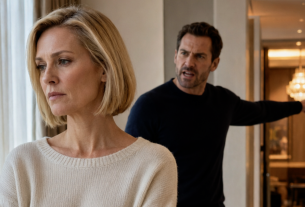
Marina discovered that she had forgotten how to do nothing.
The realization came to her on a Saturday morning, when she woke up in her new apartment—a tiny two-room place smelling of fresh paint and someone else’s history—and realized that her hands were reaching for a cleaning cloth all by themselves. Not because anything was dirty. Simply because that was how it had always been.
She placed her hands in her lap and forced herself to sit still.
Outside the window, autumn Moscow was waking up. The leaves on the poplar tree in the courtyard had already turned yellow around the edges, but they were still holding on—stubbornly, in defiance of the cold nights. Marina watched them and thought that she understood those leaves better than ever before.
Six months had passed since the day she walked out of the apartment she had considered her home for twelve years. She left with two suitcases and a box of books. Andrei stood in the hallway, watching her back with the expression of a man who could not understand what he had done to deserve this.
That expression—bewildered and wounded—was what she remembered most clearly.
The phone rang at half past ten. Marina was just making coffee—real coffee, brewed in a cezve, not in that cheap coffee machine she and Andrei had bought as a joint birthday present, the one that made so much noise the neighbors used to bang on the wall.
She looked at the screen.
“Mother-in-law,” it said. Nina Arkadyevna. Marina still had not changed the name in her contacts. She simply had not expected the woman to call.
She let the phone ring three times. Then she answered. Just to find out what she wanted.
“Marinochka,” Nina Arkadyevna began in the voice Marina knew as well as her own pulse, “I was thinking… You do remember that my birthday is next week, don’t you?”
“I remember,” Marina said.
“Well, then. I wanted to ask you… You make that cabbage pie of yours so wonderfully. Andrei says no one can make it the way you do. And there will be guests, and it would be awkward… Could you come over on Friday and help me set the table?”
Marina exhaled slowly.
Outside the window, the poplar swayed in the wind, and several yellow leaves finally let go of the branch.
“Nina Arkadyevna,” she said, and her voice sounded calm, surprisingly calm, “do you remember that I’m no longer your daughter-in-law?”
There was a pause on the other end of the line.
“Oh, Marinochka,” her former mother-in-law said with the kind of hurt she had been rehearsing for years, “that doesn’t mean we’ve become strangers. After all these years… I treated you like a daughter…”
“Nina Arkadyevna,” Marina interrupted gently, but with a firmness she was only beginning to discover in herself, “you loved me as long as I cooked borscht. I’m not offended. It’s just that from now on, I’ll be cooking borscht for myself.”
She ended the call.
Her hands were not trembling.
That surprised her.
Andrei came on Tuesday. No call, no warning—he simply buzzed the intercom and said, “It’s me,” as though the words “it’s me” still entitled him to have that door opened.
Marina let him in.
She did not know why. Perhaps because twelve years were not something you stopped feeling after only six months.
He walked in and looked around. An expression appeared on his face that she hated more than any other: condescending, appraising, faintly pitying.
“It’s small,” he said of the apartment.
“It’s mine,” Marina replied.
He sat down on the sofa—old, repainted, bought on Avito for three thousand rubles—and looked at her. There was something in his gaze that she once would have mistaken for tenderness.
Now she saw it more clearly.
It was expectation.
“Mom called,” he began, and his tone was as familiar to her as the creak of the second step in the stairwell of their old building. “She’s upset. She says you were rude to her…”
“I told her the truth,” Marina interrupted. “Sometimes that feels like rudeness.”
Andrei rubbed his forehead. He always did that when he wanted to look tired and misunderstood.
“You’ve changed,” he said.
“Yes,” Marina agreed.
Andrei stared at her as though she had spoken in a foreign language.
“And changing is a good thing?” he asked in a tone that implied, of course not. Changing was bad. It was an accusation. Something she ought to admit guilt over.
“Changing is a fact,” Marina said, and went into the kitchen to put the kettle on.
Not because she wanted to offer him tea. She simply needed something to do with her hands.
Andrei followed her. He had always followed her around the apartment when he wanted to continue a conversation she had already finished. It used to exhaust her.
Now she merely observed it, the way one notes the weather outside.
“Marin,” he said, sitting on the only stool by her kitchen table, “I understand that you’re hurt. But life goes on. Mom is alone, things are difficult for her. She has high blood pressure, her knees hurt, she can’t…”
“Andrei,” Marina interrupted without turning around, “your mother has two grown sons. You and Seryozha. Seryozha has a wife. And you…” She paused. “You have hands.”
Silence settled behind her.
Marina could hear him breathing a little faster, the way he always did when he was angry but did not want to show it.
“We don’t know how to do things the way you do,” he finally said.
There was genuine, undisguised helplessness in his voice, and that was the most frightening thing of all. He was not pretending. He truly did not understand why “we don’t know how” was his problem rather than her obligation.
Marina turned around.
She looked at him carefully, the way one looks at someone they may be seeing for the last time.
“Andrei, you’re a grown man. You’re forty-one years old. You know how to drive a car, prepare financial reports, and repair electrical outlets. You can learn how to mop your mother’s floor.”
“That’s not the same thing,” he muttered.
“I know,” Marina agreed. “You’re happy to repair electrical outlets. But a cleaning cloth is humiliation. I lived with that logic for twelve years. I just applied it to myself in reverse: a cleaning cloth isn’t humiliation—it’s my duty.”
Andrei opened his mouth. Closed it. Opened it again.
“You’ve always known how to do that,” he finally said. “Twist everything around so that I end up being the guilty one.”
Marina felt something sharp inside her—not anger, no. More like exhaustion from having to explain the obvious.
“I’m not making you guilty,” she said quietly. “I’ve simply stopped blaming myself for being tired.”
He left twenty minutes later.
At the very end, already standing in the hallway and fastening his jacket, he said what people always say when they have nothing else left to say:
“You’ll regret this. Being alone, without a family—that’s no life.”
Marina held the door open.
“Andrei,” she said, “I spent twelve years in a family, and I was alone. Now I am alone—and I’m not lonely.”
He left without answering.
Marina closed the door, leaned her back against it, and stood there for about three minutes.
Just breathing.
Then she went into the kitchen, turned off the kettle, which had boiled long ago, and poured herself coffee.
Real coffee, which she made for herself, without rushing.
That evening, her friend Katya called.
“So, how are you?” she asked without any preamble, because they had been friends for twenty years and knew how to begin in the middle of things.
“Strange,” Marina admitted. “He came over. I listened to him, told him everything I thought, and I didn’t feel guilty or relieved.”
“What did you feel?”
Marina thought for a moment.
“Emptiness. But not a bad kind. Like a room after renovation—empty, and that’s right because you haven’t yet decided what to put in it.”
Katya was silent for a second.
“That’s a good kind of emptiness,” she finally said. “That’s what freedom feels like at the very beginning. It’s not frightening yet, and it’s not joyful. It’s simply—space.”
Marina looked around her apartment. At the stack of books she still had not unpacked. At the geranium on the windowsill—hers, brought home from work because there was no one there to water it on weekends. At the unfinished pencil sketch on a sheet of paper.
She had been good at drawing in school. Then she had stopped because Andrei had once said, “And what’s the point of that?”
“Katya,” Marina said, “do you remember that I used to draw?”
“Of course I do. You drew Nina Ivanovna’s portrait for Teacher’s Day, and she cried.”
“I bought a sketchbook,” Marina said. “A month ago. It’s still lying in the bag. I haven’t opened it even once.”
“Open it,” Katya said simply.
Marina opened the sketchbook that very night.
She sat on the floor with her back against the sofa. There was no room on the table, and somehow sitting at a table felt too formal for what she was doing. At first, the pencil felt awkward and foreign in her hand, the way your own body can feel after a long illness.
She drew the poplar tree outside the window.
It was a little crooked, with disproportionate branches and leaves that looked like commas. No skill. No technique.
But it was her poplar tree, her pencil, her evening—an evening she had not spent serving someone else’s needs.
Marina stared at the drawing for a long time.
Then she smiled.
Not because it was beautiful.
But because it was hers.
The phone lay beside her. On the screen was an unread message from Andrei:
“Mom is offended. You could at least apologize.”
Marina picked up the phone.
Her finger hovered over the screen.
Then she blocked Nina Arkadyevna’s number.
To Andrei, she wrote one word:
“No.”
She placed the phone facedown.
Picked up her pencil.
Outside the window, the wind shook the poplar tree, and the last yellow leaves finally let go of the branches—not because they had surrendered, but because their time had come.
Marina began a new sketch.
In the morning, she woke up without an alarm, made coffee, and realized that for the first time in many years, she was not thinking about what someone else needed.
Only about what she needed.
It was unfamiliar.
Almost frightening—this emptiness in her schedule, this silence where other people’s expectations used to be.
But somewhere at the bottom of that emptiness was something warm and solid at the same time.
Like earth beneath the snow—invisible, but there, holding everything up.
Marina took her sketchbook and wrote on the first page, the one people always leave blank for something important:
“I need myself.”
She put a period at the end.
Outside the window, the gentle autumn sun was shining.