Valentina Sergeyevna never came empty-handed.
Every visit, she invariably brought a pie, a jar of jam, or at least a bunch of dill from her garden. The gift itself was insignificant. What mattered was the ritual: enter, place it on the table, sweep her eyes over the kitchen—and begin.
“New curtains again?” she would say in the tone of a doctor who had discovered a worrying symptom. “Why, Nadyusha? The old ones were still perfectly decent.”
Nadya smiled. Poured tea. Set a cup in front of her mother-in-law.
She had learned to do this long ago—to smile at the right moment, the way people learn to maintain good posture or stop squinting in the sun. Not because it was easy, but because otherwise a conversation would begin that could drag on for hours and lead nowhere.
Her mother-in-law would sit down, wrap both hands around her cup, and look at her daughter-in-law with the expression of someone forced to tolerate another person’s peculiarities.
“Igor will be late today,” she would announce, as though she knew her son’s schedule better than his wife did. “He’s very busy. A major project. Do you even understand how difficult things are for him right now?”
“I understand,” Nadya would answer.
And it was true—just not in the sense Valentina Sergeyevna meant.
Nadya and Igor had met eleven years earlier at a corporate party hosted by a mutual acquaintance. He danced awkwardly, but his laugh was infectious, and he knew how to listen as though no one else existed in the room. At the time, Nadya worked as an economist for a small construction company—a modest position, but one with prospects.
The first few years were real. They rented an apartment together, counted every penny, argued over trivial things, and made up by nightfall. Igor worked as a design engineer, earned a steady salary, and made plans with such enthusiasm that it was impossible not to believe every word.
“In three years, we’ll buy our own place,” he would say, scrolling through apartment listings. “Then a car. And then you’ll be able to work because you enjoy it, not because you have to.”
Nadya nodded. Back then, she had no idea that “then” would eventually mean something entirely different.
Five years ago, Igor quit his job. Officially, it was by his own choice. Unofficially, it happened after a conflict with management, the full details of which Nadya never learned. At first, he actively sent out résumés, attended meetings, and returned home cautiously optimistic.
“There are a couple of interesting possibilities,” he would say over dinner. “Let’s wait a little.”
They waited.
Then came the courses—first project management, then construction management. Then the idea of opening his own firm, then a partner who “unexpectedly dropped out,” then more courses. Igor wasn’t doing nothing—that would have been simpler. He was constantly studying something, planning something, discussing something.
It simply never brought in any money.
And Nadya worked.
In four years, she rose from an ordinary economist to chief financial officer—quietly, methodically, without making grand declarations. Promotions came not because she asked for them, but because there was simply no other option: she did the work better than everyone else.
Her salary became the foundation supporting everything: the mortgage, which she paid off early; the renovations; family vacations; Valentina Sergeyevna’s medical treatment the year before—expensive treatment at a good private clinic.
Her mother-in-law knew none of this.
Igor had made sure of that.
“Nadyusha, are you going on another business trip?” Valentina Sergeyevna asked one evening as Nadya packed her travel bag.
“For three days. Negotiations in Yekaterinburg.”
“That’s what comes of having an unserious job,” her mother-in-law sighed. “Always running here and there. And what about the home? What about your husband? Igor works from morning till night on his project, comes home exhausted—and the house isn’t even properly looked after.”
Nadya carefully folded a blouse.
“The house is in order, Valentina Sergeyevna.”
“I’m not talking about dust. I mean a different kind of order. The proper kind.”
Her mother-in-law never explained exactly what “proper order” meant, but the meaning was clear enough without words.
The husband earns the money. The wife takes care of the home.
Everything else is wrong.
Nadya remained silent.
She had been silent for a long time. Ever since she realized that explanations were pointless, arguing cost more than it was worth, and Igor would never defend her anyway.
He had a talent for disappearing at such moments—going out onto the balcony, suddenly discovering an urgent message on his phone, remembering that he had been meaning to get a glass of water.
The turning point did not come when Nadya got tired.
She had learned not to notice exhaustion.
It came when she overheard him.
She returned from work earlier than usual one day. A meeting had been rescheduled, and everyone had been allowed to leave early. In the hallway, she took off her shoes and froze.
Igor’s voice was coming from the kitchen, quiet but perfectly clear.
“Mom, I understand. But that’s just how she is—you can’t stop her. She’s invested money somewhere again, more unnecessary spending. I keep telling her we need to save, but she doesn’t listen. You know I try, but she’s difficult.”
Nadya stood against the wall.
Outside, rain was falling.
In the kitchen, her husband was complaining to his mother about the wife who paid for his courses, his periods of unemployment, his dreams.
Nadya did not go in.
She walked to the bedroom, sat on the edge of the bed, and stared at one spot for a long time.
Something inside her did not break at that moment.
Quite the opposite.
Something finally fell into place.
It clicked softly and permanently, like a lock.
Her father-in-law’s anniversary was celebrated at the country house of his older brother.
There was a long table under a canopy, strings of lights between the apple trees, and the smell of grilled meat and freshly cut grass.
Everyone had gathered: Igor’s brothers and their wives, neighbors the family had known for decades, and a cousin from Samara who had made a special trip for the occasion.
The atmosphere was warm and lively. People laughed, clinked glasses, and recalled old stories.
Nadya sat beside her husband and felt completely calm.
Not the stiff kind of calm that comes from holding yourself together by sheer force—but genuine calm, almost detached. As though she were watching everything from a distance, from a height where she could clearly see the table, the people, and how all of it would end.
She knew Valentina Sergeyevna would speak.
It was as predictable as the succession of courses being served.
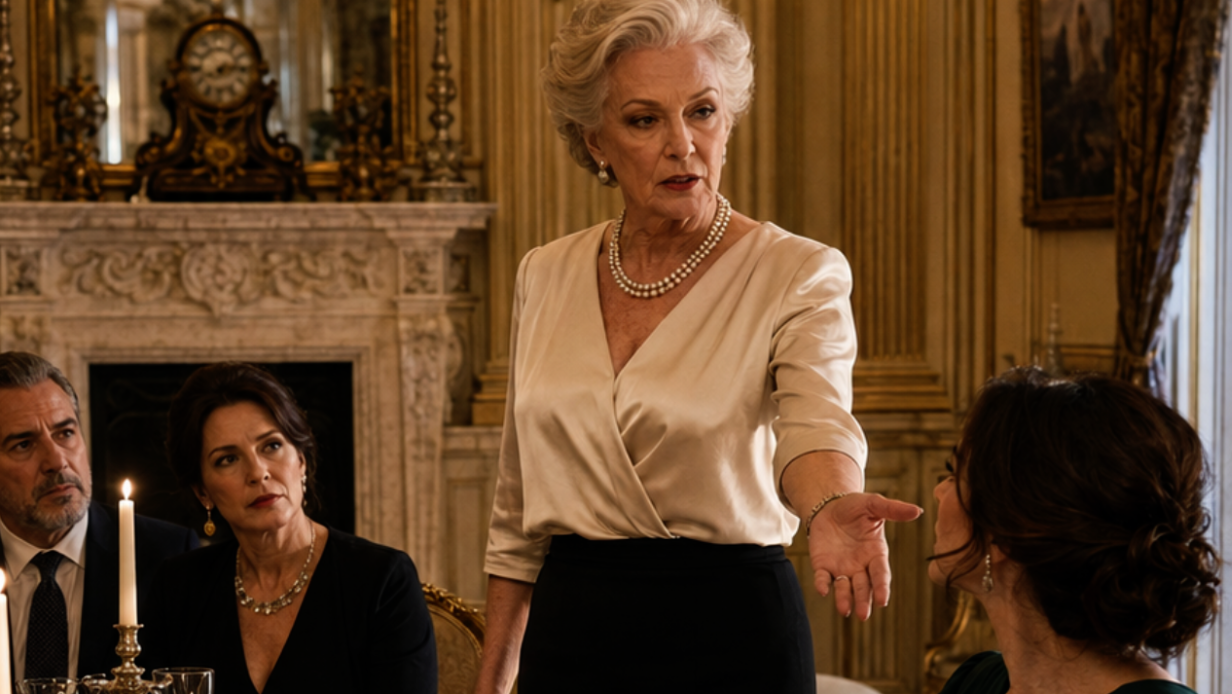
Her mother-in-law took the floor after the third toast.
She began gently—with praise for her husband, memories of their youth, gratitude to their children. Her voice was practiced and confident, the voice of someone accustomed to being listened to.
“Our Igor is wonderful,” she said, and her tone carried that special kind of maternal pride that required no proof. “He works hard and supports his family. Not everyone can do that. The only problem is that they spend too much money, let me tell you. Our Nadya is a young woman with expensive tastes.”
She smiled at her daughter-in-law, but there was not a drop of warmth in that smile.
“That’s how young people are these days. They haven’t even earned the money yet, but they’ve already decided how to spend it.”
Someone laughed, not maliciously, simply out of habit.
An elderly neighbor nodded knowingly.
Nadya looked at her husband.
Igor stared down at his plate.
She waited a few seconds—not because she was uncertain, but out of one last, almost mechanical act of politeness.
“Igor,” she said quietly. “Would you like to add anything?”
He did not raise his head.
He merely shifted one shoulder slightly, so faintly that it could have been mistaken for a nervous twitch.
That was enough.
Nadya carefully set down her glass. Dabbed her lips with a napkin.
Then she began to speak, evenly and without haste, in the same tone she used when opening business meetings.
“Valentina Sergeyevna, I’d like to clarify something. Not to argue—just so everyone has an accurate picture.”
She looked around the table.
“The apartment we live in is registered in my name. I bought it four years ago. I paid off the mortgage early—with my salary. The car is also mine. Groceries, utility bills, vacations, doctors—I pay for all of it. Igor has not officially worked for five years.”
The table fell completely silent.
Not the silence that comes between toasts.
A different kind.
Dense.
Almost tangible.
Valentina Sergeyevna stared at her daughter-in-law with the expression of someone who had just been spoken to in an unfamiliar language.
Then she slowly turned toward her son.
“Igor.”
Her voice had changed. The usual confidence was gone.
“Tell her. Explain.”
Igor raised his head.
He looked at his mother, then at Nadya.
For a moment, something resembling relief appeared in his eyes—as though he himself had been waiting for someone to finally say it aloud.
“Mom,” he said quietly. “She’s right.”
The silence grew even heavier.
Then Igor’s brother Sergei began speaking, asking questions in disbelief and trying to clarify the details.
Sergei’s wife remembered aloud that two years earlier Igor had told her about a major contract that was “just about to be signed.”
The cousin from Samara frowned and said nothing, but her silence was more eloquent than words.
Gradually, everything else came to light.
The renovation of Valentina Sergeyevna’s hallway—paid for by Nadya.
The course of treatment at a private clinic the previous winter—also paid for by Nadya.
Igor listed the facts himself, quietly and without emotion, as though he were reading someone else’s inventory.
Valentina Sergeyevna did not interrupt.
Nadya watched her and saw something changing in her face—not immediately, not sharply, but slowly, layer by layer.
First confusion.
Then something resembling shame.
And finally, something Nadya recognized at once because she herself had carried it for years:
The desire to pretend that nothing had happened.
“You humiliated your husband,” Valentina Sergeyevna finally said.
Her voice was quiet, but there was steel in it.
“In front of people. That is unforgivable.”
“I told the truth,” Nadya replied. “I’m not the one who made him look ridiculous.”
She did not wait for the conversation to continue.
She stood up, thanked her father-in-law sincerely—because she had nothing against him—said goodbye to the guests, and walked to her car.
Igor came home late.
He paced around the room, not knowing what to do with himself, then stopped in the middle of the living room and said what she had long expected and feared at the same time.
“You wanted to humiliate me.”
“No,” Nadya replied. “I wanted you, just once, not to stay silent. But you did stay silent—and then I spoke.”
“Mom keeps calling me. She’s crying. Do you understand what you’ve done?”
“Igor.”
Nadya looked him in the eyes—calmly, without anger, almost wearily.
“Find a job. Any job. Just start. That’s all I’m asking. Not a great achievement, not a career. Just one step.”
He did not answer.
The next morning, he packed a bag and went to stay with his mother.
Their divorce was finalized six months later—without scandals, without court battles, almost routinely.
The apartment remained Nadya’s. Everything had been legally arranged properly, long before anything began to fall apart.
Igor found a job three months after leaving.
Not as an engineer, not as a manager, but as an ordinary technical specialist at a small company.
Valentina Sergeyevna stopped telling acquaintances about her successful entrepreneur son.
Nadya learned about it by chance from a mutual acquaintance.
She felt neither triumph nor pity.
She simply took note of it, the way one takes note of a weather report.
In the mornings, she made coffee in silence.
She read before work.
Sometimes she stayed in the bath longer than usual—not because she needed to, but because she could.
A small freedom that would have been impossible to explain to anyone looking from the outside.
One day, her friend Larisa asked her directly:
“Do you regret it?”
Nadya thought honestly, without rushing, the way she had learned to think about important things.
“The marriage—sometimes. What it could have been.”
She paused.
“But the decision? No.”
Outside the window was an ordinary November evening: wet pavement, yellow streetlights, pedestrians carrying umbrellas.
Nadya looked at it all and thought about how freedom rarely arrives beautifully.
More often, it comes exactly like this—in the rain, after a long silence, with a bitter aftertaste and the feeling that, at last, the air is real.
She finished her coffee.
Got dressed.
Went outside.
She walked without an umbrella—simply because she wanted to.