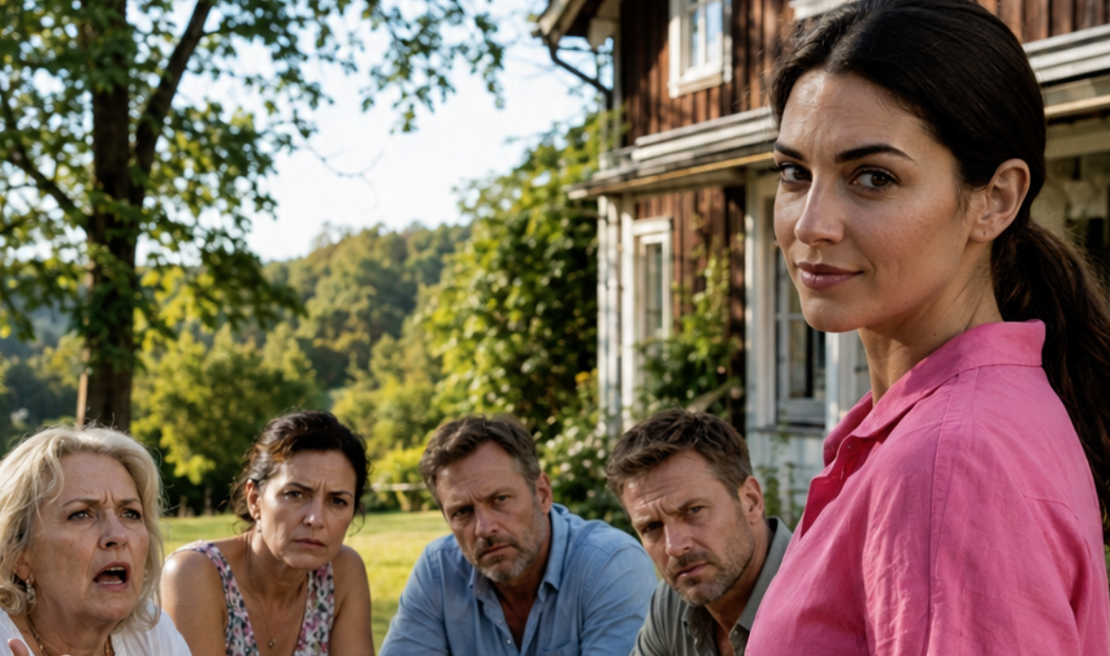
— This is the kind of table I have for you now, — she said, placing potatoes and water in front of the shameless guests.
Galya woke up, as always, at dawn. The habit had become deeply ingrained years ago, ever since her husband died and the entire household had fallen on her shoulders. Mist still hung outside the window, while the piglets were already grunting in their pen, demanding breakfast. She pulled on an old padded jacket, slipped her feet into rubber boots, and went outside.
Her house stood on the edge of the village, surrounded by a vegetable garden that Galya had tended with her own hands for twenty-five years. Everything grew there: potatoes, tomatoes, cucumbers, cabbage, all kinds of herbs. Hens clucked in the shed, piglets grunted in their pen, and ducks splashed in the little pond behind the house.
Galya was proud of her household. It fed not only her, but also her two grown children, who had long since moved to the city and found jobs there, but still occasionally came to their mother for jars of pickles and sacks of potatoes.
“Fifty is no age at all,” Galya liked to say as she straightened her aching back after weeding the garden beds.
Her hands were strong and work-worn, her face weathered, but her eyes shone with the special warmth found only in people who are accustomed to giving more than they receive.
On the morning when it all began, Galya was picking strawberries when she heard a car horn outside the gate.
“Who could that be this early?” she muttered, wiping her hands on her apron.
Her cousin Svetlana’s car was parked outside. Galya had not seen her for a year, since the previous summer, when Svetlana had stopped by for barely half an hour to pick up a jar of honey for her sick mother-in-law.
Svetlana got out of the car with a welcoming smile and opened her arms wide.
“Galochka! My dear!” she exclaimed, hugging her cousin. “Let me have a look at you! You’re still blooming!”
“Sveta, what brings you here?” Galya asked in surprise, returning the hug. “Come in, come in. Why are we standing at the gate?”
Svetlana walked into the yard, looking around with undisguised admiration.
“Oh, it’s so beautiful here!” she exclaimed. “A garden, chickens, piglets… You live like a lady of the manor!”
“Some lady of the manor,” Galya chuckled. “I dig around in the soil from morning till night. Sit down in the gazebo. I’ll make us some tea.”
Over tea, Svetlana explained that she had simply decided to stop by because she missed Galya and wanted to see her. The conversation flowed easily and pleasantly, just like in the old days when they had been girls running back and forth to each other’s houses.
Galya even became emotional. It had been a long time since she had enjoyed such a heartfelt conversation.
When it was time for Svetlana to leave, Galya loaded her up with bags of vegetables and a jar of jam.
“Take them, take them. I have plenty,” Galya said, waving away Svetlana’s half-hearted protests. “There’ll still be enough left for me.”
Svetlana drove away looking pleased, while Galya stood at the gate for a long time, watching the car disappear with a warm feeling in her chest.
It was nice when relatives did not forget about you.
But after that day, Svetlana began visiting more often.
At first, she came once a month. Then every two weeks. By the end of summer, she was coming every weekend.
And every visit followed the same pattern: hugs, compliments about the household, long conversations in the gazebo, and bags full of produce to take home afterward.
Galya tried not to think badly of her.
They were family, after all. Why keep score?
Maybe Svetlana really was going through a difficult time, reaching out to her relatives and looking for support. Galya remembered how inseparable she and Svetlana had been as children, even though life had eventually taken them in different directions.
Galya had stayed in the village, while Svetlana had moved to the city, married a promising engineer, and had two children.
But one day, while they were drinking tea, Svetlana casually mentioned money.
“Oh, Galochka, things are so difficult for us right now,” she sighed, stirring sugar into her cup. “All our savings went toward helping the children buy apartments. Can you imagine? We helped our daughter arrange a mortgage, and our son too. Now we live from paycheck to paycheck and save on everything.”
Galya felt genuinely sorry for her.
She knew herself how difficult it was to raise children and help them get established in life. She helped her own children whenever she could—with potatoes, preserved food, and money whenever she had some to spare.
“Come by more often,” Galya told Svetlana. “At least I can feed you a little from the garden. That should make things easier.”
Those words turned out to be a fatal mistake.
Because after that conversation, Svetlana stopped coming alone.
At first she came by herself, then she started bringing her children—her grown daughter and son, both nearly thirty, both employed, but according to Svetlana, barely making ends meet because of their mortgages.
The first time Svetlana arrived with an entire group—her husband, her daughter and son-in-law, and her son and daughter-in-law—Galya was stunned for several seconds but quickly pulled herself together.
Hospitality was in her blood. She could not even imagine refusing to help relatives.
“Oh, we decided the whole family should come visit you,” Svetlana chirped while unloading bags containing a barbecue grill and charcoal from the car. “The kids missed the fresh country air so much! You don’t mind if we grill some shashlik, do you?”
“Of course not,” Galya replied uncertainly. “Come in, make yourselves comfortable.”
The entire day passed in a blur of chores.
Galya chopped vegetables from her garden for salad, brought pickles up from the cellar, and fried potatoes.
The younger relatives settled themselves in the gazebo. Her nieces and nephews asked her questions about the farm with apparent interest, although Galya noticed that they seemed much more interested in how much she owned than in how she managed everything by herself.
“Aunt Galya, do your chickens lay well?” her niece Olya asked lazily, glancing toward the henhouse. “Maybe we could take a dozen eggs home? They’re so expensive in the city, and farm eggs taste so much better.”
“Of course, take some,” Galya nodded, although something unpleasant pricked inside her.
By evening, when the guests were finally leaving, their car was packed with bags—potatoes, cucumbers, tomatoes, jars of jam and pickles, eggs, even a piece of pork fat from the cellar.
Galya watched her relatives leave, feeling a strange mixture of exhaustion and resentment that she was afraid to admit even to herself.
From then on, the visits became regular.
Every weekend, not one car but two or three would pull up outside Galya’s house.
They came as an entire group—Svetlana and her husband, her daughter and son-in-law, her son and daughter-in-law.
Sometimes they even brought friends who, apparently, also loved fresh country air and outdoor barbecues.
Galya rushed around the kitchen trying to feed everyone. She put everything she had on the table, picked the last tomatoes from the garden beds, and opened jars she had preserved for winter.
Soon even the meat for the barbecue became the hostess’s responsibility.
Then there were vegetables, herbs, pickles, bread—everything paid for out of Galya’s modest budget and produced through her own hard labor.
The younger relatives increasingly began calling ahead with requests.
“We’re coming Saturday. Put the potatoes on early.”
“Marinate the meat for the barbecue in advance.”
Galya, accustomed to pleasing everyone, agreed, even though her exhaustion kept growing and the household required more and more work to replace everything the guests carried away.
One day, Aunt Valya, a neighbor who lived two houses down, said to Galya while they were talking by the fence:
“Galya, there are cars outside your place every weekend as if you’re having a celebration. Is all that your family coming over?”
“My cousin and her family,” Galya sighed. “They say they’ve fallen in love with the countryside.”
“Be careful not to spoil them,” Aunt Valya chuckled. “Or you’ll turn from the owner of the house into their personal food supplier.”
Galya waved the comment away at the time, but deep inside, something began to trouble her.
She started noticing that her winter supplies were disappearing much faster than usual, that the henhouse was emptying faster than it should…
One day, when Svetlana unexpectedly came alone—a rare visit without the entire group—Galya finally decided to ask directly about money.
“Sveta, you said things were difficult financially,” she began carefully as she poured the tea. “How are things now?”
Svetlana waved her hand.
“Oh, it’s terrible, Galochka. That cursed mortgage has drained the life out of us. We’re living very frugally, saving on absolutely everything.”
“Maybe I can help somehow?” Galya offered. “Maybe give you a little money?”
“Oh, what are you talking about?” Svetlana protested theatrically. “You already feed us. How could we possibly ask for more?”
The conversation left Galya with an unpleasant feeling, although she could not understand exactly what bothered her.
Everything seemed logical enough—her cousin was struggling, and Galya was helping however she could.
Wasn’t that what relatives were supposed to do?
The truth came out by accident, as such things often do.
Galya went to the city to visit her younger daughter, who had recently given birth. She wanted to help with the baby during the first few days.
While riding the bus, Galya struck up a conversation with the woman sitting beside her.
As they talked, it turned out that the woman lived in the same apartment building as Svetlana.
“Oh, you’re related to Svetlana Nikolaevna?” the woman said, suddenly interested after hearing the surname. “How are they doing now? Have things settled down? They’re renting out their own apartment now, you know. They moved in with their daughter, into her new three-bedroom apartment…”
The continuation is just below in the first comment.
Galya woke up, as always, at dawn. The habit had become ingrained in her long ago, ever since her husband died and the entire household fell on her shoulders. Mist was still drifting outside the window, while the piglets in the pen were already grunting, demanding breakfast. She pulled on an old padded jacket, slipped her feet into rubber boots, and went outside.
The house stood on the edge of the village, surrounded by a vegetable garden that Galya had tended with her own hands for twenty-five years. Everything grew there: potatoes, tomatoes, cucumbers, cabbage, all kinds of herbs. Chickens clucked in the shed, piglets grunted in their pen, and ducks splashed in a small pond behind the house. Galya was proud of her household. It fed not only her, but also her two grown children, who had long since moved to the city and had jobs of their own, though they sometimes came to their mother for jars of preserves and sacks of potatoes.
“Fifty is no age,” Galya liked to say as she straightened her back after weeding the garden beds. Her hands were strong and hardened by work, her face weather-beaten, but her eyes shone with that special warmth found only in people accustomed to giving more than they receive.
On the morning when it all began, Galya was picking strawberries when she heard a car horn at the gate.
“Who could that be this early?” she muttered, wiping her hands on her apron.
Outside the gate stood her cousin Svetlana’s car. Galya had not seen her for a year, since the previous summer, when Svetlana had stopped by for barely half an hour to pick up a jar of honey for her sick mother-in-law.
Svetlana got out of the car with a friendly smile, throwing her arms wide.
“Galochka! My dear!” she exclaimed, hugging her cousin. “Let me look at you! You’re blooming!”
“Sveta, what brings you here?” Galya asked in surprise, returning the hug. “Come in, come in. Why are we standing at the gate?”
Svetlana walked into the yard, looking around with undisguised admiration.
“Oh, what beauty you have here!” she drawled. “A vegetable garden, chickens, piglets… You live like a lady of the manor!”
“Some lady,” Galya chuckled. “I dig in the dirt from morning till night. Sit down in the gazebo. I’ll make some tea.”
Over tea, Svetlana explained that she had simply decided to stop by because she missed Galya and wanted to see her. The conversation flowed easily and pleasantly, just like in the old days when they had been girls running back and forth to each other’s houses. Galya was even touched. It had been a long time since she had enjoyed such a warm, heartfelt conversation.
When she saw her cousin off, she loaded her up with bags of vegetables and a jar of jam.
“Take them, take them. I’ve got plenty,” Galya said, brushing aside Svetlana’s weak protests. “There’ll still be enough for me.”
Svetlana drove away pleased, while Galya stood at the gate for a long time, watching the car disappear with a warm feeling in her chest. It was nice when family didn’t forget about you.
But after that day, Svetlana’s visits became more frequent. At first she came once a month, then every two weeks, and by the end of summer she was arriving every weekend. And every time, it was the same scene: hugs, compliments about the farm, long gatherings in the gazebo, and bags of produce to take home afterward.
Galya tried not to think badly of it. They were family, after all. Why keep score? Maybe her cousin really was going through a difficult period and was reaching out to family for support. Galya remembered how inseparable she and Svetlana had been as children, although life had later taken them in different directions. Galya stayed in the village, while Svetlana moved to the city, married a promising engineer, and had two children.
But one day, during a conversation over tea, Svetlana happened to mention money.
“Oh, Galochka, things are so difficult for us right now,” she sighed, stirring sugar into her cup. “All our savings went toward helping the children buy apartments. Can you imagine? We helped our daughter with her mortgage, and our son too. Now we live paycheck to paycheck. We save on absolutely everything.”
Galya sincerely sympathized. She knew herself how difficult it was to raise children and help them get on their feet. She also helped her own children whenever she could—with potatoes, preserves, and money whenever she had some to spare.
“You should come by more often,” she told Svetlana. “At least I can feed you a little from the garden. It’ll make things easier.”
Those words turned out to be a disastrous mistake.
Because after that conversation, Svetlana stopped coming alone. At first she came by herself, then with her children—her grown daughter and son, both nearly thirty, both employed, but according to Svetlana, barely making ends meet because of their mortgages.
The first time Svetlana showed up with an entire crowd—her husband, daughter and son-in-law, son and daughter-in-law—Galya was stunned for a few seconds, but quickly pulled herself together. Hospitality was in her blood, and she could not even imagine refusing to help relatives.
“Oh, we decided to visit you as a whole family,” Svetlana chirped, unloading bags containing a barbecue grill and charcoal from the car. “The kids missed the country air so much! You don’t mind if we make some shashlik, do you?”
“Of course not,” Galya replied, somewhat bewildered. “Come in, make yourselves comfortable.”
The whole day was spent bustling around. Galya cut vegetables from her garden for salad, brought preserves up from the cellar, and fried potatoes. The younger guests settled into the gazebo, and her cousins’ children asked with interest about the farm. But Galya noticed that they seemed far more interested in how much she had than in how she managed to take care of all of it alone.
“Aunt Galya, do your chickens lay well?” her niece Olya asked lazily, glancing toward the henhouse. “Maybe we could take a dozen eggs home? They’re so expensive in the city, and farm eggs taste so much better.”
“Take some, of course,” Galya nodded, though something unpleasant pricked inside her.
By evening, when the guests were finally leaving, the car was packed with bags—potatoes, cucumbers, tomatoes, jars of jam and pickles, eggs, even a piece of cured pork fat from the cellar. Galya saw her relatives off feeling a strange mixture of exhaustion and hurt that she was afraid to admit even to herself.
From then on, the visits became regular. Every weekend, not one car but two or three would pull up outside the house. The whole crowd came—Svetlana and her husband, her daughter and son-in-law, her son and daughter-in-law. Sometimes they even brought friends, who apparently also loved the country air and outdoor barbecues.
Galya rushed around the kitchen trying to feed everyone, setting everything she had on the table, cutting the last tomatoes from the garden beds, opening jars she had saved for winter. Before long, even the meat for the barbecue became the hostess’s responsibility. Vegetables, greens, pickles, bread—everything came out of Galya’s modest budget and was paid for with her hard labor.
The younger relatives increasingly began calling ahead with requests.
“We’ll come Saturday, so put the potatoes on early and marinate the meat for the barbecue in advance.”
Galya, accustomed to pleasing everyone, agreed, even though her exhaustion was growing and the farm required more and more effort to replace everything the guests carried away.
One day, her neighbor Aunt Valya, who lived two houses away, remarked while talking to Galya by the fence:
“Galya, you’ve got cars outside every weekend like there’s a celebration. Is that all your family coming?”
“My cousin and her family,” Galya sighed. “They’ve grown attached to village life, they say.”
“Be careful not to spoil them,” Aunt Valya chuckled. “Otherwise you’ll go from being a hostess to being their personal food supplier.”
Galya brushed the words aside at the time, but deep down, something began scratching anxiously at her thoughts. She started noticing that her winter stores were disappearing faster than usual and that the henhouse was being emptied of eggs more quickly than before.
One day, when Svetlana arrived alone again—a rare occasion without the whole crowd—Galya finally decided to talk directly about money.
“Sveta, you said things were difficult financially,” she began carefully while pouring tea. “How are things now?”
Svetlana waved her hand.
“Oh, terrible, Galochka. That damned mortgage has worn us down completely. We live frugally. We save on literally everything.”
“Maybe I could help somehow?” Galya offered. “Maybe with a little money?”
“Oh, what are you saying?” Svetlana protested theatrically. “You already feed us. How could we possibly take anything more?”
The conversation left Galya with an unpleasant feeling, though she could not understand exactly what bothered her. Everything seemed logical enough—her cousin was struggling, and Galya was helping however she could. Wasn’t that what relatives were supposed to do?
The truth came out by accident, as it often does.
Galya traveled to the city to visit her younger daughter, who had recently given birth. She wanted to help with the baby during the first few days. On the bus, she struck up a conversation with a fellow passenger who, as it turned out, lived in the same apartment building as Svetlana.
“Oh, you’re related to Svetlana Nikolaevna?” the woman said brightly after hearing the surname. “How are things with them? Better now? They’re renting out their own apartment these days, you know. They moved in with their daughter in her new three-bedroom place.”
Galya felt as though the ground had disappeared beneath her feet.
“What three-bedroom place?” she asked, struggling to keep her voice steady.
“Well, their daughter bought a three-bedroom apartment with a mortgage in a new residential complex,” the woman continued readily. “It’s a nice place, already renovated. They all live together there now—Svetlana and her husband, their daughter and son-in-law. They rent out their own apartment, so they get some income from that. And I heard they bought their son a new car recently too. A nice foreign model.”
“Did they buy their daughter a car too?” Galya asked, although she was already afraid of the answer.
“Of course they did,” the woman nodded. “They’ve set both children up very well. They certainly aren’t poor, although they’re always complaining about how difficult things are.”
Galya spent the rest of the journey in a daze. Numbers spun around in her head—not exact figures, but rough calculations. Two cars for the children. A mortgaged three-bedroom apartment. Another apartment being rented out.
That was serious money. Serious investments.
And all this time they had been telling her stories about cutting expenses, financial hardship, and how they needed to drive out to the village every weekend for free food.
Galya stayed at her daughter’s house for only a couple of hours, although she had planned to remain for several days. She couldn’t stop thinking about the conversation on the bus, mentally calculating everything she had given her relatives over the past months.
The harvest that was supposed to feed her through winter.
The preserves she had worked so hard to prepare.
The meat from the pigs she had raised with her own hands.
“Mom, you seem completely distracted,” her daughter remarked while rocking the baby. “Did something happen?”
Galya told her everything—the visits from Svetlana, the constant weekend gatherings with her children, and the conversation she had overheard on the bus.
Her daughter listened, frowning more and more.
“Mom, seriously?” she said, shaking her head. “They’re blatantly using you! They come here and eat at your expense while they themselves are living comfortably. Do you even realize how much effort and money you’re spending on them?”
“I thought they were really struggling,” Galya said, bewildered. “She’s my cousin. I couldn’t refuse.”
“A relative shouldn’t take advantage of your kindness,” her daughter replied firmly. “You need rest yourself, not to spend every weekend feeding other people’s grown children barbecue.”
Galya returned home with a heavy heart. The hurt grew inside her, mixed with shame over her own naivety. She replayed all the visits in her mind—Svetlana’s cheerful smile, how eagerly she accepted the gifts, how her niece and nephew asked questions about the household, as though they were calculating how much more could still be taken.
Another family visit was scheduled for the following Saturday. Svetlana had called to say they would all come as usual and asked Galya to prepare extra food because her son-in-law was bringing a friend.
Galya could not sleep on Friday night. She tossed and turned, wondering what she should do.
Make a scene?
Refuse to let them in?
Simply tell them everything she had been holding inside?
None of those options seemed right.
But she knew one thing for certain: it could not continue like this.
On Saturday morning, she got up at dawn as usual, but instead of rushing into her usual household chores, she did something different.
She boiled potatoes—plain potatoes, without butter or spices, exactly enough for all the guests.
She filled a pitcher with clean water from the well.
And she prepared nothing else.
No salads.
No pickles.
She didn’t even slice any bread.
By lunchtime, just as promised, two cars honked outside the gate at once.
Svetlana and her husband got out of the first car.
Her daughter and son-in-law, her son and daughter-in-law, and an unfamiliar young man—apparently the son-in-law’s friend—climbed out of the second.
“Galochka, hello!” Svetlana called cheerfully, taking the barbecue grill and a bag of charcoal from the trunk. “We decided to stop by with a friend too, hope you don’t mind? Stepa wants to see what village life is like. He’s interested.”
“Come in,” Galya replied shortly, opening the gate.
The group settled into the gazebo, making themselves comfortable among the garden beds and farm buildings as usual. The men began lighting the grill, while the women spread a plastic tablecloth over the table and discussed how many eggs they would be able to take home.
When everything was ready and everyone had sat down at the table expecting the usual abundance of appetizers—pickles, fresh vegetables, herbs straight from the garden—Galya came out of the kitchen carrying two large dishes.
One contained plain boiled potatoes.
Beside it, she placed a pitcher of water.
“This is the kind of table I have for you from now on,” she said, putting the dishes in front of her astonished guests.
Silence fell.
Svetlana stared at the modest meal in confusion, unable to understand what was happening.
“Galya, what’s wrong with you?” she asked. “Where are the vegetables? Your delicious pickles? We’ve gotten used to them already…”
“Exactly,” Galya interrupted sharply, crossing her arms over her chest. “You’ve gotten used to it. You’ve gotten used to arriving here with an entire crowd every weekend and eating me out of house and home. And I, like an old fool, kept thinking my relatives were in trouble and needed help.”
“Galya, what are you talking about?” Svetlana tried to object, but her voice lacked confidence.
“I’m talking about the fact that I know the truth now,” Galya said, looking her cousin directly in the eyes. “I know you bought cars for both of your children. I know your daughter bought a three-bedroom apartment with a mortgage and that all of you moved in there together. And I know you’re renting out your own apartment and earning money from it. So you’re living quite comfortably, while telling me fairy tales about hardship and saving every penny.”
Red blotches spread across Svetlana’s face.
Her daughter and son-in-law exchanged glances.
Her son shifted awkwardly on the bench.
“How we live is none of your business,” Svetlana snapped, though even she did not sound convinced.
“You’re right, it isn’t,” Galya agreed, her voice trembling with accumulated resentment. “But my garden, my potatoes, my preserves—they weren’t yours to eat for free every weekend while pretending you were counting every penny. I work here alone from sunrise to sunset to grow this food, preserve it for winter, and help my own children when I can. And you came here as if this were some kind of holiday resort, carried away half my supplies, and kept admiring how wonderful Aunt Galya’s life was, as if I were some wealthy landowner.”
“But we’re family,” Svetlana’s daughter Olya tried to say soothingly. “Aunt Galya, you’re exaggerating.”
“Family?” Galya gave a bitter laugh. “Family that takes advantage of someone’s kindness while living comfortably themselves and hiding the truth? Wonderful family, I must say.”
A heavy silence settled over the table.
The men awkwardly stared at the smoking grill.
The women lowered their eyes.
The unfamiliar friend of the son-in-law clearly wished he were anywhere else after accidentally landing in the middle of a family confrontation.
“Galya, well, forgive us if something went wrong,” Svetlana said, trying to smooth things over, although her voice carried more annoyance than genuine remorse. “We didn’t mean anything bad. It was just convenient to come here. Fresh air, nature…”
“Convenient,” Galya repeated bitterly. “Of course it was convenient. Foolish Aunt Galya would feed everyone and pack food for you to take home afterward. And the fact that it’s difficult for her to run this whole place alone, that she gets tired too, that she might want to rest sometimes—none of you cared about that, did you?”
She paused for a moment, trying to control the emotion threatening to burst out.
“I don’t regret helping when I thought you were genuinely struggling,” she continued more quietly, but firmly. “Helping relatives is a good and proper thing to do. But lying to your cousin and taking advantage of her kindness when you know perfectly well that you’re doing fine—that isn’t family. That’s simply using someone.”
The meat on the grill began to burn, but nobody paid attention.
“So this is your table,” Galya said, nodding toward the potatoes and water. “Don’t expect my hospitality like before anymore. If you want to visit, come. I’ll be glad to receive you as family. We can have tea and talk. But I will not feed all of you at my expense while you’re buying foreign cars and moving into three-bedroom apartments. No, thank you. I’ll help my own children instead of pretending to be a generous fool while watching other people prosper at my expense.”
Svetlana stood up from the table, her face pale with a mixture of shame and irritation.
“Well, if that’s how you feel about us,” she said through clenched teeth, “then naturally we won’t come anymore. I never thought you were so greedy, Galya.”
“I’m not greedy,” Galya replied calmly, although everything inside her was shaking from tension. “I’m simply tired of being used. There’s a difference, if you think about it.”
The guests silently began packing up.
The men folded the grill.
The women gathered the tablecloth.
No one said another word.
The atmosphere was so tense that even the sound of the car doors slamming seemed deafening in the silence.
When both cars drove through the gate and disappeared around the bend, Galya stood alone in the empty yard for a long time, staring at the untouched potatoes and the full pitcher of water on the table.
The tears she had held back throughout the confrontation finally rolled down her cheeks.
It hurt that she had been forced to treat her own relatives this way.
It hurt to realize how long she had fooled herself into believing in their sincerity.
But at the same time, she felt relief—as though a heavy burden she had been carrying for months, without even admitting its weight to herself, had finally fallen from her shoulders.
She cleared the untouched food from the table, poured the water back into the well, and went inside.
That evening, her daughter called and asked how the family visit had gone.
“It’s over,” Galya replied briefly. “They probably won’t come again.”
“Good,” her daughter said firmly. “Mom, you’re too kind for this world. It’s time you learned to say no when you need to.”
Galya was silent for a long time, looking through the window at the garden watered with her sweat and labor, at the henhouse, and at the half-empty cellar that she could now fill again for herself and her own children.
“I’m learning, sweetheart,” she finally said. “I’m learning.”
Svetlana never came again.
Only several months later did she call once, apologize dryly and uncertainly, and ask how Galya was doing. The conversation was short and formal, without the old warmth but without hostility either.
They were simply two relatives who now knew each other’s true value.
Galya returned to her old life—waking at dawn, working in the garden, harvesting crops, and preparing food for winter.
Only now, everything she grew through her own hard work truly went to those who needed it—her own children, who never hesitated to thank their mother and never confused her care with an entitlement to endless generosity.
Sometimes, in the evenings, sitting on the porch and watching the sunset over her garden, Galya thought about how kindness was a precious thing, but one that required wisdom in how it was given.
And that true family was revealed not at tables piled high with barbecue and food, but through honesty and respect for another person’s labor.