Valeria had been looking for a dacha for almost two years. Not one where the neighbors breathed right into your fence, and not one that took half a day to reach on three buses, but something right in the middle: a quiet settlement forty minutes from the city, six hundred square meters of land, a sturdy house with a veranda, two apple trees, and an old lilac bush by the porch. When the realtor opened the gate and Valeria first stepped onto that overgrown plot, she immediately knew: this was it. The place that had been worth four years of denying herself a new car and expensive vacations, putting bonuses into a separate envelope, and counting every kopeck.
She worked as an analyst, and remote work allowed her to work from anywhere. In her dreams, it looked like this: in summer she would move to the dacha, answer emails and compile reports in the mornings while sitting on the veranda with a cup of coffee, and in the evenings she would water the garden beds, read, and listen to the grasshoppers chirping. Silence. Her own rhythm. No one bothering her. After the bustle of the city, the constant noise outside the window, and the upstairs neighbors, it seemed almost like paradise.
Valeria bought the dacha a year before the wedding. Herself, with her own money, without anyone’s help. Artur appeared later: they met at a mutual friend’s birthday party, things developed quickly, and a year later they got married. Artur worked in some sales department. He was easygoing, sociable, loved noisy feasts and big gatherings—the complete opposite of her, and at first that even attracted her. He gladly began going to the dacha with his wife, and Valeria did not object. On the contrary, she was happy: it was more fun together, and there was someone to dig up the garden beds.
But Artur, like many people who come into something already prepared, very quickly stopped remembering whose labor had earned it all. In his speech, the dacha smoothly changed from “yours” to “ours,” and then simply to “the dacha.” Without clarification. As if it had fallen from the sky onto both of them equally. Valeria did not nitpick words. What difference did it make what he called it, as long as he respected her plans, her routine, her right to decide how everything was arranged there? As long as he respected that, there was no problem.
The problem arrived in June. In a white Gazelle van, with huge bags, children, and a firm intention to stay.
The summer had started well. In the first days of June, Valeria and Artur moved to the dacha properly—with laptops, chargers, and a box of groceries for the week ahead. Valeria had calculated everything in advance, as she liked to do: a menu for seven days, a shopping list so they would not have to keep running to the village store, where the selection was poor and the prices were steep. In the mornings, they both worked—each at their own laptop, she on the veranda, he in the room—and after lunch they were free. They swam in the nearby river, grilled vegetables on the rack, and sat on the porch in the evenings. The first week passed exactly as Valeria had dreamed. Calmly, steadily, humanly.
And on the eighth day, the Gazelle arrived.
Valeria was just finishing an important call when the vehicle rolled into the yard, honking. People got out of it—many of them, all at once, loudly. Her mother-in-law, Darina Viktorovna, a stout energetic woman of about sixty with a booming voice. Her sister-in-law, Arina—Artur’s sister, a little over thirty, with two children, a boy of about seven and a girl of about five. And a mountain of belongings: bags, an inflatable mattress, packages, a child’s scooter, some fishing rods.
Valeria closed her laptop and went out into the yard, understanding nothing.
“Artur? What is this?”
Her husband rushed out to meet his relatives, hugged them, helped carry the bags, and only afterward, in passing, threw to his wife:
“Oh, yes. Mom and Arina came to stay for a while. To get some fresh air. It’s good for the kids, you understand. Just for a couple of days.”
“For a couple of days,” Valeria repeated, looking at the inflatable mattress and the box of provisions that Darina Viktorovna was already dragging into the house. “With a mattress.”
“Well, where are they supposed to sleep? Lera, come on, they’re family. It would be awkward to refuse.”
Darina Viktorovna, passing by, kissed her daughter-in-law on the cheek.
“Hello, Lerochka! Oh, it’s so nice here, what air! We won’t stay long, don’t worry. We’ll visit and then leave.”
Valeria swallowed her questions. After all, a couple of days meant a couple of days. Children, fresh air, summer. She could endure it. She trusted her husband’s words—if he said not for long, then it meant not for long.
If only she had known.
The relatives settled in at lightning speed. By evening, Darina Viktorovna had taken the best room—the one where Valeria liked to work on rainy days. Arina and the children settled into the second room. Valeria and her husband were left with the small bedroom, and it was good that even that was left. The relatives’ belongings spread throughout the entire house—children’s toys on the veranda, someone’s slippers by the porch, her mother-in-law’s cosmetics in the bathroom, fishing rods in the entryway. In one evening, Valeria’s cozy, carefully arranged little world turned into a thoroughfare.
And most importantly, no one behaved like a guest who had stopped by for two days. Everyone behaved like people who had come for a full summer vacation. With every convenience. At someone else’s expense.
The very next morning, Valeria came out onto the veranda with her coffee and laptop and found Darina Viktorovna sitting in her favorite armchair.
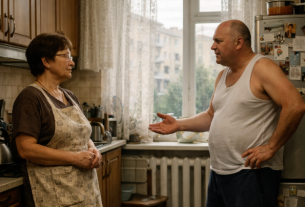
“Lerochka, will breakfast be ready soon?” her mother-in-law asked, not looking up from her phone. “The children are hungry. You could make some scrambled eggs. And pancakes would be nice too.”
Valeria looked at the clock in confusion. Nine in the morning. She had a planning meeting in twenty minutes.
“Darina Viktorovna, I work in the mornings. I have a call now.”
“Well, work, who’s stopping you? But people need to eat. The children, you know.” Her mother-in-law finally raised her eyes. “Or am I supposed to stand at the stove myself, at my age, while I’m a guest?”
And just like that, with one light nudge, Valeria somehow found herself turned into a cook for a large family. She had to cook for five adults, all told, and two children—breakfast, lunch, dinner. The children were picky, Darina Viktorovna made comments, and Arina always said, “Could I have a little more?” The groceries bought for a week for two people disappeared in three days. Valeria rushed to the village store, then to the city, to the wholesale market, because the local store could not feed such a crowd. And she paid, of course, herself. Neither Darina Viktorovna nor Arina even hinted at chipping in.
The refrigerator emptied at cosmic speed. Valeria would buy a dozen eggs—by evening, not one was left. She would buy a chicken for two days—they ate it in one sitting. Sausage, cheese, fruit for the children, sweets—everything disappeared into the bottomless stomach of the visiting relatives. And there was also gas, electricity, water—all at her expense, all on her shoulders.
Valeria tried to talk to her husband.
“Artur, this is no longer a couple of days. It’s already been a week. And there’s no end in sight.”
“What’s the big deal?” Artur was lying in the hammock, which, by the way, Valeria had also bought. “Let them rest. It’s stuffy for Arina in the city, the kids are pale. Here they have room to run around. My mom needs a change of scenery too, she’s tired.”
“And I’m not tired? I work, cook for seven people, run to the store every other day, and spend money on everyone. I came here to rest too, by the way.”
“Lera, they’re family. What am I supposed to tell them—pack up and get out? That’s shameful. Bear with it a little, they’ll leave soon.”
Soon. That “soon” hung in the air, supported by nothing. No one was getting ready to go anywhere. On the contrary, the guests were becoming more deeply rooted in dacha life. Darina Viktorovna already ordered things around in the kitchen as if she owned the place, rearranged Valeria’s dishes, threw away what seemed “not fresh” to her, and commanded what and how to cook. Arina spent entire days sunbathing, dumping the children either on their grandmother or on Valeria herself—“Lera, watch them for a minute, I’m going to take a shower.” The children raced through the house, broke whatever they got their hands on, and stripped both apple trees while the apples were still green.
Valeria worked at night because during the day they simply did not let her concentrate. Noise, commotion, children shrieking, the television blasting at full volume. She sat down at her laptop when everyone fell asleep and worked until two or three in the morning to finish what she had not managed to do during the day torn to pieces. Shadows appeared under her eyes. Her beloved dacha, her place of peace and recovery, had turned into a source of constant irritation and exhaustion.
Artur, meanwhile, seemed not to notice anything. He defended his relatives at every opportunity. “Mom is used to being taken care of.” “Arina is raising the kids alone, it’s hard for her.” “Kids are kids, what do you expect?” He found an excuse for everyone except his own wife, who was carrying this whole caravan on her back.
The last straw came one evening, near the end of the second week.
Valeria finished a difficult workday—a burning project, deadlines missed because of the daytime noise, a scolding from her boss. Hungry and exhausted, she opened the refrigerator, hoping to grab at least something.
The refrigerator was empty. Completely. Bare shelves, a lonely jar of mustard on the door, and a half-started bottle of water. Everything Valeria had brought from the city just the day before yesterday—an entire trunk full of groceries—had been swept away in two days.
She stood in front of the empty refrigerator, and then Darina Viktorovna’s cheerful voice drifted in from the veranda as she spoke on the phone:
“…yes, of course, come! There’s enough room for everyone! Petya, bring Makar too, why should he languish in the city? There’s a river here, fresh air, paradise. Lerochka cooks so well you’ll lick your fingers. Come this weekend, we’ll be waiting!”
Valeria slowly closed the refrigerator door. Petya. Makar. Two more. So now her dacha was being turned not just into a hotel for her mother-in-law and sister-in-law, but into a gathering place for all of Artur’s relatives. A free boarding house with full meals, servants, and payment at the owner’s expense.
She went out onto the veranda. Darina Viktorovna had just finished the conversation and put away her phone, pleased.
“Darina Viktorovna,” Valeria’s voice sounded even, but something new had appeared in it, something firm. “Who did you just invite?”
“Oh, Petya and Makar, my nephews.” Her mother-in-law did not even think of being embarrassed. “Good boys, you’ll like them. They’ll drop by for the weekend and rest.”
“Here? To my dacha? Without asking me?”
“Oh, what is there to ask?” Darina Viktorovna waved her hand. “The house is big, there’s enough room for everyone. They won’t eat you out of house and home.”
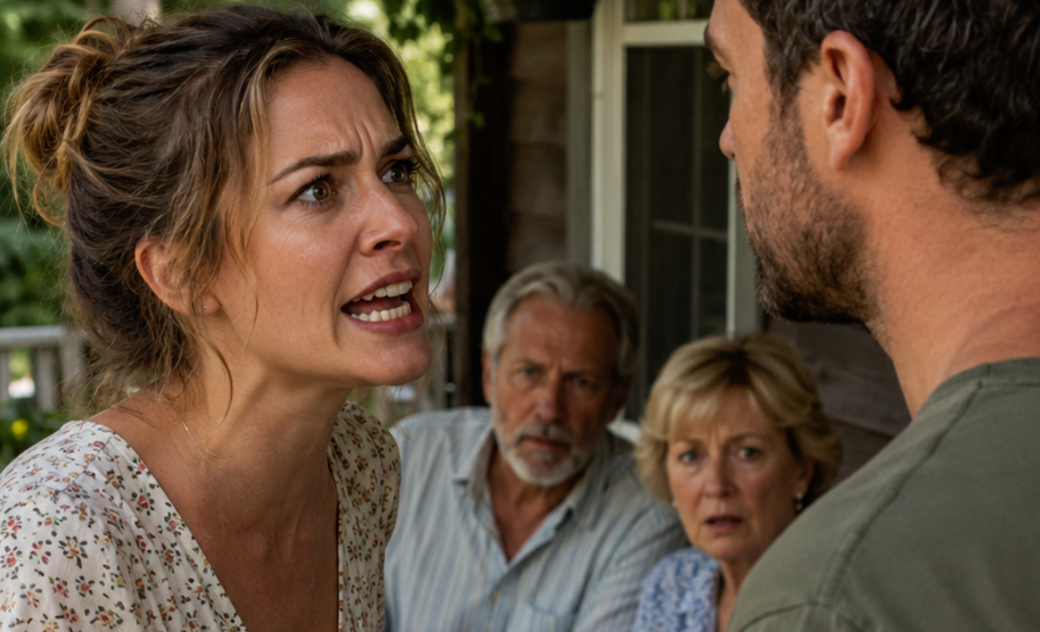
The others gathered at the noise—Artur from the hammock, Arina from the garden. And then Valeria exploded. Everything that had been accumulating for two weeks—the empty refrigerator, the sleepless nights, the disrupted work, other people’s slippers on her porch, orders being given in her kitchen—burst out all at once.
“What, am I supposed to feed your relatives all summer? This is a dacha, not a canteen for freeloaders!” the wife flared up.
The veranda went quiet. Only somewhere in the garden, the children were squealing. Darina Viktorovna recovered first—her face became covered in red blotches, and she heaved herself up from the armchair.
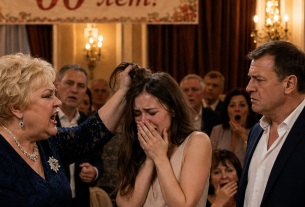
“Who are you calling freeloaders here?! Am I a freeloader?!” Her mother-in-law’s voice rose to a shriek. “I am your husband’s mother! I came as a guest, to my own son! And you call me a freeloader?! Did you hear that, Artur, did you hear what your wife is calling your relatives?!”
“Lera, you’ve completely lost your mind,” Artur stepped onto the veranda, frowning. “How are you talking to my mother?”
“And how should I talk to her?” Valeria turned to her husband. “Two weeks! For two weeks I’ve cooked for everyone, fed everyone, paid for everything, gone without sleep at night because it’s impossible to work during the day because of this circus! And now two more people are coming here! Did anyone ask me? Whose house is this, remind me?”
“Oh, now she’s counting!” Arina butted in, putting her hands on her hips. “She begrudges money for family! We’re not strangers! Artur is our brother and son. We have the right to visit him!”
“To visit him,” Valeria enunciated each word. “But the house is not his. The house is mine. I bought it. With my own money. Before the wedding. And I decide who lives here, who gets fed, and who invites whom.”
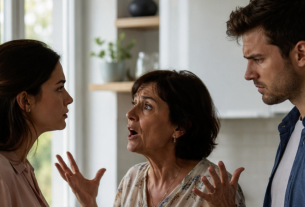
“Ugh, how petty,” Darina Viktorovna grimaced. “She’d choke over a bowl of soup. I raised my son, and look who he got involved with—a greedy woman, a miser! Artur, open your eyes and see whom you brought into the house!”
Valeria looked at her husband. She waited—at least this time. Just one time, stand up for me. Tell your mother that I am right, that this is unacceptable, that I am wearing myself out.
But Artur looked at his wife with resentment and anger.
“You humiliated my mother,” he hissed. “You called people dear to me freeloaders. I will not forgive you for this. Apologize right now.”
And at that moment, Valeria finally understood. There was no point in proving anything, explaining anything, or waiting for support. Her husband had made his choice long ago—only now it had been spoken aloud. Family was more important than his wife. Convenience was more important than fairness. Her labor, her money, her house—none of it weighed anything in his eyes compared with his offended mother.
“Apologize,” Valeria said slowly. And suddenly she calmed down, as if something inside her had clicked and fallen into place. “All right. Listen, everyone. There will be no apology. There will be something else. I want you to gather your things and vacate the dacha. Today. By evening.”
“What?!” her mother-in-law and Arina gasped in unison.
“By evening,” Valeria repeated. “The house was bought with my money, and I no longer wish to maintain a lodging house here. The party is over. Pack your things.”
“How dare you!” Darina Viktorovna nearly choked. “Throwing us out! Your husband’s mother—out onto the street!”
“Not onto the street. Home,” Valeria corrected her. “All of you have your own homes. Go there.”
“Lera, stop this immediately!” Artur raised his voice. “No one is going anywhere! This is my house too!”
“No, Artur.” Valeria looked straight at him. “This was never your house. You simply got used to thinking it was. The documents are in my name. The money was mine. And my patience was mine too, and it has run out.”
The scandal raged for a long time. Darina Viktorovna went through her entire repertoire—shouting about ingratitude, clutching her heart, threatening that Artur would come to his senses and leave “that snake,” recalling how she had raised her son in difficult years. Arina echoed her mother, mentioning greed and cold-heartedness. The children, frightened by the shouting, cried in the garden. Artur rushed between his mother and his wife, but increasingly leaned toward his mother—calming her, stroking her shoulder, casting furious glances at Valeria.
But Valeria did not retreat a single step. She stood her ground with a new calmness, unfamiliar even to herself. She took their bags from the entryway and began placing other people’s belongings by the porch—the inflatable mattress, the children’s scooter, the fishing rods. Silently, methodically. It worked better than any words. Realizing that the owner was not joking, the relatives began packing—with lamentations, door-slamming, and demonstrative offense.
By evening, the Gazelle had been loaded again. Darina Viktorovna, settling into the seat, threw through the window:
“Remember my words, girl. You’ll be left all alone. Artur will never forgive you for this.”
“I’ll survive,” Valeria replied curtly.
And then something happened that finally put everything in its place. Artur, after shifting from foot to foot by the vehicle, suddenly threw in his own bag too.
“I’m going with Mom,” he muttered, not looking at his wife. “Since you’re like this. I’ll stay with her. And you think hard about your behavior. When you cool down, you’ll call and apologize. Then we’ll talk.”
Valeria watched as her husband got into the Gazelle beside his mother. As he chose—right now, in front of everyone—her, his wife, or his offended relatives. And the choice was so obvious that it no longer even hurt. It simply confirmed what she now already knew.
“Have a safe trip,” Valeria said.
The Gazelle snorted, turned around on the narrow road, and drove away, leaving behind a cloud of dust and an unfamiliar, ringing silence. Valeria stood by the gate until the vehicle disappeared around the bend. Then she returned to the house.
The dacha looked as if a small hurricane had passed through it. Furniture moved out of place, other people’s crumbs on the floor, scattered toys that had been forgotten in the rush, empty refrigerator shelves, stripped apple trees. Valeria slowly walked through the rooms. She opened all the windows wide to air out the foreign presence. She gathered the forgotten toys into a bag and put it on the veranda—she would give them back if they came for them. She washed the dishes. She put her favorite armchair back on the veranda, where it had stood before the invasion.
And suddenly she felt not grief, not despair, but a strange, almost forgotten lightness. As if a sack had been taken off her shoulders, one she had been carrying for two weeks while bent double, and she had already forgotten what it felt like to walk upright.
That night, Valeria went to bed early—for the first time in a long while, she did not have to work until dawn. And she slept as soundly as she had not slept in a long time.
Artur, as promised, stayed with Darina Viktorovna. And waited. He called every other day, at first with the confidence of a man who knew the truth was on his side. “Well, have you thought about it? Are you ready to apologize to Mom? Then I’ll come back.” Valeria listened and was astonished—he was sincerely convinced that she was the one at fault. That she should repent for not allowing her house to be turned into a thoroughfare.
She took those weeks to calmly, without emotion, assess everything. The marriage, which had lasted a little over a year. The husband who had not once taken her side during that time. The person for whom her labor, her money, and her property meant nothing compared with his relatives’ whims. And who now, instead of coming and talking like a decent person, was sitting at his mother’s place and waiting for his wife to crawl back guilty.
The longer Valeria thought, the clearer it became: there was nothing to bring back. The order Artur wanted to restore was an order in which she was a servant, a wallet, and always the guilty one. She was not going to preserve a marriage at such a price—at the cost of her peace, her home, her dignity.
Two weeks later, Valeria filed for divorce. Calmly, she gathered the documents and submitted the application. She informed Artur with a dry message—no reproaches, no explanations, just a fact. He, not expecting such a turn, first did not believe it, then got angry, then began writing long messages—sometimes begging her to come to her senses, sometimes again demanding an apology to his mother, sometimes threatening that she would regret it. There was, incidentally, nothing to divide: the dacha had been registered before the marriage, bought with personal funds, and was not subject to division. Artur was left with what he had come with.
They were divorced quickly. No children, no property disputes, nothing to drag out. Valeria walked out of the registry office on a fine July day and realized that there was still an entire month of summer ahead. Her beloved dacha summer, which Artur’s relatives had so shamelessly stolen from her. And which had now fully returned to her.
Valeria spent the rest of the season exactly as she had dreamed when she had once bought that dacha. In the morning—work on the veranda with a cup of coffee, in silence, to the singing of birds. At lunchtime—a break, a walk to the river, an unhurried lunch that she cooked only for herself and ate whenever she wanted, not on the demand of a hungry crowd. In the evening—the garden beds, a book, the sunset over the apple trees. She once again controlled her own time. No one commanded in her kitchen, emptied her refrigerator, or invited uninvited guests onto her plot.
Her neighbor over the fence, elderly Nina Petrovna, once asked where her husband and all that noisy company that had stayed at the beginning of the summer had gone.
“They left,” Valeria smiled. “Summer ended. For them.”
Nina Petrovna nodded knowingly and handed a bunch of dill from her garden over the fence.
“And rightly so. A home is for those who love it. And those who only come to consume should not even be allowed onto the threshold.”
Valeria took the dill and thanked her. Good words, true words. A home really was for those who loved it. She had suffered for this house, saved for it ruble by ruble, put her soul into it. There was no reason to let into it people who saw it only as a free resort.
The apples did ripen that year after all—the ones the children had not managed to shake down. In August, Valeria gathered the harvest, made jam, and poured it into jars. In the evening, she sat on the veranda, in her armchair, in her silence, and watched the tea cool in her cup and the long shadows fall across the grass. Somewhere, grasshoppers chirped—exactly as she had imagined when she first walked through the gate onto that plot two years earlier.
Everything returned to its place. The dacha once again became what it had been meant to be—a place where Valeria could rest, work, and live the way she wanted. Without freeloaders. Without endless guilt. Without a person who called her house his own and treated her as nobody.