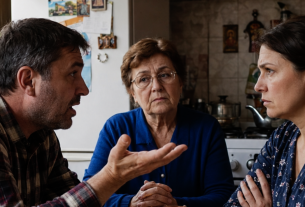
A year earlier, in the cramped entryway of someone else’s home, Artyom set his glass on a shelf and began speaking loudly enough for all eight people at the table to hear. His voice was calm, almost bored, and that very calmness seemed to make the air grow heavy. Ksenia was still holding the coat she had been about to hang up.
“Friends, I’ll tell you what’s going on, and you can decide for yourselves,” Artyom began. “My wife is cheating on me. She comes home late, messages someone, smiles at her phone. I’m not blind.”
“Artyom, you’re not blind. You’re just loud,” Ksenia said, hanging up her coat and turning toward the table. “Those are two different illnesses, and they require different treatments.”
“Don’t twist this around! I’ve been noticing it for a year. A whole year!”
“You’ve been noticing it for a year, and you decided to announce it over salad? Convenient. The witnesses are well fed and too lazy to object.”
Someone at the table coughed. Someone else stared down at their plate. Nikita, the owner of the apartment, reached uncertainly for the bottle as though it might somehow fix everything. Ksenia looked around at the guests and smiled without warmth.
“Do you have any facts?” she asked. “A name, an address, a time? Anything besides your imagination?”
“I don’t need facts. I can feel it!”
“Wonderful. Your feelings are strong, but your evidence is weak. Do you know what else works that way? Horoscopes.”
She left without slamming the door, and somehow that was louder than if she had.
Back at the rented apartment where they had lived together for two years, Ksenia packed her belongings in an hour and a half. Artyom stood in the doorway watching her like a spectator who had bought a cheap ticket.
“You’re not going anywhere,” he said.
“I am. In fact, I’ve already left. You just haven’t noticed yet, like everything else.”
For the first few weeks, Artyom called three times a day. His tone kept shifting from orders to complaints and then back to orders again.
“Come back. Stop putting on this circus.”
“You’re the one who created the circus. I simply walked out of the tent,” Ksenia replied. “The show wasn’t interesting, and the performer was always the same.”
“I was right! You ran away because you’re guilty!”
“Artyom, by that logic, everyone who runs out of a burning house must be an arsonist.”
At the same time, he was telling their acquaintances his own neat and convenient version of events. He claimed he had caught her, that he had figured everything out, and that her running away was proof he had been right. The rumors spread like an oil stain across a tablecloth, and Ksenia learned new things about herself from people she hadn’t seen in years.
Then came the money.
“We rented the apartment together,” he announced one day. “Half the rent is yours. Fifty percent, every month.”
“I don’t live there.”
“The lease is in both our names!”
“A lease isn’t a love spell, Artyom. I’m not going to pay for the air you breathe there alone. If you want something cheaper, move into a room. If you want more space, work for it.”
“You owe me!”
“I owe you one thing: the truth. Here it is for free—you slandered me in front of people, and now you’re sending me a bill. That’s not even greed anymore. That’s creativity.”
He hung up.
A month later, he went to his mother.
At first, Larisa Petrovna had been entirely on her daughter-in-law’s side. When she heard exactly what her son had said in front of the guests, she herself had wanted to slap him so hard he would remember to watch his tongue in the future.
But then Artyom kept coming to her with the same complaint, and every one of those conversations ended with money.
“I can’t afford it,” he would say. “I’m paying the rent all by myself. She walked out and now she’s living happily.”
“Son, maybe you should find a smaller apartment?”
“I don’t have time to move!”
It was a lot of money, month after month, and little by little Larisa Petrovna’s thinking began to change.
Why had Ksenia left after all?
Fine, they had argued. Fine, he had insulted her. But she could have explained herself, proved she had nothing to hide, and gone on with her marriage. Instead she had simply walked out, and now his mother was the one paying for it.
With that new thought firmly planted in her mind, Larisa Petrovna went to see her son without warning, bringing a bag of groceries and another sum of money.
A woman opened the door wearing Artyom’s T-shirt. She was barefoot, and her hair was wet.
“Can I help you?” the woman asked.
“I’m here to see my son. And who, if you don’t mind me asking, are you?”
“I’m Zhanna. Artyom and I are… close.”
Larisa Petrovna placed the grocery bag on the floor very carefully, as though it contained glass.
“Put your shoes on, Zhanna. And leave.”
“You have no right… We’re adults!”
“Adults don’t walk barefoot around my son’s apartment building. The door is to your left. The elevator is there too.”
Under Larisa Petrovna’s stare, Zhanna was dressed and out the door within two minutes.
Artyom rushed out of the bedroom when the lock clicked shut—and received the slap his mother had been holding back for an entire year.
“What are you doing?!” he shouted, clutching his face. “In front of her! You humiliated me in front of her!”
“I scolded you in front of myself. She was lucky she got out in time.”
“What was I supposed to do?! My wife is sleeping with someone else, so I’m supposed to be the worse one?!”
“Stop.” Larisa Petrovna straightened. “Name.”
“What?”
“The name of the man Ksenia is sleeping with. His address. The day of the week. You’ve been shouting about this for a year, so give me one fact.”
“I can feel it!”
“You feel it. But here’s what I saw: in an apartment your mother is paying for, another woman was walking around in your T-shirt. That is a fact. The difference between you and Ksenia is that there isn’t a single piece of evidence against her, while the evidence against you just stepped into the elevator.”
Artyom began pacing around the room, jerking his hands in frustration.
“You’re taking her side!”
“I’m taking the side of common sense, son. You should try visiting it sometime.”
She looked at him and suddenly understood far too many things at once.
He had two friends from school and a couple of acquaintances. He didn’t know how to communicate; he could live for months barely saying a word. He had always struggled with women, and the fact that Ksenia had once agreed to become his wife had been one of those miracles life rarely gives a person twice.
And now that miracle was gone.
So Larisa Petrovna decided it had to be brought back.
She got Ksenia’s address through some of Ksenia’s friends. Fortunately, she had the perfect excuse—Ksenia’s birthday was coming up.
She arrived carrying a cake, put it on the table in Ksenia’s small, tidy room, and sat down without waiting to be invited.
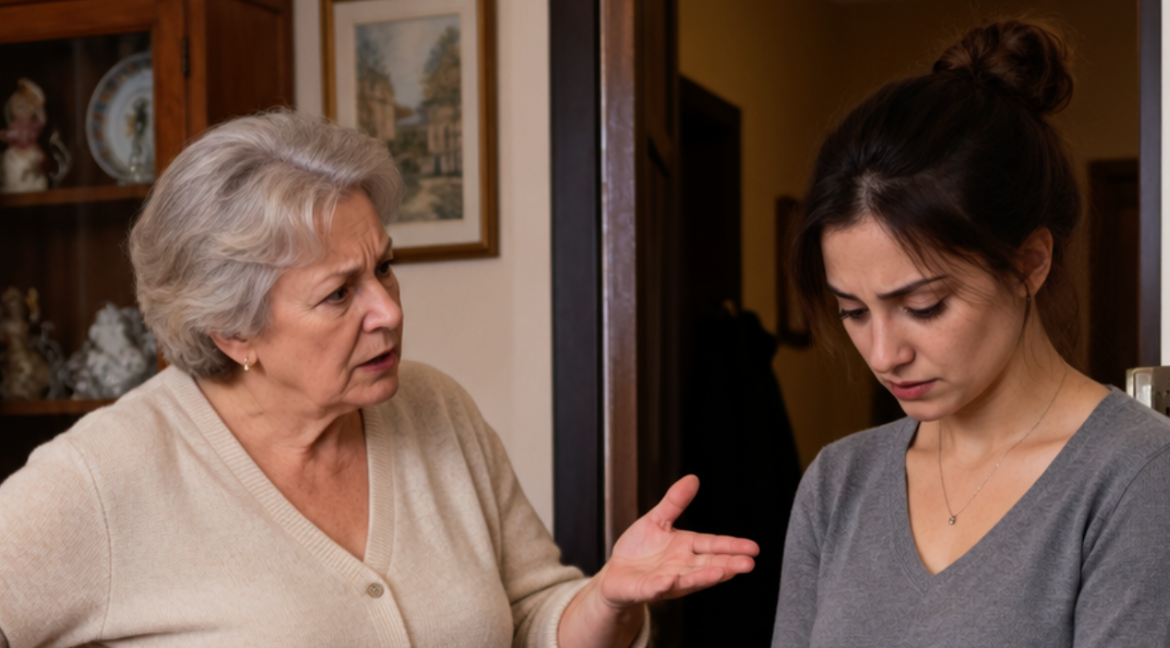
“Isn’t a whole year of resentment a bit much?” she said irritably. “Pack your things and go back to my son!”
“Hello, Larisa Petrovna. Judging by the look of it, that cake is filled with demands.”
“Ksyusha, you’ve been away long enough. Your husband is alone, there’s one rent to pay, and everything is falling apart.”
“Things that are badly built fall apart. What does that have to do with me?”
“You’re his wife! You had a fight. You should have talked it out instead of running away.”
“Talked it out with a man who made a public speech in front of eight guests?” Ksenia smiled. “I don’t defend myself in stadiums. My voice is weak, but my conscience is strong.”
“Everyone argues! He said something stupid. You get over it.”
“He said it once and then repeated it for an entire year. You thought what he said was disgusting too, at first. So what changed? Money? Did the rent suddenly become more important than the truth?”
Larisa Petrovna pursed her lips.
Ksenia picked up her phone and dialed a number.
“One second. One phone call, and then we’ll continue.”
“Who are you calling?”
“Valery Ivanovich.”
She switched on the speakerphone and placed the phone on the table.
“Hello, Valery Ivanovich. Your wife is sitting here with me, and we’re having an argument. Tell me honestly: do you trust Larisa?”
“Ksyusha, what do you mean, do I trust her?” came a heavy male voice. “She goes off somewhere, who knows where. Dresses herself up, puts makeup around her eyes, then comes back two hours late. Smiles at someone in the building. I see everything.”
Larisa Petrovna straightened as though she had been jabbed with a needle.
“Valera?!”
“And that red dress of hers,” the voice continued. “We’ve been married for thirty years, and I’m still not sure she’s faithful to me. There’s probably someone else.”
“What are you saying in front of our daughter-in-law?!” Larisa Petrovna gasped. “Valera, have you lost your mind?! I’ve spent thirty years—”
“Thank you, Valery Ivanovich,” Ksenia said calmly and ended the call. “A brilliant performance.”
The room became very quiet.
Larisa Petrovna sat there, her face red, her hands lying heavily on her knees.
“What… what was that?”
“A performance. I asked your husband to accuse you of cheating without a single piece of evidence. Exactly what your son did to me. Except your husband did it over the phone in front of one daughter-in-law. Your son did it in front of a full table of guests and then kept repeating it for an entire year.”
“You… you…”
“I showed you what it feels like. How are you feeling? Fun?” Ksenia leaned slightly forward. “Now imagine it wasn’t an act. Imagine Valery Ivanovich had said all of that in front of his friends and then spent months explaining to them why he was right. Would you smile, pack your things, and go back to him?”
“Stop it.”
“I didn’t start anything. I only brought you a mirror. It’s cheap, you know, but at least it’s honest.”
Larisa Petrovna stood up so sharply that the chair rocked backward.
The words she wanted to say became stuck, and different ones came out instead.
“You snake. We welcomed you into our family, and you…”
“You welcomed me into the family, and then I was publicly slandered. You decide what bothers you more: what happened to your son or what the truth says about him. Just don’t confuse the two.”
“Damn you,” the woman breathed from the doorway. “I hope the same thing happens to you someday!”
As she walked down the stairs, she could hear the sound of her own breathing.
One image filled her mind: Zhanna, barefoot, wearing her son’s T-shirt.
And with it came an understanding that made her feel twice as sick.
Her daughter-in-law was right.
Her own boy was the one responsible for all of it.
Her phone rang when she stepped outside.
“Well?” Artyom asked eagerly. “Did you talk to her? When is she coming back?”
“Never.”
“What do you mean, never?! You promised!”
“I promised to talk to her. I did. You’re not her husband anymore. You’re a story women tell their friends.”
“You don’t understand!”
“I understand perfectly. Listen carefully, because I’m not going to repeat myself. File for divorce yourself. Don’t drag it out. Starting this month, you pay your own rent. You won’t get another ruble from me.”
“What?! Mom! My payment is due in a week!”
“Your payment is due in a week, and after thirty years of marriage I found another woman in an apartment I’m paying for. And don’t come to our house either. Your father and I won’t let you in. Our doorway is narrow. Your ego won’t fit through it.”
“But you… this is all her fault! She’s poisoned your mind—”
The call ended.
Artyom was left standing in the middle of the room, which suddenly seemed far too spacious and far too expensive.
He began calculating in his head.
Money was tight. Rent was due soon. There would be no more help.
And inside his mind, a convenient explanation quickly began to take shape—one in which there was exactly one person to blame.
Her.
She had started it.
She had left.
She had abandoned him to deal with the rent alone.
She hadn’t filed for divorce, which meant she was keeping him on a leash.
She hadn’t called.
She hadn’t tried to make peace.
She hadn’t explained herself.
Her, her, her.
His phone beeped with a message.
Zhanna.
“Your mother humiliated me. You owe me an apology. I’ll accept it if you take me to a decent restaurant.”
A restaurant.
A bill.
More expenses.
Artyom typed quickly with two fingers without rereading what he had written:
“Leave me alone. I’m sick of you. It’s your own fault.”
He sent it and immediately regretted it.
He should have written something different, something gentler. He could have kept things going for another couple of weeks.
And instantly, he found someone to blame.
If Ksenia hadn’t created this whole mess, there would never have been any Zhanna. He wouldn’t have had anyone to be angry with, and he could have lived peacefully.
He sat down on the edge of the sofa and opened his banking app.
He still hadn’t told his mother that he had activated a credit card a long time ago.
Two hundred and eighty-four thousand rubles in debt.
Rent due in seven days.
His mistress was offended.
His wife was free.
His parents had closed their door to him.
Things were bad.
So bad that he no longer even had time to look for someone to blame.
That evening, Ksenia put the entire cake in the refrigerator without cutting it.
She sliced it the next day, on her birthday, while sitting with two girlfriends.
And the first thing she said was:
“Girls, here’s to diagnosis. A year ago, I was diagnosed in front of a room full of guests—and I cured myself by moving out.”