The modest civil ceremony at the registry office, without witnesses or expensive outfits, was exactly what Evgenia had dreamed of—quiet, intimate, just for the two of them. She wore a simple white dress that she had sewn herself, carefully thinking through every detail of the design. Lyosha smiled shyly as he squeezed her fingers in his broad palm.
“Mom will grumble, of course,” he joked awkwardly as they rode an old trolleybus to his home. “But once she sees how capable and hardworking you are, she’ll soften right away. She’s strict, but she gets over things quickly. And now she has no choice but to accept my wife.”
Evgenia believed him. An orphan who had grown up under the care of a strict aunt who was always busy, she desperately longed for a real family. She believed that her love and hard work would be enough to melt even the coldest heart.
The door of the three-room apartment was opened by Tamara Viktorovna. She stood there in a silk robe, her hair styled flawlessly, smelling of expensive French perfume. Her small, sharp eyes immediately scanned the newcomers. When her gaze settled on Zhenya, it felt like a bucket of ice water had been poured over the girl. Her mother-in-law ignored the modest cake and bouquet of spray roses Zhenya held out to her.
“And what exactly is this?” Tamara Viktorovna asked icily, not even allowing them farther into the hallway.
“Mom, meet Zhenya. She’s my wife now. We got married today,” Lyosha said, trying to smile, though his voice betrayed him with a tremor.
Tamara Viktorovna slowly looked down at Evgenia’s inexpensive shoes, then at the handmade dress with what she considered a slightly uneven seam along the hem. She curled her lips in disgust.
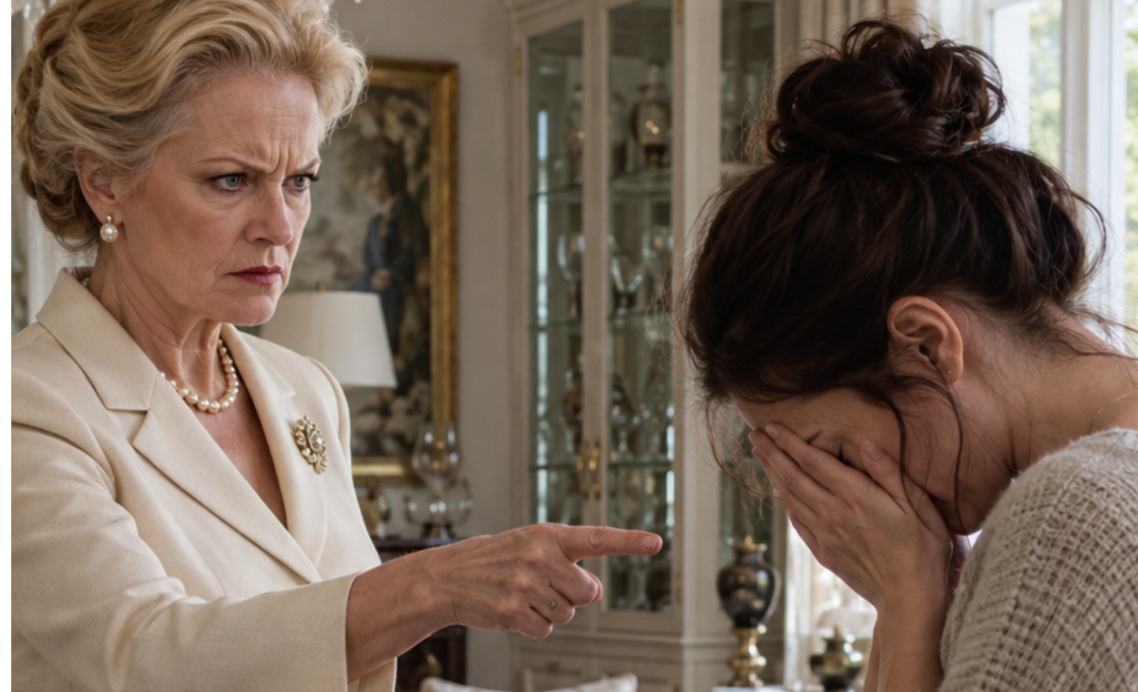
“Your wife? Lyoshenka, you must have lost your mind. Marrying this… penniless girl?” She spat the final words as though they were an insult. “Look at her! You’re far too poor for my son! You trapped him because you wanted residency in a central apartment, didn’t you? Thought you’d move in and have everything handed to you? We’ve never had beggars in our family, and we never will. My son deserves a better woman, not some girl from a dormitory who sews curtains for pennies.”
“Mom, stop it. Zhenya is a good person!” Lyosha timidly interrupted, taking a step backward.
“Shut your mouth!” his mother snapped. “Choose right now: either this pauper or your mother and everything I’ve done for you. My business, this apartment, your future—you’ll lose all of it because of your stupidity. And you, young lady,” she added, staring directly at Zhenya, “take your things and get out. You will never set foot in this house again.”
Evgenia stood frozen, barely alive. Her heart pounded somewhere in her throat. She looked at Lyosha, expecting him to take her hand, tell his mother a firm no, and leave with her.
After all, they could rent an apartment. Evgenia had some savings, enough to cover the first month’s rent. She had even suggested that option to Alexei before, but he had assured her that his mother would come around.
Now he simply lowered his eyes.
His shoulders drooped.
“Zhenya…” he whispered without looking at her. “Maybe you could go stay with your aunt for now? Just for a couple of days. I’ll talk to Mom. She’ll calm down… We’ll figure something out.”
That was the hardest blow of all.
More painful than the shouting of an angry stranger.
Lyosha was collapsing before her eyes, transforming from a man into a frightened little boy.
Evgenia silently turned around. Not a single tear fell from her eyes. Inside, everything seemed to have burned to ashes in an instant and then frozen beneath a thick crust of ice.
She stepped outside, realizing that her marriage had ended before it had even truly begun.
Her husband’s betrayal could not be repaired.
How could she ever have believed that their relationship had a future?
The next day, Evgenia filed for divorce.
Lyosha called her repeatedly, crying into the phone, begging her to “wait until the storm passed” and suggesting that they continue meeting secretly behind his mother’s back.
Zhenya blocked his number.
She had understood one simple truth: in this life, the only person she could truly rely on was herself.
The poverty Tamara Viktorovna had thrown in her face was not about the amount of money in her wallet. It was about being dependent on someone else.
And Evgenia swore that no one would ever again dare to call her poor.
She packed a single suitcase, took her old sewing machine—the only inheritance she had received from her mother—and left for a large regional city nearby so that she would no longer depend on her aunt or anyone else.
The night train carried her toward complete uncertainty.
The first two years became a waking nightmare.
Zhenya rented a tiny corner room on the outskirts of the city, where icy air seemed to seep through the walls in winter. During the day she worked herself to exhaustion in a sewing workshop for almost no money. At night, until her eyes burned, she took private sewing orders.
Her fingers were covered in needle pricks, her back constantly ached from the strain, and she rarely slept more than four hours a night.
“Zhenka, you’re going to destroy yourself,” her landlady, Aunt Vera, would say, shaking her head. “You can’t live like this. You’ll work yourself into the ground.”
“I won’t, Aunt Vera. I have to get back on my feet,” the young woman stubbornly replied as she tightened a knot in the fabric.
Zhenya saved every spare kopek.
When she finally accumulated a small amount of money, she took a risk. She borrowed money at an enormous interest rate and opened a tiny tailoring studio in a semi-basement space in a residential district.
She was the director, pattern cutter, seamstress, and cleaner all at once.
Evgenia had a rare gift. She could look at a person and immediately understand what style would highlight their best features and conceal their flaws.
At night, after finishing her customers’ orders, she created her own designs.
Flowing dresses appeared in her sketchbook, along with strict yet incredibly feminine suits and perfectly fitted coats.
Luck finally smiled on her in her third year.
A local television presenter named Vladlena happened to wander into Evgenia’s basement studio after the seam on her expensive imported dress split shortly before she was due to go on air.
Zhenya did more than repair the damage in ten minutes. She pinned and adjusted the hem so skillfully that the entire outfit suddenly looked completely different.
Vladlena was delighted.
“You have golden hands!” the television star exclaimed. “And what are those sketches on the table?”
When Vladlena saw Zhenya’s designs, she froze.
A week later, she ordered a suit from Evgenia for a major social event.
When people asked which couturier had designed her outfit, Vladlena publicly announced Evgenia’s name.
That was the breakthrough.
A line of customers appeared outside the basement studio.
Zhenya hired her first assistants, then moved into a spacious loft in the city center.
Within five years, the modest tailoring studio had become a Fashion House, with a network of branded stores throughout the region and its own factory.
Zhenya transformed into an elegant, confident businesswoman.
She bought a spacious apartment, wore clothes from her own brand, and managed a company with millions in revenue.
Yet her heart remained closed to men.
The wound inflicted years earlier in her mother-in-law’s hallway had been too deep.
While Evgenia was climbing up from the bottom, Tamara Viktorovna’s empire was rapidly sliding into ruin.
Her chain of small grocery stores could not compete with the large supermarkets that had entered the city.
Instead of adapting, Tamara Viktorovna stubbornly continued pouring money into unprofitable locations, taking out loan after loan.
Lyosha, whom she had appointed general director of her “company,” turned out to be completely useless.
He knew how to sign documents elegantly and nod during meetings, but he understood absolutely nothing about real business.
He obediently followed his mother’s confused instructions, and when things became truly bad, he secretly began drinking, drowning his sense of failure and his longing for Zhenya in alcohol.
As it turned out, he really had loved her.
He simply had not been strong enough to defend her.
The collapse came suddenly.
The banks refused another restructuring of their debts.
Bailiffs appeared at the door.
In an attempt to save at least one store, Tamara Viktorovna made a fatal mistake.
She turned to semi-legal lenders and used her only valuable asset as collateral—the very same three-room apartment in the city center.
Six months later, intimidating men in leather jackets explained to her that the accumulated interest now exceeded the value of all her property.
The stores were seized to cover the debts.
Tamara Viktorovna and Lyosha were literally thrown out of the apartment and allowed to take only their personal belongings.
For the proud woman, it was the end of her world.
They rented a filthy, neglected room in a communal apartment on the very edge of the city—in a neighborhood Tamara Viktorovna had once been afraid to drive through even in her car.
Lyosha could not endure the humiliation.
After another argument with his mother, who blamed him for everything that had happened, he packed his things, lied that he was going north for temporary work, and simply disappeared.
No calls came from him.
No money arrived.
Tamara Viktorovna was completely alone.
The stress aggravated her long-standing diabetes, and she developed heart problems.
She barely had enough money to pay for the room and the cheapest possible food—pasta and coarse gray bread.
There was absolutely no money for the expensive imported medication her doctor had prescribed.
Her former mother-in-law seemed to shrink before everyone’s eyes, turning into a thin, stooped old woman.
Her former friends and business partners instantly forgot her phone number as soon as they learned she had gone bankrupt.
One winter evening, Tamara Viktorovna sat beside the cold window wrapped in a worn shawl.
Her compassionate neighbor from the communal apartment, Aunt Masha, brought her a bowl of soup.
“Listen, Viktorovna,” the neighbor began. “You’re wasting away. Why don’t you go to the Hope charity foundation? They have a program for single women who’ve fallen on hard times. They pay for expensive medicine and give out food packages. Some rich local woman started the foundation. They say she came from a simple background herself and helps women in trouble.”
At first Tamara Viktorovna wanted to snap, as she normally would, that she was no beggar who needed charity.
But then a stabbing pain struck her side, and only one painkiller remained in her medicine cabinet.
Pride was a poor companion when you could barely breathe.
Two days later, gathering the last of her strength, Tamara Viktorovna went to the foundation’s address.
Its office was located in a beautiful modern building.
Inside, it was warm and smelled of good coffee and cleanliness.
A polite young receptionist greeted her.
“Hello. I… I need some help. I can’t afford my medicine anymore,” the former businesswoman said quietly in a submissive tone that disgusted even her.
“Please fill out this form. But you know, the founder of the foundation is personally seeing applicants today. She handles the more difficult cases herself. Go to office thirteen. She’ll meet with you.”
Tamara Viktorovna obediently shuffled down the corridor.
A simple plaque on the office door read: “Foundation Director.”
The woman timidly knocked, waited for a quiet “Come in,” and pushed open the heavy door.
A woman sat behind a large desk.
She wore an impeccable burgundy pantsuit, her hair arranged in an elegant bun, and an expensive watch glittered on her wrist.
She was reviewing documents on a tablet.
“Please have a seat. I’ll finish in just a moment,” the woman said without looking up.
Tamara Viktorovna lowered herself onto the edge of a leather chair, nervously crushing an old handbag with peeling handles between her fingers.
That voice…
It seemed strangely familiar.
Somewhere deep inside her, it awakened a vague sense of dread.
The woman behind the desk put down the tablet and raised her eyes.
Tamara Viktorovna gasped and instinctively clutched her heart.
The air seemed to vanish from her lungs.
Sitting across from her was Evgenia.
The very same “poor girl” she had once thrown out of her home.
Only now, Evgenia was a luxurious, confident woman whose very gaze radiated extraordinary strength.
Her former mother-in-law turned pale.
Blotches appeared across her face.
She wanted the ground to swallow her, to run away, to disappear—anything rather than remain under that calm, penetrating gaze.
She awkwardly began to rise from the chair.
“I… I came to the wrong office. I’m sorry,” Tamara Viktorovna muttered, backing toward the door.
“Sit down, Tamara Viktorovna,” Evgenia said without raising her voice. “You came here for help. Let’s talk.”
The old woman froze by the door like a thief who had been caught.
Slowly, on trembling legs, she returned to the chair and sat down again.
She did not dare lift her eyes.
All her arrogance and pride had disappeared, leaving behind only a miserable, sick elderly woman.
“How… how did you end up here?” Tamara Viktorovna whispered.
“I worked. I worked very hard,” Zhenya replied calmly as she reviewed the medical file that the receptionist had already sent to her electronically. “I can see that you have serious health problems. You need a course of expensive imported medication, as well as an examination at a good cardiology center.”
Tamara Viktorovna remained silent, expecting revenge to begin at any moment.
She waited for Evgenia to remind her of every cruel word, laugh at her poverty, and throw her out just as she herself had once thrown Evgenia out.
Her former mother-in-law closed her eyes, preparing for the blow.
She knew she deserved it.
But Evgenia simply picked up a pen and signed the document with a broad stroke.
“The foundation will fully cover your treatment and medical examinations. You’ll also receive a monthly food package and a social allowance from my Fashion House. It will be enough for your medication and a decent standard of living. Visit our lawyer in the office next door as well. He’ll see whether it’s legally possible to recover at least part of the value of your apartment. It looks very much as though you were dealing with fraudsters.”
Tamara Viktorovna stared at her former daughter-in-law in shock, tears frozen in her eyes.
“But… why?” Her voice broke into sobs. “After everything I did to you? After I called you a pauper… after I turned Lyosha against you? Why aren’t you throwing me out?”
Evgenia rose from behind the desk and walked over to the window.
She turned and looked at her former mother-in-law without anger or triumph, only with a faint trace of gentle sadness.
“You know, Tamara Viktorovna, when you threw me out, I thought my life was over. It hurt terribly. But it was your cruelty that forced me to prove—first and foremost to myself—what I was worth.
“I will help you. Not because I’ve forgotten what you said. I still remember every single word.
“But because, unlike you, I was never poor in spirit.
“Money can be earned. A business can be rebuilt.
“But losing your humanity and compassion—that is real, hopeless poverty.
“I don’t want to become like you.”
Tamara Viktorovna covered her face with her hands.
Large tears streamed between her dry, trembling fingers.
This was worse than any curse or angry outburst.
Evgenia’s generosity burned her soul more painfully than the cruelest rejection could have.
She finally understood what kind of person she and her son had trampled on and lost for the sake of a false golden idol that had ultimately turned to ashes anyway.
“Forgive me… if you can,” her former mother-in-law sobbed quietly.
“God will forgive you. I don’t need your apologies. What matters is that you get treatment.”
Evgenia gently pressed the intercom button.
“Lena, please escort Tamara Viktorovna to the lawyer and arrange all the documents for the medical assistance program.”
The woman slowly stood and shuffled toward the exit.
At the doorway she turned around once more, as though she wanted to say something.
But Evgenia had already returned to her work, studying charts on her tablet.
The past had finally been left behind.
And ahead of Evgenia lay a long, beautiful, and truly rich life.