I entered my husband’s parents’ apartment on December 31 and saw words written across my daughter’s forehead in black marker.
“LIAR”—right across her forehead in large, uneven letters, as though someone had scribbled it in a hurry.
Nastya was sitting on the sofa with her legs tucked beneath her, staring blankly ahead.
“Mom…” she whispered, her voice trembling.
I had been working as a veterinarian for eleven years. Over the years, I had seen animals lash out at people because of pain and fear, and I had almost always been able to understand what was really happening. But at that moment, I understood nothing. All I could see was my seven-year-old daughter’s face and the word someone had written across her forehead in black marker.
My father-in-law shifted awkwardly near the window, as though searching for an excuse to leave the room. Dmitry, my husband, stood frozen in the doorway, looking as though someone had suddenly switched off the sound.
“Who did this?” I asked quietly, trying not to start shouting the moment I walked through the door.
The silence stretched for several seconds. Then Olya, Dmitry’s younger sister, came out of the kitchen. She wrapped her cardigan tightly around herself and carefully avoided looking at me.
“She lied to me,” Olya muttered, staring at the floor. “About my phone. She said she hadn’t taken it, but it was in her jacket pocket.”
“So you decided to write that directly on her forehead?” My voice became harsher than I intended.
“I just… didn’t think,” Olya said, trailing off.
My mother-in-law, Valentina Petrovna, was the last to emerge from her room. She had already changed into her festive dress, as though nothing unusual had happened in the house.
An open crossword book lay on the coffee table beside the sofa, with a black marker next to it. Valentina Petrovna usually used it to fill in letters that were too large for an ordinary pen. I recognized the marker immediately. I had seen it dozens of times in that apartment, always lying on the same table.
“Marina, why are you attacking her immediately?” she said, adjusting an earring. “The child was simply being naughty. Olya lost her temper. These things happen in families.”
I looked at her and remembered how many times I had heard similar words from that woman about things that were not really insignificant at all. For eleven years, I had listened to her say that my profession was not a real profession—that all I did was trim cats and give dogs injections. Three times during the previous two years, she had said it in front of guests at the table, and once she had even said it in the courtyard, within earshot of the neighbors.
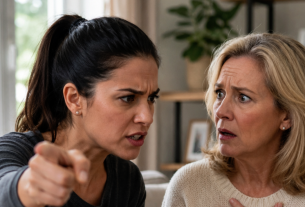
“Valentina Petrovna, do you see what happened here?” I asked, pointing at Nastya’s forehead.
“Of course I see it,” she said dismissively. “But why discuss it in front of everyone? Let’s not do this now.”
I crouched in front of Nastya and took her cold little hands in mine. She was only a child, yet an adult’s resentment had been poured directly onto her face by someone else’s hand.
“Did it hurt?” I asked softly.
She shook her head, but her lips were trembling. I understood immediately that it had hurt—just not in a way she could put into words yet.
My father-in-law remained silent at the side of the room, as though hoping to stay unnoticed and avoid becoming involved in the conversation. I remembered that he rarely interfered in his wife’s arguments with anyone—not with me, not with Dmitry, and not even with Olya, who had spent years unable to settle on a job.
But once, a couple of years earlier, he had put his wife in her place in front of me. He had done it quietly, with a single sentence, after she criticized Dmitry too harshly for being late. Since then, I had known that he remained silent not because he agreed with her, but because he preferred not to get involved until things became truly unbearable.
We arrived at their home later than planned. That morning, I had told Dmitry that we would pick up Nastya ourselves, together, at around six in the evening. But traffic at the edge of the city came to a standstill, and we spent forty minutes trapped in it instead of sitting around the festive table with the rest of the family.
During that time, I managed to regret ever agreeing to leave my daughter with my mother-in-law, even for a couple of hours.
“Should I call Mom and tell her we’re running late?” Dmitry asked, drumming his fingers against the steering wheel.
“I already called,” I replied, looking through the window at the motionless cars. “She said everything was fine and Nastya was playing with Olya on the carpet.”
At the time, it had sounded completely harmless. Olya had come to her parents’ home on December 31 without any particular plans for the evening, just as she did almost every year. She was twenty-nine and had not yet managed to build a family of her own. She usually got along well with her niece—or at least that was what all of us believed.
I did not know then that Olya had been harboring resentment for a long time. Not toward Nastya, but toward me. She resented the fact that I had a husband, a child, and a job I loved, even if my mother-in-law called it “not a real profession.” She resented the fact that my life appeared settled while hers did not, and that comparison had been made too often in their family.
Every year, we celebrated New Year’s Eve at Dmitry’s parents’ home. We had done it six years in a row. Not once at home, not once alone with my husband and daughter—always there, on Valentina Petrovna’s territory, following her rules and sitting at a table she had arranged.
“I want to celebrate at home this year,” I had told Dmitry sometime in November.
“Mom will be upset,” he had replied, and that was always how the conversation ended.
As we sat in traffic, I remembered that discussion again. I also remembered the fifteen thousand rubles my mother-in-law had supposedly “lent” us for Nastya’s art classes. Afterward, she mentioned the money during every minor disagreement, as though it had not been help but a lifelong promissory note.
Even as we sat in traffic, I could feel something heavy rising inside me—a sense of foreboding I did not want to believe.
I remembered one such incident from about eight months earlier. We had come to visit straight from work, and I was still wearing my clinic jacket. When Valentina Petrovna saw me, she grimaced in front of all the guests.
“Marina treats cats, by the way,” she had said with a mocking tone, as though she were introducing a circus performer rather than a doctor. “Unlike Dima—at least he has a serious education.”
I had kept quiet. I did not want to argue in front of strangers, even though resentment had tightened inside me just as it did now in the car.
“Why have you gone so quiet?” Dmitry asked, glancing at me.
“I’m thinking about your mother,” I admitted. “About how she constantly brings up those fifteen thousand rubles she gave us for Nastya’s art classes. As though it wasn’t a gift but an IOU.”
“She doesn’t mean any harm,” Dmitry said, although judging by his voice, even he did not really believe it.
“By the way, I gave her a new crossword book for her birthday,” I remembered aloud. “She was delighted and spent the entire evening solving it with the same black marker she always uses.”
“There, you see?” Dmitry chuckled. “Things between the two of you aren’t all bad.”
“We’re finally moving,” he exhaled when the cars began to roll forward.
The apartment door opened before I could press the bell. That was when I saw Nastya sitting on the sofa—and the word written across her forehead. The uncapped marker was lying on the coffee table beside her, the same one used for the crossword book. I recognized it at once.
Valentina Petrovna fussed around the dining table as though she could drown the awkwardness beneath the clatter of dishes and cutlery.
“Why are you just standing there? Take off your coats,” she said cheerfully. “The clock will strike midnight in an hour, and all the food will get cold.”
I took Nastya by the hand and led her into the kitchen, toward the sink. There was a packet of wet wipes on the shelf. I took several and began carefully wiping my daughter’s forehead.
“It hurts, Mom,” Nastya said, wincing and squeezing her eyes shut.
“I know. Just be patient for a little while,” I said, trying to keep my voice steady even though everything inside me was tightening into a knot.
Dmitry stood in the kitchen doorway without saying a word. He rarely said anything that contradicted his mother. That was how things had been throughout the nine years of our marriage, and ordinarily I tolerated it.
But not this time.
“Dima, do you even see what happened?” I asked without turning away from the sink.
“I see it,” he replied quietly. “But let’s not ruin the holiday, all right? We’ll sort it out later, calmly.”
That sentence was the final straw.
“Let’s not ruin the holiday,” as though the problem were the guests’ spoiled mood, rather than the fact that a grown woman had taken a marker and written an insulting word across a seven-year-old child’s forehead.
My hands turned cold, and something inside my chest suddenly snapped. I finished washing Nastya’s forehead, looked at her reddened skin, and felt everything inside me harden into one solid knot.
I walked into the living room. Valentina Petrovna was arranging napkins beside the plates as though nothing had happened.
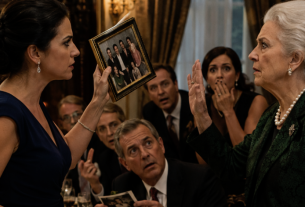
“Valentina Petrovna, did you see what Olya was doing?” I asked loudly enough for everyone in the room to hear.
She looked up at me and, for a second, seemed to shrink.
“Marina, I didn’t understand what Olya was writing at first,” my mother-in-law said. “By the time I realized, she was already finishing the last letter.”
“So you stood beside them and simply watched,” I said.
“I wasn’t watching deliberately,” she began defensively, averting her eyes. “I was in the kitchen. I walked into the room and saw it when it was already finished.”
“You could have stopped her immediately, in the very first second,” I said. “Instead, you simply went away to change for dinner.”
Valentina Petrovna opened her mouth to object but changed her mind and remained silent. Olya shrank against the window, wrapping her arms around herself as though she had suddenly become cold in the warm apartment.
“I’m sorry,” she muttered, looking somewhere near the floor, but she still did not move any closer to Nastya.
I looked at my mother-in-law and remembered the words I had heard from her many times over the years:
“Your work isn’t a profession. It’s just some kind of animal cruelty.”
She said those words easily and casually, as though they could never hurt anyone.
“Valentina Petrovna, you have always said that my work isn’t a profession but some kind of animal cruelty,” I said evenly, looking directly into her eyes. “So what do you call this?” I nodded toward my daughter. “Is this your idea of raising a child?”
The room became completely silent. Even my father-in-law stopped pretending to examine the decorations on the Christmas tree.
“Nastya, put on your coat. We’re leaving,” I said, turning toward my daughter.
“Marina, where are you going at this hour? The clock will strike midnight in an hour!” my mother-in-law exclaimed, throwing up her hands.
“Home,” I replied firmly. “To our own home, where no one writes on my child with a marker.”
Dmitry remained motionless for another couple of seconds. Then, without saying anything, he went into the hallway to get our daughter’s coat.
Valentina Petrovna tried to stand between us and the front door.
“You’re taking my granddaughter away on New Year’s Eve,” she said, her voice trembling with outrage. “Do you even understand what you’re doing, Marina?”
“I understand perfectly,” I replied calmly. “I’m taking my daughter away from a place where someone hurt her while you watched and failed to stop it in time.”
“Olya lost her temper! It happened once!” my mother-in-law almost shouted.
“Once was enough,” I said, zipping Nastya’s coat all the way up to her chin.
My father-in-law tried to say something but faltered beneath my gaze and fell silent again.
“Valera, say something to her!” Valentina Petrovna demanded, turning to her husband for support.
“What can I say?” my father-in-law replied quietly, looking her in the eyes for the first time that evening. “Someone wrote ‘liar’ across the child’s forehead. There’s nothing more to say, Valya.”
My mother-in-law fell silent for a moment, as though she had not expected to hear those words from her husband.
Olya remained in the same place, completely still, as though rooted to the floor. She did not even try to come closer, apologize again, or stop us at the door.
We stepped onto the landing, and the door closed behind us. It did not slam; the lock merely clicked softly. I heard Valentina Petrovna saying something angrily to her husband on the other side of the door, but I could no longer make out the words.
It was cold outside, and the snow crunched beneath our feet with every step. Nastya held my hand tightly and remained silent all the way to the car.
“Mom, are we really going home?” she finally asked after we got into the car and fastened our seat belts.
“We really are,” I replied, turning around to look at her. “Straight home—to our home.”
Dmitry started the car and drove in silence for a while, staring at the empty road ahead.
“You got very angry,” he said, his voice somewhere between a question and a statement.
“I wasn’t angry,” I replied. “I was frightened for her. And I realized that she could be hurt there again if we kept going back.”
He nodded and did not ask me anything else for the remainder of the journey.
I leaned back against the seat and slowly exhaled. The panic that had overwhelmed me in my mother-in-law’s apartment was gone. All that remained was the firm certainty that I had done what I needed to do.
I did not want to investigate every detail, call anyone, or look for support. I wanted only one thing: to be at home with my daughter and husband, without other people’s voices surrounding us.
At home, we reheated what was left of our festive dinner and switched on the lights decorating the small Christmas tree in the corner of the living room. Nastya was still unusually quiet, but she helped me separate the mandarins into neat segments.
“Mom, are we always going to celebrate New Year like this now?” she suddenly asked, raising her eyes to mine.
“Maybe,” I replied with a smile. “At home, just the three of us, without rushing anywhere. I think that might actually be nice.”
She smiled back—for the first time that entire long evening, it was a genuine smile.
We went to bed after midnight. I lay awake for a long time, staring at the ceiling. Again and again, I got up to check whether my daughter was sleeping peacefully in her room.
By morning, I finally drifted off for a short while. For the first time that night, I slept peacefully, without the heaviness in my chest.
My phone did not remain silent for long. Just before morning, it vibrated with a message from my mother-in-law:
“You made a mountain out of a molehill. You ruined the holiday for everyone who had nothing to do with it.”
I read the message, did not reply, and immediately blocked her number—both on my phone and in the messaging app. I hesitated for only a second before deciding that this was how it would be: no discussions and no explanations.
Three weeks passed. Nastya did not visit her grandmother once—not on the weekends and not even for a couple of hours.
Dmitry visited his parents several times without our daughter or me. He always returned unusually quiet and did not tell me much. Only once did he mention that his mother was “calling every relative and complaining about me.”
Olya did not call me once during those three weeks. It seemed that she had offered her brother a brief apology, but she never apologized to me. Apparently, she had no intention of doing so.
A few days ago, Dmitry stopped by his parents’ home alone and told me about their conversation when he returned. His mother had asked when it would finally be “all right” to bring Nastya over for a visit, as though nothing unusual had happened.
I sent a brief answer through my husband: it was still too soon.
Perhaps Nastya would never go back to that home—a place where a child had been left without protection beside someone who had failed to control her jealousy.
And I sleep peacefully now. For the first time in a long while, I no longer feel that heavy knot in my chest that used to appear before every visit to that house.
Sometimes protecting a child means no longer explaining to adults why they cannot be trusted with that child’s safety.
Even when those adults are family.