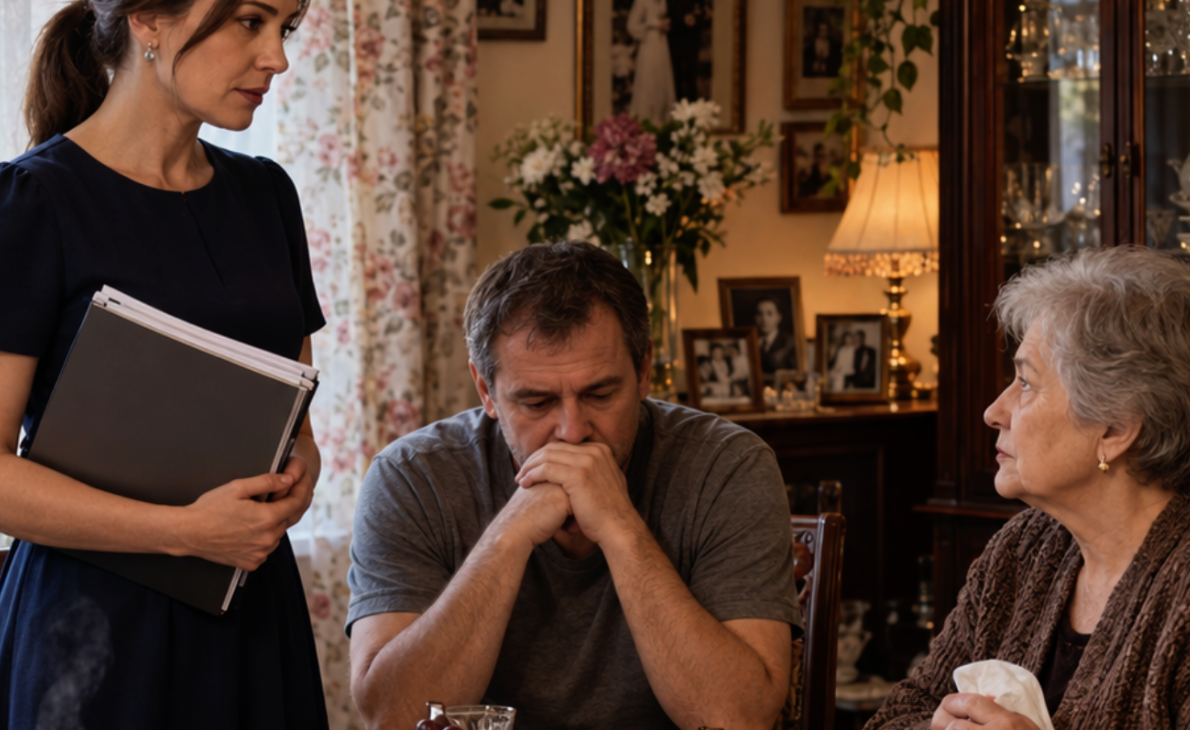
“Pack your things and leave today. Quietly, without making trouble—before the entire neighborhood finds out what kind of conscience you have.”
My mother-in-law said this softly, almost affectionately, while standing in the middle of my kitchen with a cup of my tea in her hands. And I realized that behind this sweetness, she was hiding something she desperately did not want me to see.
My name is Natalia. I’m thirty-eight years old and work as an accountant for a small construction company. Numbers are my element. I can look at a column of figures and immediately see where something doesn’t add up. My husband, Dmitry, always used to joke that there was no point trying to deceive me: I would balance any set of accounts and discover exactly where the missing penny had gone.
He used to joke, that is. Over the past few months, he had stopped joking altogether.
It all began with a phone call from my longtime friend Elena.
“Natasha, just don’t get angry right away,” she said in that particular tone people use when they are about to deliver bad news. “But I have to tell you something.”
I was working on a report at the time, and the numbers blurred before my eyes. Whenever someone close to you begins with “Don’t get angry,” you immediately feel like getting angry.
“Tell me, Lena.”
“There are rumors about you going around the neighborhood. People are saying you’re seeing someone. That you were spotted with another man instead of Dima. They say you’re cheating on him while your poor husband suffers in silence.”
The tea in my mouth suddenly tasted bitter. I put down my cup.
“And who supposedly saw me?”
“That’s the thing—no one specific. It’s always ‘people are saying.’ But between you and me, Galina Sergeyevna is the one spreading it. Your mother-in-law. Yesterday, I heard her whispering to a neighbor outside the building. You know, in that breathless voice of hers: ‘My poor boy is suffering so much.’”
I had known Galina Sergeyevna for nine years, and I knew one thing for certain: that woman never said anything without a reason. If she had suddenly begun talking about her “poor boy,” then her boy had something to hide behind his mother’s back.
“Thank you for telling me,” I replied calmly. “I’ll think about it.”
Elena had known me for a long time. When I said, “I’ll think about it,” it did not mean I would simply let it go. It meant I would sit down and recalculate everything. That was both my profession and my nature.
There had never been another man in my life—not in my thoughts, not on the horizon, not even in its remotest corner. I went home from work to my husband and our son, Artyom. There was no other path in my life.
That meant someone desperately needed this imaginary man to exist, even if only in words.
And it was not some abstract stranger who had slandered me. It was my mother-in-law.
There was only one question: why? What was she trying to conceal behind all that smoke?
Dmitry and I had been together for ten years and married for nine. We had met in an ordinary way, through mutual friends. He worked as a manager at an auto repair shop, spoke charmingly, and found it easy to get along with people. He was charismatic, carefree, and always the life of the party. Back then, I thought that with a man like him beside me, I would never be lost.
Three years after our wedding, when Artyom was born, we bought an apartment of our own. It was a two-bedroom apartment measuring fifty-eight square meters in a quiet brick building. It was registered in both our names, and we paid the mortgage together from our shared household income.
We had scraped together the down payment little by little. Part came from my savings, part from Dmitry’s, and Galina Sergeyevna contributed two hundred and fifty thousand rubles. She handed us the cash in an envelope at a family celebration, in front of all our relatives, while everyone exclaimed, “What a wonderful mother! What generous support for the young couple!”
There were no documents and no receipts.
At the time, it felt like warmth and kindness. Back then, there was still a great deal I did not understand about that family.
For the past two months, Dmitry had seemed as though he were living behind a pane of glass. He came home late and constantly claimed he had been delayed at work or had gotten stuck dealing with a difficult customer. He had also begun placing his phone facedown.
I blamed it all on exhaustion and did not interrogate him. I had always believed that becoming jealous without any reason was the worst thing a person could do. But now, after learning about my mother-in-law’s rumors, that lack of reason no longer seemed quite so empty.
I decided not to invent explanations. I would do what I always did: investigate calmly, like an accountant.
Facts first. Conclusions afterward.
And I did not have to wait long for the facts.
That Thursday, I stopped at a large shopping mall on the other side of town after work. I needed to buy Artyom a winter jacket because he had outgrown his old one.
I was walking along the second floor, past a café with a glass wall, when I suddenly froze.
Dmitry was sitting at a table by the window.
My husband—the same husband who had texted me an hour earlier to say he would be at the repair shop until nine—was sitting opposite a young woman who looked to be under thirty. She had long blonde hair.
They were drinking coffee. She was laughing, and he was looking at her in a way he had not looked at me for a long time.
Warmly. Attentively.
It was not the way a man looked at a colleague.
I did not storm into the café and cause a scene. I did not throw anything to the floor. I stepped behind a column and stood there for a minute until my heart stopped pounding so violently.
Then I turned around and went to buy the jacket.
Strangely enough, I did buy it that evening—a blue one with a hood. My hands were trembling a little, though.
That night, I could not sleep. I lay in bed and added up the facts as if they were columns of numbers: the rumors spread by my mother-in-law, my husband’s late nights, the woman in the café, and the phone he always placed facedown.
Everything added up to one simple conclusion: Dmitry had another woman.
And instead of talking sense into her son, his mother was walking around the neighborhood and portraying me as the unfaithful wife.
Why?
The answer came shortly before dawn, clear and cold as a window in January.
She wanted me to be blamed when the truth came out. She wanted her son to be seen not as the man who had betrayed his wife, but as a poor, deceived husband. And when the time came to divide our property, she wanted me to be too ashamed and cornered to fight back.
That was where they had miscalculated.
Property division, documents, and numbers were my territory. I knew every corner of it.
Two days later, Galina Sergeyevna arrived without warning. She brought a bag of mandarins “for her grandchild,” walked into the kitchen as if it were her own home, sat down, and folded her arms across her chest.
After waiting until Artyom had run to his room to play, she delivered that same line about leaving quietly.
“You must understand, I’m not judging you,” she sighed so dramatically that the neighbors probably heard her. “But people don’t say these things for no reason. There’s no smoke without fire. Poor Dimochka is beside himself. Perhaps the two of you should separate quietly and civilly before this turns into a scandal.”
“Separate,” I repeated evenly. “And I assume the apartment will remain with Dima?”
“Well, of course.” She actually brightened when she realized how quickly I had supposedly understood. “The apartment is practically ours, after all. I gave you two hundred and fifty thousand rubles. Have you forgotten? That was enough money to buy a car.”
Outside, someone was trying to start an old car in the courtyard. The engine sputtered and died.
I placed a cup of tea in front of my mother-in-law as calmly as I would place a completed report on a desk.
“I remember the two hundred and fifty thousand, Galina Sergeyevna,” I said. “But we bought the apartment during our marriage, and it is registered in both our names. The matter isn’t nearly as simple as you seem to think. Finish your tea. It’s getting late, and you should go home.”
She became flustered and muttered something about only wanting to settle things peacefully and speaking from the heart. Then she pushed away the cup and left without finishing her tea.
I noticed that I felt strangely relieved. For the first time in two months, the fog had cleared. I now knew about my husband’s other woman, and I understood why my mother-in-law was inventing stories about me.
It was all about the apartment.
And apartments and documents were precisely what I understood best.
Dmitry returned close to midnight. He looked inside the refrigerator and poured himself some water.
“Mother called,” he said over his shoulder. “She said you were rude to her and threw her out.”
“She came without permission while you were away and suggested that I move out. She said the apartment was ‘practically yours.’ I reminded her that we bought it during our marriage.”
He put the glass down a little more forcefully than necessary.
“Listen, Natasha, let’s not turn this into a performance. I’m tired. Work is a disaster, and now I have to deal with this too.”
“‘This’ is your mother telling the entire neighborhood that I’m cheating on you. And Dima, I happened to see you on Thursday. In that café on the second floor of the shopping mall. You weren’t alone.”
That silenced him.
And his silence was worse than any shouting because he did not look surprised. He did not become indignant or ask whom I was talking about. He was simply searching for something to say.
“You imagined it,” he finally forced out. “There are plenty of people who look alike.”
“I didn’t imagine anything. I was standing three meters away.” I looked him directly in the face. “But let’s not discuss that right now. I’m more interested in something else. Do you truly believe that if your mother tells everyone about my imaginary affair, you’ll receive the entire apartment when we divide our property?”
“It belongs to us anyway,” he replied stubbornly. “Mother paid the down payment. I pay the mortgage.”
“We pay the mortgage together, from our shared budget, every month. And for your information, I have kept every single payment record. So don’t start telling me that you’re the one paying for it.”
He went to sleep in the larger room, slamming the door behind him.
I sat down at the kitchen table and opened my laptop—not to start a fight, but to get to work.
I gathered our entire financial history from the past nine years. It was in my nature and part of my profession to keep everything.
I had mortgage statements clearly showing that the payments came from our joint account, where my salary was also deposited. I had receipts for the renovations we had completed together and invoices for the furniture.
The accountant’s personality Dmitry had mocked for so many years was now working in my favor. Every document became another brick in the wall I was building.
And that wall protected both Artyom and me.
I had a separate calculation regarding the rumors. I knew that if my mother-in-law and sister-in-law started naming dates when I had supposedly been “seen with my lover,” I would have something concrete to place on the table.
I worked from nine to six. My workplace had an electronic access system that recorded every arrival and departure. I also had colleagues who saw me at my desk every day.
Proving that I had been sitting at work instead of walking arm in arm with a stranger would be easy.
They had only “people are saying.”
I had facts.
The following day, without looking at me, Dmitry muttered that his mother was inviting everyone over on Saturday to “sit down as a family and talk.”
As a family.
I nearly laughed. I knew what Galina Sergeyevna’s family gatherings were like: a trial where the verdict had already been written and I was invited merely so it could be read aloud to my face.
Inside, I was boiling—with anger over my husband’s betrayal and over the coming performance with its carefully assigned roles.
But losing control, shouting, and smashing dishes would only allow me to release my anger while accomplishing nothing.
I did not want a scandal.
I wanted a conclusion.
I wanted every person in that room to understand who was really trying to throw whom out of the apartment.
Apparently, Dmitry had not told his mother that I had already caught him. Otherwise, she would never have organized this circus.
Galina Sergeyevna was certain her plan was working. She believed that if she pressured me in front of the entire family, I would be too ashamed to defend myself. I would swallow the insult and leave quietly.
They were counting on my shame.
They expected me to become confused.
That suited me perfectly. I could not have chosen a better place to reveal everything at once, directly to each of their faces.
I took Artyom to my mother’s house on Saturday. A nine-year-old boy did not need to listen to adults arguing over his home.
My mother-in-law’s apartment smelled of pies and something old and stale. The table had been arranged as if for a celebration. Besides Galina Sergeyevna and Dmitry, his older sister, Olga, was there. Her lips were pursed exactly like her mother’s.
They seated me opposite all three of them, as though I were being interrogated.
At first, they talked about trivial things—the weather and how much Artyom had grown.
I waited.
Experience had taught me that a difficult conversation was always started by the person who needed it most.
Galina Sergeyevna began. She put down her fork and dabbed her lips with a napkin.
“Well, my dears, I didn’t gather you here without a reason,” she announced solemnly. “There is trouble in Dima’s family, and we are going to speak openly about it in front of everyone.”
“Let’s speak openly,” I said with a nod. “I’m entirely in favor of that.”
“Natasha, I don’t blame you as a person,” my mother-in-law continued. “But people are saying that you’re unfaithful to Dima. The whole neighborhood is talking about it. As his mother, I cannot remain silent. There’s no smoke without—”
“—fire,” I finished for her. “I’ve already heard that. Olga, have you heard something too?”
My sister-in-law immediately perked up, as though she had been waiting for her cue.
“Of course I have! Someone saw you near the market with a man. You were practically walking arm in arm.”
“Excellent. When?”
“What do you mean, ‘when’?”
“On what date was I seen walking arm in arm with a man near the market? Name the day.”
I spoke calmly, as if I were clarifying the date on a contract.
Olga looked uncertainly at her mother.
“Well… recently. Sometime last week.”
“Last week. Fine.” I removed a folder from my bag. “I work from nine in the morning until six in the evening. We have an electronic access system, and every time I enter or leave is recorded to the minute. Here is a printout covering the past three months. Name any day when I was supposedly seen near the market, and I’ll show you that I was sitting at my desk at that time, surrounded by my colleagues. So, which day was it? Monday? Wednesday?”
The room became so quiet that we could hear the old clock ticking on the wall.
“What difference does the day make?” my mother-in-law said, suddenly flustered. “The point isn’t the specific day. The point is what people are saying.”
“The day is exactly the point, Galina Sergeyevna. A witness can name the day and the place. You have neither a date nor a place nor a witness. All you have is ‘people are saying.’ And you invented those people yourself.”
“How dare you speak to your mother like that!” Olga snapped.
“I’m speaking calmly. You are the ones accusing me of infidelity without a single fact—and clearly for your own benefit.” I closed the folder. “But let me explain what truly surprises me. Galina Sergeyevna, you’re not a foolish woman. Why did you start all this?”
“To protect my son!”
“Protect him from what? If I truly were having an affair, that would benefit you. Dima could divorce me with a clear conscience, and I would be blamed for everything. So why spread rumors throughout the neighborhood? Why summon the entire family?”
I looked around the table.
“Because of my work, Galina Sergeyevna, I have seen many divorces and handled the financial side of many property settlements. So here is some free advice: infidelity has no effect on the division of an apartment. None whatsoever. You can write on every lamppost that I’m sleeping around, and the apartment will still be divided equally. The court does not care who was faithful to whom. It cares about one thing: whether the property was purchased during the marriage. And this apartment was.”
Dmitry had not spoken once all evening. He simply sat staring at the tablecloth.
“So,” I continued, “the rumor was not intended for the court. It would be worthless there. It was intended to frighten me—to make me believe I was guilty, disgraced, and responsible for everything. You wanted me to leave voluntarily, quietly, and without claiming the apartment. Then, in front of the entire family, Dima would appear not as the man who found another woman, but as the poor, betrayed husband. It was a convenient plan. Unfortunately for you, it doesn’t work.”
“What other woman?” Olga gasped, though her outrage sounded weak and uncertain.
“I’ll tell you.” I turned toward my mother-in-law and husband. “Last Thursday, I stopped at the shopping mall to buy our son a jacket. I saw Dima sitting in a café on the second floor. He wasn’t alone. He was with a young woman. They were drinking coffee, and he was laughing. Yet that evening, he texted me and claimed he would be working until nine.”
I fell silent.
Not a single fork clinked against a plate.
“So while you, Galina Sergeyevna, were telling the neighborhood that I was chasing after other men, your son was sitting in a café with another woman. And I did not imagine it. I was standing three meters away. If you want, ask him yourself, right now, in front of everyone. After all, he came here today to speak honestly.”
The silence was not broken by a shout.
Olga slowly turned toward her brother.
“Dima, is that true?”
He raised his head and did what he did best: tried to wriggle out of it.
“Are you really going to believe her instead of me? She’ll invent anything to make me look guilty.”
“I saw you, Dima, with my own eyes, in broad daylight.” I did not even raise my voice. “Would you like us to call the repair shop right now and ask whether you were at work until nine on Thursday? Or will you tell your mother and sister yourself who you were drinking coffee with? You wanted honesty today, so let’s be honest.”
He remained silent.
Outside, a neighbor’s dog barked once and then fell quiet.
“Now, regarding ‘our apartment,’” I said, turning toward my mother-in-law. “Since we’re already dividing it, let’s be honest about that too. It was purchased during the marriage, which makes it jointly owned. Half belongs to me, and half belongs to him.
“And your two hundred and fifty thousand rubles? Thank you, of course. But you gave that money to us in cash, at the table, as a gift ‘to the young couple.’ There is no deed of gift and no receipt stating that it was intended exclusively for Dima. According to the documents, it was simply money added to our shared funds. It does not buy you a share or increase your son’s share.
“And a nine-year-old child lives in that apartment. When the court considers where he will live, it will also take the child’s interests into account. So there will be no simple outcome where ‘Natasha leaves and Dima stays.’”
“How heartless,” Galina Sergeyevna muttered. But her voice was very quiet now, without any of its former confidence. She looked from me to her son.
“Heartless is deceiving your wife and then using your mother to make her look guilty in front of the entire neighborhood.” I rose from the table. “It turns out you and Dima are very much alike. He betrayed me without blinking. You understood everything and did not even raise an eyebrow. You merely started calculating the most convenient way to drive me out.
“You have every right not to love your daughter-in-law. That is your choice. But destroying a family and dragging a nine-year-old child through it is not maternal love. It is heartlessness shared by two people.
“I’m not someone who keeps silent, Galina Sergeyevna. I simply observe, calculate, and verify everything before I speak. Thank you for the pies.”
A mother will always find an excuse for her son. The problem was that she had decided to look for that excuse at my expense.
And for the first time in nine years, she had missed her target—because she had chosen a battlefield where I knew every number by heart.
Olga remained seated, staring at her brother as if she were seeing him for the first time. Dmitry looked down at the table. Galina Sergeyevna nervously twisted the napkin between her fingers.
I picked up my bag and left.
No one tried to stop me.
That silence was an answer in itself.
Dmitry returned home after midnight. I was still awake, sitting in the kitchen.
“Natasha, let’s handle this like adults,” he said from the doorway, all his earlier confidence gone. “I’m guilty, and I understand that. But we have a family and a child. Maybe we shouldn’t make any rash decisions.”
“We are going to make a decision, Dima.” I felt neither anger nor pity—only a calm, settled clarity. “We’ll do it according to the law. We’ll divide the apartment through the courts. The court will also decide where Artyom will live, and I already know what I’ll say. And you are moving out.”
“This is my home too.”
“Your home is wherever you drink coffee on Thursdays now. I’m sure you can pack your own things.”
He smirked, but it was a crooked, empty expression.
“I suggested that we settle this peacefully.”
“Peacefully would have meant not starting a second life behind my back. It’s too late, Dima.”
He did not move out immediately. For another couple of days, he wandered around the apartment like a stranger and spoke quietly to someone on the balcony.
On the third evening, he packed his bags and left his keys on the cabinet.
The following day, I changed the lock.
We still had to divide the apartment in court, and I prepared the documents calmly and thoroughly, folder by folder. But I had no intention of continuing to live with a door that remained open to him.
I now understood my boundaries precisely.
Galina Sergeyevna stopped walking around the neighborhood talking about her “poor boy.” It was difficult to feel sorry for her son after the entire family had heard, with their own ears, where he had been drinking coffee on Thursdays.
A week later, I went into Artyom’s room. He was arranging toy soldiers on the carpet.
“Mom, is Dad coming back?”
“Dad will come to visit now, sweetheart. And you and I are going to make some changes.”
I had decided to give him the larger room that was now vacant. He could move out of his cramped bedroom. We would put a desk beside the window where he could do his homework. There would be plenty of room for his toy soldiers and everything else he might dream up.
The small room would be more than enough for me.
“Why are you looking around at everything?” he asked, glancing up from his game.
“I’m deciding where to put your new desk. The large room is yours now.”
Nine years earlier, I had begun making that apartment into a home without knowing who would eventually occupy each room, who would be happy there, and who would betray the family.
Now I knew.
I still had to defend every square meter through court proceedings, documents, and the division of our property.
But I was no longer calculating those meters for strangers or for the man who had left.
I was calculating them for Artyom and myself.
And I always finish my calculations.