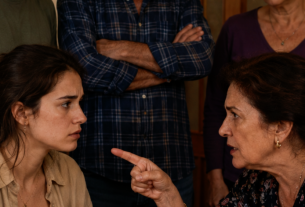
“First serve everyone, then you can eat yourself. In the kitchen,” Raisa Petrovna said as she handed me her plate with unfinished aspic. “Here, finish this, no point throwing it away.”
There were eleven people at the table. No one laughed, but no one objected either. Vadim, my husband, picked up a pickle with his fork and, without looking at me, said:
“Laris, seriously, it’s mom’s birthday. Why are you getting up?”
I stood up because, for the first time that long day, someone put a plate in front of me. My own. I brought it from the cabinet myself, placed a napkin next to it, and was just about to sit down at the end by the balcony door.
I slowly moved my plate from the edge of the table toward the center. The porcelain thudded dully against the dish of herring.
«I’m not a servant to finish your mother’s leftovers,» I said.
I said it quietly. And suddenly, you could hear the kitchen faucet dripping in the room.
Before that lunch, I had just finished a twelve-hour shift in the ER. I’m the head nurse, and on Saturday night, we had two accident victims brought in from the highway and an old man with a stroke who kept trying to get up and go home for a fishing trip. I got home at eight in the morning, and by half past eight, I was already chopping vegetables.
It was Raisa Petrovna’s seventy-fifth birthday. We decided to have the celebration at our place because we have a two-bedroom with a big living room, while my mother-in-law only has a tiny one-room flat on the third floor where you can’t even extend the table. This was Vadim’s decision. He just told me over dinner on Wednesday and that was that.
«You’ll rest up on Monday after your shift on Sunday,» he said then. «And it will be nice for Mom. It’s a milestone birthday, after all.»
I nodded. I’ve been nodding for twenty-six years. At first because I loved him, then because it was easier, and after that it just became a habit, like putting on shoe covers before going into ICU.
My daughter Nastya arrived at eleven. She’s twenty-three, rents a room by the metro with a friend, and works at a veterinary clinic. She immediately took the knife from me.
«Mom, you look green. Sit down for at least ten minutes.»
«No time. The aspic hasn’t set, so I moved it to the freezer. The duck needs to go in the oven in an hour.»
«Why duck? Grandma doesn’t even eat duck.»
«Last year Grandma said Svetlana had duck on New Year’s, and we only had chicken.»
Nastya just snorted and didn’t say anything. At the time, I didn’t think twice about how she looked away for a second and pulled out her phone.
At one o’clock, my mother-in-law and father-in-law Viktor Ilyich arrived, then my sister-in-law Svetlana with her husband and two teenage sons, and then Vadim’s cousin with her family. Raisa Petrovna was the first to step into the hallway, and without taking off her shoes, went straight to the kitchen.
«Alright. Where’s your big blue platter? I brought a cake and it needs to look nice.»
«It’s in the top cupboard, Raisa Petrovna. I’ll get it.»
«I’ll do it myself. You’ll just put it in the wrong place anyway.»
She found the platter, moved my salad bowls from the windowsill to the fridge because «there’s a draft by the window,» and went to the living room. Later, I had to take the bowls out of the fridge standing on a stool.
Lunch went as usual. Vadim gave a toast, Svetlana shared how her youngest got his driver’s license on the first try, and my father-in-law ate in silence. I was running around. Hot dishes, bread, another fork because the boy dropped his, sauce that Raisa Petrovna asked to heat up because “you don’t serve cold sauce with meat.”
By the third time I returned from the kitchen, there was no empty seat left at the table. Svetlana’s husband was in my chair—he just didn’t know it was mine. I brought over a stool, set it by the balcony, and went for a plate.
That’s when my mother-in-law made the comment about the kitchen.
After what I said, Svetlana was the first to react:
«Larisa, what’s wrong? Mom is just being nice. She was just joking.»
«It’s not a joke,» Raisa Petrovna pursed her lips. «I’ve always done it this way. My mother-in-law, may she rest in peace, never sat at the table with us until everyone else had eaten. And it was fine—she survived. But this one, apparently, thinks she’s too proud.»
«Mom,» Vadim put down his fork. «That’s enough. Larisa, just sit down, don’t make a scene. Eat wherever you want.»
«Don’t embarrass yourself.» I’m forty-eight years old. I place catheters for people older than his mother, and not once has any of them told me, «don’t embarrass yourself.»
I walked out. I didn’t slam the door, just quietly closed it behind me and made my way down the hall to the small room we still call Nastya’s, even though Nastya hasn’t lived here for two years. I sat down on the couch. And then, I just broke down.
Nastya came in a minute later. I didn’t turn away or wipe my face the way I used to when she was little and I’d cry in the bathroom after another call from my mother-in-law. I just sat there and cried, and my daughter stood nearby in silence.
Then she sat next to me and picked up my phone from the armrest, as if she wanted to cover something with it.
«Mom. I’ve been wanting to tell you this for a while. I just didn’t know how.»
«Tell me what?»
«We have a chat. ‘The Gordeyevs.’ Grandma created it when she learned how. Dad is there, Aunt Sveta, Oleg, the boys, Grandpa. And me. But you’re not in it.»
«So what. I never asked to be.»
«Mom, she writes about you in there.»
Nastya handed me her phone. On the screen was a message sent last Friday at 11:40 PM:
«Once again, Vadik’s house is empty. I dropped by on Wednesday—the only thing in the fridge was a pot of soup. She works all the time, or so she says. ‘Shifts,’ as if we believe those shifts.»
Below, Sveta reacted with a laughing emoji. Vadim didn’t reply at all.
From the other room, I heard Viktor Ilyich calling out, asking where the horseradish was. It was in the fridge, second jar from the left. I sat still and didn’t go.
«How long has this been going on?» I asked.
«About three years. At first, it was rare. Then more often. One time I told Grandma to stop but she said I’m still too young to understand how a wife is supposed to act. Later, Dad told me not to interfere or it would only get worse. And not to tell you, because you’d just get upset.»
«He really said that?»
«Yeah. Mom, I’m sorry. I’m a coward.»
I hugged her. She smelled like the dog shampoo they always keep in every room at their clinic.
«You’re not a coward. You’re caught in the middle.»
I didn’t see any more of the guests that day. Vadim saw them out himself—I heard Raisa Petrovna say loudly in the hallway, «Let her rest if her nerves are shot.» They finished off the duck. All the dishes were left as a mountain in the kitchen sink.
Nastya left around nine. Before she went, she forwarded me all the screenshots—so many of them. She must’ve scrolled for half an hour.
«Just don’t read them all at once,» she asked at the doorway. «Get some rest first.»
I didn’t listen.
There were so many messages. I sat in the kitchen surrounded by dirty plates, reading them one by one, starting from the fall of 2023.
«Lariska went on vacation to her mother again, and Vadik is all alone and hungry.»
«Sveta, you won’t believe it—she burned his shirt with the iron. Some nurse she is! She can’t even use her hands properly.»
«I told her those curtains needed replacing, and she just pouted her lips. No taste at all, and she ignores advice.»
I remembered the curtains. I hadn’t pouted. I said, «Okay, I’ll look into it,» and a week later I put up the ones my mother-in-law picked out. They’re still in the room, beige with gold thread—never once have I liked them.
And I never burned the shirt. Vadim did that himself when he was getting ready for a work party and I was on shift. He even called me afterward, asking where the other white one was.
Vadim got back from his mother’s kitchen at ten at night—he’d been driving his parents home. He walked in, saw me at the table with my phone, noticed the untouched sink, and let out a sigh.
“Alright, look. Mom went overboard. You know how she is. It’s her age.”
“Vadim, have you read what she writes about me in the group chat?”
He froze mid-step. Not scared—more like he was trying to figure out just how much I knew.
“Nastya showed you, didn’t she? I told her not to.”
“Told her not to show me, you mean.”
“Larisa, come on, it’s just Mom. She’s bored, at home all day, and writes all sorts of nonsense. You should see what she says about Sveta’s Oleg. I just don’t reply, that’s all. Why do you care so much?”
“Because you know the truth about the shirt. And you’re staying silent.”
“Oh, for heaven’s sake, the shirt.” He laughed and opened the fridge. “We got any duck left? Nope, it’s gone. Never mind.”
I watched his back and thought about how, for twenty-six years, I counted that laugh as something kind. That’s how he laughed the first year of our marriage when I cried after his mother called my borscht “slop” in front of everyone. That’s how he laughed when she gave our wedding china set to Sveta because ‘Larisa always ends up breaking everything anyway.’ He used laughter to put out any talk, just like turning down a pot to a slow simmer.
“Vadim. I want you to write something in that chat. Tell them this isn’t right.”
“Are you crazy? Mom’s seventy-five. Her birthday was just yesterday—well, today, technically. She’ll have a heart attack if I do that.”
“Funny how she never has a heart attack when she tells everyone I’m out God-knows-where all day.”
“Larisa. Let’s talk tomorrow. You just finished your shift, you’re tired, you’re on edge.”
And then he went to bed. I did the dishes. All eleven plates—except for one empty one, which I pushed to the side. I left that one sitting on the edge of the table in the room.
The week felt strange. Vadim was especially gentle, bought me pastries from the bakery by the bus stop twice, even did the vacuuming himself on Thursday. Raisa Petrovna didn’t call, despite always ringing every evening at eight, right as the news came on.
I figured she must be upset. That’d be typical for her—silent for a week, then call Vadim and complain that her blood pressure’s one-eighty and it’s all her daughter-in-law’s fault.
On Friday night, Nastya sent me another screenshot. This one was brand new.
«Well, has your princess recovered? I didn’t say anything bad to her, by the way. And my poor son is working two jobs just for her. The least she could do is thank him for feeding her—and for still helping me out.»
Working two jobs. I read that line three times.
Vadim works as a service engineer for a management company. One job. Five days a week, nine to six. For the last six months, he’s been coming home late on Wednesdays, saying there’s an inspection and they need to redo the elevator paperwork. But a second job?
So I messaged Nastya:
“Nastya, what does Grandma mean about Dad having two jobs?”
“No clue, Mom. She’s been saying that forever. That Dad works two jobs and supports everyone. And that he gives her money for medicine too.”
It was all for medicine. This I knew for certain. After her thyroid surgery, Raisa Petrovna needed an expensive medication that wasn’t covered, plus special eye drops. Two and a half years ago, Vadim and I agreed we’d give her twelve thousand rubles a month. I remember the conversation clearly: Vadim said it was a tough time, their bonuses had been cut, and I agreed to cover it. Each month, on the fifth, right after my advance came in, I transferred him twelve thousand and he brought it to his mom, because she “doesn’t trust these transfers.”
That’s how it was explained to me.
I opened my banking app and scrolled through the history. Twelve thousand, twelve thousand, twelve thousand. Since April twenty-fourth. Thirty payments. The note was always the same, in my own handwriting: “For mom’s medicine.”
That’s over three hundred thousand altogether—if you add it up. I never had.
On Saturday, I went to visit my mother-in-law myself. I didn’t call ahead, just showed up—the way she always did with us.
I’m not sure why. I was planning to talk about the group chat, the shirt, the curtains. I wanted to keep calm, the way I do when I talk to relatives of seriously ill patients, when they need to hear things they don’t want to accept.
Viktor Ilyich answered the door. He looked at me over his glasses and stepped aside.
«Raya, it’s for you.»
Raisa Petrovna was at the kitchen table, sitting behind a small table with a crossword puzzle in front of her and a box for her pills organized by days of the week. When she saw me, she took off her glasses.
«So, you showed up. Come to apologize?»
«No, Raisa Petrovna. I came to talk.»
«Well, go ahead. I’m not offering tea; you never drink my tea anyway. Nothing I do is good enough for you.»
I sat across from her. On the windowsill were the familiar bottles of eye drops.
«You write in the group chat that Vadim works two jobs. Is that what he told you?»
She squinted at me.
«Why, is it not true? On Wednesdays he drives a taxi in the evening. He told me himself. Says he does it so there’s enough for my medicine, and so you don’t have to support me. What could your pennies possibly cover?»
A taxi. I just sat there, and my fingers instinctively locked together in my lap.
But we only have one car, and it’s with me. For the last three years, Vadim’s taken the bus to work because he lost his license for speeding and never got it back. I knew that. So, no taxi job.
«Raisa Petrovna. How much does Vadim actually bring you for medicine?»
«Why do you care?»
«Please. It’s important to me.»
For the first time, she looked at me differently. No squint, just tired, maybe for the first time in all these years.
«Six thousand. Sometimes seven. He says he can’t give more, that everything else goes to you. I’ve even had to cut back on my eye drops, buying them every two months instead of every month.»
Six thousand. And I was giving twelve.
I didn’t tell her anything right away. I said I needed some time to think and left. Viktor Ilyich closed the door behind me and then quietly said, so the kitchen wouldn’t hear:
«Don’t be hard on her. She’s always been afraid for him. He was a late, long-awaited child.»
I walked down two flights and sat on the windowsill in the stairwell. So, six thousand a month simply disappeared. Thirty months. That’s almost two hundred thousand, and it wasn’t with me or his mother.
My first thought was: another woman. Of course, a woman. Wednesdays. Pastries. The vacuuming on Thursdays. Everything fit together like in those stories the girls at our post like to share during night shifts.
But I didn’t go home. I went to see Nastya.
She listened to me in silence, sitting in her little room with a poster of a dog’s skeleton hanging on the wall. Then she finally spoke:
«Mom, it’s not another woman. Dad’s not like that.»
«No one’s ‘like that,’ until they are,» I replied.
«Mom, remember last year when he borrowed twenty thousand from me? He said the car needed to be serviced. He didn’t want you to know because you’d be upset about how expensive it was.»
I didn’t remember—because I never knew. I was the one who took the car to the shop in March, and I paid for it myself.
«Did he pay you back?» I asked.
«He paid me back after two months. In parts, via bank transfers from some number that wasn’t his. I thought it was odd at the time.»
I asked her to show me. Nastya opened her banking history. Three transfers, seven thousand each, from a number labeled by the bank as ‘Rustam F.’
I got home just before nine. Vadim was watching football. He looked up and smiled at me:
«Hey, I made some dumplings. Want some?»
I put my phone on the table next to the remote, screen up, with the transfer history open.
«Vadim, who’s Rustam?»
He didn’t drop the smile. It just froze in place.
«Rustam who?» he said.
«The one who repaid your debt to Nastya. And why does your mom get six thousand from you when I transfer twelve thousand every month? And where do you go on Wednesdays, if you’re not driving Uber—since you don’t even have a license?»
He turned off the TV and sat in silence for a long time. Then he tried again:
«Laris, you sound like an investigator. Sometimes you just miss a bit of pocket change, pitched in for the guys at work…»
«For thirty months in a row?» I countered.
And then he broke. Not all at once—more like an old door, creaking before it finally falls off its hinges.
Turns out Rustam was his coworker, an electrician. And on Wednesdays, they weren’t checking elevators—they were going out to a club on the edge of town to play poker. Not a casino, just «private nights» in a basement that used to be a gym, where the stakes are low and everyone knows each other. At first, Vadim lost a little. Then he borrowed money from Rustam. Then he started repaying it from the twelve thousand I sent for his mother. He told his mom that’s all he had because his wife was squeezing him for money. He told me he gave everything to his mother.
«How much do you owe?» I asked.
«Almost nothing. There’s forty left. I’ll pay it back, I promise. I’ve quit, Laris—haven’t gone since June. Well, almost.»
«So why did you lie to your mom about me?» I pressed.
He looked at me like I had just asked the most obvious question in the world.
«What am I supposed to tell her? That I waste money in a basement poker game? She’d have a heart attack. It’s easier for her to think it’s you. She doesn’t really like you, so she doesn’t mind.»
That «she doesn’t mind» stuck with me more than anything else he said.
I didn’t yell. I sat down on the sofa across from him and asked him to turn the light on over the table, because I couldn’t see his face.
«Here’s how it’s going to be, Vadim. No more jokes. Listen carefully.»
«Laris…»
«Tomorrow, you’re going to write a message in the ‘Gordeevs’ chat yourself, in your own words. Tell them that all these years, it was me giving you money for medicine—twelve thousand a month. Say that you were taking half for your debts. And that everything your mother wrote about me, how I was supposedly living off you, was because of your lies. You send the message while I’m right there.»
«So you want to shame me in front of everyone?»
«No. I want you to stop shaming me. Those are two different things. If you refuse to write, on Monday I’ll go to the registry office and file for divorce, and Nastya is done paying you back—she’s already returned everything. The apartment is shared, bought during the marriage, and we’ll split it evenly, as is fair. I’m not sending your mother any more transfers through you, only to her directly.»
He tried to laugh. I saw the corner of his mouth twitch. But the laugh never came.
«Are you really ready to throw away twenty-six years over my mom’s messages?»
«It’s not because of your mother’s messages. It’s because of yours. You’ve been erasing those twenty-six years little by little this whole time. I’ve just finally kept count.»
On Sunday afternoon, he wrote the message. He sat at the kitchen table for a long time, erasing and starting over. I didn’t help. Finally, he put the phone in front of me.
The message was short, messy, and missing commas. But it had all the important parts: about the twelve thousand, the debts, and that ‘Larisa isn’t to blame, it was me lying to mom.’
«Send it,» I told him.
He sent it.
Sveta called back four minutes later and started yelling at him so loudly I could hear her from the hallway. The guys in the chat didn’t write anything. Viktor Ilyich sent just one word: «Understood.»
Raisa Petrovna stayed silent until the evening.
Around 8 o’clock, the doorbell rang. She was standing on the landing in a dark coat, no hat, even though it had been drizzling since morning. She held a bag in her hands.
«Will you let me in?»
I let her in. She walked to the kitchen but didn’t sit down. Vadim came out of the room, saw his mother, and stopped in the doorway.
«Mom…»
«Be quiet,» she said to him. The way she said it, he really did fall silent. «All your life, I’ve protected you from everything. From your father, when he wanted to use his belt. From the army. From Sveta, when she called you a tattletale. And from her—» she nodded at me, «—I protected you too. But what I really should’ve protected you from, was yourself.»
Then she turned to me. Her voice was the same as always—dry and steady—but her hands fidgeted with the bag’s handles.
«I don’t know how to apologize. I was never taught. Here are the drops, I haven’t opened them, and the money I saved up for teeth—twenty thousand. It’s not everything, I know. The rest he’ll return to you himself.»
«Raisa Petrovna, you don’t need to give me money. Please just buy the drops for yourself each month, not once every two.»
«Don’t tell me what to spend money on,» she said—and then, out of nowhere, «That jellied meat last time was excellent. I told Sveta so, just never wrote it in the chat.»
She put the bag on the table and still didn’t stay for tea. In the hallway, she struggled for a while to get her hand into her coat sleeve, so I helped her with her coat.
We haven’t gotten divorced. Not yet, anyway. In November, Vadim gave Rustam the last forty thousand by selling his fishing rod and old laptop. He’s started seeing a psychologist at the local center—the one you get sent to if you have gambling problems. He goes on Wednesdays, at the same time he used to disappear into the basement. I don’t check up on him. He sends me a photo of his appointment slip every time, showing the room number.
Now I transfer the money for medication directly to my mother-in-law. She’s learned to open notifications and always replies the same way: “Received. R.P.” No thank you. But at least there’s nothing else, either.
Nastya added me to the ‘Gordeevs’ group chat, with grandma’s permission. I barely write anything there. Raisa Petrovna writes about her blood pressure, TV shows, and how Sveta’s boys have gotten bad grades in chemistry again.
The beige curtains with gold thread came down the first Saturday after everything happened. I hung up the light green linen ones—the ones I’d noticed in a shop by the market three years ago but never bought. My mother-in-law came over in December for Nastya’s birthday, looked at the window, and didn’t say a word.
That night, I was the first to take my seat at the table—my usual spot by the window. And Raisa Petrovna handed me the salad bowl herself.