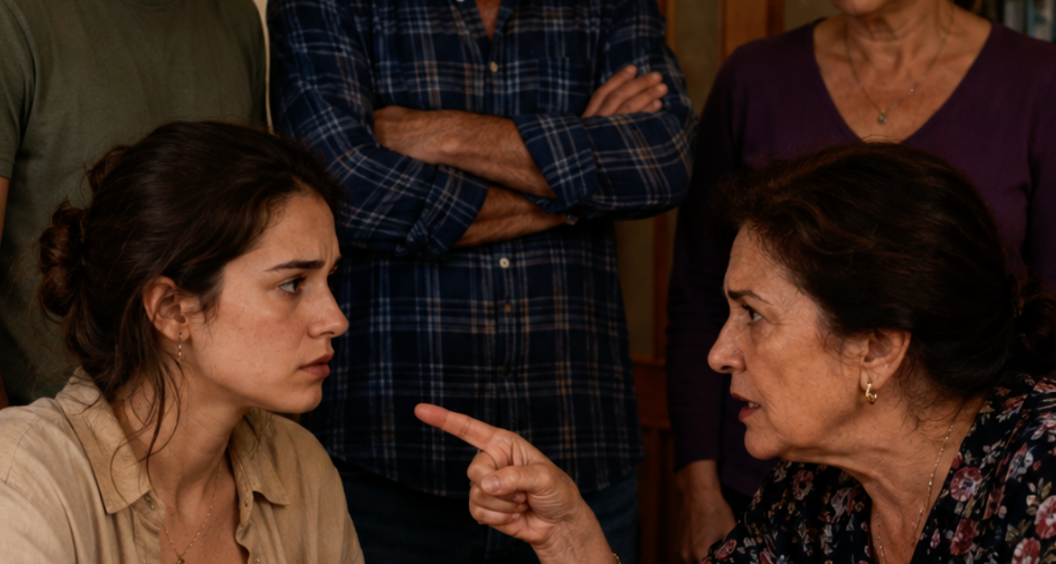
Margarita stood in the entryway of her own apartment, still wearing her black coat, unable to bring herself to take it off, as though the slightest movement might shatter the fragile, not-yet-fully-understood state she had been in for the past few hours. She held a folder of documents in her hands—the notary had handed it to her immediately after reading the will, briefly wishing her “all the best under the new circumstances,” as though she were simply changing jobs.
“Well?” Viktor appeared from the kitchen, wiping his hands on a towel. “How did it go?”
“Fine.” Margarita finally removed her coat and hung it on the hook. “Aunt Zina left me her apartment. And some savings.”
Viktor froze with the towel still in his hands, as though he had not immediately understood what she had said.
“To you?” he asked again. “Only you?”
“To me,” Margarita confirmed, walking into the kitchen and sitting down at the table. “There’s an apartment on Rechnaya Street, and about two million in the bank account.”
Viktor slowly lowered himself into the chair opposite her, studying his wife with an expression that mixed surprise with something else Margarita could not yet name.
Zinaida Yegorovna was Margarita’s maternal aunt—a distant relative whom the rest of the family rarely visited because they considered the trips burdensome. During the last three years, when the elderly woman had begun struggling with ordinary household tasks, Margarita had been the one traveling across the entire city every weekend. She brought groceries, cleaned the apartment, sat beside her in the evenings, and listened to the same stories about her childhood before the war. Neither Viktor nor his relatives had ever taken part in those visits. They believed Margarita already had enough responsibilities of her own.
“No one expected her to leave anything at all,” Margarita said, looking at the folder of documents. “She had a daughter, after all. My third cousin, from Novosibirsk.”
“So Aunt Zina left everything to you instead of her own daughter.” Viktor shook his head as if he still could not quite believe it. “Imagine that.”
The next day, once the rest of the family learned the news, congratulations began pouring in almost immediately—first from Galina, Viktor’s sister, then from Lidia Pavlovna and Gennady Ilyich, his parents.
Their voices sounded cheerful, and they chose all the appropriate words, but Margarita quickly began noticing something strange in their tone. There were too many questions about exact sums and far too much interest in the details of the will.
“What kind of apartment is it? Is it big?” Galina asked over the phone that same evening. “And how much exactly is in the account, if it’s not a secret?”
“Galya, I haven’t really sorted everything out myself yet,” Margarita replied evasively.
“Well, approximately?”
Margarita avoided giving a direct answer, saying she was tired, and the conversation soon ended, leaving behind a faint but unmistakable feeling of discomfort.
A week later, Viktor brought up the money directly for the first time.
“Listen,” he began one evening as he sat beside his wife on the sofa, “of course I understand that the inheritance is yours. But maybe we should think about how to use it wisely? For the good of the family as a whole.”
“What do you mean, for the good of the family?” Margarita put down her book.
“Well, Galya has a mortgage. It’s hard for her to manage it alone with two children after the divorce,” Viktor said carefully, choosing his words. “And my parents’ roof at the dacha has been leaking for three years. They keep postponing the repairs. Maybe we could help them a little?”
“I don’t mind helping if I’m able to,” Margarita shrugged, “but it’s my decision when and how much. It’s not an obligation.”
“Of course, of course,” Viktor agreed quickly. “I’m just suggesting that we think about it.”
Margarita nodded, deciding the conversation was over.
She was wrong.
The subject returned again and again, each time phrased differently. Viktor suggested paying off Galina’s debts, helping his nephews with their education, financing his parents’ repairs. The list grew longer each time, as though the inheritance had already been mentally divided among everyone except Margarita herself.
“Vitya,” she said one day, exhausted by yet another attempt, “this inheritance belongs exclusively to me. Aunt Zina left it specifically to me, not to our entire family collectively.”
“So you’re not willing to share at all?” Viktor frowned. “Not even with my parents?”
“I’m willing to help voluntarily when I decide it’s appropriate,” Margarita repeated patiently. “But not because someone thinks it’s my duty.”
Viktor fell into offended silence and turned toward the television. Later that evening, he remarked casually:
“Family is more important than money, Margo. Strange that anyone even has to explain that to you.”
Those words began to repeat with alarming regularity—during almost every conversation, whatever the subject, as though Viktor had memorized a new mantra and now tested it on his wife whenever the opportunity arose.
Margarita noticed how her husband’s attitude was gradually changing. Previously calm and not inclined toward arguments, he now frowned more often and sighed meaningfully, as though carrying around an unspoken grievance.
Galina came to visit almost immediately after learning about the will. She arrived with a cake, gifts for her nephew—Margarita and Viktor’s ten-year-old son Artyom—and an unusually warm, almost ingratiating smile.
“Margo, you really did a wonderful thing,” Galina said as she settled into the kitchen and poured tea. “You visited Aunt Zina all those years, and she appreciated it.”
“I was just helping her,” Margarita shrugged. “I wasn’t doing it for money.”
“Of course, of course.” Galina nodded quickly, then added as though she had suddenly remembered something important. “Listen, how are you doing anyway? Isn’t it difficult managing such a large amount of money by yourself?”
“I’m managing,” Margarita answered briefly.
Galina turned her cup slowly in her hands, studying the pattern on the tablecloth, then sighed.
“To tell you the truth, things are hard for me right now. After the divorce, I’m alone with two kids, I still have the mortgage, and you know what a kindergarten teacher earns—practically nothing. Didn’t Vitya tell you?”
“He mentioned it,” Margarita admitted.
“Maybe you could help?” Galina raised her eyes, and Margarita could see a mixture of pleading and calculation in them. “At least help me pay off part of the mortgage interest. After that I’ll try to manage on my own.”
Margarita felt an unpleasant pressure in her chest, as though the conversation had subtly turned into someone presenting her with a bill.
“Galya, I’ll think about it,” she said evasively. “I’m not ready to give you a definite answer right now.”
The smile slowly disappeared from her sister-in-law’s face, replaced by poorly concealed irritation.
“All right,” Galina said dryly. “Think about it.”
That visit marked the beginning of a whole series of similar encounters.
Galina came over again and again, each time finding a new excuse to bring up money and each time receiving a polite but firm noncommittal response from Margarita. Gradually, all politeness disappeared from her sister-in-law’s voice, replaced by open hints and veiled accusations.
“It’s strange how things work out,” Galina remarked during one visit, looking at a new throw blanket on Margarita’s sofa. “You can buy new furniture for yourself, but you can’t help your husband’s own sister.”
“We bought the sofa last year, long before the inheritance,” Margarita replied calmly.
“Sure, sure,” Galina snorted skeptically. “That’s what everyone says.”
Lidia Pavlovna and Gennady Ilyich, Viktor’s parents, joined the discussion somewhat later, but with no less persistence.
At first, Margarita’s father-in-law stayed out of it, allowing his wife to lead the conversations. Gradually, however, he began adding his own comments, each time emphasizing family values and the importance of helping one another.
“Margarita,” Lidia Pavlovna said during a Sunday lunch when the entire family was gathered around one table, “Gennady Ilyich and I aren’t strangers to you. We’ve been a family for so many years, and ever since you received this inheritance, you’ve acted as though you’re shutting us out.”
“I’m not shutting anyone out,” Margarita tried to object. “I simply believe that what happens to my inheritance is my personal decision—who I help and when.”
“A personal decision,” Gennady Ilyich repeated with obvious disapproval. “Then what is family for if everyone only thinks about themselves?”
Viktor, who had remained silent until then, unexpectedly sided with his parents.
“Mom and Dad are right,” he said, looking at his wife. “Margo, seriously, it’s time you stopped thinking only about your own interests.”
Something cold tightened inside Margarita—not even from hurt, but from the realization of how completely her husband had taken his relatives’ side, forgetting who had spent the past three years caring for Aunt Zina while everyone else preferred not to remember that the elderly woman even existed.
Gradually, the demands became increasingly specific and persistent.
Viktor no longer hinted. He started naming actual amounts. First it was three hundred thousand for Galina, then around four hundred thousand for repairs to his parents’ dacha. After that came money for tutors for his nephews.
Every refusal from Margarita immediately triggered another argument.
“You’re just greedy. That’s all,” Viktor snapped one evening, apparently tired of hearing another refusal. “I never noticed that about you before.”
“It’s not about greed.” Margarita tried to keep her voice steady, though it trembled from accumulated tension. “It’s about the fact that I decide what happens to my money, not your entire family collectively.”
“My family is your family too, by the way,” Viktor shot back.
“Then why am I the only one expected to share?” Margarita asked quietly. “Why did none of you help Aunt Zina for three years, but now everyone has suddenly remembered their family obligations?”
Viktor looked away and said nothing.
He had no answer.
The inheritance was now discussed everywhere—at family dinners, over the phone, even in front of neighbors who happened to be nearby during one of Galina’s visits.
Margarita felt as though she had been put on display, as though her private life had become the subject of a public hearing open to anyone who wished to participate.
Gradually, she began avoiding family celebrations, always finding some excuse not to go. Sometimes work kept her late. Sometimes Artyom was supposedly feeling unwell. Sometimes she simply lacked the strength to endure another round of accusations.
Her absence only irritated the relatives more, adding yet another item to their growing list of complaints.
“She’s completely turned her back on the family,” Lidia Pavlovna complained to her son on the phone, fully aware that Margarita was standing nearby and could hear every word. “She used to visit regularly. Now she only comes for major holidays, and even then unwillingly.”
A month later, Viktor suggested that everyone meet together, supposedly to make peace and have a calm conversation without resentment.
“We’ll just sit down and discuss everything like civilized people,” he persuaded his wife. “Enough of avoiding each other.”
Margarita agreed, although an inner voice warned her that nothing good would come of it.
The meeting took place at Viktor’s parents’ apartment on Saturday evening.
Everyone was gathered around the table—Lidia Pavlovna, Gennady Ilyich, Galina with her children, and Viktor.
From the very beginning, the atmosphere seemed tense to Margarita, completely lacking the warmth Viktor had promised when he invited her.
“Well,” Lidia Pavlovna began, pouring tea into the cups, “since we’re all here, let’s speak openly.”
“All right,” Margarita agreed cautiously.
“We all believe,” Lidia Pavlovna continued, looking around at the others for support, “that your behavior lately has been completely unacceptable. You’ve distanced yourself from your relatives and you’re hiding the money as though we were strangers.”
“I’m not hiding money from anyone,” Margarita tried to object. “I just don’t think it’s right to hand out my inheritance whenever someone demands it.”
“And who is demanding anything?” Galina cut in, throwing up her hands. “We’re asking you as family, and you’re acting as though there’s something criminal about our request.”
The conversation quickly turned into something resembling a courtroom trial in which Margarita was the only defendant and had no real right to defend herself.
Every attempt she made to explain her position was met with another wave of accusations, while several people interrupted her at once.
“You’re the one who got the inheritance, so you’re obligated to help all your relatives!” Galina burst out, slamming her cup down so hard that tea spilled onto the tablecloth.
After those words, the accusations came with twice the intensity, becoming harsher and more openly insulting.
Margarita felt something long suppressed rising inside her—something heavy, but at the same time strangely clear, as though the fog of uncertainty had finally disappeared.
“For three years I went to Aunt Zina’s every single weekend,” she said, trying to speak clearly despite the trembling in her voice. “I cleaned her apartment, cooked for her, sat with her in the evenings, listened to her stories. Not one of you ever offered to come with me or help even occasionally.”
“That was your personal choice,” Galina snorted. “No one forced you.”
“Exactly,” Margarita replied firmly. “My personal choice. Just like it is now my personal choice to decide what to do with what she left me.”
“Oh, enough digging up the past,” Viktor interrupted, rubbing his forehead irritably. “Margo, just give the relatives what they’re asking for and let this be over.”
Margarita slowly turned toward her husband, staring at his face as though he had become a near stranger.
“So you’re completely on their side,” she said quietly. “Even now, after hearing all of this.”
“I’m not on anyone’s side,” Viktor tried to justify himself. “I just want peace in the family.”
“Peace,” Margarita repeated bitterly. “You call this peace? It seems to me that all of you see me as nothing more than a source of money, not as a person.”
Her words provoked another, even more furious burst of indignation.
Gennady Ilyich, who had remained silent until then, unexpectedly joined the argument with an irritated expression.
“Maybe it really would have been better if someone else had inherited the money,” he said, “if receiving it reveals this kind of greed in a person.”
“Exactly,” Lidia Pavlovna immediately agreed with her husband. “I never thought that after all these years I would discover your true character, Margarita. Perhaps a daughter-in-law like you no longer has any place in our family.”
Galina nodded energetically and added her own accusations, while Viktor, instead of making any attempt to stop the escalating scandal, demanded that his wife apologize immediately.
“Apologize to Mom,” he said firmly. “She’s right. You really are behaving badly.”
Margarita slowly rose from her chair and looked around at everyone present—Lidia Pavlovna, red-faced with indignation; Gennady Ilyich, his lips pressed into a severe line; Galina, looking triumphant; and Viktor, confused but stubborn.
“You know what?” Margarita said in an even, almost calm voice, although there was unmistakable finality behind it. “I’m not going to explain myself anymore, and I’m not apologizing to any of you. From this moment on, I’m ending all relations with your family.”
“Are you serious?” Viktor stared at his wife in bewilderment.
“Absolutely.” Margarita picked up her handbag from the back of the chair. “I’m tired of being a convenient subject for conversations about other people’s money. I’m tired of having to prove that caring for someone cannot be measured solely by the amount written in a will.”
“Margo, stop being so dramatic,” Viktor tried to stop her, but his voice no longer carried its former confidence.
Margarita said nothing and walked toward the door.
At the entrance, she turned around one last time and looked at the family still sitting around the table in tense silence.
“Thank you for being honest,” she said quietly. “At least now I know exactly what all of you are really worth.”
With those words she left, gently closing the door instead of slamming it, as though even that final bit of drama was unnecessary.
Viktor remained sitting at the table, convinced that his wife would return in a day or two, calm down, and come to her senses. They had spent too many years together for the separation to be permanent.
His relatives, encouraged by Viktor’s apparent confidence, reinforced that belief, repeatedly telling him that Margarita would inevitably see reason once the first wave of resentment passed.
Days went by.
Then weeks.
Margarita did not call, write, or appear on the doorstep with apologies.
Viktor called her several times. She answered, but their conversations were brief, practical, and completely devoid of their former warmth.
“I need to pick up some things from the apartment. I’ll come by on Saturday,” Margarita would say in a dry, even tone. “I’ll take Artyom with me for the weekend. I’ve already arranged everything with the school.”
“Margo, maybe we could finally talk properly?” Viktor would try.
“We have nothing to talk about,” she would reply, “until your position changes.”
Viktor’s position did not change.
He continued believing that his wife would eventually return on her own, that time would put everything back in its proper place, and that family would ultimately prove more important than temporary hurt feelings.
But time passed, and Margarita showed not the slightest sign that she intended to return to her former life.
She filed for divorce, moved the rest of her belongings into her new apartment, and completed part of the paperwork necessary to transfer Artyom to a school closer to her new home.
Viktor’s relatives, who until the very end had counted on generous financial assistance from the inheritance, did not receive a single ruble.
Margarita permanently closed the subject, leaving no opening for further requests.
Galina, deprived of the financial support she had expected, continued paying her mortgage on her own, occasionally complaining to acquaintances about her “ungrateful relative.”
Lidia Pavlovna and Gennady Ilyich never repaired the leaking roof at their dacha, postponing the work indefinitely.
Viktor gradually began to understand that the family life he had once taken for granted had fallen apart not because of his wife’s greed, but because of his own choice—the choice he had made that Saturday evening at the family table when he sided with his relatives instead of defending the woman who had spent three years caring for a helpless elderly aunt without ever asking for gratitude in return.
Margarita, meanwhile, settled into her new apartment on Rechnaya Street—the very apartment she had inherited from Aunt Zina—and gradually learned how to live again without constant pressure and endless accusations hanging over her.
In the evenings, after Artyom had fallen asleep in the neighboring room, she would sometimes sit by the window with a cup of tea and gaze out into the courtyard.
And she would catch herself thinking that, for the first time in many months, she did not feel guilty for standing her ground.
Instead, she felt something calm and almost unfamiliar:
the quiet certainty that she had made the right choice.