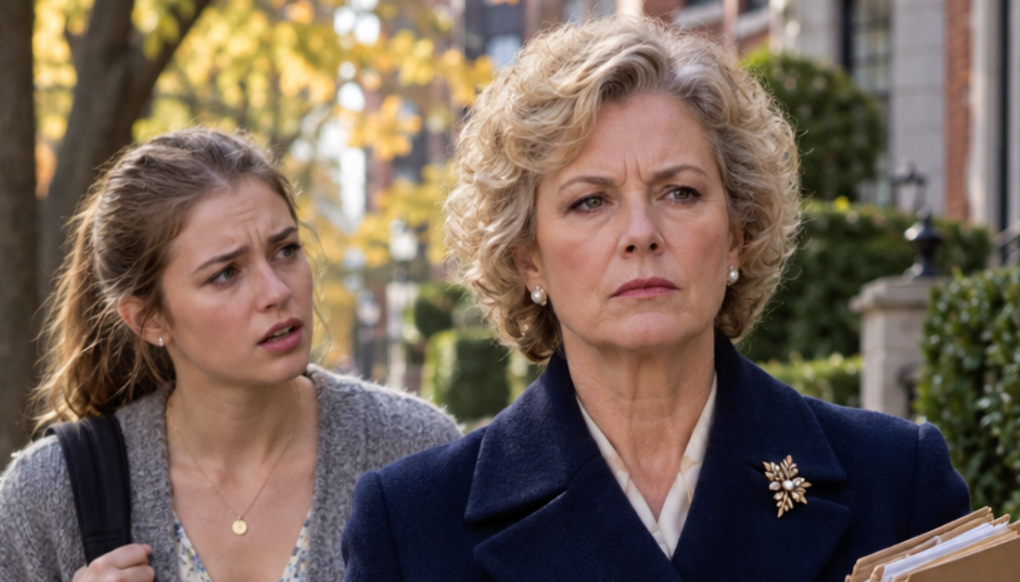
Around 6:30 in the morning, Inna Valeriivna was ironing a suit. Yulia saw her through the slightly open kitchen door and knew right away—it wasn’t going to be a peaceful day.
The dark blue jacket with two rows of buttons had hung in the closet, in its garment bag, for as long as Yulia could remember. Grandma wore it rarely. To graduation ceremonies, back when she was still working at school. To her friend Lidiya’s milestone birthday. Once—to Yulia’s college induction in September. Now, the jacket was spread out on the ironing board, and the iron hissed steam through a damp cloth.
«Grandma, where are you going?»
«Eat your breakfast. The oatmeal’s on the stove, I grated some apple into it.»
«Grandma.»
Inna Valeriivna lifted the sleeve to the window light, examined a crease closely, and only then replied:
«We’re going together. I need to go to your college.»
Yulia set her cup down so abruptly that tea splashed onto the lemon-printed tablecloth.
* * *
It all happened yesterday, during the third period.
Yulia was a first-year student at a professional college, studying accounting. She had moved from her village to stay with her grandma because her mom had been working in Poland for three years, at a mushroom packing factory, saving up for her own apartment. Just a small, single-bedroom place, but still her own. Every Sunday, her mom called on video and always asked the same thing: «How’s school? Is anyone giving you trouble?» And every Sunday, Yulia replied that everything was fine.
And it almost was—with everyone except Hanna Serhiivna.
Advanced mathematics had been a struggle for Yulia from the very start. Not because she didn’t try—in her village school, they had no math teacher for two years, so the biology teacher just read the math curriculum. Hanna Serhiivna realized this from the first test. And, it seemed, that annoyed her more than anything.
She pronounced «Melnychuk» with a sigh, as if the surname was a burden. She’d give Yulia a C for the very same answer she gave Viktoria Hnatiuk, up front, a B. Once, in front of the whole class, she asked if their village even had any internet, since «it sure feels like you don’t.»
Yulia stayed silent. She was good at that.
Yesterday, she was called to the board for a calculus question. She started off fine, but got the sign wrong on the third line and everything fell apart. She stood there with chalk in her fingers, knowing there was a mistake somewhere, but unable to see where.
Hanna Serhiivna sighed, took off her glasses, and set them down on the gradebook.
«Sit down, Melnychuk. And tell me honestly—do you even know where you’ve ended up? Actually, who am I asking. Mom’s abroad, kid’s with grandma, grandma’s on a pension. How could you possibly have a good head for this. I’ve been teaching twenty years and never seen a straight-A student from that kind of family. Don’t torture yourself or me. Go be a shop assistant—math there is just enough to give change from two hundred hryvnias.»
Someone in the back rows snickered. Most kept their eyes glued to their notebooks. Vika Hnatiuk didn’t even look up from her manicure.
Yulia sat down. Stayed through the rest of the class. Wrote down everything on the board. And after the bell, she didn’t take the tram—her classmates would be there—instead, she walked home for forty minutes through the November drizzle, in sneakers that let the water soak through.
* * *
Grandma was the first to notice the sneakers. Wet, streaked with dark stains, they stood in the hallway not on the shoe rack, but right in the middle of the rug, as if they’d been slipped off in a hurry.
Inna Valeriivna didn’t ask any questions. She put the kettle on, took a pie out of the fridge, and sat down across from Yulia. Yulia held back for about two minutes. Then she told everything, word for word—the words had been running through her head the whole way and were already worn out, like an old coin.
Grandma listened with her hands folded on the table. She didn’t interrupt. She didn’t gasp. She just asked one question at the end:
“So, what’s her name again? The full name.”
“Ostapenko Hanna Serhiivna.”
“And what does she look like?”
Yulia was surprised by the question, but answered anyway: short, fair-haired, short haircut, a small scar on her left eyebrow—like from chickenpox.
Inna Valeriivna nodded and didn’t bring the subject up again. She asked if Yulia had done her English homework. Reminded her to call her mom. They watched a TV show together.
Then, at one in the morning, Yulia woke to the sound of someone dragging a stool across the hallway floor. She peeked out and saw her grandma on the stool by the top cupboards. With glasses on a chain and wearing her old robe, she was pulling down a cardboard box from above the wardrobe. Written on it in marker: ‘2000–2003.’
“Grandma, what are you doing up there?”
“Go to sleep,” Grandma said. “I’m just looking for something.”
* * *
They walked to college on foot. Inna Valeriivna said her jacket would get wrinkled on the tram. Yellow chestnut leaves stuck underfoot, drops fell from the bus stop roof, and Grandma carefully avoided every puddle—just as carefully as she approached everything in life.
She carried a folder under her arm. An ordinary cardboard one with tie fastenings—the kind Yulia hadn’t seen in stores for at least ten years.
“Grandma, please,” Yulia walked half a step behind and spoke to her back. “Just don’t make a scene. I have two more years to study with her. She’ll totally eat me alive if you do. I’ll retake the exam, I’ll study with Taras, he promised he’d help explain…”
“Yulia.”
“Really! You don’t know her. She’ll say I complained and then…”
Grandma stopped at the crosswalk, waiting for the light to turn green.
“I worked in a school for forty-one years,” she said calmly. “In all that time, I never once raised my voice. Not at students, not at parents, not at the principal. And I don’t plan to today.”
“Then why are we going?”
The light turned green.
“To settle a debt,” Inna Valeriivna said as she crossed the street.
* * *
The waiting room smelled of fresh paint—they’d just finished renovations on the college’s second floor. The secretary, a young woman with long eyelashes, glanced at the suit, at the brooch shaped like a viburnum branch, at the tied-up folder—and for some reason, didn’t ask if they had an appointment.
Director Vitalii Andriiovych, a sturdy man around fifty, stood up from behind his desk. A brand-new laptop still covered in plastic sat there.
“How can I help you?”
“Melnychuk Inna Valeriivna, grandmother of your student,” Grandma said, lightly touching Yulia’s shoulder. “I won’t take much of your time. I’m not here to complain. Could you please call Hanna Serhiivna Ostapenko in? Just for five minutes.”
The director looked at Yulia. She stared at the floor. He seemed to consider for a moment, sighed, and pressed the button on his phone.
Hanna Serhiivna came in about seven minutes later, carrying her register, already wearing the look teachers get when they’re about to deal with parents. She saw Yulia and raised the eyebrow with the scar slightly. Then she shifted her attention to the woman in the blue suit.
And she stopped in the doorway.
«Inna Valeriivna?» she said, her voice suddenly different—thin, almost childlike.
«Hello, Anya,» replied the grandmother. «Please have a seat.»
Yulia felt her fingers grow cold. She didn’t understand anything at all.
* * *
Inna Valeriivna untied the folder. Inside was a single sheet of lined paper, yellowed at the edges, the handwriting round and careful with large loops on the letter ‘u’.
«Seventh grade, school number eighteen,» said the grandmother. «Essay on ‘Who I Want to Be.’ April, 2001. Remember?»
Hanna Serhiivna took the paper. Her hands visibly trembled.
«Read it,» the grandmother asked softly. «You can do it out loud. We’re all among friends here.»
Hanna Serhiivna stayed silent. So Inna Valeriivna took the page from her, put on her glasses, and read calmly, just like she used to read dictations to children:
«They call me a rag in class because my mom cleans the apartment buildings. When I made a mistake solving a problem at the board, the math teacher told everyone that nothing good comes from a family like mine and I’d be better off cleaning like my mom. I came home and cried. But Inna Valeriivna told me that your mind doesn’t come from your parents, but from how much you work on yourself. When I grow up, I will be a teacher. The best one. And I will never ever tell a child that they’re worth nothing because of their family.»
The grandmother put the paper down. At the bottom, written in red ink in neat teacher’s handwriting, it read: «Anya, I’m holding you to your word. 12.»
The office grew so quiet you could hear the secretary clicking her mouse on the other side of the wall. Vitaliy Andriyovych turned to the window. Hanna Serhiivna sat red to the base of her neck, staring at her hands.
«I didn’t come to embarrass you in front of your boss,» said Inna Valeriivna. «I came to return what’s yours. I’ve kept this essay for twenty-five years. I thought I’d bring it to you someday, when you became a teacher. So I could be proud. And here you are.»
She paused.
«Yulia told me everything yesterday. Word for word. And I believe her because she never lies to me.»
«Inna Valeriivna, I…» Hanna Serhiivna swallowed. «I didn’t know she was your granddaughter.»
Grandmother looked at her over her glasses. For a long moment.
«And what if she wasn’t my granddaughter, Anya? Would it be okay then?»
There was no answer. But it seemed like no one expected one, either. Suddenly, Hanna Serhiivna stood up, turned to Yulia and, stumbling like a student at an exam, said:
«Yulia… Yesterday I said terrible things to you. About you and your family. It was cruel. Please forgive me, if you can.»
Yulia didn’t know where to look. She nodded. That was all she could do. Inna Valeriivna placed the essay on the table in front of Hanna Serhiivna, tied up the empty folder, said goodbye to the director, and left. Yulia hurried after her.
* * *
On the steps outside the college, the grandmother finally exhaled and unbuttoned the top button of her jacket.
«You promised no scenes,» Yulia said, and even she could hear how much her voice trembled.
«Was there a scene, though?»
Yulia thought about it. And then she laughed—for the first time since yesterday’s third period.
They bought two hot cabbage pies at the kiosk near the bus stop, each wrapped in a napkin, and ate them on the go—something Grandma never normally allowed herself or her granddaughter.
«Grandma, did you really keep all my essays? From all those years?»
«Not all of them. Only the ones where a child wrote something real. I have four boxes up on the shelves. Your mom says it’s all just waste paper and that we could fit a nice cabinet up there instead.»
«But why?»
Inna Valeriivna wiped her fingers with a napkin.
«Because people forget who they used to be. Especially those who were once hurt. You’d think that if you were humiliated at thirteen, you’d remember forever how much it hurts—and never do it yourself. But that’s not how it works. Sometimes, you grow up and turn into that very same math teacher. Nobody reminds you—so that’s what happens.»
* * *
The next higher math class was on Thursday. Hanna Serhiivna walked in without the grade book. She stood by the desk while the group settled in, then said she had an announcement to make.
«On Monday, I said unacceptable things to Yuliia Melnychuk in front of everyone. I did it in front of you—I owe my apology in front of you as well. Yuliia, I’m sorry once again.»
For the first time all semester, Vika Hnatyuk looked up from her phone.
That same day, Hanna Serhiivna called Yulia up to the board to solve the same derivative. When Yulia got the sign wrong in the third line again, Hanna didn’t sigh this time—she stepped closer and quietly said, «Stop. Look at the minus sign. What happens when we factor it out?» Yulia looked, and then she saw it.
She passed her exam in December—with a solid B, honestly earned, with no favors given.
Before New Year, someone rang the apartment doorbell. Hanna Serhiivna stood at the doorstep with a cake box and flowers, looking like she’d come to turn in an essay for seventh grade again. She and Grandma sat in the kitchen talking until eleven. Yulia could hear them laughing from her room, hearing her grandmother say, “Do you remember, Anya…”—and noticing how Hanna Serhiivna would fall silent for long stretches.
After their guest left, Yulia brought the teacups into the kitchen and finally asked what had been on her mind for a month:
«Grandma. Are any of my essays in those boxes?»
Inna Valeriivna smiled without turning away from the sink.
«Where else would they be?»