At the Akvarel salon, client appointments were recorded the old-fashioned way—in a thick grid-lined notebook that administrator Nelya kept right by the cash register and never let anyone else touch. All bookings were written in blue pen. But Nelya always circled one name in red.
“Lidiya Borysivna, Saturday, 10:00.”
Ivanna noticed this in her third week at the job, when she was starting to get the hang of things: she knew where the fresh towels were, which hair dyes ran out faster than others, and why you should never put the hair dryer on the shelf near the window—it leaked whenever that wet, November city snow started falling.
“Why in red?” she asked.
Nelya looked up from the notebook and glanced at Khrystyna. Khrystyna, who was just finishing washing the sink, looked at Nelya. They both shared a strange smile.
“Go on, you tell her,” said Nelya. “You’re the one who suffered the most.”
* * *
Ivanna was told the story over tea in the staff room, and it had more juicy details than any TV series ever could.
Lidiya Borysivna had been coming to Akvarel for seven years now. She was the widow of a man who once owned several hardware stores in the region. After he passed, she was left with apartments downtown that she rented out, and a house with a garden where, rumor had it, the roses grew as tall as a person. Basically, this woman could have her hair cut or styled anywhere—even in the most expensive salon in the capital, the kind people travel to just for a blowout. But she came here. Every Saturday, once a month, exactly at ten o’clock.
And in those seven years, she never stuck with the same stylist.
“She drove me out in just two visits,” Khrystyna said, twirling a teaspoon in her fingers. “I was picking out a dye for her and she says, ‘Have you tried this shade on yourself? No? Then why are you recommending it to me?’ I ended up sitting on an upside-down bucket in the back, bawling. Nelya brought me napkins.”
“I sure did,” Nelya confirmed. “A whole pack.”
“Before Khrystyna, there was Olena,” Nelya added. “She basically said, it’s either me or her. Now she works elsewhere, in a shopping center. Says it’s peaceful there.”
Ivanna listened, feeling her tea grow cold in the cup. She was starting to sense where this conversation was headed.
“The next appointment is on the twenty-eighth,” Nelya said cautiously. “Girls, we sort of decided… You’re new, you have a gentle touch, a fresh outlook…”
“No one else wants to do it,” Khrystyna interrupted honestly. “That’s all there is to it.”
Ivanna could have refused. But being able to refuse and actually refusing are two very different things. At home, in her rented one-bedroom apartment, she had Matviy, who was nine, and Zakhar, who was five, waiting for her. The landlady had already hinted back in September that the rent would go up after New Year.
The salon where Ivanna worked before going on maternity leave had closed while she was home with the youngest, and it had taken her two months to find this job. Half of her stylist friends had either moved away or switched to doing manicures during that time.
“Okay,” she said. “Book me for it.”
Nelya exhaled in relief and picked up the red pen.
* * *
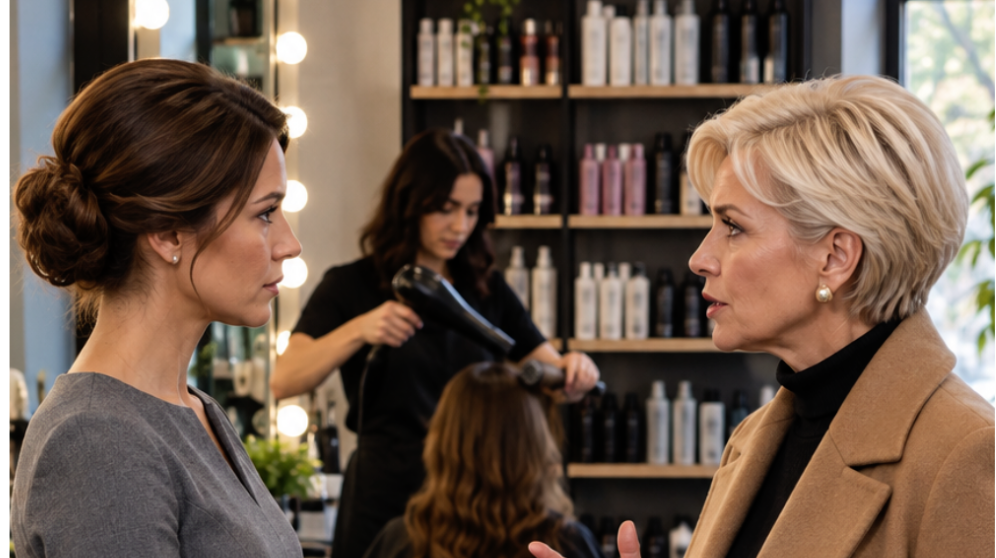
On the twenty-eighth, it was snowing with rain. Lidiya Borysivna arrived at nine fifty—Ivanna would later learn that she never arrived late, but never on time either, always early. Tall and straight, dressed in a coffee-with-milk colored coat, she shook off her umbrella right on the doorstep, not minding the doormat. On her left wrist was a man’s watch, too big for her hand, with a leather strap.
She sat down in the chair, looked at Ivanna through the mirror, and instead of greeting her, asked:
“Is your water hot today? Last time it was like swimming pool water in October.”
“It’s hot,” Ivanna replied. “If it’s uncomfortable at any point, just let me know and I’ll adjust it.”
“I will, don’t worry.”
She really did speak up. That Ivanna was pressing too hard on her scalp. That the towel should go under the collar, not on it. That her part had always been on the left, ‘and let’s not try anything new here.’ Ivanna nodded, adjusted everything, and stayed quiet. Out of the corner of her eye, she saw Khrystyna in the chair next to her start drying her client’s hair extra slowly, making sure not to miss a thing.
The second comment was about the comb. Apparently, only a horse should be brushed with one like that. Ivanna switched combs.
And the third comment came when Ivanna picked up the scissors and separated the first lock of hair.
“Young lady, you’re holding the scissors all wrong. Who taught you? You’re holding them like a kitchen knife for peeling potatoes.”
Ivanna lowered her hand. She set the scissors down gently on the table, blades facing away. She didn’t look at the client, just at her reflection in the mirror—because that was easier.
“Lidiya Borysivna,” she said in a steady voice, though her heart was racing. “You have every right not to trust me. You’re seeing me for the first time. So let’s stop now, before I cut anything. Nelya can schedule you with another stylist and no one will take it personally. But if you do trust me—just give me twenty minutes. Twenty minutes to do my job.”
The salon fell silent. The blow dryer in Khrystyna’s hands stopped. Nelya at the register stopped flipping through her notebook. Even the manicure client in the corner froze with her fingers spread wide.
Lidiya Borysivna stared in the mirror for a long moment. Then the corner of her mouth twitched upward—just barely, so that Ivanna wasn’t sure she’d seen it at first.
She raised her left hand and tapped the glass of her man’s wristwatch with her fingernail.
“Twenty,” she said. “I’m timing you.”
* * *
Ivanna finished in nineteen.
During those nineteen minutes, the client didn’t say a single word. She sat up straight and watched the gray strands fall onto the cape. Ivanna worked the way she had in her very first salon, before Matviy, before maternity leave, before all the moving: not wondering if the client would like it, but thinking how the hair would lie when a woman steps into the wind and pulls down her hood.
Then came the styling. Then Ivanna took a small mirror and showed the back of her head.
Lidiya Borysivna turned her head to the left. Then to the right. She touched her temple with her fingers, as if to check if it was really her hair.
“Thank you,” she said.
Nelya later swore that after seven years, it was the first time she’d ever heard a “thank you” from this woman. Khrystyna said it was actually the second time, but the first had been nothing like this—it was forced, nearly muttered through gritted teeth. But this one was just “thank you.” Quiet, and it even sounded a little surprised.
At the checkout, Lidiya Borysivna paid, pulled on her gloves, and said to Nelya:
— For her. December, January, and February. Saturday, ten o’clock.
Nelya wrote it down, her hand trembling slightly. She never did pick up the red pen that time.
* * *
They didn’t start talking right away. It was around the third visit when Lidiya Borysivna noticed a child’s drawing taped to Ivanna’s mirror: a blue dinosaur, a red sun, and a misspelled note that read “FOR MOM.”
— Is this yours?
— It’s Zakhar’s. He’s five. He says that’s me, and the dinosaur protects me.
— And the sun?
— The sun is Matviy. My oldest. He didn’t want to draw, so Zakhar drew him too.
For the first time, Lidiya Borysivna laughed out loud. Her laughter sounded unexpectedly young.
From then on, every Saturday at ten, there were talks in the salon about everything. About Zakhar, who didn’t want to go to preschool because of “lumpy porridge.” About Matviy, who decided to become an architect and built cities from shoeboxes. About the apartment where winter drafts came through the balcony so much that Ivanna taped the cracks shut and still went to bed in socks. About the landlord, who eventually raised the rent by two thousand hryvnias.
Lidiya Borysivna listened closely, asked lots of questions. Sometimes she gave advice—dry, precise, like a recipe. How to deal with the landlord. What to look for when renting an apartment, so you don’t end up freezing later. She knew her stuff: she rented out three apartments herself and understood tenants inside and out.
And then, one day, she shared something about herself.
— This watch belongs to Arkadiy, my husband, she said while Ivanna was drying her hair. — He used to tease me, saying I scared people. He’d say, ‘Lida, if you look at someone, they immediately remember all their sins.’ What could I say? I was a math teacher for fifteen years. It’s a habit.
She paused in silence.
— When he was around, it was funny. But after he passed, it turned out everyone tiptoes around me. Family, neighbors. My son from Lviv calls once a week and talks as if he’s reporting to a supervisor. Everyone tries hard. Everyone’s so careful. And nobody talks to me like a real person.
Ivanna didn’t know what to say to that. So she just kept drying the hair, slowly and evenly, just how Lidiya Borysivna liked.
* * *
The tips grew bigger every month. The first time Ivanna tried to give the money back—because it really was too much, honestly—Lidiya Borysivna pushed her hand away.
— That’s not for you. It’s for the boys. For mandarins. Don’t insult me.
Right before New Year’s, she brought a bag: a big book of fairy tales with a hard cover, a bit worn at the corners, and a tin box of colored pencils.
— My son’s, she explained simply. — He outgrew it thirty years ago. Maybe someone else will need it now.
Zakhar later slept with that book under his pillow for a whole week.
But the most important thing Lidiya Borysivna did happened in the spring—and, as always, she didn’t warn anyone.
In March, a woman called the salon and asked to be booked «with Ivanna, the one who cuts Lidiya’s hair.» It turned out to be Tetyana Volodymyrivna, the head of the homeowners association where Lidiya Borysivna lived. A week later, Raisa Petrivna, a former assistant principal who used to work with Lidiya Borysivna at the same school, arrived. After that came her sister. Then the sister’s daughter-in-law. Then a neighbor from her summer cottage, bringing along her two adult daughters.
Each of them, as they sat down in the chair, said almost the exact same thing:
«Lida told me, only to you. Not to look at anyone else here.»
By summer, Nelya had started a separate page just for Ivanna in her notebook. Then another. Come June, Ivanna had the longest list of clients in the entire salon, and by July it was impossible to get a Saturday appointment with her.
That summer, Ivanna told her landlady that she’d be moving out in the fall. She found an apartment closer to Matviy’s school—warmer, brighter, and with a balcony where there was no draft.
* * *
That June morning, Ivanna went into the back room for clean towels, and Khrystyna, who had been waiting for the chance, approached the chair.
«Lidiya Borysivna,» she said shyly, «Can I ask you something? We all tried—me, Olena, and the other girls, too. Why her specifically?»
Lidiya Borysivna looked at her in the mirror. She wasn’t stern anymore, even looked a little warm.
«You all tried to please me, Khrystyna. Every one of you. You looked at me like a storm cloud about to burst. Hung on my every word, did whatever I said. But she,» Lidiya Borysivna nodded toward the back room, «she looked at my head. And did her job. Do you see the difference?»
Khrystyna thought about it, and it seemed she understood.
When Ivanna returned with the towels, Lidiya Borysivna was already at the register. She paid, adjusted her watch strap, and then suddenly paused and said quietly—just so Ivanna could hear:
«You know, you’re the first in seven years who wasn’t afraid of me.»
Ivanna smiled.
«Oh, I was scared, Lidiya Borysivna. My knees were shaking back then. I just never let go of my scissors.»
Lidiya Borysivna laughed—that young-sounding laugh, the one that always made Nelya look up from the register. Then she opened her umbrella, even though the rain had stopped, and stepped out onto Soborna Street.
And Nelya opened her notebook for the next month and wrote in blue ink, just like always: «Lidiya Borysivna, Saturday, 10:00.»