Twenty years ago, Olena knew everything a good secretary needed to know about Viktor Petrovych. He liked his coffee without milk, with two spoons of sugar. The cup had to be placed to the right of his phone—if it was on the left, he’d always knock it over with his elbow. His wife was only to be called back after lunch, never before. Yet, even after all these years, Viktor Petrovych never managed to remember Olena’s patronymic.
«Olenka, coffee!» he would call through the open door, not once looking up from his paperwork.
And she would bring it.
Back then, the company occupied just two offices and a reception on the ground floor of a former design institute. Most of the time, they built private houses to order, occasionally taking office renovation contracts too. Olena was twenty-nine and always had a notebook and the habit of listening closely.
She listened to everything. How Viktor Petrovych haggled with brick suppliers. How he explained to clients why an apartment in a building under construction was a third cheaper than a finished one. How he scolded site managers on the phone. In the evenings, once the office was empty, she would write unfamiliar words in her notebook: ‘general contractor’, ‘hidden works certificate’, ‘cost estimate’, ‘equity participation’. Next to them, in pencil, she’d jot down explanations in her own words so she wouldn’t have to ask again the next day.
Seven years in, she moved from reception to the sales department. Four years later, she was running it. Then the company grew so much that the only thing left of those first two offices was the nameplate at the entrance, and Olena’s department became the biggest one: apartment sales across three residential complexes, turnkey renovations for buyers, legal support for every deal. Forty-three people. Even the director’s deputies would come to her for advice. Sometimes, even the director himself.
Viktor Petrovych was still around too. Three years ago, his department was merged into hers, and he was given the new title of advisor, with his own office but no staff. He came in at ten, left at four, and at meetings he mostly stayed silent. At least, whenever Olena was in the room.
* * *
The company’s 25th anniversary celebration was held at the end of October in a restaurant with towering windows and heavy chandeliers. Outside, a fine drizzle was falling, yellow maple leaves stuck to the wet pavement at the entrance, and guests shook out their umbrellas onto the carpet as they walked in.
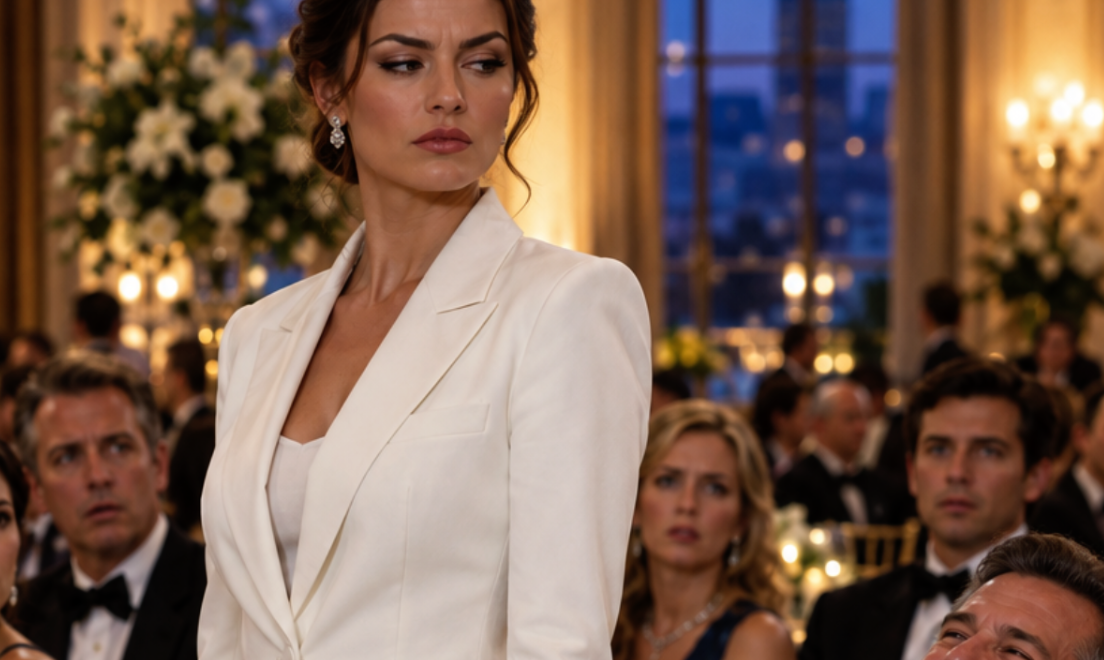
Olena wore a white suit. She had bought it back in the spring, tried it on at home in front of the hallway mirror, then hung it in her closet to save for a special occasion. When her husband saw her that evening, he just whistled and said the taxi was already waiting. She did her hair herself, not bothering with a salon—for twenty years ago, she had no money for a hairdresser, and her hands still remembered how to twist a bun that would last until morning.
She was given a seat at the second table, next to the finance director. Across the aisle and closer to the stage sat Viktor Petrovych. He managed to raise his glass several times—to the company, to the founder, to «those who were there from the beginning»—and each time, he glanced around to see if everyone noticed that he was still among them.
The host, a young man in a bowtie, kept everyone laughing for a while, handed out certificates, and called team leaders and accountants up to the stage. Then he took out an envelope, let the anticipation build, and announced:
«Best Manager of the Year… Olena Mykolaivna Kovalchuk!»
The room erupted in applause. Someone at her department’s table let out a joyful shout. Olena stood up, grabbed her purse—not wanting to leave it on the chair—and started making her way down the aisle between the tables.
That’s when Viktor Petrovych burst out laughing. Loudly, so the whole hall heard, leaning back in his chair and pointing at her with his finger.
“No, did you hear that? Olena! Manager of the Year!” he said, glancing around at the nearby tables for support. “I remember when she used to bring me coffee! Two spoons of sugar, no milk! And now, look at that, she’s the boss. What crazy times we live in!”
Someone giggled—one of those uncertain laughs people make when they’re not sure if it’s a joke or not. The woman next to him covered her mouth with her hand. A few people stared down at their plates. Ulyana, Olena’s assistant of just half a year, flushed bright red, as if the laughter had been aimed at her. The company’s founder, Yaroslav Mykhailovych, slowly set his glass down on the tablecloth.
The music faded away. The host stood there awkwardly, microphone in hand.
* * *
Olena stopped right in front of his chair.
She could have said so much. Like that time in the spring of 2008, when he dropped a big investor presentation on her desk at six in the evening, told her «by morning,» and then went to present it himself, never mentioning who reworked it until three a.m. Or how half the clients he claimed as his own would call reception for years, because only the front desk staff knew what to say. She remembered everything. But none of that was said aloud.
Olena adjusted the cuff of her white blazer, shifted the strap of her bag more comfortably in her hand, and looked at him calmly—the same look she’d give to clients who raised their voices about price per square meter.
“Yes, Viktor Petrovych. I did. Five times a day, seven years in a row. And do you know what I’m still grateful to you for?”
He grinned smugly and waved his hand, like, ‘Go ahead, say it.’
“For the fact that in those seven years, you never once said thank you.”
The room grew so quiet you could hear a plate clink in the kitchen.
“Standing in your waiting room with a tray, I made myself a promise,” Olena continued, her voice just as steady. “If I ever have my own office, everyone who walks in—whether with a cup, a folder, or bad news—will hear ‘thank you’ from me. My department has forty-three people. You can ask any of them.”
No one needed to ask. From her table, Ulyana’s small voice piped up:
“There’s never been a time she didn’t say it.”
Someone laughed, this time in a completely different way. Someone started clapping, and within a second, the whole hall was applauding.
“So I really am grateful to you,” Olena said once the applause settled down a bit. “You taught me that better than any leadership course ever could.”
She nodded to him—politely, just as she would to a colleague in the hallway—and made her way to the stage.
Viktor Petrovych sat there with his hand still raised, though his finger was no longer pointing at anyone. Eventually, he set it down on the table and stared at the tablecloth for a long while.
* * *
Yaroslav Mykhailovych handed her the glass statuette himself, even though the script said it should’ve been the host.
“Twenty years,” he said softly, just for her. “I still remember you with that checkered notebook.”
“I still keep it in my drawer,” Olena replied just as softly.
Her speech was brief. She didn’t have time to thank everyone by name, so she mentioned only those who closed the toughest deals this year. She also thanked the lawyers who spent nights reviewing documents. Finally, she added she was grateful to the people who, twenty years ago, gave her a chance to take a seat at the reception desk. She didn’t mention any names. Those who needed to know, understood.
* * *
Later, as the guests mingled between the tables and the dance floor, Olena walked over to the bar. She asked for a coffee. After thinking for a moment, she told them to add two spoons of sugar. She took the cup and carried it across the hall.
Viktor Petrovych was sitting alone. His table neighbors had long gone to dance. His phone lay in front of him, screen down.
Olena set the cup to the right of his phone.
“No milk, two spoons—I remember,” she said.
He looked up at her. He was silent for a long time, turning the little spoon in his fingers.
“Olena… Mykolayivna,” he finally said, as if testing out the words. “Please forgive me. I overdid it today.”
“Drink it while it’s hot,” she replied.
And she went back to her group.
* * *
She headed home after eleven. The drizzle had turned into a real autumn rain, and the taxi’s wipers barely kept up. The statuette rested on her lap, wrapped in a restaurant napkin so it wouldn’t get scratched.
Her husband asked how everything went. Olena thought for a moment and said it was good. That she’d received an award, that Ulyana beamed all evening, and that the cake was too sweet.
She didn’t mention Viktor Petrovych. It was only at home, taking off her earrings in front of the hallway mirror, that she suddenly smiled to herself.
It had taken twenty years for him to remember her patronymic. And she had never been in any hurry.