The buyers were running twenty minutes late.
Yulia stood by the garden gate, gazing down the path between the lots. The May sun was already warming the day and the first bees buzzed over the currant bushes. Next door, Pyotr Semyonovich, in his faded cap, was digging a new plot for potatoes, sneaking glances over the fence at her.
At last, a silver car rounded the corner and stopped by the gate. Three people got out: a young man in a checkered shirt, a slender girl dressed in denim overalls, and a little boy around five, clutching a plastic pail.
«Yulia? Hi, we’re Kirill and Nastya. From the ad. Sorry, the GPS led us to the wrong lane.»
«It’s okay. Come on in.»
The little boy was the first to dart through the gate, racing down the walkway toward the house.
«Matvey!» Nastya called after him. «Don’t run!»
«Let him run,» Yulia replied. «It’s fine here.»
She followed the boy down the path. Her father had laid this walkway—gray and red paving stones in a herringbone pattern. He’d spent two weeks on his knees that summer when Yulia was fourteen.
The house was small, built of timber, with a glassed-in veranda. Yulia opened the door.
«Come in. You don’t need to take your shoes off.»
Kirill stepped inside first and immediately looked at the floor beneath his feet.
«Wow. Is that solid wood?»
«Larch. My dad laid it himself. He planed every single board by hand.»
Kirill crouched down and ran his hand across the floorboards. They were wide, honey-colored, smooth as silk from thirty years of footsteps.
«Not a single creak,» he said in surprise.
«No creaks,» Yulia nodded. «Dad always said, if a floor creaks, the craftsman was rushing.»
She moved toward the window while Kirill and Nastya looked around the room. The view outside was of the garden—apple trees in full bloom.
Dad spent three summers on these floors. Yulia remembered—she was ten, then eleven, then twelve. Her father worked factory shifts, but in summer and on weekends, he’d come out here and plane boards at the bench under the shed. Mom would bring his lunch in an enameled bowl and sit next to him on a log. Yulia handed him nails.
«You remember this, Yulka,» her father would say, wiping sweat from his brow. «We’re not building just a dacha. We’re building it for you. So you always have somewhere to come.»
Money was always tight. Her father was a welder, her mother a nurse at the district clinic. They bought the timber a little at a time, whenever they could, and Mom spent three years using her network to find some of the windows. They redid the roof twice. Her parents never took a vacation anywhere—Yulia could only remember summers at the dacha. Every year, all thirty years.
«Yulia, where does the water come from?» Nastya asked. «Is there a well?»
«There’s a borehole. Dad drilled it. Out back behind the house. The water is good—we had it tested.»
«Can you stay here in winter?»
«Yes, you can. There’s a stove. Dad insulated everything.»
Nastya glanced at her husband and Kirill nodded.
«Let’s go into the garden,» Yulia suggested.
There were seven apple trees in all. Mom planted them one by one, over the years. The first—a White Transparent—when Yulia started first grade, and the last, an Antonovka, when she graduated from university.
«Did you plant all of these?» Nastya asked, touching the white blossoms on a low branch.
«Mom did.»
Matvey was already playing under the currant bush with his pail, busy digging something up.
«Why are you selling?» Nastya asked softly. «Sorry if it’s none of my business, it just seems like… this place means so much to you.»
Yulia was silent for a moment.
«It’s a long story.»
Twelve years ago, she married Anton. She was twenty-six, he was thirty-three. He worked as a construction foreman. He had a daughter from his first marriage, Veronika, who was ten at the time. Veronika lived with her mother in another city but visited her father during school breaks.
Anton loved the country house from the very first day. Especially the sauna. Julia’s father finished building it the year they got married. Every Saturday, Anton and his father-in-law would steam together, then sit on the porch in towels, drinking kvass from a three-liter jar and arguing about football.
«It’s easier for me with your dad than with my own,» Anton would say. «He’s a real man.»
When Anton’s car broke down that very first winter, Julia’s father spent two weeks fixing it in a neighbor’s garage, free of charge. When Anton and Julia were buying their apartment, her parents gave them three hundred thousand, all their savings.
«You need it more,» her mom said. «We’ll have enough for the country house.»
They bought the apartment together—a two-bedroom in a new building on the outskirts. Julia worked as a technologist at a confectionery factory, Anton was a foreman. They both put in equal shares, along with the parents’ money. The apartment was registered fifty-fifty. For twelve years, Julia considered Anton the closest person in her life—even closer than her parents.
Every summer, Julia’s mom would prepare jars of food for Anton—blackcurrant jam, his favorite, along with pickles and mushrooms. Anton would bring them home and say, «My mother-in-law is a gem.»
Her parents passed away a year and a half apart. First her dad, then her mom. Julia was an only child. Six months after her mother’s funeral, the notary gave her the certificate of inheritance. The country house was now hers.
Julia would come out on weekends, alone or with Anton. She sorted through her mom’s things, her dad’s tools, trimmed the blackcurrants, and chatted with Petr Semyonovich over the fence. Selling the place never even crossed her mind.
«That’s right,» Anton would say. «It’s a memory. Let it stay. We’ll go in the summer.»
Anton had a mother. Zoya Borisovna lived alone in a one-bedroom in the city center, living on her pension from years as a vice-principal. She had been reserved with her daughter-in-law from the very beginning.
«Why don’t you have your own children?» she asked three years into the marriage, at the holiday table.
Julia blushed. She and Anton had tried, but it never worked out. Doctors were baffled.
«It’s just not happening, Zoya Borisovna.»
«Well, if it’s not happening, at least there’s Veronichka. She’s Antosha’s only one. You should treat her as your own.»
Veronika grew up. Now she was twenty-two, living in their city, renting a room, working part-time as an administrator in a beauty salon. She didn’t want more. She said she was burnt out. Zoya Borisovna transferred part of her pension to her every month. Anton did too.
«She’s a deprived girl,» Anton’s mother would say. «Grew up without a father. Now her dad has a new wife, and she has nothing—no apartment, no support.»
Veronika dreamed of having her own place. Everybody knew this. Zoya Borisovna brought it up every time they met. «Veronichka needs her own apartment.» «Veronichka could use help with a down payment.» «You’re not a stranger to her, Yulia.»
Julia stayed silent. Veronika did feel like a stranger to her—always polite, distant, and bored-looking. In twelve years, she never once called Julia herself. But she was Anton’s daughter, so Julia said nothing.
«Yulia, what’s this over here?» Kirill stood next to a small log structure tucked into the corner of the lot. «A shed?»
«It’s a sauna.»
«Can I take a look inside?»
«Of course.»
She opened the heavy door. The air was thick with the scent of old wood and birch branches, still hanging on a nail since last year.
«What kind of stove is it?» Kirill peeked into the steam room.
«Brick. My dad built it. It holds heat all night long.»
Kirill knocked his knuckles against the bench.
«Linden wood?»
«Linden,» she confirmed.
Yulia stood in the entrance to the changing room. An old blue-striped towel hung from a hook. Antonovo. He never took it. Yulia still couldn’t bring herself to take it down.
About a month after she inherited the property, Zoya Borisovna suddenly became warm and affectionate.
She called on a Saturday, just because.
«Yulechka, how are you? Not feeling down, are you? How’s the dacha? Do you go there?»
«I do, Zoya Borisovna.»
«It’s a great dacha, I remember. Spacious. How many hundred square meters is it?»
«Eight.»
«Eight! And the house. And the sauna.» Her mother-in-law’s voice turned dreamy. «I wonder how much places like that cost now? Two million or so, maybe?»
Yulia felt a twinge of suspicion.
«I don’t know, Zoya Borisovna. I haven’t checked.»
«Well, you never know. Might come in handy.»
A week later, her mother-in-law called again. She asked if the paperwork was all set. If the road to the community was in good shape. If the property had gas.
Yulia kept her answers short. The whole conversation left her uneasy, like someone was going through her mother’s things without permission.
Then Anton started asking questions.
«Yulia, where do you keep the inheritance certificate?»
«In the cabinet. Why?»
«Oh, just wanted to see it. You know, good to know where the documents are, just in case.»
A few days later:
«Yulia, is the plot owned or leased? The land, I mean.»
«It’s owned.»
«Have you checked the cadastral value?»
«Anton, why do you need to know that?»
«No reason. I just care about our family’s well-being, that’s all.»
Yulia looked at her husband and barely recognized him. He never used to ask about the dacha. Only about the sauna and the blackcurrant jam.
At the end of September, on a Saturday evening, the doorbell rang.
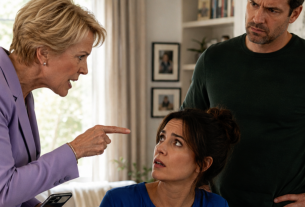
Yulia answered the door. Standing there was Zoya Borisovna in a beige trench coat. Behind her was Veronika in a short jacket, clutching her phone. Her mother-in-law had a plastic folder under her arm.
«Hello, Yulechka. We’re here to see you. May we come in?»
They came into the kitchen. Anton was already there, sitting at the table. Yulia glanced at him. Anton looked up but immediately looked away, out the window, rolling the salt shaker between his fingers.
Yulia got it. He knew. He was expecting them.
Zoya Borisovna sat at the table, opened her folder, and pulled out some papers. Printouts from a real estate website. In color, with photos.
«Here, Yulechka, take a look.» Her mother-in-law spread the pages out like playing cards. «A one-bedroom on Severnaya. Three point eight million. A studio on Lenina, three point two. This one’s the best, on Sadovaya, thirty-eight square meters, recently renovated, four point one. Veronika likes it.»
Veronika nodded, her eyes still on her phone.
«Zoya Borisovna. Why are you showing me these?»
Her mother-in-law looked at her as if Yulia were a slow student.
«Why do you ask? We already decided! We’re selling your parents’ dacha, adding some money, and buying my daughter an apartment! It’ll all stay in the family!» She cheerfully slapped her palm on the stack of listings. «Oops, I mean my granddaughter. Veronika. You know what I mean. The dacha is worth two million two hundred thousand, I checked with the realtor. We’ll top it up with around eight hundred thousand from your and Anton’s savings. Plus, Veronika can get a small mortgage. Then the girl will finally have a place of her own.»
Continued in the comments.
Yulia stood by the stove. She looked at her husband. Anton was fiddling with the salt shaker.
«We decided?» Yulia repeated. «Who’s ‘we’?»
«Well, us. The family. Me, Anton.»
«Without me.»
«But you’re not against it, Yulichka. You love Veronika like your own.»
Yulia set her cup down on the table.
«Zoya Borisovna. No.»
Her mother-in-law froze, still holding the ad in her hand.
«What do you mean, no?»
«No. I’m not selling the dacha. And I’m not buying Veronika an apartment. The dacha was inherited from my parents. By law, it’s mine. Only mine. Neither Anton, nor you, nor Veronika have any claim to it. My dad spent three summers building that floor. My mom planted the apple trees. I won’t sell it for Veronika’s apartment.»
A hush fell over the kitchen. The refrigerator hummed.
Zoya Borisovna flushed red.
«So that’s it. Greed. I always knew it. Always!» She turned to her son. «Anton, do you hear? Your wife is greedy! She couldn’t spare anything for the girl—your own daughter! Twelve years in this family and not once did she do anything for Veronika!»
Suddenly Veronika put down her phone. Her lips quivered. She covered her face with her hands and began to cry—loudly, dramatically, with sobs.
«I knew it…» she sobbed through her tears. «I was never important to her… I’m just a stranger to her…»
Anton finally stood up.
«Yulia. Stop. Look what you’ve done. Veronika is crying. She’s my daughter. You should respect her.»
«Anton, I do respect her. But I’m not obliged to give her my parents’ inheritance.»
«You are!» Anton slammed his palm on the table. «We’re family! I have one daughter. One! We have no children together and never will. That means Veronika is yours, too!»
Yulia looked at the three of them. Her mother-in-law with the printouts. Veronika, crying into her hands. Anton, standing over the table. And suddenly she felt like a complete outsider. In her own kitchen. In the apartment she’d bought with her parents’ three hundred thousand. Surrounded by people she had considered family for twelve years.
They came to divide up her mother’s apple trees. And her husband had brought them himself.
«Anton,» she said quietly. «You knew they were coming. You knew why.»
He didn’t answer.
The weeks that followed turned into a war. Silent, relentless, draining.
Every evening, Anton came home from work and started in right from the hallway:
«Yulia, have you thought about it?»
«Anton, I said no.»
«Just think about it again. Veronika is my daughter. Forever. Do you understand? Wives can be replaced, but I have just one daughter.»
Yulia froze with a plate in her hands.
«Wives can be replaced?»
«That’s not what I meant. You know what I mean.»
She understood.
A few days later:
«Yulia, why do you even need that dacha? You go there once a month. The house is old. The roof leaks. You have to pay tax. And Veronika has nowhere to live.»
«Anton, those are my mother’s apple trees. That’s my father’s floor.»
«Apple trees, the floor…» Anton grimaced. «Yulia, these are just sentimental things. Meaningless sentiment. Old boards and trees. The dead don’t need it anymore. The living do.»
Yulia placed the plate in the dish rack and wiped her hands.
«Anton. You spent twelve years in the sauna with my dad. Do you remember that?»
«So what?»
«He fixed your car. For two weeks. For free. Mom gave you homemade jam every summer. You always said your mother-in-law was golden. They gave us three hundred thousand for this apartment. Everything they had. Do you remember any of that?»
Anton shrugged.
«Yeah, I remember. They helped. So what? That was a long time ago. Your dad isn’t family to me, Yulia. But Veronika is.»
Yulia looked at her husband.
Her parents had helped him for twelve years. He accepted the help, praised his mother-in-law, enjoyed the sauna with his father-in-law, ate their currant jam. Now they were gone, and all that was left were «not family» and «meaningless sentiment.» The gratitude he owed them—he wanted to turn it into an apartment for his daughter. At her expense.
In mid-October, on a Friday, Yulia came home from work, silently packed a bag, and left for the dacha.
She caught the last commuter train, then walked forty minutes from the station in the dark. Her house key was on the ring. She opened the door, turned on the light, lit the stove. She lay down on her mom’s bed in the small room, under her mother’s quilt.
And she slept for eleven hours. For the first time in a month.
She woke up with sunlight streaming through the window. Outside, apple tree leaves were falling in the garden. It was peaceful. Only thrushes chattered in the rowan tree.
In the morning, Pyotr Semyonovich arrived with a jar of milk.
«Yulka, why are you here alone? Where’s Anton?»
«At home, Pyotr Semyonovich.»
He looked at her carefully, didn’t ask anything. He set the jar on the table and left.
Anton came on Saturday at noon. He drove his car, walked through the gate without greeting, and headed to the porch. Yulia sat on the steps with a cup of tea.
«Yulia, what are you doing? You left without saying a word.»
«I needed some time alone.»
«Okay. You’ve had your time.» He sat down beside her on the steps. «Yul. Let’s settle this. Mom found a buyer through a realtor. Two million two hundred, just like we said. He’s ready in November. All you have to do is sign, that’s it. Then we’ll make peace. Everything will be like before.»
Yulia gazed at the garden. At the apple trees her mother had planted. At the path her father had laid.
«Anton, you came here for my signature.»
«Well… not just for that.»
«You didn’t ask how I was. You didn’t ask why I left. You just showed up and said there’s a buyer.»
Anton stood up.
«Yulia, enough with the drama. I’m telling you what’s best for the family.»
And that’s when Yulia understood. Calmly, finally, while sitting on the porch steps her father painted every spring. The family Anton spoke about no longer existed. Maybe it never did. There was Zoya Borisovna, there was Veronika, there was Anton. But her parents, her home, her apple trees—they were just money to them.
«Anton. Leave.»
«What?»
«Leave. I’m going to file for divorce.»
He stared at her for a long time. Then he laughed.
«Are you serious? Because of the dacha?»
«Not because of the dacha. Because of ‘meaningless sentiment.’ Because of ‘your dad isn’t family to me.'»
«Fine, go ahead. But listen, I’ll make this a court case you’ll run around for years. It’ll take ten lawyers to split the apartment. You’ll regret it.»
He left, slamming the gate behind him.
On Monday, Yulia filed for divorce and initiated a lawsuit to divide the apartment.
Anton kept threatening her for another month. He called, texted, said he’d find a good lawyer, that he could prove he invested more, that Yulia wouldn’t get anything. Then he finally met with a lawyer. The lawyer, after seemingly checking the property records, explained to Anton that the apartment was registered in equal shares. Half each. There was no basis for Anton to demand more.
Anton went quiet.
They sold the apartment in March. Yulia received three million one hundred thousand.
Zoya Borisovna called once, in February.
«Yulia. Do you realize what you’ve done? You’ve left our Antosha without a home. Now he’s living with me in my little one-bedroom, sleeping on a fold-out bed. And Veronika still has just her room.»
«Zoya Borisovna. Anton has his half of the apartment. He can buy himself something.»
«With three? You can’t get anything decent for three these days!»
Yulia hung up the phone.
A week later, she got a message from an unknown number.
«Yulia, it’s Veronika. I wanted to say… The idea about the dacha was Grandma’s. I didn’t want it. I mean, yes, I wanted the apartment, but not like this. Grandma had already told me you’d agree—that Dad would talk you into it. When you all gathered in the kitchen, I panicked and cried. I’m sorry. I’m ashamed.»
Yulia read the message twice. She replied: «Thank you for writing.» Nothing more.
After the divorce, she thought about the dacha a lot. Going there alone every weekend felt heavy. Two hours each way. The roof over the veranda was leaking and needed to be replaced. The stove smoked. Pyotr Semyonovich said the foundation under the sauna was shifting.
And then, one day in April, sitting on her mother’s porch, Yulia suddenly realized: her father hadn’t built the dacha just to let it fall apart. «We’re building this for you, Yulka. So you’ll always have a place to come back to.» For her to have something of her own. Her own corner. Her own place.
She needed something of her own. Not a dacha two hours away, slowly falling to pieces. A home she could return to every evening. Somewhere no one would split her parents into ‘family’ and ‘not family.’
She decided to sell. On her own. Not for Veronika. Not for Zoya Borisovna. For herself. To good people. So the house would live on.
«Yulia,» Nastya stood in the middle of the garden with Matvey in her arms. The boy was clutching a bucket full of dirt and two earthworms. «We’ll take it. If you agree.»
Kirill walked over and stood beside them.
«I won’t touch the floor,» he said. «Promise. Not a single board. It’s better than anything I could put in.»
«What about the apple trees?» Yulia asked.
«We won’t touch those either,» Nastya said. «Matvey already said he’s going to climb that one—the crooked one.»
«That’s an Antonovka,» Yulia said. «My mom planted it the year I graduated from university. It’s the strongest.»
Over the fence, Pyotr Semyonovich raised his cap.
«Yulka. Selling after all?»
«I’m selling, Pyotr Semyonovich.»
He looked at Kirill, at Nastya, at Matvey with his bucket. He was silent for a moment.
«Well, that’s right. Your father would have understood. He built it so you’d be happy. Not so you’d be here alone on weekends, cleaning up. If you need anything, Kirill, I’m here. I’ll help with the well. We dug it with your father, after all.»
They finalized the deal at the end of May. Two million two hundred. Kirill and Nastya moved out to the dacha for the whole summer.
Before handing over the keys, Yulia took down the old blue-striped towel from its hook in the bathhouse. Antonovo. She folded it, put it in a bag, and later tossed it in the container by the station.
From the house, she took her mother’s quilted blanket, her father’s wood planer, and three jars of blackcurrant jam from the cellar. The last ones. Her mother’s.
Five million three hundred. Half the apartment and the dacha. With this money, Yulia bought herself a one-bedroom in June. Not a new build. An old place, in a brick building with thick walls, on the third floor. High ceilings and wooden floors. Herringbone parquet, worn in places. The first thing she checked when she came to view the apartment: did it creak?
It didn’t creak.
Anton found out about the purchase in July. From Veronika, whom Yulia, not even sure why, texted briefly to say she had moved. Anton called that evening.
«Yulia. Did you buy an apartment? By yourself? For the dacha?»
«With my half and the dacha. Yes.»
«And you didn’t tell me.»
«Was I supposed to, Anton?»
There was silence on his end of the line.
«Well… We were together for twelve years…»
«Yes, Anton. Twelve. Goodbye.»
She set her phone down on the windowsill.
In the evening, after work, Yulia climbed up to her third floor. She carried a shopping bag—bread, milk, cheese. She unlocked her door with her own key, stepped into the hallway, slipped off her shoes and stood barefoot on the parquet. Warm, wooden, quiet.
Then she closed the door behind her and turned the lock. She stood in the hallway and listened.
The apartment was silent. No one was spreading other people’s mail across the kitchen table.
Yulia went to the kitchen, put the kettle on, and opened a jar of her mother’s blackcurrant jam.