«How many people in your party?» the girl at the entrance asked, already reaching for two menus.
«Just one,» replied Tamara Fedorivna.
She was surprised at how steady her voice sounded. At home, while getting ready, she’d practiced this phrase several times in front of the hallway mirror, and each time her voice would falter, as if apologizing. But now it came out calm. For one. As if this was how it should be.
The girl placed the extra menu back on the stand, smiled, and led her through the dining room.
Tamara Fedorivna was sixty-three. She’d spent forty years by the stove: first at the train station buffet in her home district, then in a factory canteen, and for the last fifteen years in a school cafeteria—where the kids just called her ‘Aunt Toma,’ knowing she’d always have an extra cutlet for anyone who needed it.
She could tell with her eyes closed if the borscht in a forty-liter pot was salted just right, and could judge—just by the sound—exactly when it was time to flip the syrniki.
But sitting at a table while someone else brought her a plate? That was something she’d barely ever learned.
She’d known about this restaurant for years. She was twenty-two when she arrived in the regional capital for chef training courses, passing the big windows on the corner by the chestnut-lined boulevard every morning. Behind the glass sat tables with crisp white tablecloths, a candle in a low glass on each, and the napkins folded into perfect fans.
One day, she stopped to check how much a cup of coffee cost there. Turned out, it was as much as her lunches for an entire week. Even then, Tamara promised herself: someday. Not now, but someday, for sure.
That ‘someday’ stretched out for forty-one years.
* * *
She’d been setting money aside for two years, a few hundred hryvnias from each pension payment, stuffing it into a paper envelope hidden in her closet under a stack of towels. On the eve of her birthday, she told herself: enough waiting.
The first person she called was her daughter.
«Irochka, come to the restaurant with me. My treat.»
«Mom, I’d love to, but I have a report due Friday. I’m basically living at work right now. Let’s do it another time, okay?»
Her son Andriy happened to be installing new floors in his apartment, speaking with his phone cradled between his shoulder and ear:
«Mom, the contractor can only come on Saturday. If I let him go now, he won’t be back before New Year. You understand, right?»
She understood. She’d always understood everyone.
Her friend Valentyna—who’d worked with her for twenty years in the same kitchen—listened and laughed:
«Tamara, are you really going to a restaurant by yourself? People will think you have nobody to go with!»
«But I do have nobody,» Tamara Fedorivna replied calmly. «That’s exactly why I’m going alone.»
That evening, she sat in the kitchen for a long time, looking at the envelope. Then she spoke aloud, though she was the only one in the apartment:
«I spent forty years feeding everyone who came. Isn’t it okay—just once—for someone to feed me?»
And she went to iron her best blue suit.
On the train, by habit, she pulled a container of pirozhki from her bag—then laughed at herself. Heading to a restaurant, but bringing her own pastries. She offered some to the conductor and the student sitting across from her, but didn’t eat any herself. She was saving her appetite.
Outside, the fields were soaked and yellow maples shone in the groves. October had been rainy, and when she arrived in the regional center, a mist greeted her, making her hair damp underneath her beret.
* * *
They gave her a small table right by the window. The glass was a bit foggy, and wet chestnut leaves covered the cobblestones outside. A candle in a short glass burned just like it had forty years ago. Tamara Fedorivna ran her hand across the tablecloth. Stiff and starched, just as it should be. Only then did she truly believe she was sitting here.
She studied the menu for a long time, the same way she used to pore over technical charts. «Confit,» «tartare,» «beurre blanc»: half the words she was hearing for the first time, even though she’d spent her whole life working with food. The waiter, a young man with a neat beard, waited patiently.
«You know what, son,» she finally said, closing the menu. «Bring me something I’ve never cooked even once in forty years. Not at the cafeteria, and not at home.»
«And what did you cook?» he clarified gently.
«It’s easier to say what I didn’t cook.»
Someone at the neighboring table snorted loudly. Tamara Fedorivna turned around. A gray-haired man in a plaid shirt with rolled-up sleeves was trying to discreetly pull out a napkin he’d tucked into his collar earlier.
«Sorry, ma’am,» he said, awkwardly crumpling the napkin in his fist. «I wasn’t eavesdropping—it just happened to catch my ear. You know, I’ve spent twenty years looking for a dish I couldn’t mess up. Haven’t found one yet.»
«Then order water,» she advised, without even blinking. «Just make sure it’s not boiled. It might burn, too.»
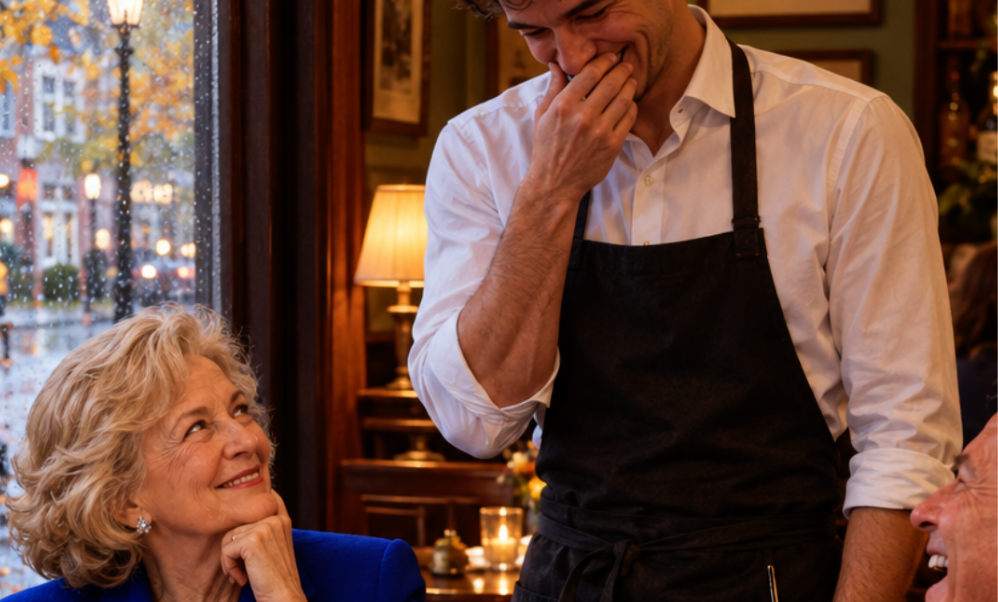
The waiter turned away so he wouldn’t laugh out loud. But the man let out a hearty laugh that filled the whole room, making a couple at a distant table look up from their phones.
«My name’s Mykola,» he introduced himself, rising slightly. «Lukyianovych, if you want the full. Worked thirty-five years as a train engineer.»
«Tamara Fedorivna. Forty years at the stove.»
«Looks like we’re colleagues,» he said seriously. «I used to carry people, and you used to feed them. Without the both of us, no one would get anywhere.»
They chatted across the aisle for about ten minutes. Then Mykola Lukyianovych picked up his glass of fruit drink and asked:
«May I sit with you? Because shouting across the hall seems a bit much, and I don’t want to stop talking now.»
She thought for a second and nodded toward the empty chair.
* * *
It turned out, he had driven trains through her district center back in the ’80s.
«You used to have a buffet at your station,» he recalled. «Right next to the ticket office. They sold cabbage pies there—so good my assistant and I would stretch our stop by two minutes just to get some. The pastry was thin, packed with cabbage, and seasoned with caraway.»
Tamara Fedorivna put down her fork.
«With caraway,» she repeated. «Because my mother always added caraway.»
«No way,» he said slowly.
«I baked those there for seven years. Every morning, starting at five.»
Mykola Lukyianovych gazed at her for a long time, then shook his head and laughed:
«Forty years have passed, and I still remember how they smelled. And you say you can’t cook when someone feeds you. You already fed me back then—I just didn’t know who to thank.»
She was served duck breast with roasted pear. The sauce was dark and thick, and Tamara Fyodorivna immediately detected cherry and honey in it. There was something else, a third flavor she just couldn’t identify. She chewed slowly, eyes half-closed, while Mykola Lukyanovych watched her with the rapt attention of someone witnessing a theatrical performance.
«Well?» he couldn’t hold back.
«Don’t interrupt. I won’t say until I figure it out.»
Meanwhile, his steak—ordered well-done and «simple, no frills»—arrived. The chef had still added a dollop of green foam on top, and Mykola Lukyanovych cautiously slid it to the edge of his plate with his knife, just like clearing snow off a windshield.
«Rosemary,» Tamara Fyodorivna finally announced.
A waiter who happened to be passing by stopped and nodded in surprise.
Their conversation wandered everywhere. They talked about how children swap their juice at the school cafeteria. They discussed how, in the fog, every signal light along the tracks seems closer than it actually is. He shared that his wife had passed away six years ago, and since then, he usually ate dinner standing by the open fridge. His daughter and grandchildren live abroad and call every Sunday. His son works shifts, and today happens to be one of his.
«Today is my birthday,» he said a little awkwardly. «Sixty-six. This morning, I was sitting in front of the TV with a store-bought cake, thinking: so is this how it’s going to be? I shaved, put on this shirt, and took the first train.»
«Oh wow,» Tamara Fyodorivna said quietly. «It’s my birthday today, too.»
«What do you mean, too?»
«Birthday. Sixty-three.»
They both fell silent. Then Mykola Lukyanovych raised his glass of berry drink, she raised hers, and they toasted so gently, as if afraid something might break.
* * *
When Tamara Fyodorivna returned from the ladies’ room, dessert was already on the table. Cherry strudel with a scoop of vanilla ice cream, a thin candle in the middle, and two spoons set atop a napkin.
She stopped by her chair.
«Please don’t be upset,» Mykola Lukyanovych said quickly. «I thought: what kind of celebration would it be if dessert was only for one? I haven’t eaten sweets in six years. They just don’t taste right when there’s no one to share them with. But today, it seems, I have someone.»
«But I reserved a table for just one person,» she replied—and, for some reason, felt herself blushing like when she was twenty-two.
«But dessert was brought for two,» he smiled. «Maybe the kitchen staff knows best.»
Together, they blew out the candle.
Afterward, he walked her to the station, holding the umbrella over her so carefully that he was half-soaked himself. On the platform, Tamara Fyodorivna took out her ticket, scribbled her phone number on the back, and handed it to him.
«Forty years working around stations,» Mykola Lukyanovych said as he carefully tucked the ticket into his shirt pocket. «But I’ve never had a ticket like this before.»
* * *
He called the very next evening, right at nine. And then he called every evening at nine, as punctual as if he set his watch by it. He’d ask how much water to add to his buckwheat because it always turned out either undercooked or mushy. Tamara Fyodorivna would give him instructions, he’d write them down, and the next evening he’d report back: «It burned again, but less than yesterday.»
He could spend half an hour talking about switches and semaphores, and she could go on about the right way to stew cabbage, and they both listened as if there was nothing more interesting in the whole world.
In mid-November, when the puddles already had a thin layer of ice in the mornings, Tamara Fedorivna was standing on the platform of her small town’s station. She was wearing the same blue suit under her coat. Her phone rang.
«Mom, where are you? It’s so noisy there.»
«At the station, dear.»
«Going to that restaurant again?» Irina’s voice had a hint of envy.
«No, Irochka. This time, the restaurant is coming to me. By train at seven forty. And its name is Mykola.»
The phone got so quiet that Tamara Fedorivna could hear her daughter set her cup down on the table.
«Mom… Who is this Mykola?»
«Come on Sunday and you’ll meet him. There’ll be enough borscht for everyone.»
The train arrived with a long sigh of its brakes. Mykola Lukyanovych was the first to step off, even though his carriage wasn’t at the front—he must have been standing by the door since the previous station. In his hands, he held a box tied with a ribbon.
«Strudel,» he said instead of hello. «From that same restaurant. I barely convinced them to pack it up. I won’t eat it myself, you know that.»
«I know,» she said, taking his arm.
At home, two plates were already set on the table, with two spoons beside them. Tamara Fedorivna had put them out in the morning, and spent the whole day passing the table and smiling, like a girl waiting for her very first date.