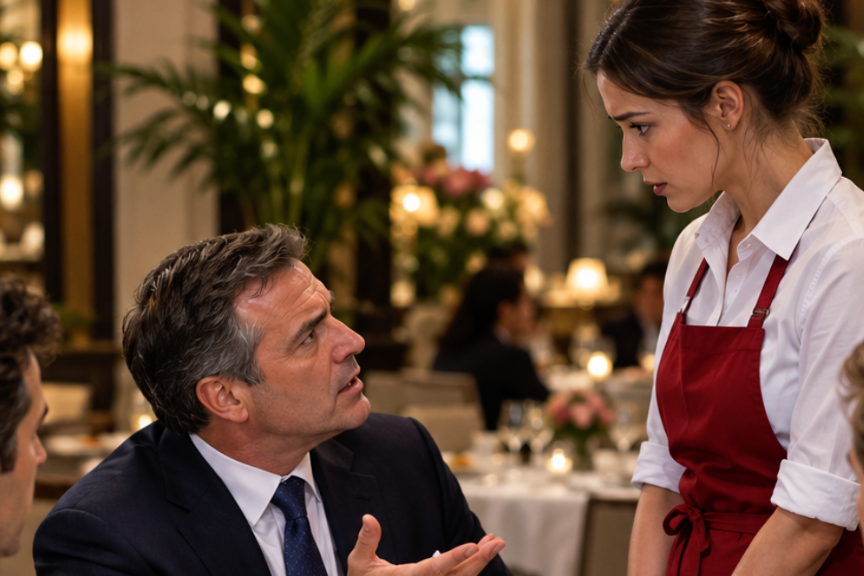
The name cards on the table weren’t where they had been left that morning. Nadya noticed this when she brought water into the separate room and saw that the translator’s seat had been pushed right to the edge, while the «Tanaka» card was now next to the chair Vadim Sergeevich had chosen for himself.
There were just fifteen minutes left before the guests arrived.
«I moved them,» he said without turning around. «It’s more comfortable this way. I need to sit next to Tanaka.»
Nadya straightened the tablecloth next to another place setting and stayed silent. That morning, the Japanese delegation’s assistant had sent a seating plan. The administrator had printed it and asked the staff not to change anything unless absolutely necessary. But Vadim Sergeevich was the host of the dinner, had paid for the private room, and had already reminded the manager of that—twice.
«And take the vase away from here. It’s blocking the view.»
Nadya took the vase to the service table. Behind her, the businessman switched from Russian to Japanese while talking on the phone. His language skills were decent: basic phrases, polite expressions, and a few obviously memorized business terms.
She had to pause for a second at the counter—the intonation was unmistakably familiar. Then Nadya set the vase down and went to get the cutlery.
Hardly anyone at the restaurant remembered that she spoke Japanese. On her job application, it was listed in just one line. It used to matter: seven years at a logistics firm, emailing port agents, meetings with Japanese partners, paperwork, phone calls. Then the department closed, some people were laid off, others transferred to another city. Nadya chose not to move.
At first, she thought she’d find a similar job in a month. That month stretched into almost four. Money was running out, her landlord raised the rent, and Nadya ended up working at the restaurant inside the hotel. She told herself it was «temporary» for the first few weeks, but after a while, stopped saying it.
She didn’t like her job, but it didn’t humiliate her—just wore her down. Eight hours on her feet could easily become ten if there was a banquet. By evening, her legs throbbed, and sometimes guests would talk as if a waitress uniform erased your education, your previous career, and your entire life before this shift.
Everyone on staff knew Vadim Sergeevich. He didn’t come every day, but he was there often enough that the administrators’ voices changed when they heard his name. In this city, he owned warehouses, a share in a transport company, and a few other businesses. People called him an oligarch behind his back, though the restaurant never got involved in such talks: good bills, regular business meetings, never any debts.
Still, he could surprise you by leaving a generous tip for a cleaning lady he saw struggling alone with heavy boxes in the hallway. Once, he paid for a taxi for the elderly cloakroom attendant after a late banquet. And just a week later, he’d scold a young waiter for approaching from the left side.
She’d stopped trying to neatly sort people into categories a long time ago.
The Japanese delegation arrived right at seven o’clock. There was Mr. Tanaka, his assistant, another staff member, and a translator. Everyone greeted each other, exchanged business cards, and spent a few minutes on the usual business introductions. Vadim Sergeyevich immediately started speaking in Japanese, and the translator—a man in his forties with neatly stacked papers on his lap—didn’t intervene at first.
The first two lines of the conversation went smoothly. On the third, Vadim Sergeyevich stumbled, switched to a Russian word, and laughed.
Mr. Tanaka smiled politely.
Meanwhile, Nadezhda was putting water on to boil. It was easy to tell he wanted to make a joke about the weather but mixed up two similar words. She definitely wasn’t going to correct him.
The first hiccup came with the appetizers. Although the menu was agreed on in advance, just before dinner Mr. Tanaka’s assistant quietly asked through the translator that one of the sauces be served separately.
Nadezhda nodded at the request and was headed to the door when Vadim Sergeyevich stopped her:
“What else is there?”
The translator explained.
“Just serve it as is,” he brushed it off. “It’s not a big deal.”
“But the guest asked for it separately,” Nadezhda responded.
He looked at her without anger, more with a kind of exasperated surprise.
“Miss, I heard. Bring it as we agreed with the kitchen, let’s not complicate things.”
Mr. Tanaka didn’t get involved. His assistant glanced at the translator, who just shrugged slightly.
But the kitchen got the request anyway. Not out of principle—just because it was a simple ask, and fixing it later would have taken even longer.
A few minutes later, the dishes were served. The sauce was presented separately.
Vadim Sergeyevich didn’t say a word.
At the table, the conversation was about the warehouse, delivery deadlines, and various agreements that Nadezhda neither understood nor had any desire to. She only approached the table when it was time to swap plates or serve the next dish.
But she kept hearing Japanese spoken constantly.
At first, the businessman spoke through the translator. Later, as the conversation became simpler, he switched back to Japanese, sometimes successfully, sometimes mixing formal and casual speech. Mr. Tanaka replied in brief, friendly answers.
About half an hour in, Vadim Sergeyevich asked in Japanese if the guests liked the restaurant, then nodded in Nadezhda’s direction and added:
“The staff here is very serious. It’s like they’re giving an exam.”
It wasn’t meant as an insult—more of a joke, though not a particularly good one.
Hearing this, Nadezhda pretended to be busy with the plates.
Mr. Tanaka didn’t laugh. He simply made a remark about the beautiful view from the window.
The translator only shared Mr. Tanaka’s response.
A little later, Nadezhda had to come to the table earlier than usual. The kitchen had warned her that one guest’s main course would be delayed about seven minutes because the chef was redoing the side dish as requested before dinner.
“Serve the others,” said Vadim Sergeyevich.
“They asked for everything to be served at the same time.”
“Who is ‘they’?”
“Mr. Tanaka’s assistant. Through the translator.”
The businessman sighed and set his phone down next to his plate.
“Listen, this is a meeting. If we have to discuss every little thing, we’ll be here until midnight. Just serve the food.”
Nadezhda didn’t rush to respond. Here, she wasn’t being too smart: instead of just calling the manager, she decided to stand her ground about the correct serving order.
«Seven minutes won’t make a difference. The kitchen will finish, and we’ll serve everything together.»
«I said bring it out now.»
His voice didn’t get louder, which actually made his words come across even more unpleasantly.
The translator was focused on his papers. Tanaka’s assistant was flipping through the menu, even though he’d obviously already read it all.
In the hallway, Nadezhda ran into the manager, Timofey.
«They’re holding up the main course,» she said. «He’s insisting it be brought out in parts.»
«Serve it the way the host at the table asks.»
«But the guests wanted everything at once.»
Timofey closed his reservation folder.
«Nadya, don’t start. We’ve got twenty-two people in the main hall and two groups upstairs. Seven minutes won’t change anything.»
Nadezhda smirked in response.
«Very funny.»
«I’m not joking. If there are complaints later, we’ll just let the kitchen know why we did it this way.»
This time, Nadezhda didn’t argue.
The main course started getting served, minus the delayed dish. Tanaka-san glanced at the empty spot in front of his assistant and asked something. The translator explained the reason. The guest nodded and didn’t complain.
After serving, Nadezhda felt a little awkward. Half of the scene in the hallway could have been avoided.
When the last dish was finally brought out, Vadim Sergeevich looked at her as if to silently remind her he was right, but he didn’t say anything.
The conversation at the table gradually moved away from work. Tanaka-san asked about the city, then about the weather in October. Vadim Sergeevich started speaking Japanese again, clearly getting more animated. He enjoyed the effect of managing without a translator, even just for a couple of minutes.
Nadezhda came up to collect the plates right as he was telling a fishing story. He used the wrong verb, ending up saying something like «caught a boat» instead of «fished from a boat.» The investor’s assistant smiled just a little.
Nadezhda could barely keep from smiling too.
Not because she was worried about giving herself away. It was just that the person at the table already had enough listeners.
Before dessert, the translator stepped away to take a call—just for a couple of minutes. Vadim Sergeevich continued the conversation himself, a little more slowly now. Tanaka-san replied with short phrases.
Then he pointed at a menu card and asked about lunch the next day. Nearby, Nadezhda was clearing empty cups from the serving table. They were talking about vegetables: could they be prepared without sauce, since the previous version seemed too salty.
Vadim Sergeevich didn’t catch the first word and turned toward the door, waiting for the translator.
At that moment, the translator returned.
«Mr. Tanaka is asking…» he began in Russian.
Vadim Sergeevich waved a hand toward Nadezhda and grunted in Japanese:
«She doesn’t understand anyway.»
The phrase sounded matter-of-fact. Not as an insult, just a statement of what was obvious to him.
She could have waited for the translation. That probably would have been wiser.
But all evening, Nadezhda had held her tongue too many times, even when she understood every word.
She turned to Tanaka-san, ready to answer in Japanese:
— Of course. I’ll let the kitchen know to prepare the vegetables separately and without sauce. It’s best to mention this ahead of time, about ten minutes in advance.
The translator stopped mid-sentence.
The investor’s assistant looked up.
Vadim Sergeevich first glanced at Tanaka, then at Nadezhda.
— Do you speak Japanese? he asked in Russian.
— Yes.
— For long?
— Long enough.
— And you couldn’t have mentioned this before?
Nadezhda placed a cup in front of Mr. Tanaka and adjusted the spoon.
— You never asked.
The translator lowered his gaze. This time it was clear he was hiding a smile.
Mr. Tanaka then asked Nadezhda another question—where she learned the language. Her answer was brief: university, then work with Japanese companies in Vladivostok.
He clarified which industry. Upon hearing ‘logistics,’ he nodded.
There were no rounds of applause, no surprised exclamations, no enthusiastic job offers. Within a minute, the conversation turned back to tomorrow’s meeting.
And that, in fact, was the easiest outcome for Nadezhda.
Vadim Sergeevich was silent for almost ten minutes, then asked for the administrator to be called.
Timofey arrived quickly. The entrepreneur leaned over to him and spoke quietly, though Nadezhda was close enough to hear:
— Let another waiter handle the rest.
— Is something wrong?
— Just want someone else.
Timofey had already turned toward Nadezhda when Mr. Tanaka addressed the translator.
The translator listened and relayed:
— Mr. Tanaka says there’s no need to change staff. He’s fully satisfied.
Vadim Sergeevich pressed his lips together.
— Alright. Don’t change.
He didn’t apologize. Nadezhda hadn’t expected him to anyway.
The rest of the hour went more smoothly. The entrepreneur barely used Japanese without the translator, but suddenly became much more careful with his phrasing. Once, he even asked Nadezhda if he pronounced a dish’s name correctly.
She answered honestly:
— Almost. The stress is in the wrong place.
He looked at her and then laughed.
— Well, at least someone corrected me this time.
It was the first normal sentence directed at her all evening.
After dinner, the guests lingered near the coat check. Tanaka’s assistant returned to the hostess stand and asked for a business card. Then he asked for the waitress’s name.
Timofey wrote: «Nadezhda.»
— Are they going to write a complaint? she asked when the door closed behind the delegation.
— Quite the opposite. They said they want the same table and, if possible, you for the next dinner.
In the staff room, Nadezhda took off her apron and placed it in her locker.
— Great. That means home after eleven, again.
Timofey looked at her.
— Are you serious right now?
— Absolutely.
He laughed, but then finally asked:
— Why did you keep quiet about the language? I saw your file, but totally forgot.
— Everyone forgot.
— You could have reminded us.
Nadezhda closed her locker door.
— Why bother? They don’t pay extra for Japanese here.
A week later, the delegation really did come back. The reservation was for the same dining room, but this time made under Tanaka’s assistant’s name. Vadim Sergeevich was not on the guest list.
She discovered this when checking the seating chart before her shift. She drew no conclusions—businesspeople change meetings for a dozen reasons, most of which waiters never hear about.
Timofey simply said:
«This time, don’t touch the cards—they sent everything themselves.»
«I didn’t touch them last time either.»
«That’s right.»
He left to greet the guests.
Before dinner started, the translator recognized Nadezhda and was the first to greet her in Japanese. She replied, placed the water on the table, and returned to the door.
The evening went smoothly with no surprises. When Tanaka-san requested vegetables without sauce, the translator didn’t even have a chance to repeat the request in Russian.
Nadezhda was already writing the request down for the kitchen.