Liza hadn’t spoken to her brother in over seven years. It all started because of the apartment: when Andrey got married, their mother sold a gorgeous two-bedroom in the city center, gave half the money to him, and used the other half to buy a tiny flat on the outskirts. The place wasn’t convenient, and the apartment was minuscule—but what won’t a mother do for her beloved son.
“Don’t worry, Liza,” her mother would say. “I’ll make sure this apartment is written into my will for you.”
But Mother never got around to making the will. By then, her brother had already used the money for a mortgage and had two kids. Liza had been friends with his wife, Dasha—they’d known each other since childhood, took dance classes together, even spent a summer at camp side by side. Liza really liked Dasha’s level head; she thought Dasha was a good influence on her wayward brother. But it turned out Dasha was even more calculating than Liza ever imagined. On Dasha’s advice, her brother declared there was no will, so the apartment should be split evenly.
I won’t abandon them!
“What do you mean, split it evenly? Andrey, have you forgotten our agreement? Mom already gave you your share of the money,” Liza protested.
“That’s just what you think,” he shot back. “Mom just wanted to help me out—I have a family now. And you’re alone anyway, so what difference does it make to you?”
Liza went to see Dasha hoping she could talk some sense into Andrey, but it turned out they were on the same team.
“We have two kids, we need more space. How can we live in a one-bedroom—seriously? And you’re alone, have a good job. What more do you need?” Dasha said.
A friend suggested Liza take the case to court, where she might be able to prove she and her mother had a verbal agreement, but Liza refused to sue her own brother. She just stopped speaking to him—and Dasha, of course.
Through mutual friends, Liza heard that her brother bought a bigger apartment, also on a mortgage. Then, two years later, he suddenly left Dasha, leaving her with the apartment and their sons. Dasha called Liza herself, hoping she’d help her bring Andrey back, but Liza replied:
“I don’t want to hear anything about Andrey or you.”
“At least think about your nephews!” Dasha pleaded. “What did they ever do to you?”
“You two should have thought of them before you stole half my apartment,” Liza shot back. “You reap what you sow, remember?”
Rumor had it her brother had moved in with some girl from a village—he quit his good job. They said he now had twins with her, but Liza didn’t know for sure. She didn’t want to know. Why should she care?
When Liza got a call from an unfamiliar woman, who said she was a distant relative of Andrey’s new wife, Liza didn’t even want to listen. The woman sobbed about poor children and a looming deadline. Liza tried as hard as she could to block it out, but couldn’t. After a sleepless night, she called the woman back in the morning.
“What happened to my brother?”
“He’s in jail—for robbery.”
“And what about his wife?”
“She’s been gone a year. Died in a fire at the bathhouse.”
That’s all she needed…
“So where are the kids?”
“The authorities are trying to push them on me, but I can’t—I have three of my own already. Maybe you could take them?”
“We’ll see…”
Lisa had never been to a village before, and when she arrived, everything seemed so strange—she couldn’t understand how her brother traded his old life for this. The woman who called Lisa met her by the bus and led her to the house. It was unremarkable, sunken into the earth with age, a smoky pipe on the roof, and a shattered window patched up with something white.
Inside, Lisa saw two children—a girl and a boy about three or four years old, dark-eyed like Andrei, both wary. They huddled together like shivering puppies, saying nothing. Both wore grubby, ill-fitting clothes. The boy’s dirty toe poked out from a hole in his sock.
«Pasha and Irochka,» the woman introduced them. «Aren’t they sweet? Don’t mind that they’re quiet—they understand everything, they just don’t want to talk, the little scamps.»
It sounded like she was selling goods at a store. Lisa looked at the children and remembered herself and Andrei as kids, tears welling up in her eyes.
«Where are their documents?» Lisa asked, swallowing the lump in her throat. «Do they have birth certificates? And what about guardianship?»
The woman began rushing around the house, rummaging through an old nightstand.
«Oh dear, the whole place is a mess. Ever since Nadya died, the police came and took some papers. Then the authorities came, and I promised to handle the guardianship papers for the kids—they’re family, after all—but how can I manage two? One, maybe, but two… You should go see them, there’s Aunt Lyuba there, she’s nice and easy to talk to. Ah, here, I found the documents, look!»
She pulled out a worn-out bag. Inside were two crumpled birth certificates, stained with grease.
«And where are their things?» Lisa glanced around at the shabby room. «We need to pack at least something.»
The relative shrugged helplessly:
«They don’t have anything, dear. Maybe a couple tops, a pair of pants. I’ve given them whatever I had, though it’s all old, and I’m barely scraping by myself…»
While Aunt Zina searched for «tops,» Lisa crouched down in front of the kids. They shrank back, and the girl, Irochka, blinked rapidly, ready to cry.
«Don’t be afraid,» Lisa said as gently as she could. «I’m your aunt. Aunt Lisa. I won’t hurt you. Will you come with me? My home is warm, and I have tasty food.»
Pasha glanced up at her from under his brow and hugged his sister even tighter.
Dealing with the guardianship went smoothly—Lisa was allowed to take the children now, with paperwork to follow. The whole ride back to the city, the kids huddled together in the car’s back seat without a word. They didn’t look out the window, ask questions, or fuss. Only once did Irochka quietly sob, and without saying a word, Pasha stroked her head with his dirty little hand. Lisa’s heart ached. She found herself constantly glancing at them in the rearview mirror, thinking about her wayward brother and how thoughtlessly he had ruined his life.
At home, she brought the kids to the bathroom. When Irochka saw the big white tub, she froze and clung to her brother’s hand. Pasha stepped protectively in front of her, and for the first time, there was real terror in his eyes instead of just fear.
«It’s okay,» Lisa fussed. «Look, the water’s nice and warm. You need a bath, you two are so grubby.»
Bath time turned into a real ordeal for all three of them. The kids acted like they had never seen shampoo before and shrank away from the sponge. When Liza finally washed the dirt off, both children were pale, with old bruises on their backs and legs. It hadn’t occurred to her that the kids didn’t have any proper clothes to wear, and what they had brought with them wasn’t suitable at all. She ended up wrapping them in big, fluffy towels and rushing off to the nearest children’s store to buy clothes. She had to ask her neighbor, Aunt Nina, to watch the kids for a while.
“Goodness, where did these children come from? Wait right here, I’ll get them some candy.”
The children gobbled up the candy so quickly they didn’t even chew. When they saw the plates of pasta and steamed cutlets, they stared as if they had never seen such food before. Pasha grabbed a cutlet with his hands and shoved it whole into his mouth, nearly choking. Looking at her brother, Irochka copied him. Liza quietly sliced another cutlet for each of them and demonstrated how to use a fork.
After settling them to sleep on her bed—where they fell asleep holding hands—Liza collapsed exhausted into an armchair. What had she gotten herself into? Alone, without a husband or any experience, with two tiny, frightened children who didn’t even speak.
Once everything was settled with social services, Liza started taking the kids to doctors. The pediatrician—and then the neurologist—gave a grim verdict: severe malnutrition, vitamin deficiencies, chronic conditions that had never been treated. And worst of all—a delay in psychological and speech development.
“Reactive mutism due to psychological trauma,” the neurologist said, looking at the silent Pasha, who was clutching his sister’s hand and wouldn’t let go, even in the doctor’s office.
“Oh, my girl, why did you take on this burden?” Aunt Nina exclaimed, throwing up her hands, when she ran into a worn-out and bewildered Liza in the elevator with a bundle of cheap children’s clothes hurriedly bought. “How old are you? Thirty-two! You could still get married, have a child of your own, not raise someone else’s, especially not these poor, unhealthy kids. My cousin works in child protective services—why not give them up before it’s too late? They’d sort everything out, find them a good orphanage.”
Liza walked out of the elevator in silence, clutching her shopping bags. Aunt Nina’s words stung like nettles. ‘Unhealthy…’
Liza couldn’t sleep that night. She stared at the ceiling, lost in thought. She reflected on how her brother and Dasha had once taken a piece of her life away without a second thought, convinced that she—just because she was single—had no right to her share. Now, these two miserable children, whose only fault was being born, were completely alone. She imagined their mother looking down from above, hoping that Liza would help them. For the first time in a long while, Liza felt that her life—so calm and empty—had suddenly gained a new, frightening, and yet very important meaning.
Three months passed. Three months of endless doctor visits and attempts to connect with the children. Pasha still didn’t speak, only nodding occasionally. Irochka started to say a few words—“give,” “drink,” “aunt”—but she whispered them, as if terrified someone would hear and punish her.
Liza barely left the house. She was on unpaid leave, living off her savings. Her colleagues sighed heavily over the phone, and her boss hinted that he couldn’t wait much longer. But Liza didn’t care. She was busy learning how to feed, bathe, dress, and put to bed two little people who looked at her with such mistrust, as if she might disappear or lash out at any moment.
And then, for the first time in all this time, Liza decided to go for a long walk. On Sunday, she got the kids ready, dressed them in their new jackets and hats, and took them to the zoo. The psychologist she’d been taking the kids to said they needed exciting experiences, needed to see the world, to be brought out of their stupor.
The zoo was crowded, and Liza held their small hands tightly in hers. At the monkey enclosure, Ira stopped and started clapping her hands, watching a monkey clown around.
“Liza, is that you?”
Liza turned around. Standing nearby was Dasha—thinner and more drawn than before. Two boys shuffled beside her—Liza’s older nephews, whom she hadn’t seen in seven years. They had the same dark eyes as Andrey, as Pasha and Ira. But these eyes were so different: full, calm, confident.
“Dasha…” was all Liza could exhale.
Dasha looked from Liza to the children clinging to her hands. Her eyes widened in surprise.
“Are those yours?” she asked with such genuine amazement it felt like she’d just seen a flying cow. “Did you have kids? Get married? I haven’t heard anything…”
“No,” Liza answered shortly. “They’re not mine. They’re Andrey’s kids. Pasha and Ira. Twins.”
There was a pause. Dasha slowly looked at the children, and her face changed—first to disbelief, then to disgust, and finally to something angry.
“Those ones?” she asked deliberately. “From that village girl? The one who broke up his family?”
“Yes,” Liza felt Pasha grip her hand even tighter. “Andrey is in prison. I took them in.”
Dasha suddenly laughed—sharp, unpleasant, strained.
“Well, isn’t this a plot twist!” she exclaimed, attracting glances from passersby. “So you just left my kids! Your own nephews!” she jabbed a finger at the boys, who were looking at Liza with curiosity. “There they are, your nephews! Seryozha and Dima! Seven years you didn’t see them, never called once, never said happy birthday, never cared! And just so you know, they’re doing well in school, they play sports—golden kids! So you don’t care about them, but these—” she nodded at Pasha and Ira, “these ones, who nobody even knows who fathered, you take them in and play nanny? Are you out of your mind?”
Liza couldn’t catch her breath. She felt a wave of anger mixed with hurt rising inside her.
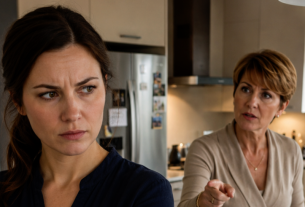
“Dasha, calm down,” she said quietly but firmly. “You know exactly why this happened. You and Andrey betrayed me. You took the apartment that was promised to me. And seven years ago when you called me, you weren’t asking me about the kids—you were begging me to take Andrey back.”
“So you couldn’t bear to lose the apartment?” Dasha spat out, lowering her voice though her eyes burned. “Couldn’t you understand that we had a family, kids? You were alone, but we had two children! You turned your back on your own family out of greed!”
«It’s not about greed,» Liza said calmly, though inside she was boiling. «It’s because you simply used me. And now…» She looked at the boys shifting from foot to foot. «Seryozha, Dima, I’m glad you’re doing so well in school and working hard. But now, excuse us, we have to go.»
«Oh, you have to go?» Dasha stepped forward, blocking the way. «Isn’t that a bit much, Liza? Think you can handle them? They’re clearly…» She twirled her finger at her temple, glancing at silent Pasha. «Maybe they belong in an orphanage, not with you playing the hero. And by the way, my kids are star students! Seryozha wins math competitions!»
«That’s none of your business,» Liza snapped, scooping Ira into her arms as the little girl suddenly burst into tears.
«You just want to show off in front of everyone!» Dasha shouted after her. «Little miss benefactor! Let’s see how long you last when they ruin your life! Parasites!»
Liza hurried toward the exit, holding Ira close and feeling Pasha hustling nearby, not falling behind for a second. Tears stung her eyes, but she fought them back with all her strength. Only when they got through the zoo gates and sat in the car did she finally allow herself to breathe out.
«Auntie…» came a thin, trembling voice.
Liza turned around. It was Pasha. He was looking at her with his big dark eyes, tears shining in them. His lips were trembling.
«Auntie, don’t cry,» he said.
The first words Liza had heard from him in three weeks.
Liza broke down crying. She reached out and hugged both children, pressing them close.
«I’m not giving you up to anyone, do you hear me? No one.»
That night, Liza couldn’t sleep for a long time. She watched the children as they slept and thought about what Dasha and Aunt Nina’s neighbor had said. Maybe she really had lost her mind? Maybe she shouldn’t have gotten involved in all this?
But then she remembered how Pasha spoke up. How he said, «Auntie, don’t cry.» How both children clung to her, as if she was their only hope in the world. And Liza realized she had no choice. These kids were her family. Maybe not by blood (well, a little by blood), but by something so much more. By the fact that no one but her could truly help them. And the fact was, she needed them, too.
continued in the comments