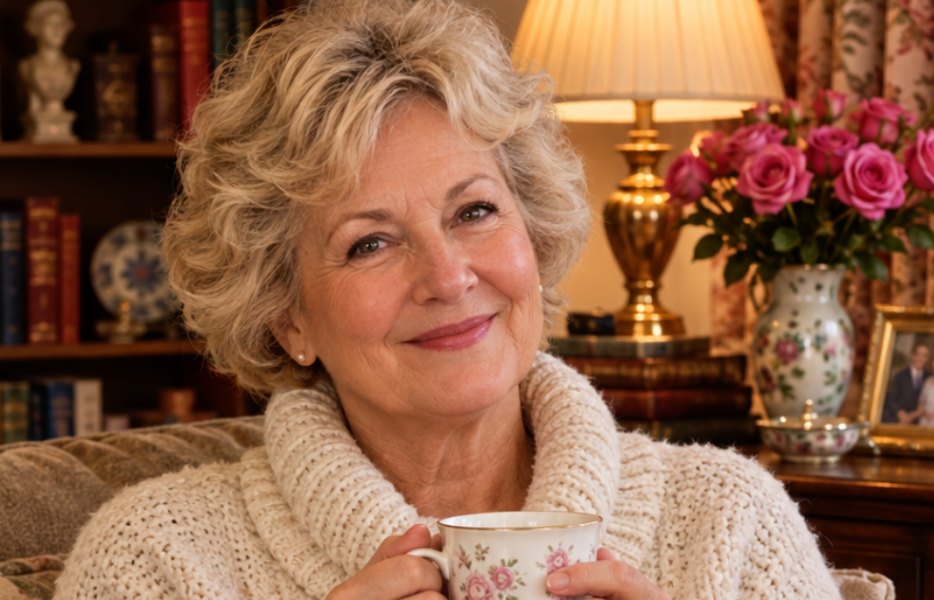
“After sixty, a woman should remain calm—like still water in a glass.”
That’s exactly what Nikolai once told me. Back then, I just nodded in agreement. How silly I was!
My name is Vera, I’m sixty-one. Not long ago, I tossed a beautiful, expensive vase that had been gifted to me down the trash chute. I didn’t do it out of spite. I simply no longer want to keep things around me that people used to buy my silence.
Let me start from the beginning. Or maybe the middle is better. For most women, life unfolds much the same way: you marry, raise children, and then your husband passes away. It’s the most ordinary story. There are so many women just like me.
After Grisha died, I lived alone for seven years. I mean truly lived—not just existed from one day to the next. I started learning Italian—not because I planned to move anywhere, but because I wanted to keep my mind busy so it wouldn’t be filled only with the voices from the television. My friend and I went to the theater, I read all sorts of books—detectives, biographies, anything I came across. I even got a ginger cat with a terribly difficult personality. In short, I had a pretty full life.
And then, one day, Nikolai entered my well-ordered, familiar life.
We were introduced by Lyudmila. She had long taken on the role of matchmaker with great enthusiasm, as if it was her favorite job. She constantly invited me to birthday parties, dragged me to all sorts of “cultural evenings,” and once even convinced me to attend a wine tasting. I have to admit, I felt completely out of place there.
Nikolai was a friend of her husband’s. He had recently been widowed. Lyudmila kept assuring me, “He’s a very decent man, Vera, just listen to him.”
So, I decided to listen.
Nikolai turned out to be a tall, neat man. He was already retired and had two grown children living in Moscow. He didn’t drink excessively or smoke. Overall, he seemed charming to me. And honestly, I liked him from the very first meeting. I won’t pretend it was otherwise.
The first three months of our relationship were wonderful. Every evening, Nikolai would call and ask about my day. And it wasn’t just a polite, formal question—he genuinely wanted to hear my answer and listened attentively. Once, when I caught a bad cold, he came to see me himself.
I can’t say exactly when things started to change. It’s like the weather shifting: just recently it was warm, and suddenly you realize it’s been cold for a while now. You can’t even remember the exact moment when the chill set in.
At first, it all seemed like trivial things
Nikolai started reacting oddly to my plans. For example, I would tell him, “On Saturday, Lyudmila and I are going to the Vakhtangov Theater. We’ve already got the tickets.” He never made a scene or openly showed disapproval. But his expression would immediately change. He looked somehow hurt, a little weary, as if I had said something unpleasant.
“Alright then, since the tickets are already bought,” he would say.
I ended up going to the theater after all, but during the first act, I just couldn’t focus on the play. I kept thinking: why did I even come? I should’ve stayed home.
Then came the comments. They seemed completely harmless—spoken gently and cautiously.
“Why do you need Italian, Verochka? You’re not planning on traveling anywhere anyway.”
“A cat on the couch isn’t very hygienic, you know.”
“You spend too much time with Lyudmila.”
And every time, he would say these things with a smile, using a calm, gentle voice. It felt like he was simply looking out for me, as if everything he said was only in my best interest.
At that point, I still didn’t realize what was going on or the pattern that was developing. I thought we were just getting used to each other, learning how to communicate, and that little things like this were perfectly normal. Grisha used to grumble sometimes, too. After all, a lot of men tend to treat their partner as a bit of their own property.
But Grisha always made his displeasure clear; he could raise his voice or directly say what he didn’t like, then make up with the same enthusiasm. Nikolai, on the other hand, never lost his temper. He was always unflappable. And it was precisely this endless calm confidence in his own rightness that ended up annoying me much more than any heated argument ever could.
The conversation about ‘calmness’ happened in January.
We were sitting in my kitchen, drinking tea. I was telling Nikolai about a phone conversation with my daughter. Masha lives in St. Petersburg, she’s got enough of her own problems, and of course I worry about her. Isn’t that normal? I guess I was being pretty emotional because suddenly Nikolai said in a perfectly even tone:
“Vera, why are you so worried? At our age, these kinds of worries aren’t necessary anymore. For a woman after a certain age, it’s better to keep calm. You need to learn to accept things as they are.”
I started thinking, trying to understand what exactly he meant. What does he mean by ‘after a certain age’? After sixty? After menopause? After a husband passes away? When, in his opinion, am I supposed to become a motionless piece of furniture and stop showing emotions?
I didn’t try to guess—I just asked him directly. And then Nikolai said something I keep replaying in my mind:
“Well, a woman in her mature years… She’s already been through it all. The most important parts of her life are behind her. So she should cherish what she has, be grateful for it, and not expect too much from life.”
Grateful? Grateful for what, exactly? For him sitting in my kitchen enjoying the tea I made? For his evening phone calls? For the mere fact that he chose to notice me and keep me company?
Out loud, I didn’t say any of this. I just smiled and refilled our cups. I suppose life has trained me so well to be convenient that I didn’t even notice how easily I swallowed those words.
Back in April, we had our very first real argument. I was planning a three-day trip to Suzdal with Lyudmila—a getaway we’d been talking about for quite a while. Nikolai didn’t approve of the idea and called it frivolous. He believed that grown women shouldn’t go off on adventures as if they were little girls.
«I was actually counting on us spending the May holidays together,» he announced.
But we hadn’t actually made any plans for those days. I reminded him of that.
After that, Nikolai seemed to disappear from my life for three days, even though technically we hadn’t broken up. There were no arguments, no accusations—he just replied to my messages with cold, brief responses:
“Ok.”
“Got it.”
“Do as you think best.”
His icy silence felt so much worse than a heated argument. I kept replaying everything in my mind, trying to figure out how I’d hurt him. Maybe I really was in the wrong? Should I have turned down the trip with Lyudmila? Was I supposed to…
But in the end, I went to Suzdal anyway—and not once did I regret it. The snowy white monasteries were stunning, they served cucumber brine in the cafes, and Lyudmila told stories so hilarious that we both burst into tears laughing. I felt light, joyful, peaceful. I hadn’t felt that happy in ages.
Still, after coming home, it took the first half hour of talking to Nikolai just to melt his coldness. I kept trying to explain that he was important to me, that this trip didn’t mean I didn’t care, and that I hadn’t stopped valuing him at all…
And then suddenly, I stopped mid-sentence. I thought: wait a second, who’s the adult here? Why am I the one who has to justify myself and prove that I have the right to spend a few days however I want?
· · ·
Then, the real turning point came—and it was over something so tiny, I have to laugh when I think of it now.
I had signed up for watercolor painting classes. It was something I’d been wanting to try for ages, though I had no intention of becoming an artist. I just wanted to do something creative with my hands, something that would distract me from constant overthinking.
Nikolai reacted with the now-familiar look of confusion:
“Why would you want to do that at your age?”
At your age. At your age. Over and over—at your age.
Suddenly, I realized that in almost a year of knowing him, I’d probably heard that phrase from him forty times. When I decided to learn Italian, he asked why I’d try that at my age. When I wanted new boots—same thing. Even wanting to buy a new couch brought out the same remark.
And I finally started to wonder: what does “at my age” even mean? Am I supposed to treat it like a finish line? Is it the last stop, where a woman is supposed to get off the train, sit quietly, and never show initiative again?
I decided to call my friend—not Lyudmila, but Tamara. She’s a psychologist, though to be honest, her credentials are a bit unusual: she got her certificate after completing some online course. Still, she’s a very smart woman, and you can’t take that away from her.
I told her everything in detail about Nikolai—his constant remarks, his need to decide what suits me and what doesn’t match my age anymore. Tamara listened closely, didn’t interrupt once, and finally said:
«Vera, he’s slowly building a cage around you. A golden one, with mandarins, but still a cage.»
After that, I came home and settled in for a long while with Arkasha. My ginger cat stretched out across my lap, purring loudly. I have to admit, he always knows exactly when to show affection and just how loudly to purr. Sometimes I even feel he understands more than he lets on.
· · ·
Later, we had another conversation—this time about what a man should be like. It happened naturally as we talked about mutual friends. One couple had just broken up, and then Nikolai, completely seriously and without a hint of irony, shared his opinion:
«A man is always a man. He has his own desires, interests, his own life. That’s just how it is. And a woman beside him needs to understand, accept, and offer support.»
«But what if a woman has her own desires and interests too?» I asked.
He looked at me as if I’d just said something sweetly naïve.
«Well, of course, obviously. But the main thing is still the man. That’s the way the world works.»
I just smiled. The tea was finished, so I got up to clear the cups from the table. Standing by the sink, I pondered his words.
Nikolai wasn’t saying these things out of malice. He truly believed he was right. He grew up in a world where these views were normal. That’s how his mother lived, that’s how his wife acted, and all the women he knew behaved that way. He wasn’t a cruel person or some kind of monster. He just had his own ideas about family and relationships.
But I have my own ideas about life, too. I have no intention of becoming stagnant water, poured into a glass and left sitting on the table.
· · ·
We broke up in May. There was no big fight—it’s hard to imagine a scandal with someone who never raises his voice. We just sat down and talked. I told Nikolai honestly that we saw life together and the relationship between a man and a woman far too differently.
First he was surprised, then offended. And then he told me that I «probably read too much stuff» and that «at your age, it’s hard to find the right person, so you should appreciate what you have.»
At your age. He didn’t even talk to me personally anymore—he switched to «your,» as if he’d lumped me in with all women who just have to accept their lot.
I nodded silently. Nikolai got his things and left. Arkasha immediately stretched out on the couch, taking up every bit of free space.
The first week after the breakup was tough for me. I won’t pretend to be indifferent: I really did feel sad. But honestly, I think it was less about missing Nikolay himself, and more about longing for that wonderful feeling you get at the very start of a relationship. When someone calls you in the evening just to ask how your day went, and it makes you feel warm inside. That kind of attention is lovely at any age. It’s simply nice, that’s all.
But then I decided to go to a watercolor class. That’s where I met a woman named Inna. She’s seventy and used to be a surgeon. She started painting when she was just five, but never had enough time for it throughout her life. Now, she finally has the chance.
We started talking, then went for coffee together. The next time, we met up again. Inna laughs so contagiously and loudly that people at the neighboring tables can’t help but turn around. And honestly, I absolutely love it.
So, that’s basically my story. The expensive Bohemian vase has found its way to the trash chute. Arkasha is still ruling the sofa. On Wednesdays I have Italian lessons, on Fridays it’s watercolor. Masha calls from St. Petersburg, I listen to her stories and worry about my daughter. And that’s perfectly normal: I’m her mom and I have every right to worry about her.
I’m sixty-one. I don’t have to be grateful for someone’s condescension. I’m not going to stay silent or try to fit in. And I certainly won’t let anyone lock me up in a gilded cage.