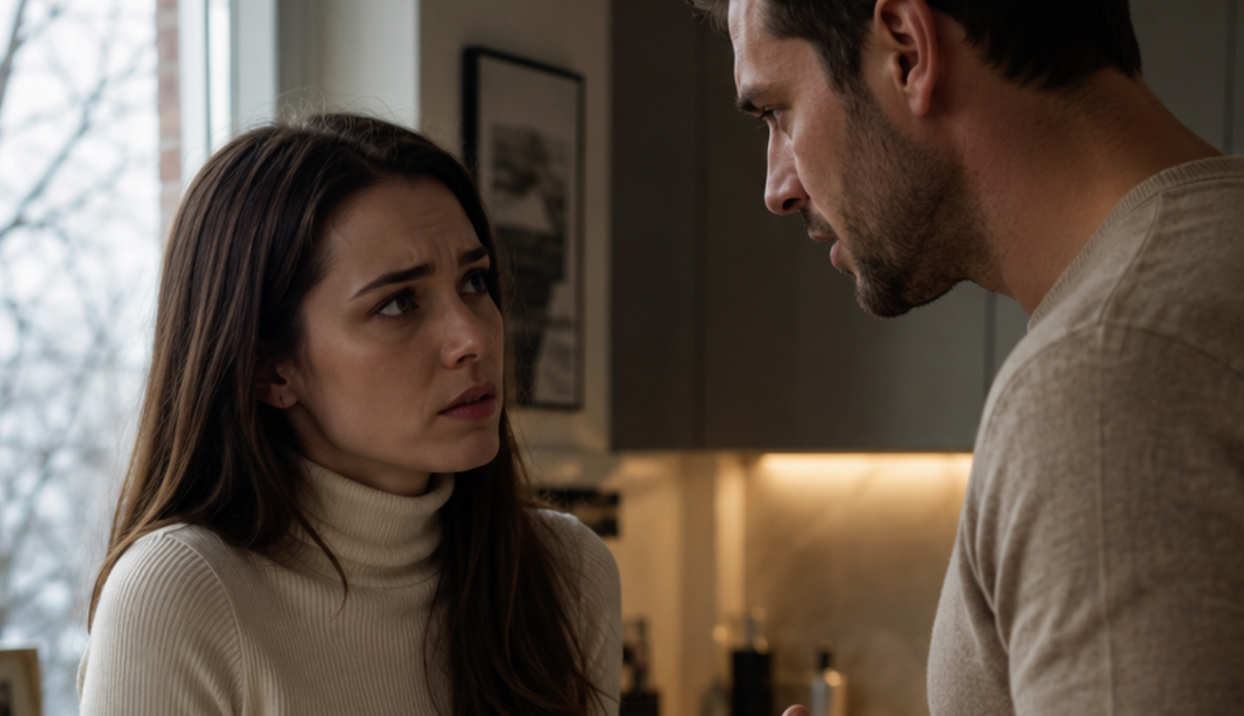
I asked it almost in a whisper, although the apartment was so quiet that even the spoon left in the cup seemed too loud. Outside the window, dusk was slowly falling. Reflected in the glass was our kitchen — new, bright, with white cabinet fronts and the curtains with tiny gray leaves that I had spent so long choosing.
“Maxim, tell me honestly. Is your mother really planning to move in with us right after the wedding?”
He was standing by the sink, washing a mug that was already clean for some reason. His shoulders were raised, as if he were waiting for a blow, and on his face was that same strained smile I had only ever seen during unpleasant conversations.
“I thought we’d discuss it calmly,” he said without looking at me. “Olesya, please don’t start shouting. It’s not as terrible as you’ve imagined.”
At first, I didn’t even understand what burned me more than the news itself. It wasn’t the fact that his$ mother had decided to move into our apartment. It was the fact that everything had already been decided without me, and now it was being called “discussing it calmly,” when the only role left for me was to swallow a ready-made decision.
“So it’s true?”
Maxim placed the mug on the drying rack, wiped his hands on a towel, and finally turned toward me. He looked tired, as if he had been carrying this conversation on his back for several days and had hoped he could drag it all the way to the wedding, when it would already be too late to change anything.
“Mom wants to rent out her apartment. She says it’s hard for her to live alone, and the rental money won’t hurt. She’ll stay with us for a little while, until everything settles down.”
Something inside me sank slowly and unpleasantly. At that moment, I remembered how three days earlier, Tamara had casually asked whether her favorite armchair would fit in the small room, and then, noticing my look, smiled and said she was “just asking for the future.”
Maxim and I had bought this apartment six months ago. The down payment came from the money I got after selling my grandmother’s room, his savings, and the loan he had taken out in his name. Together, we chose the tiles, argued over the color of the hallway walls, carried boxes, ate shawarma on the windowsill because there was no table yet, and laughed that we already had a home and only one step remained before real family life began.
And now, in place of that step, there suddenly appeared another woman — with a neat bob haircut, a sharp, watchful squint, and the confidence of someone who already knew exactly where her housecoat would be kept.
“How long is ‘a little while’?” I asked. “A week? A month? A year?”
“Olesya, why are you jumping straight to that? Mom isn’t a monster. She’ll help around the house, buy groceries. The small room is empty anyway.”
He said it softly, almost pleadingly, and in his voice I heard not anger, but the habit of justifying her in advance. As if all my future dissatisfaction was already lying in a folder somewhere, arranged point by point, and he had long prepared a quiet answer for every one of them.
“An empty room doesn’t mean it belongs to no one,” I said. “I wanted to make an office there. And in general, I was planning to live with my husband, not with my husband and his mother.”
He winced as if I had said something obscene. That made me even angrier, because in our relationship, I had always been the one to call things by their real names, while Maxim liked to tuck soft napkins under sharp corners.
Over the past two weeks, Tamara had visited us more often than my friends had in six months. She brought containers for grains, said the upper shelves were better suited for things “experienced housewives use,” rearranged the spice jars, and twice asked why I kept the plates so high if later I would have to “jump up to the cupboards with a baby in my arms.”
“I only want what’s best,” she would say, brushing an imaginary speck of dust from the new countertop. “A home should be arranged wisely. Young people usually don’t think about that.”
I smiled politely, although every time she left, I wanted to wash the kitchen all over again, air out the rooms, and put every fork back in its place. There was something about the way she touched our things that made the apartment feel not entirely mine anymore.
The day after that conversation, Maxim and I met near the metro after work. I deliberately didn’t want to talk at home, because at home it always felt as though someone was listening, even when Tamara wasn’t there.
“Let’s not speak in generalities,” I said as we walked past cars still wet from the rain. “Have you already promised her she can move in?”
Maxim shoved his hands into his pockets and stayed silent for several seconds. A woman carrying a bag of oranges passed us, followed by a boy dragging a scooter, and that ordinary evening belonging to strangers suddenly seemed so normal that I wanted to cling to it and never let go.
“I said most likely, yes. She’s already set her mind on it. Olesya, you know I can’t just throw her out. After my father left, she carried everything alone. Her whole life was about me.”
That phrase contained all of Maxim. Good, not greedy, not cruel, capable of working, capable of loving, capable of caring. And yet stitched through with guilt toward his mother like an old quilt with threads that should have been removed long ago, but he was afraid to touch them.
“I’m not asking you to throw her out,” I replied. “I’m asking you not to drag her into our bedroom through the small room. We can help her with money. We can rent her an apartment nearby. We can at least wait until we’ve lived together as a couple for a while.”
“She’s almost already made an arrangement with tenants,” he said quietly.
I stopped in the middle of the sidewalk. People moved around us on both sides, someone clicked their tongue in irritation, but I didn’t care.
“So everything has already been decided. There are even tenants. And when was I supposed to find out, Maxim? After the registry office? When your mother arrived with her suitcases?”
“I didn’t want fights before the wedding.”
I wanted to laugh, although there was nothing funny. A fight before the wedding was, of course, a terrible thing. Much more terrible than life after the wedding, where my mother-in-law would have keys, her own armchair, and an opinion about every breath I took.
That night, I barely slept. Maxim lay beside me and tried to hug me, but I moved to the very edge of the bed. From the hallway came the smell of fresh paint from the new shoe cabinet, and for some reason that smell tore my soul inside out, reminding me how much love and effort I had put into this place.
In the morning, while he was in the shower, I reached into the desk drawer for a charger and saw a folder of papers. On top lay a printout of the ad for renting Tamara’s apartment. Under it was a list of things written in her neat, rounded handwriting: “armchair,” “winter preserves,” “bedding set,” “medicine,” “small TV,” “icons.”
And beneath that lay a duplicate key to our apartment in a clear plastic bag.
I squeezed that bag so hard that the plastic cracked along the fold. My fingers were trembling, and in my head there was only one short, hollow thought: so he has already given it to her. So I am the last person they planned to inform.
“What is this?” I asked when he came out of the bathroom.
Maxim saw the key in my hand and didn’t even pretend to be surprised. He only sat down on the edge of the sofa and lowered his head.
“I gave Mom a spare key. Just in case.”
“In case of what? In case she decides to come in and start rearranging my things when I’m not here?”
“Don’t exaggerate. She isn’t a stranger.”
That was when I became truly frightened for the first time — not of Tamara, but of the fact that Maxim sincerely did not see the boundary. To him, “not a stranger” automatically meant the right to enter, ask, decide, move things around, occupy space. And for me, a home was made up of exactly those small things. The right to close the door and know that behind it was my air, my order, my life.
I went to Lera’s place, my friend since university. She rented a small two-room apartment on the other side of the city, constantly argued with the upstairs neighbor, wore funny wool socks at home, and knew how to stay silent in a way that made you want to speak honestly.
I sat in her kitchen, turning a mug of tea in my hands, and told her everything from the beginning. About the armchair. About the small room. About the list of things. About the key in the plastic bag.
“Listen carefully,” Lera said when I finally ran out of words. “This isn’t even about his mother. It’s about who he considers his main family. If you give in now, your life won’t be life. It’ll be an endless endurance contest.”
I stared at the table. A pear cut in half was lying on it, and for some reason I still remember it — green, slightly darkened at the cut. At moments like that, the mind clings to any nonsense, just so it doesn’t have to look straight into the center of the pain.
“What if he’s simply afraid of hurting her?” I asked. “He isn’t bad, Lera. He really isn’t.”
“I’m not saying he’s bad. But a good man who is constantly afraid of upsetting his mother can easily make his wife miserable. And he won’t even notice how it happens.”
I returned home the next day. In the hallway stood a bag with new towel hooks I had not bought. On the kitchen table lay a piece of fabric with tiny roses and a note from Tamara: “The kitchen will feel cozier if we sew short curtains. I’ve already measured.”
I reread that “I’ve already measured” four times. Those three words contained so much calm ownership that I felt sick.
That evening, Tamara herself came over. She walked in easily, as if entering her own apartment, placed a jar of stuffed cabbage on the table, and immediately noticed my face.
“What’s with that look? Worked yourself up again?”
“Tamara Sergeyevna, I don’t like that you are taking charge of our apartment without asking,” I said as evenly as I could.
She raised her eyebrows, then looked at her son. For a second, something almost childlike flashed across her face, as though I had violated a very old family order under which arguing with her was allowed only inside one’s head.
“Olesya, what dramatic words. I’m helping you. You work, you’re tired, the wedding is right around the corner. Someone has to think about the home.”
I wanted to answer sharply, but I held back. Maxim was standing by the refrigerator, pretending to read a magnet with the water delivery schedule.
“I think about the home. Because I’m the one planning to live in it.”
“So live in it,” Tamara said softly. “Am I stopping you? I’m not getting into your bed. I’ll quietly stay in the small room. You won’t even notice me. And when the children come along, help will be right there.”
She said “when the children come along” with such a satisfied expression that it was as if she had already handed me a complete plan for the next ten years. I suddenly saw my future life clearly: who eats when, where the diapers go, how broth should be cooked, which hats the child should wear, and why I shouldn’t go back to work too soon because “that’s not how it’s done in our family.”
After she left, I locked myself in the bathroom and stared at my hands under cold water for a long time. Then I came out, sat down across from Maxim, and realized there was no more room for half-hints.
“If your mother moves in here after the wedding, I won’t,” I said.
He went pale. For several seconds, the only sound in the room was the hum of the refrigerator.
“Are you giving me an ultimatum?”
“I’m setting a boundary. The ultimatum came from your side. It was just announced to me without my participation.”
Maxim jumped up, paced around the room, and stopped by the window. Our faces were reflected in the glass, and we both looked older and worse than we had a week earlier, when we were choosing a cake and arguing about whether to have honey cake or cheesecake.
“It’s easy for you to say. But I only have one mother. I know what she can be like, but I can’t just tell her, ‘Live however you want.’ You don’t understand.”
I looked at his hunched back and understood everything perfectly. He didn’t want to choose. He dreamed that two women would somehow squeeze themselves smaller, and he would remain good for both of them. But an adult cannot live that way. Someone’s comfort is always paid for with someone else’s silence.
Three days before the wedding, Tamara invited me to her place “just for tea.” I thought for a long time about whether to go or not, then decided one unpleasant conversation was better than ten unfinished ones.
Her apartment smelled of perfume and fried onions. In the hallway, labeled boxes were already standing. The throw had been removed from the armchair in the living room, and a rental contract lay on the table. I hadn’t even sat down yet when I realized that, for her, the matter was completely closed.
“Are you really already packing everything?” I asked.
“Why drag it out?” she replied, placing a cup in front of me. “Family should live together, especially at first. I’m helping you, after all. I’ll have my own money from the rent. I won’t be sitting on anyone’s neck.”
“I don’t want to start married life as three people.”
Tamara leaned back in her chair and narrowed her eyes. Her voice became quieter, almost affectionate, but it was the kind of affection that makes you want to check whether your back is still intact.
“Olesya, you’re young. You think love will solve everything. Then children come, expenses, exhaustion. And who will be there? Your girlfriends? Pretty curtains? I raised my son alone. I gave him everything. And now, as it turns out, in my old age I don’t even have a corner in the home of my own child?”
The words were chosen flawlessly. After hearing them, any outsider would have considered me ungrateful and cruel. I didn’t even argue. I just sat and looked at her carefully lined eyes, at the teaspoon on the saucer, at the boxes against the wall, and understood that she wasn’t talking about help. She was talking about the right to continue living her son’s life the way she was used to.
“You do have a corner. You have your own apartment. And Maxim and I have our own family,” I replied. “The problem is that you see those as the same thing.”
She pressed her lips together. After that, the conversation was practically over. I left before the tea had cooled, and outside my knees were shaking so badly that I had to sit down on a bench near the entrance.
That evening, Aunt Nina called me — my mother’s older sister. Lera had probably written to her, because I myself was no longer capable of anything.
“A wedding is one day,” Aunt Nina said. “But the person you wake up with, and the person who runs your kitchen, is every day. Don’t be afraid of ruining the celebration. Be afraid of ruining your life.”
I remembered those words many more times later.
On the day of the wedding, I woke up with a heavy head and a strange emptiness inside. Brides usually cry from happiness or nerves, but as I put on my makeup, I looked at my reflection and tried to understand exactly when my “we” had begun to come apart at the seams.
The registration ceremony passed as if in a fog. The hall, the music, other people’s smiles, the voice of the registry office employee sounding as though through water. Maxim held my hand tightly, but his palm was cold, and I knew he wasn’t calm either.
At the small banquet in the restaurant, Tamara shone brighter than anyone. She adjusted my veil, served salads to the guests, repeated that now she would “finally have a real big family,” and every time I heard it, I felt something scraping glass inside me.
About two hours later, she said she would go ahead of us, “to put the flowers in water and prepare everything.” Maxim only nodded, and in that moment I understood that I was still hoping for a miracle, although miracles had already ended.
We arrived home late that evening. I was tired, my shoes had rubbed my feet raw, my head was heavy from music and smiles, and all I wanted was to close the door, take off my dress, and finally be alone with my husband.
Maxim opened the door with his key, and in the very first second, someone else’s life hit me in the face. In the hallway stood three boxes labeled “kitchen,” “bathroom,” and “medicine.” Against the wall was that same burgundy armchair. On the shoe rack, next to my sandals, Tamara’s house slippers were already standing.
The kitchen light was on. A folded oilcloth lay on the table. The oven smelled of baked chicken, and a familiar floral housecoat hung over the back of a chair.
Tamara came out of the small room, wiping her hands on a towel, and smiled so calmly, as if everything happening were the most natural thing in the world.
“Well, here are the newlyweds. I warmed up dinner. You should eat after the road, then we’ll calmly unpack the boxes. I’ve already settled into the small room. I won’t bother you.”
I don’t remember how many seconds I was silent. My ears were ringing, and one completely ridiculous detail stood before my eyes, which made it especially frightening: on the windowsill, where that morning my candle in a glass jar had stood, her glasses and a bottle of valerian were now lying.
“You’ve already moved in?” I asked.
“Well, why delay? The tenants are moving into my place tomorrow. Maxim told you everything. I only brought the essentials.”
I turned to my husband. My husband — because only a few hours earlier, we had signed the papers. And in that moment, the word felt almost mocking.
“Maxim, say something.”
He stood in the middle of the hallway with the bouquet, which had already begun to shed. His face had the expression of a person hoping the storm would pass him by if he froze and stopped breathing.
“Mom, maybe not today,” he muttered. “Olesya is tired. Let’s discuss everything tomorrow.”
Tamara’s face immediately changed. The smile disappeared, her chin trembled, and I saw how instantly she prepared to become the victim.
“So now I’m in your way? On the very first evening? After everything I’ve done for you?”
“Don’t twist this,” I said. “That’s not what this is about. This is about the fact that you moved into our apartment without my consent.”
“Without your consent?” Her voice rose to a shrill note. “And who are you that I should ask permission from my son? This is his home too.”
That was when everything finally fell into place. It wasn’t about help, loneliness, or money. It was about territory. About the right to enter and live as if I were temporary here.
I took off my veil, placed it on the cabinet, and suddenly felt calm. Not a good, gentle calm. A cold, sober, very clear calm.
“Maxim,” I said, not taking my eyes off him. “Right now, one simple thing is being decided. Are we starting our family together, just the two of us, or not? If your mother stays here tonight, I’m leaving.”
He opened his mouth and immediately closed it. He looked at me, then at her, then back at me. I could see habit of obedience and fear of losing me colliding inside him, but somehow weakly, as if he were still hoping to find a third door.
“Olesya, don’t be so harsh. Mom can stay for a couple of days, and then…”
That was it. That “couple of days” was his choice.
I bent down, unbuckled my shoes because my legs could barely hold me, and walked barefoot into the bedroom. No one followed me. I took the travel bag from the closet, the one I had packed for our mini-vacation after the wedding, and instead of a swimsuit, I put in jeans, a sweater, a charger, documents, and a cosmetics bag.
When I came back out, Tamara was standing by the sink and crying so diligently that between sobs she had time to glance sideways to see whether her son was watching. Maxim was sitting on a stool, his face buried in his hands.
“Are you seriously leaving on your wedding night?” he asked dully.
“I’m not leaving because of the evening,” I replied. “I’m leaving a home where no place was left for me. You decided everything in advance. You were just waiting for me to endure it.”
“I love you.”
“People love in different ways. Sometimes love is used to cover cowardice.”
It was cruel, but it was honest. And in that moment, honesty mattered more to me than gentleness.
I called a taxi and went downstairs alone. Outside, it smelled of wet asphalt and lilacs from the courtyard. Music drifted from the restaurant across the street, people were laughing somewhere, and I stood there in a white dress with a travel bag, feeling for the first time in my life that I was growing up in the span of one single evening.
I stayed with Lera for almost a week. We shoved the veil into the top drawer of the wardrobe. The dress hung on the door like someone else’s joke, and my phone was exploding with messages. Maxim wrote. Tamara wrote. His aunt wrote, his cousin wrote, even Tamara’s neighbor, whom I had seen only once on the stairs, wrote.
Everyone had a version in which I was either ungrateful, hysterical, or an overly modern girl who didn’t understand family values. Only Maxim, in his messages, first tried to explain, then justify himself, and on the third day finally wrote one simple sentence: “I ruined everything. I can only see it now.”
I didn’t answer right away. The resentment still lived inside me, heavy as a wet blanket. But through it, another feeling was breaking through, one you cannot escape when you love someone: I was in pain not only for myself, but for him too. Because I understood how frightening it must have been for him to admit that his entire adult life had been controlled by a sense of duty that had long ago turned into an excuse to betray the person closest to him.
On the sixth day, we met in a small coffee shop near the park. Maxim arrived early, sat by the window, and looked as though during that week he had thrown several years’ worth of exhaustion into a sack and then received another one on top of it.
“Thank you for coming,” he said.
I sat across from him and suddenly realized that I no longer wanted to shout or argue. Something inside me had burned out — the part that hoped that if I found the right words, I could make a person grow up in one conversation when he had been avoiding that himself.
“How are you living there?” I asked.
Maxim gave a crooked smile.
“Badly. In short, very badly. In three days, Mom managed to rearrange everything. She said your saucepan was inconvenient. She packed your books from the small room into a box. And every evening she repeated that you’d come back once you were ‘done throwing your tantrum.’”
I stayed silent. He looked into his cup, ran his finger along the cardboard sleeve, and spoke not so much to me as to himself.
“For the first time, I saw it from the outside. Not Mom’s words, but what I was doing. As if I kept pushing the same role onto you, only before, it wasn’t so obvious. You were supposed to endure things so that I wouldn’t feel like a bad son.”
Those words were not easy for him; I could hear it. There was no pretty theatricality in them, the kind people sometimes use to cover empty apologies. There was only the exhaustion of a person who had finally stopped lying, at least to himself.
“And what now?” I asked.
“I returned the tenants’ advance payment. Mom caused a scandal and said I had thrown her out onto the street. But I rented her an apartment in the neighboring district for a month and told her I’d help with money later if needed. And I changed the locks.”
I looked up at him sharply. Maybe that was the first time during the whole meeting that something inside me moved.
“Really?”
“Yes. And I took the key back from her. Olesya, I’m not asking you to come back immediately. I just realized that if I cover everything up with words again now, I’ll lose you for good.”
Outside the window, people walked along the alley with paper cups, pushed strollers, and someone carried a bouquet of tulips. The world was living its ordinary life, while inside me the walls were slowly shifting.
“I can’t pretend nothing happened,” I said. “Do you understand? I walked into my own apartment in a wedding dress and saw not a life with my husband, but a ready-made place for my mother-in-law. You don’t forget something like that after one conversation.”
“I know.”
“And I’m afraid it will happen again next time. With another issue, in another form. If not moving in, then money, children, decisions. I don’t want to be the person who is simply presented with a fact.”
Maxim nodded. He didn’t interrupt, didn’t justify himself, didn’t reach out to grab my hand. And perhaps that, for the first time in a long time, seemed adult to me.
“I’m ready to work through this as long as it takes,” he said. “If you want, we’ll go to a family therapist. If you want, we’ll live separately for now. If you want, we’ll start over completely with an empty apartment, as if we’re only just moving in. But I no longer want to build a life where everything is decided behind your back.”
I listened and understood that the person sitting in front of me was no longer a boy caught between his mother and his bride. Not a completely changed person — no, people don’t change that quickly. But he was a person who had finally become ashamed of his own convenient weakness.
We did not make peace in that very minute. We did not leave the coffee shop holding hands like in cheap films. I said I needed time. I said I would return to the apartment only when I saw that our boundaries were truly there again, not just a temporary pause before the next invasion.
He answered simply:
“All right. I’ll wait.”
For another two weeks, I stayed with Lera and sometimes visited the apartment during the day, while Maxim was at work. I wasn’t checking the things; I was checking the feeling. In the hallway, only our sneakers were standing again. My candle had returned to the windowsill. In the small room were my books, a folding table, and a box of papers for my future office.
The burgundy armchair was gone. So was the floral housecoat. There was no longer someone else’s valerian on the kitchen shelf, and that empty space somehow made me feel lighter than any words could.
Maxim didn’t rush me. He wrote briefly, without pressure. Sometimes he sent photos: how he was assembling a cabinet himself, how he moved the shoe cabinet, how he bought a new lamp for the small room because I had once said I wanted warm light there in the evenings.
One day, I came over late, after work. He was home. I was wearing an ordinary coat, carrying a bag of groceries, and only when I inserted my key into the new lock did I realize how much that simple movement meant.
Maxim came out into the hallway and stopped two steps away. He didn’t rush toward me or try to hug me. He simply looked at me the way people look at someone they almost lost through their own fault.
“Hi,” he said.
“Hi.”
We went into the kitchen. Outside the window, the streetlights had already come on, and reflected in the glass were two cups, a kettle, and my tired face. Almost the same view from which everything had started, only now there was no third invisible person in the picture.
“I don’t know if things will work out quickly,” I said, sitting down by the window. “Or whether they’ll work out the way they used to at all. Maybe it won’t be like before anymore.”
“It doesn’t need to be like before,” he answered quietly. “I’ve already seen what ‘before’ was like. Nothing good came of it.”
I smiled faintly for the first time in that long, difficult month. Then I was silent for a long while, warming my hands around the cup. I wanted someone to give me a guarantee, but adulthood does not hand out guarantees — only actions, one by one, day after day.
“If I come back,” I said at last, “then on one condition. No more decisions behind my back. None at all. Not about money, not about your mother, not about children, not about our apartment. And if your mother ever tries to move into our life without knocking again, you close the door yourself.”
Maxim nodded immediately, without hesitation.
“Yes.”
“And one more thing. We are not going to pretend this was just an ‘unpleasant situation.’ This was a big thing. A very painful thing. I don’t want you to one day call it ‘what’s the big deal’ again.”
He lowered his eyes.
“I won’t. Because now I know exactly what the big deal is.”
I didn’t throw myself into his arms. I didn’t burst into tears. I didn’t say I had forgiven everything. Instead, I stood up, went to the windowsill, and adjusted the curtain — the same one with gray leaves that I had been so afraid of losing to someone else’s hands. Then I opened the small window. Cool air entered the apartment, along with the smell of wet earth after the evening watering outside the building.
It was a very small gesture, but to me it meant a great deal. I was once again doing something of my own in this home, by my own will, without the inner question of whether someone might take my place tomorrow.
We spent a long time learning again. Maxim visited his mother, argued with her, endured her tears and reproaches, then came home not with excuses, but with the truth. I, too, learned not to expect a trap in every phone call and not to flinch at footsteps in the stairwell, thinking it was her again with bags and her confidence.
We did not find instant happiness. But something more important happened. One evening, I was once again sitting by the kitchen window while Maxim washed the dishes and grumbled that I bought too many mugs. I looked around and realized I was no longer counting how many people this home was set for.
There were two cups on the table. In the small room, my laptop and a stack of work notebooks were waiting. In the hallway, two keys hung on one hook, and both belonged only to the people who truly lived there.
I cannot say that in that moment I forgot the wedding night. Things like that are not forgotten. But the pain stopped being the mistress of our home. It became a memory — one that reminds you how easy it is to lose yourself if you don’t say the simple, frightening word “no” in time.
Sometimes love is saved not by vows or beautiful photographs from the registry office. Sometimes it is saved by a closed door — the one you finally decide to close in front of someone who is used to entering without asking. And by the person beside you who, even if late, understands that a home begins with respect, not with a key in someone else’s pocket.