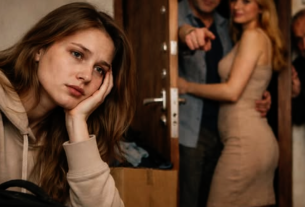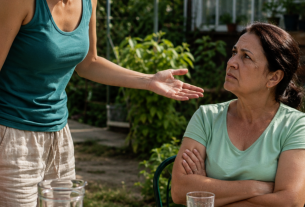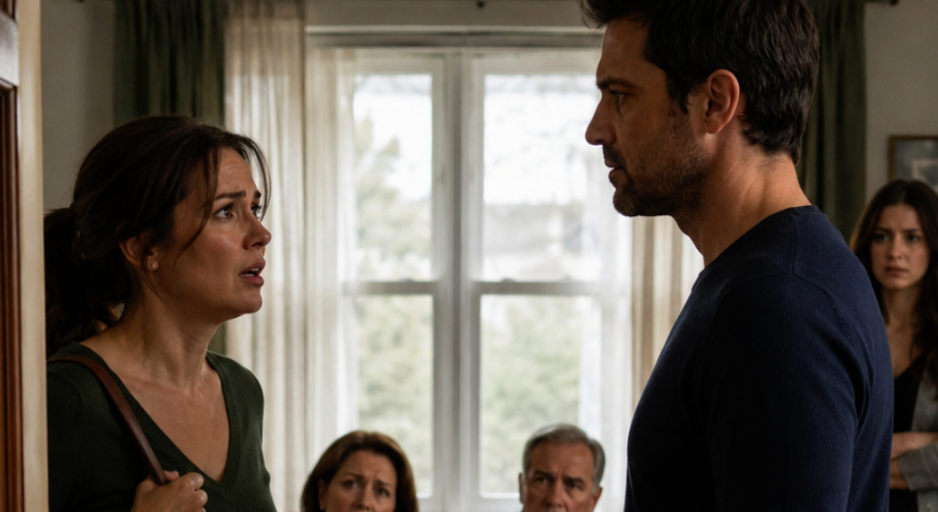
“Have you completely lost your nerve? I come home, and there’s already a whole camp with suitcases living here?!”
Vika did not say it loudly, but she said it so sharply that the laughter in the room stopped at once.
For a second, everyone froze: her sister-in-law Larisa with a bag of children’s clothes in her hands, Larisa’s husband Oleg beside an open suitcase, her mother-in-law Zinaida Pavlovna at the table, two children on the carpet with a tablet, and Artyom himself, Vika’s husband, who until that moment had been trying to smile as if nothing special had happened.
Vika stood in the middle of her own living room in her outdoor jacket, with her bag on her shoulder and her keys in her hand. She had not taken off her shoes. She had not even walked farther inside. One glance was enough for her to understand: these were not guests for the evening. These people had come seriously.
By the entrance stood three suitcases, two checkered bags, a child’s backpack with a keychain, and a bag of shoes. On the cabinet lay someone else’s keys, chargers, and a child’s hat. Towels that were not hers were already hanging in the bathroom. From the kitchen came the smell of food being cooked without her, in her dishes, in her home.
That very morning, the apartment had been empty and quiet.
Vika had gone to work on an ordinary morning, quickly checking whether the bathroom light was off, whether the kitchen window was closed, and whether she had forgotten her documents. Artyom had stayed home and said he was working remotely that day and would also wait for the internet technician.
“Just don’t forget that I’ll be late tonight,” she said at the door. “I need to go to the notary for a copy of a document and then stop by the store.”
“I remember,” Artyom replied without looking up from his phone. “Don’t worry.”
At the time, she had not paid attention to his short answer. In recent weeks, he had become distracted in general. Sometimes he went out to talk on the stairwell, sometimes he shut himself in the room, sometimes he abruptly changed the subject when Vika entered. But she blamed it on his constant conversations with his mother.
Zinaida Pavlovna knew how to appear in their lives even from a distance. She could call at seven in the morning and ask why Artyom had not answered the phone at night. She could send him a list of medications for his father, even though his father lived with her and was perfectly capable of going to the pharmacy himself. She could demand that Vika help Larisa choose clothes for the children online because, in her mother-in-law’s opinion, Vika understood city stores better.
For a long time, Vika tried to be polite. Not out of weakness. It simply seemed to her that adults should be able to speak calmly.
The apartment was hers. A two-room apartment in an ordinary building, nothing luxurious, but her own. She had inherited it from her father. After his death, Vika entered into the inheritance after the required six months, registered everything, received the official extract, and gathered the documents into a separate folder. Artyom had already been her husband then, but he had no relation to this apartment. He knew that. His mother knew it too. Larisa knew it especially well, because once she had already tried to ask why Vika did not want to sell the place and buy something bigger, but already jointly with Artyom.
“Why would I?” Vika had calmly asked then. “I’m comfortable as it is.”
“What do you mean, why?” Larisa had said in surprise. “A family should expand. Later there will be children. And Artyom would feel calmer if the housing were shared.”
Back then, Vika had only looked at her more carefully.
“Artyom feels calmer when he is at home and when he is expected here. Documents are not required to calm him down.”
Larisa laughed as if it were a joke, but Vika noticed how her jaw tightened.
After that conversation, the topic of the apartment disappeared for a while, then resurfaced again. Zinaida Pavlovna might say over dinner:
“A smart woman should understand that a husband needs to feel like the man of the house.”
Vika would answer:
“The man of the house is the one who does not confuse care with the right to dispose of someone else’s property.”
At such moments, Artyom pretended not to hear. In general, he rarely argued with his mother. He could spend hours telling Vika how tired he was of her pressure, but as soon as Zinaida Pavlovna raised her voice, he immediately became soft, compliant, almost guilty.
“You just don’t understand,” he would tell Vika afterward. “She spent her whole life carrying the house, Larisa, and me on her shoulders. She wants us to be closer.”
“Closer means coming to visit when invited,” Vika replied. “Not deciding for me who will live in my apartment.”
Then Artyom would take offense.
“You always take everything so aggressively.”
“Because your relatives don’t know how to ask. They know how to arrive with a decision already made.”
He would remain silent, and that silence irritated Vika more than words.
Things became especially worse after Larisa and Oleg quarreled with the owner of their rented apartment. They lived on the other side of the city and had been renting for several years, but they were constantly in conflict. Either they did not like the appliances, or the upstairs neighbor, or the courtyard, or the payment terms. Vika did not interfere until one day Zinaida Pavlovna called her directly.
“Vika, we need to take Larisa in for a while.”
At that moment Vika was sitting in the corridor of a clinic, waiting for her turn, and at first she thought she had misheard.
“Take whom in?”
“Larisa and the children. Oleg too, of course, with them. But not for long. They’ll find another option.”
“No.”
There was a pause on the other end.
“You didn’t even think about it.”
“I thought about it in advance. No.”
“You have two rooms.”
“One bedroom and one living room. And I am not going to turn my apartment into a public passageway.”
“What dramatic words,” her mother-in-law said dryly. “People are in a difficult situation.”
“People in a difficult situation first call and ask whether they can come. They don’t appoint themselves a place to live.”
“Artyom will talk to you.”
“Artyom can talk as much as he wants. The decision is still mine.”
After that conversation, Vika called her husband. He did not answer right away.
“Your mother just suggested settling Larisa with us.”
“Well, not settling, but temporarily,” Artyom answered cautiously.
“Did you know?”
He delayed his answer by a fraction of a second, but Vika heard everything.
“They were just discussing options.”
“They did not discuss them with me.”
“I wanted to tell you tonight.”
“Tonight you would have heard the same thing: no.”
“Vika, they are not strangers.”
“They are not strangers to you. To me, they are four people who will live in my apartment, use my things, occupy my space, and expect me to adjust on top of that.”
“You’re exaggerating.”
“No. I remember how your sister came for one day and left a whole bag of trash on the balcony because it was inconvenient for her to take it out. I remember how her younger son opened my work cabinet and dumped my documents on the floor. And I remember how Larisa said that children are children.”
Artyom exhaled heavily.
“We can do this like human beings.”
“Like human beings means asking me before buying tickets, packing suitcases, or promising someone my apartment.”
“I didn’t promise anyone anything.”
Vika half-believed him then. Not because he convinced her, but because she wanted to live peacefully.
A week passed. Then a few more days. Larisa did not call again. Her mother-in-law also suddenly became quieter. Artyom walked around thoughtful, but he did not bring up the subject. Vika decided that the unpleasant conversation was over.
She was wrong.
That day, everything began with small things. In the morning, Artyom put his phone away too quickly when Vika entered the kitchen. Then he suggested that she not hurry home.
“Maybe after the notary you could stop by Svetka’s? You’ve been meaning to for a long time.”
“Why today, exactly?”
“Well, just because. Since you’ll be nearby anyway.”
Vika looked at him over her cup.
“Are you trying to get me out of the house?”
Artyom laughed too loudly.
“Come on. I just thought it would be good for you to relax.”
She said nothing then, but inside, a small lock seemed to click. It was not anxiety, no. More like alertness. Vika knew her husband well: when he lied, he began to fuss and say too much.
After work, she really did go to the notary and picked up a copy of the inheritance certificate because she was planning to update her folder of documents. Then she bought groceries, but she did not go to Sveta’s. She did not want to. She was tired. And that unpleasant feeling would not leave her.
She reached her floor and heard voices even before the elevator doors had fully closed behind her.
At first, she thought it was the neighbors. But the laughter was too close. Then a child’s shriek came from behind her door, followed by Larisa’s voice:
“Danya, don’t touch that, it’s not ours! Well, all right, we’ll sort it out later.”
Vika stopped in front of the door. For several seconds, she stared at the keyhole, then slowly took out her key.
The lock opened immediately. In the hallway, she was met by the smell of someone else’s street, someone else’s bags, and someone else’s confidence.
She opened the door wider and froze.
Suitcases. Shoes. Children’s jackets. Bags.
Her hand did not even lower immediately. The keys clinked against the metal ring, and someone called from the room:
“Artyom, is that you?”
Vika entered.
A toy car was lying on the floor. Larisa’s makeup bag stood by the mirror. Oleg’s jacket hung on the hook. Vika slowly walked farther in without removing her shoes. Each step echoed in her temples with a dry knock.
Everyone was in the living room.
Larisa had settled on the sofa as if choosing a place for many long weeks. Her younger son lay on his stomach on the carpet, dragging his finger across a tablet screen. The older one had climbed into the armchair with his feet up. Oleg was unpacking things from a suitcase directly onto Vika’s chair. Zinaida Pavlovna was issuing orders from the table:
“Put this bag in the bedroom for now, we’ll sort it out later. Larisa and the children will stay here, and Oleg and I will see how things go.”
Vika stopped in the doorway.
Artyom came out of the kitchen with a plate in his hands. He saw his wife and immediately turned pale. He carefully placed the plate on the edge of the table, but did it so clumsily that the spoon slipped and fell to the floor.
“Vika… you’re already back?”
She looked at him. She did not blink. She did not ask immediately. She wanted to give him a chance to tell the truth himself.
“What is going on here?”
Larisa was the first to try to smile.
“Oh, Vikusya, hi! We arrived a little earlier. We didn’t want to bother you, you were working.”
Vika shifted her gaze to Larisa’s suitcase.
“A little earlier than what?”
“Well… than the move,” Larisa said cheerfully, then immediately corrected herself. “A temporary one, of course. Temporary.”
Oleg coughed.
“We’re literally only here until we find a normal option. Housing is difficult right now.”
Zinaida Pavlovna raised her head with the expression of someone who thought Vika had entered someone else’s conversation and was rudely interfering.
“No need to make that face right away. They have children. Should they sleep on the street?”
Vika slowly took the bag off her shoulder and placed it on the cabinet. Then she looked around the room. Her gaze paused on each of them: Larisa, Oleg, the children, her mother-in-law, Artyom.
He stepped toward her.
“Vika, let’s stay calm. It won’t be for long. Really. Everything fell through urgently over there, the landlord asked them to move out, there are no decent options. I thought you would understand.”
“You thought?” she asked quietly.
“I didn’t want to start a scandal in advance.”
“In advance?” Vika gave a short laugh. “So you did expect a scandal.”
Artyom ran a hand over his face.
“Well, because you take everything so sharply.”
Larisa immediately perked up.
“Exactly. We’re not here forever. We’ll live here for a couple of weeks. Maybe a month. The children are quiet, Oleg will be at work, and I won’t bother anyone either.”
At that moment, the younger boy hit the leg of the coffee table with his toy car. The older one said loudly:
“Mom, where are we going to sleep? There isn’t much space here.”
Vika looked at him, then at Larisa.
“Good question. Where were you planning to sleep?”
Larisa waved her hand.
“Well, the children in the living room, and Oleg and I here too somehow. Mom said we could buy a mattress. And if it gets too cramped, Artyom said you two could squeeze in the bedroom for now.”
Vika turned to her husband.
Artyom looked away.
That was enough.
Not the suitcases. Not the strange shoes. Not her mother-in-law at the table.
It was enough that he had already divided up her apartment. He had not asked. He had not warned her. He had not even been ashamed. He had simply decided that Vika would put down the groceries, take off her jacket, and start adjusting.
She unzipped her jacket but did not take it off.
“So you let them in with my keys?”
“With our keys,” he tried to correct her.
“With the keys to my apartment, Artyom.”
Zinaida Pavlovna sharply placed her palm on the table.
“Here we go again! Yours, mine… How long are you going to keep throwing this in our faces? Did you get married, or did you open a separate principality?”
Vika turned to her.
“I got married. I did not sign permission for relatives to move in without my consent.”
“You’re too proud,” her mother-in-law said. “Larisa has children. She needs help.”
“Help her. Rent her a place. Take her in yourself. Pay for a hotel. Ask acquaintances. But do not include my apartment on the list of options.”
Oleg straightened up.
“Listen, why be like that? We’re not going to ruin anything.”
Vika looked at the open suitcase on the chair.
“You already are. Not things. Boundaries.”
Larisa flared up.
“What boundaries? We only just came in! Artyom opened the door himself!”
“Artyom is not the owner.”
Those words hung in the room, heavy and unpleasant.
Artyom jerked.
“Vika, not in front of everyone.”
“You shouldn’t have brought everyone here without me.”
“I’m your husband. I live here.”
“You live here. But you have no right to move third parties in without my consent.”
Zinaida Pavlovna grimaced.
“Now she’s speaking in legal terms. What a good wife, nothing to say.”
“A good wife is not obligated to be a free hotel.”
The children fell quiet. Larisa looked at her mother as if waiting for an order. Oleg stopped unpacking and zipped up the suitcase, but did it slowly and demonstratively.
Artyom came closer.
“Let’s go to the kitchen. We’ll talk.”
“No. It started here, and we’ll talk here.”
“You’re emotional right now.”
Vika slowly turned her face toward him. Her cheeks had reddened, her fingers tightened around the keys, but her voice remained steady.
“I am standing in my own apartment, where other people’s things have been laid out without my consent. Don’t call this emotion. Call it your actions.”
Larisa abruptly got up.
“Why are you so obsessed with these things? Where are we supposed to go with the children? To the train station?”
“You should have decided in advance where you were going. Not moved in through my husband.”
“And what if this had happened to you?” Larisa asked. “What if you were kicked out?”
“I won’t be kicked out of my own apartment. And if I were renting, I would not go to people without an invitation.”
Zinaida Pavlovna rose from the table.
“Vika, enough. You’re disgracing everyone in front of the children.”
“The disgrace was arranged by the adults who brought children to a place where no one was expecting them.”
Her mother-in-law opened her mouth but did not immediately find an answer.
Artyom tried to intervene again:
“Vika, I understand I should have told you earlier…”
“Not told. Asked.”
“All right, asked. I’m guilty. But they’re already here now. We can’t kick them out in the evening.”
“It’s seven o’clock. There are hotels in the city, apartments by the day, relatives, and your mother. Choose.”
Larisa gave a short, joyless laugh.
“Yes, of course. We should take two children and go God knows where right now because the apartment owner decided to show her character.”
Vika nodded.
“Exactly. The apartment owner has decided to remind you that no one lives here without her consent.”
Oleg glanced at Artyom.
“You said she’d grumble and calm down.”
The room became quiet again.
Artyom closed his eyes for a second. Vika slowly turned to him.
“Now this has become really interesting.”
“Oleg, why did you…” Artyom began.
“What?” Oleg said irritably. “We packed our things because of you. You said the matter was settled.”
Vika took a step toward her husband.
“You told them the matter was settled?”
Artyom clenched his fingers into a fist, then unclenched them.
“I thought I could convince you.”
“No. You decided to put me in front of a fact so that I would feel awkward kicking people out in front of the children.”
Larisa cut in sharply:
“No one wanted to humiliate you. It’s just that you always refuse everyone. It’s impossible to come to an agreement with you normally.”
“It is very possible to come to an agreement with me if you start with a question, not with suitcases.”
Zinaida Pavlovna came closer to Vika. Not right up to her, but close enough to apply pressure.
“Vika, you are destroying your relationship with your husband’s relatives right now.”
“No, Zinaida Pavlovna. Right now I am saving my apartment from your habits.”
“What habits?”
“Deciding for others. Arriving without an invitation. Using someone else’s kindness until that person starts defending herself, and then accusing her of cruelty.”
Her mother-in-law narrowed her eyes.
“You’ve been carrying this inside for a long time.”
“Yes. Since the day Larisa asked why Artyom wasn’t registered in my apartment. Since the day you said a husband should be made to feel like the owner. Since the day Artyom started going out to the stairwell to discuss my home with everyone.”
Artyom sharply raised his head.
“I wasn’t discussing anything bad.”
“The result is standing in my hallway.”
That sentence hit harder than shouting. Artyom turned away. Larisa went to the suitcase, but not to pack. She went to take a charger from the side pocket.
Vika saw the movement and understood: they were still hoping to stay.
Then she took off her jacket and carefully hung it on her own hook. After that, she picked up her phone.
“What are you doing?” Artyom asked warily.
“I’m going to call and document the fact that there are people in my apartment who refuse to leave.”
Larisa jerked her head up.
“You’re going to call the police? Because of relatives?”
“Because of strangers who moved into my home without my consent.”
“We’re not strangers!” Larisa shouted.
“For the documents, you are.”
Oleg turned pale.
“Wait, why the police right away? We didn’t break in. We were let in.”
“You were let in by a person who does not have the right to dispose of my housing however he pleases.”
Artyom gripped the edge of the table.
“Vika, don’t. Let’s not do this.”
“Then you have ten minutes to pack your things.”
Zinaida Pavlovna smirked.
“Now come the ultimatums.”
“Yes.”
Vika tapped the screen of her phone and opened the timer.
“Ten minutes.”
For several seconds, no one moved.
Then Larisa snapped:
“Mom, say something to her! She’s completely… She’s throwing us and the children out onto the street!”
Zinaida Pavlovna turned to Artyom.
“Are you a man or what? Tell your wife properly.”
Vika did not even turn. She was looking at her husband.
Artyom swallowed. His face had turned gray. He understood that they were now waiting for a command from him. His mother was waiting, his sister was waiting, Vika was waiting. Only for the first time, his word decided nothing. Because he had already made his choice when he opened the door.
“Vik,” he said dully. “At least until morning.”
“No.”
“I’m asking.”
“You didn’t ask when you let them in.”
“I made a mistake.”
“Then fix it.”
Larisa threw up her hands.
“What a circus! A queen sitting in two rooms and trembling over every square meter!”
Vika turned to her.
“I’m not trembling. I’m protecting. Those are different things.”
“Who even needs your apartment?” Larisa said angrily.
Vika looked at the suitcases.
“Judging by the hallway, you do.”
Oleg quietly said to his wife:
“Larisa, pack. Enough.”
“What are you talking about?” she snapped, turning to him. “Where are we going?”
“To your mother’s.”
Zinaida Pavlovna immediately straightened.
“To me? I don’t have space.”
Vika smiled faintly. For the first time that evening, almost with amusement.
“How quickly the price of sympathy becomes clear.”
Her mother-in-law’s face flushed in patches.
“We have a one-room apartment. Father is ill. Where am I supposed to put them?”
“So I have a palace, then?”
“You’re young, you’ll endure it.”
“No.”
Oleg was already fastening the suitcase. His movements became sharp. It was clear he was angry, but he did not want to create a scandal. Perhaps because he understood: anything further would only be worse.
Larisa stood in the middle of the room, holding a child’s sweater, and looked at Vika as if Vika had personally ruined her life.
“You’ll regret this later.”
“Regret what?”
“That you turned away from people.”
“I turned away from insolence.”
The children began to whine. The older one asked why they were going somewhere again. The younger one reached for the tablet. Vika silently picked up the toy car from the floor and held it out to Larisa.
“Take it.”
Larisa snatched the car away as if Vika had been holding something stolen.
Artyom stood nearby and helped no one. Neither his sister nor his wife. He seemed to be waiting for the situation to choose a convenient way out by itself. But there was no convenient way out anymore.
Vika looked at the timer.
“Five minutes.”
“Are you enjoying this?” Artyom asked quietly.
She turned to him.
“No. I am remembering.”
“What?”
“What you look like when you need to choose honesty, but you choose silence.”
He opened his mouth but said nothing.
Larisa and Oleg packed quickly. At first, Zinaida Pavlovna tried demonstratively not to participate, but then she began picking up bags too. She did it sharply, throwing glances at Vika.
“You’ll see, Artyom,” she said. “You won’t get far with a wife like this. Today she threw out your relatives, tomorrow she’ll throw you out.”
Vika answered calmly:
“If Artyom brings someone to live in my apartment without consent again, I will.”
Artyom looked up at her.
“Are you serious?”
“Yes.”
“So because of this, you’re ready to destroy the marriage?”
“The marriage is not destroyed by refusing a camp in the living room. The marriage is destroyed by secretly deciding to bring it in.”
Oleg dragged the first suitcase into the hallway. Larisa put jackets on the children. The younger boy started crying because he wanted to finish watching his cartoon. Larisa said loudly:
“Thank Aunt Vika. She’s the one kicking us out.”
Vika crouched in front of the boy, but kept her distance so as not to intrude on the child.
“No one is kicking you out because of bad behavior. The adults brought you somewhere they had not agreed upon. That is their mistake.”
Larisa sharply tugged her son by the sleeve.
“Don’t talk to her.”
Vika stood up.
“Correct. Better talk to your mother about why she didn’t rent housing in advance.”
Larisa wanted to answer, but Oleg had already taken her by the elbow.
“Enough.”
“It’s not enough!” she hissed. “She humiliated us.”
“We came without an invitation ourselves,” Oleg said quietly.
Those words sounded unexpected. Even Zinaida Pavlovna turned to him.
Oleg was not looking at anyone.
“I said from the beginning that this was wrong. But you and Artyom decided you would push through.”
Larisa went pale.
“Whose side are you on right now?”
“The side of common sense. Get the children ready.”
For the first time that evening, Vika looked at Oleg without irritation. Not with gratitude, no. She simply noted that at least one person had called things by their names.
A few minutes later, they were standing in the hallway. The suitcases once again blocked the entire passage, only now they were moving toward the exit.
Zinaida Pavlovna put on her shoes last. Before leaving, she turned to her son:
“Artyom, are you coming with us?”
Vika slowly looked at her husband.
There it was, the real question.
Artyom was confused.
“Mom, where would I go right now?”
“What do you mean, where? You’ll help your sister. Then you’ll sort things out with your wife.”
The word “your” sounded as if Vika were not a person, but a problem inside the apartment.
Artyom looked at Vika.
“I’ll see them off and come back.”
Vika went to the cabinet and picked up the set of keys she had noticed when she entered.
“Whose are these?”
Artyom flinched.
“My spare ones.”
“Why are they lying separately?”
He was silent.
Larisa looked away too quickly.
Vika lifted the keyring. It had a keychain on it that she did not recognize.
“Did you make a copy?”
“Just in case,” Artyom said. “So Mom could come in if something happened.”
For several seconds, Vika looked at the keys. Then she put them into the pocket of her house cardigan.
“These stay with me.”
Zinaida Pavlovna stepped forward.
“Those are Artyom’s keys.”
“They are keys to my apartment.”
“You have no right to take your husband’s keys!”
“I have the right to take an extra copy made without my knowledge. Artyom will keep his main key for now. For now.”
Artyom asked sharply:
“What does ‘for now’ mean?”
“It means exactly that. Today you see your relatives off. Then you come back alone. And we talk. Without your mother, without your sister, without suitcases.”
“And if I don’t come back?”
Vika looked him straight in the face.
“Then tomorrow I call a locksmith and change the lock. I’ll pack your things separately. You can pick them up by agreement.”
Larisa gasped quietly.
“What a wife…”
Vika did not turn.
“This is no longer your concern.”
Oleg opened the door. The children went out first. Larisa squeezed out after them with a bag. Zinaida Pavlovna lingered on the threshold.
“Remember this, Vika. Things like this are not forgotten.”
“That is exactly what I am counting on.”
The door closed.
The apartment became quiet, but the silence was not calm. It lay heavily, like dust after repairs, when everything seems to be over but it is still hard to breathe.
Artyom remained in the hallway. He did not leave immediately. He looked at Vika as if hoping that she would soften now, cry, apologize for being harsh. But Vika simply stood in front of him with the strange set of keys in her pocket.
“Do you really want to take this to divorce?” he asked.
“I want to understand whom I’m living with.”
“Because of one mistake?”
“This is not one mistake. It is a chain. First you hid the conversations. Then you promised my apartment. Then you made a copy of the keys. Then you let people in. Then you waited for me to swallow it.”
Artyom lowered his head.
“I thought it would be easier that way.”
“For whom?”
He did not answer.
“For you,” Vika said. “For your mother. For Larisa. For everyone except me.”
“I’m being torn between you.”
“No, Artyom. You are not being torn. You choose the side that demands louder. And at home you hope I will endure it.”
He sat on the edge of the shoe cabinet, then immediately stood up, as if he himself understood how pathetic he looked.
“I need to see them off.”
“Go.”
“You won’t change your mind?”
“No.”
He took his jacket and left.
Vika locked the door from the inside and turned the bolt. Then she slowly walked through the apartment.
In the living room, there were crumbs, a candy wrapper, and a child’s sock under the armchair. On the table lay an open pack of cookies she had not bought. In the bathroom, someone else’s toothbrush stood on the shelf. In the kitchen, dishes were in the sink, and next to them was a bag of Larisa’s groceries.
Vika did not rush to clean. She took out her phone and began photographing everything: the suitcase marks in the hallway, the things, the towels, the toothbrush, the open cabinet where someone had already moved her boxes aside.
Not because she planned to go to court immediately. Simply because now she wanted evidence. Not verbal. Real.
Then she wrote to Artyom:
“If you come back alone, we’ll talk. Your mother, Larisa, and Oleg are not to come to this apartment again without my invitation. The extra keys are with me. Tomorrow the lock will be changed.”
The reply came two minutes later:
“Don’t dramatize. They went to acquaintances. Mom is crying.”
Vika looked at the screen and, for the first time that evening, smiled without anger.
“My apartment is not responsible for your mother’s tears.”
Artyom did not answer.
She called a locksmith for the morning. She did not file any complaints or invent anything extra. She simply called the service, confirmed the time, and ordered the lock cylinder changed. Then she gathered the things that had been left behind: the toothbrush, the child’s sock, the charger, a bag of grains, Larisa’s makeup bag. She put everything into one bag and placed it by the door.
She cleaned for a long time. Not fussily, not crying. Calmly and thoroughly. She swept up the crumbs, wiped the floor, washed the dishes. The plates did not clatter, the water ran evenly. Every movement returned to her the feeling that this was her home.
Artyom returned almost at midnight.
Vika was sitting in the kitchen with a notebook. In front of her lay the apartment documents, the copy of the inheritance certificate, the official extract, and her passport. She was not going to wave papers around, but she wanted him to see: the conversation would not be about hurt feelings. It would be about boundaries.
Artyom entered quietly.
“I’m back.”
“I can see that.”
He took off his jacket, walked into the kitchen, and stopped in the doorway.
“They rented an apartment for a few days. Oleg found it through an acquaintance.”
“So they could.”
Artyom tiredly rubbed the bridge of his nose.
“Vika, I don’t want to fight.”
“Neither do I. That’s why I’m speaking calmly. First: your relatives do not come here anymore without my direct consent. Second: no copies of keys. Third: you no longer discuss my home as an option for anyone. Fourth: if this happens again, you move out.”
He sat across from her.
“You’re talking to me like I’m a tenant.”
“Today you behaved like a person who forgot where he lives.”
“I’m your husband.”
“Then behave like a husband, not like your mother’s representative in my apartment.”
Artyom lifted his eyes.
“You’ve always been harsh.”
“No. I was patient for a long time. You confused the two.”
He was silent. Vika could see how badly he wanted to object, but every word ran into facts.
“Mom said I should have insisted,” he finally said.
Vika tilted her head slightly.
“And do you still think she is right?”
“I don’t know.”
“That is the problem.”
He looked at the documents.
“Why did you take all of this out?”
“So that tomorrow you don’t say you didn’t understand. This apartment came to me by inheritance. It is not shared property. You live here because I wanted to live with you. Not because you gained the right to dispose of it.”
“I wasn’t going to take it away.”
“Today you already took away my right to open the door and enter an empty home.”
Artyom lowered his gaze. His shoulders sagged. For the first time that evening, he looked not offended, but guilty.
“I really thought everything would be settled afterward.”
“Settled means the person agreed. When a person is pressured by circumstances, it is not settled. It is forced through.”
“I was afraid to tell you directly.”
“That means you knew the answer.”
He nodded almost imperceptibly.
Vika closed the folder with the documents.
“Tonight you sleep in the living room.”
Artyom flinched.
“Vika…”
“Don’t argue. I need space. And you need to think about where helping relatives ends and betraying your wife begins.”
He wanted to say something but stopped. He took a blanket from the closet and went to the living room.
Vika remained alone in the kitchen. She did not feel victorious. Victory is when the enemy is outside. Here it hurt more: the enemy turned out not to be her husband’s relatives, but his weakness, his habit of yielding to those who pressured him more loudly.
In the morning, the locksmith came without unnecessary questions. He quickly changed the lock cylinder, checked the keys, and handed the set to Vika. Artyom stood in the corridor, gloomy but silent.
When the repairman left, Vika separated one key and placed it in front of her husband.
“This is yours. One. No copies.”
He took the key.
“You don’t trust me now.”
“Yes.”
The answer was honest and short.
Artyom clenched the key in his palm.
“And what happens next?”
“Next, you decide whether you want to earn back trust. Not with words. With actions.”
That same day, the calls began.
First Larisa. Vika did not answer. Then Zinaida Pavlovna. Vika did not answer either. Then the messages started pouring in.
“You went too far.”
“The children were crying.”
“Artyom is beside himself because of you.”
“You can’t treat people like that.”
Vika read everything and answered only once, in the group chat where Artyom, Larisa, and Zinaida Pavlovna were all present:
“I will repeat this once. No one comes or arrives at my apartment without my invitation. Yesterday you entered and tried to stay without the owner’s consent. This will not happen again. The things you forgot can be picked up by the entrance by agreement. You are not coming up to the apartment.”
A minute later, Artyom called.
“Why did you write it like that?”
“So there are no different versions.”
“Mom now is completely…”
“Artyom,” Vika interrupted. “Your mother is not a participant in our marriage. And she is certainly not a participant in my housing decisions.”
He fell silent.
Larisa picked up the bag in the evening. Vika did not go out. Artyom went downstairs himself. He returned ten minutes later, angry and pale.
“She said you destroyed everything completely.”
“What exactly?”
“The relationship.”
“Relationships are not built on moving yourself in without permission.”
He threw his keys onto the cabinet, then noticed Vika’s look, picked them back up, and placed them down carefully.
“I’m sorry.”
Vika raised her eyes.
It was the first normal word in twenty-four hours.
“For what exactly?”
He exhaled.
“For not asking. For the keys. For deciding that you wouldn’t go anywhere. For wanting to be good for everyone and, in reality, hurting you.”
Vika looked at him for a long time. She wanted to believe him. Very much. But faith after such things does not return in one evening.
“Accepted,” she said. “But that is not enough.”
“I understand.”
“Good.”
The next few days were difficult. Artyom walked around quietly, tried to help around the house, cooked dinner himself, and did not start conversations about his mother. Vika did not push him away deliberately, but she also did not pretend everything had passed.
On the third day, Zinaida Pavlovna came herself.
Vika saw her through the peephole and did not open immediately. Her mother-in-law stood there with a bag and rang the bell so insistently that it was as if she had the right to demand entry.
Artyom came out of the room.
“Who is it?”
“Your mother.”
He tensed.
“I’ll open.”
“No,” Vika said. “We’ll open together. And she will not come past the threshold unless I invite her.”
Artyom wanted to object, but he met her gaze and nodded.
Vika opened the door on the chain.
“Hello, Zinaida Pavlovna.”
Her mother-in-law immediately tried to step forward, but the door did not open fully.
“What kind of circus is this?”
“A conversation at the door.”
“Artyom!” she called, trying to look over Vika’s shoulder. “Do you see how I’m being treated?”
Artyom came and stood beside Vika.
“Mom, speak here.”
Zinaida Pavlovna froze. She had clearly not expected her son not to move his wife aside.
“I came to talk normally.”
“Normally means without trying to force your way in,” Vika replied.
“You insulted me in front of the whole family.”
“I removed people who were trying to stay in my apartment without permission.”
“Larisa is still in shock.”
“Next time, let her think in advance where she is going.”
Her mother-in-law turned to her son.
“Artyom, do you hear this?”
He slowly nodded.
“I hear it. And Vika is right.”
Zinaida Pavlovna recoiled as if she had been pushed.
“What?”
“I should not have let you in. And I should not have made the keys.”
“Are you against your mother now?”
“I am for order. And for my wife.”
Vika said nothing, but her fingers on the door handle relaxed a little.
Zinaida Pavlovna turned crimson.
“So she turned you against me after all.”
Artyom shook his head.
“No. I understood it myself.”
“You understood badly. When you need your family, don’t come.”
“Mom, family should not begin with seizing an apartment.”
His mother opened her mouth, then closed it. Her face twitched, but Vika felt no pity. The technique was too familiar: first pressure, then offense.
“Fine,” Zinaida Pavlovna said. “Live as you know best.”
“That is what we will do,” Vika replied.
She closed the door.
Artyom stood beside her, looking at the floor.
“Thank you for saying it yourself,” Vika said.
“I said it late.”
“Better late than staying silent again.”
He nodded.
But the story did not end there.
A week later, Vika received a call from her neighbor on the first floor, Valentina Sergeyevna. They sometimes spoke because Vika helped her with utility bills through the app, and in return the woman watched the entrance better than any camera.
“Vikusha, are you home?”
“No, I’m at work. Why?”
“A woman came to your place. With that high hairstyle. And a young woman with her. They were hanging around the entrance door, then talking to someone on the phone. I asked who they were visiting, and they said their son. But they didn’t go upstairs.”
Vika closed her eyes for a second.
“Thank you for telling me.”
“Be careful there. They looked unhappy.”
Vika thanked her and wrote to Artyom:
“Your mother and Larisa were at the building. Did you know?”
The answer did not come immediately.
“No. I’ll call now.”
Half an hour later, he called Vika himself.
“They wanted to talk to you.”
“Without warning?”
“Yes. I told them not to do that again.”
“And?”
“Mom hung up. Larisa said you had turned everyone against each other.”
Vika tiredly ran her palm over the table.
“Artyom, I am not going to live under siege.”
“I understand.”
“If they come without invitation again, I will call the police. Not for a family spectacle. Simply so strangers don’t wait around by my apartment.”
“I understand. I’ll write to them myself.”
That evening, he showed her the message he had sent to his mother and sister:
“Do not come to Vika’s apartment without her invitation. Do not wait for her at the entrance. Moving in, visits, and conversations about her housing are not handled through me. If you pressure her, I will stop communicating.”
Vika read it twice.
“Did you write this yourself?”
“Myself.”
“Without a hint?”
“Yes.”
She returned the phone.
“That is already an action.”
For the first time in those days, Artyom exhaled slightly.
But trust did not return quickly. Vika still checked the door. She kept the keys in one place. She moved the documents into a small safe she had long been planning to buy. Not out of fear, but out of respect for her own experience.
Larisa still tried to send pitiful messages. She wrote that the children were uncomfortable, that the temporary apartment was far away, that Oleg was angry, that everyone was tired. Vika did not answer. Then Larisa changed her tone:
“I didn’t think you were like this.”
Vika finally wrote:
“And I didn’t think you would come to live without an invitation. This conversation is over.”
After that, Larisa disappeared.
A month passed.
During that time, Artyom changed — not magically, not instantly. He still sometimes flinched when his mother called. Sometimes after talking to her, he became gloomy. But now he did not hide his phone and did not go out to the stairwell. If Zinaida Pavlovna started complaining about Vika, he cut the conversation short.
One evening, he himself said:
“I talked to Larisa. They found another apartment. Signed a proper lease.”
“Good.”
“She said that if you hadn’t kicked them out back then, they wouldn’t have moved out of our place in three months.”
Vika looked up.
“She said that herself?”
“No. Oleg did. He said Larisa was already planning to look for a kindergarten nearby.”
Vika slowly closed the book she was holding.
“You see? ‘Not for long’ sometimes means ‘until they are forced out.’”
Artyom sat beside her, but not too close.
“I was an idiot.”
“You were convenient.”
“For them?”
“For everyone except yourself. And except me.”
He nodded.
“I don’t want to be like that anymore.”
“Then don’t be.”
Vika said it calmly. Without threat. Without softness. Simply as a condition of adult life.
A few days later, Zinaida Pavlovna sent Artyom a short message, and he showed it to Vika:
“Tell Vika I got carried away.”
Vika looked at the screen.
“That is not an apology.”
“I know.”
“But it is no longer an order.”
“Yes.”
She did not answer. Not because she wanted to punish anyone. Simply because not every phrase needs to be picked up and dragged into a conversation. Sometimes it is useful for a person to remain with what they left unsaid.
Another week later, Artyom himself suggested:
“Maybe we should go to a family psychologist?”
Vika looked at him carefully.
“Not to courses, not to a training, not to one of your mother’s acquaintances?”
For the first time in a long while, he smiled normally.
“No. To a specialist. So I can learn not to be a carrier pigeon between you and Mom.”
Vika did not laugh, but the corners of her eyes softened.
“I’ll think about it.”
“That is already not bad.”
She really did think about it. She did not agree immediately. What mattered to her was not that Artyom had offered a beautiful way to fix things. What mattered was that he continued doing ordinary, boring, adult things: telling the truth, not hiding conversations, not promising what was not his, not expecting his wife to endure everything in silence.
One evening, returning home, Vika stopped at the door and remembered that day: the strange suitcases, the laughter from the room, Larisa on the sofa, Zinaida Pavlovna at the table, Artyom with the plate in his hands.
Back then, it had seemed to her that the apartment had become someone else’s in a single hour.
Now she opened the door with the new key and entered silence. In the hallway stood only her shoes and Artyom’s. On the cabinet lay two sets of keys — exactly two, with no extra copies. The living room was clean. No bags. No strange voices. No feeling that someone would again try to confront her with an accomplished fact.
Artyom came out of the kitchen.
“You’re early.”
“Yes.”
“Is everything all right?”
Vika looked at him. He was not fussing. He was not hiding his phone. He was not pretending to be cheerful to conceal guilt. He simply stood there and waited for an answer.
“Everything’s all right.”
She took off her jacket and went into the room.
The next day, Larisa called after all. Vika answered because she was tired of things being unfinished.
“Well, are you satisfied?” Larisa asked without greeting. “Now we live in the middle of nowhere.”
“You live where you rented housing yourselves.”
“You could have helped.”
“I did help. I quickly explained that my apartment was not suitable for you.”
“You’re cruel.”
“No. I am precise.”
Larisa fell silent.
“We really thought then that you would agree,” she said more quietly.
“No, Larisa. You thought I would feel too uncomfortable to refuse.”
Breathing was heard on the other end.
“Maybe that’s true.”
It was almost an admission.
“Then don’t do that again. Not with me, not with anyone else.”
“All right,” Larisa said dully.
The conversation ended without reconciliation, but also without shouting. Vika put the phone down and felt a strange relief. Not joy. Just one more knot untied.
That evening, Artyom asked:
“Was she arguing again?”
“She tried. Then she got tired.”
“How are you?”
Vika shrugged.
“Fine. I’m no longer afraid of seeming bad.”
He looked at her seriously.
“You’re not bad.”
“I know.”
And that was the main thing.
Because on the evening when Vika opened the door and saw the strange suitcases, what was being decided was not Larisa’s fate or Zinaida Pavlovna’s convenience. What was being decided was whether Vika would remain the mistress of her own life or once again allow insolence to be called misfortune, pressure to be called a request, and the seizure of space to be called a temporary necessity.
She chose herself.
Not loudly, not beautifully, not like in a movie.
She simply stopped in the middle of the room, looked everyone straight in the eye, and said what she should have said:
“Have you completely lost your nerve? I come home, and there’s already a whole camp with suitcases living here?!”
After that phrase, the conversation broke off. But it was from that very phrase that order began again in Vika’s home. Because “we arrived” really does not mean “we have the right to stay.”