“Where is my sewing machine?” I asked, staring at the perfectly clean stretch of countertop where, that very morning, my Swiss Bernina had stood—the one I had bought with my grandmother’s inheritance.
Herman, my lawful husband, did not even look up from his smartphone. On his evening radio show, he was the life of the party, a psychologist, and the darling of housewives, pouring out advice about family happiness in his velvet baritone. At home, however, that same baritone was usually used to read out a list of my shortcomings.
“I gave it to Lyudochka,” he said casually, scrolling through his news feed. “She needed some start-up capital for her blog. She sold it.”
I carefully set my bag down on the ottoman. Nothing broke inside me. Nothing skipped, dropped, or collapsed. Somewhere deep within, a heavy metal valve simply turned with a quiet click, cutting off the supply of free fuel.
“You gave my property, bought with my money, to your sister so she could sell it?”
“Olya, why are you acting like such an owner?” Herman finally raised his eyes, and they were filled with sincere, unclouded indignation. “The family needed it more! You don’t have time for it anyway. You spend your days stuck at that clinic. And Lyuda is trying to find herself. She needs a push!”
I looked at this well-fed, polished man talking about pushes and asked him exactly one question:
“Then why didn’t you sell your brand-new Toyota to give your sister that push?”
Herman fell silent. His mouth opened slightly, like a fish thrown onto the shore of reality. He tried to find a beautiful radio phrase, but his brain produced a system error.
The next day, the heavy artillery arrived in the form of my mother-in-law. Alla Markovna, a monumental woman and former warehouse manager at a meat-processing plant, sailed into the kitchen smelling of sickly sweet perfume and unshakable certainty that the entire world was her personal subordinate.
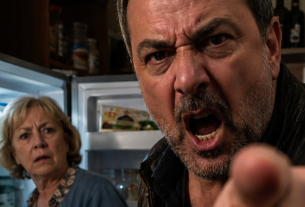
“Olenka, Gerochka told me you’re upset over some kind of machine,” she began, opening my refrigerator with a proprietary gesture and inspecting the shelves. “Forget it. Sewing is for cooks and women without higher education. A real woman should manage assets, not stitch rags.”
I leaned against the doorframe and smiled.
“Assets? You mean the way you managed the meat plant’s assets in 2008, when a truckload of canned meat somehow turned into feed for nonexistent mice on the paperwork?”
Alla Markovna choked on the piece of cheese she had just cut without asking. Her face turned an interesting shade of overripe plum, and she grabbed at a glass of water, spilling half of it onto her leopard-print cardigan. My mother-in-law looked as though a statue of Lenin had suddenly started dancing the cancan.
“You rude woman!” she squeezed out after coughing.
From that day on, my life changed. I stopped being convenient.
For twenty years, I had worked as a nurse at a clinic, and then on the second shift as unpaid staff for my husband’s family. I put Alla Markovna on IV drips. I gave Lyudochka massages. I paid the utilities because “Herman was saving for investments.” I cooked three-course dinners while my sister-in-law, who had never worked a day in her twenty-eight years, came to our place with containers to collect food for the week.
On Friday evening, Herman came home expecting roasted pork knuckle. The stove was empty. In the refrigerator lay a lonely head of cabbage and a forlorn carton of kefir.
“Where’s dinner?” my husband demanded, lifting the lids of empty pots.
“The family needed it more,” I answered philosophically, polishing my nails. “I decided that you and Lyuda would benefit from intermittent fasting.”
That weekend, Lyuda showed up. Without calling, opening the door with her own key. She flopped onto the sofa, stretching out her legs in fashionable sneakers.
“Olya, I need a medical certificate for my Odnoklassniki channel saying I’m allergic to synthetic fabric. Do it quickly, okay? My unboxing of Chinese dresses is falling apart, and I want to press my subscribers’ pity button. And anyway, I’m gaining weight from stress. My energy is malfunctioning because of jealous people. My aura is swelling!”
I put down my book and looked at my sister-in-law with pleasure.
“Lyudochka, your ‘aura’ isn’t swelling because of jealous people. It’s swelling because of insulin resistance. When you eat an entire cake every evening, your pancreas produces a horse-sized dose of insulin to handle the sugar. Insulin blocks fat breakdown, and your constant stress from doing nothing drives up cortisol, which lovingly stores that fat around your waist. That’s basic physiology, not the evil eye. As for the certificate—Article 327 of the Criminal Code of the Russian Federation. Forgery of documents. Up to two years in prison. I need my diploma more than you need your blog.”
Lyuda blinked her extended eyelashes, trying to digest the information.
“You… you’re just jealous of my media presence!” she declared, the universal argument of every talentless person.
“Absolutely,” I nodded. “So jealous I can’t even eat. Please put the keys on the nightstand. I’m changing the locks tomorrow.”
She threw the keys as if they were a grenade and stormed out, stomping loudly.
A week later, Herman decided to use his signature manipulation tactic: the radio sermon. He sat across from me, folded his hands into a little steeple, and spoke in his most velvety voice.
“Olya, we are losing our boat of love. You’ve become cold. You’re rejecting my loved ones. Family is a harbor where one must know how to sacrifice…”
“Gera,” I interrupted, sealing a cardboard box of my books with tape. “Your harbor turned out to be a paid port where I’ve been charged a docking fee for twenty years. And I’m leaving your boat. The apartment is yours, there’s nothing for us to divide, and we never had children—you always said it was ‘too early.’”
“Where do you think you’re going?” His baritone malfunctioned and broke into a squeal. “Who’s going to iron my shirts?”
There it was. The true face of love. Not “How will I live without you?” but “Who will do the ironing?”
“Alla Markovna. Or Lyudochka, if she can tear herself away from unboxing socks,” I said, picking up my suitcase. “Goodbye, radio star.”
I left for my hometown, Yekaterinburg. Quietly, without scandals or theatrical hand-wringing. I simply crossed out of my life the people who had considered me their inventory.
A month later, while walking along the Iset River embankment, I ran into Sashka. Alexander Nikolayevich, the owner of a small but solid chain of gas stations in the region. Twenty years earlier, he had stood under my windows with a guitar, while I chose a big-city fop with a beautiful voice. Sashka had never married. He said business had taken up all his time, but his eyes, when he looked at me, said something else.
We sat in a coffee shop, drinking raf coffee, and he listened carefully to my story. Without judgment. Without stupid advice. Then he simply covered my hand with his large, warm one.
“Do you know what we’re going to do tomorrow?” he asked.
“What?”
“We’ll go and buy you the best sewing machine we can find. And then I’ll sign you up for those cutting and sewing courses you dreamed about when you were nineteen.”
Now I’m sitting in my bright studio, with a brand-new, incredibly smart Japanese serger humming in front of me. Beside me on the table is a cup of hot tea that Sashka brewed.
Recently, mutual acquaintances told me that Herman was fired from the radio after a scandal live on air—he snapped at a woman who called in because, at home, no one was cooking pork knuckle for him or ironing his shirts anymore. Lyuda shut down her channel and went to work as a cashier at Magnit, while Alla Markovna writes complaints to every authority about how bad life is.
I listen to this and smile. Not maliciously, just with mild surprise. How long I had lived inside a crooked mirror, thinking I was the one being reflected incorrectly. All I had needed to do was break the glass and step into the light.