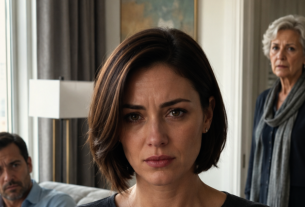
“Are you seriously sitting there choosing a TV for my mother for forty-eight thousand?” Irina asked so quietly that even the kettle on the stove hissed as if it felt guilty.
Oleg looked up from the laptop. On the screen gleamed a huge black panel, so important and smooth it looked as though it was not going to show Valentina Petrovna TV series, but receive a parade on Red Square.
“Not forty-eight,” he said. “With bonuses, it’s forty-six thousand seven hundred. And delivery is free.”
“Oleg, I’m not talking about delivery.”
“Then what are you talking about?”
Irina was standing in the hallway in the coat she had been promising for three years to take to the dry cleaner’s, but every time something more important came up: car insurance, the dentist, utilities, new sneakers for Oleg because the old ones “rubbed his soul raw.” In her hand she held a bag from Pyaterochka: milk, eggs, chicken on sale, dill that would once again turn into a wet broom in two days. She had spent eleven hours at work, then forty minutes stuck in traffic, then another ten minutes looking for a spot in the courtyard between a snowdrift and someone’s Solaris, parked as if the driver had gone off to the front and said goodbye to geometry.
“I’m talking about the fact that our fridge is empty, the faucet in the bathroom is leaking, you haven’t had a job for two months, and you’re choosing a TV for your mother.”
Oleg sighed as if Irina were distracting him from saving humanity.
“Mom’s old TV has lines across the screen.”
“My eye is twitching, but for some reason I’m not ordering myself a new one.”
“Why do you have to say it like that?” He half-closed the laptop, leaving a narrow crack, like in a cheap detective story. “Mom is an elderly woman. She has nothing to do in the evenings.”
“Let her read.”
“Her eyesight is bad.”
“Let her listen to the radio.”
“Ira, don’t start.”
She put the bag on a stool, took off her boots, and felt the sticky snow melt into her socks. There it was, family life: you bring home groceries, take off wet socks, and discover that your unemployed husband has already mentally bought his mother a TV the size of a window into the future.
“Mom is an elderly woman, and you’re young. You’ll earn more.”
Irina slowly raised her eyes to him.
“Repeat that.”
“Repeat what?”
“That wonderful thought. One more time. I want to savor it.”
Oleg rubbed his face with his palm.
“That’s not how I meant it.”
“That’s exactly how you said it. ‘You’re young, you’ll earn more.’ Is that our family financial strategy now? I work, you spend, Mom watches movies?”
“Don’t twist my words. I’m not buying it for myself.”
“Of course not. Yesterday you bought yourself headphones for eight thousand. So you can send out résumés in high-quality sound?”
“I needed them for interviews.”
“Oleg, at your last interview you said a five-two schedule was ‘too traumatic for the psyche.’ What headphones?”
He got up from the table. In sweatpants, a stretched-out T-shirt, and with the expression of a man everyone owed something to, but nobody had realized it yet.
“You want to humiliate me again.”
“No. I want to understand when exactly I became an ATM with a dinner-cooking function.”
“Ira, you’re going too far.”
“I’m going too far? Fine. Let’s count. Utilities — me. Groceries — me. Gas — me. Your phone — me. The loan for your car, the one you drive your mother to the clinic in — also me. What have you paid for in the last two months?”
“I do a lot around the house.”
Irina looked at the sink. There were dishes in it: two mugs, a plate with dried buckwheat, a frying pan that had held scrambled eggs yesterday and now held an archaeological layer.
“What exactly? Creating the atmosphere of an abandoned summer cottage?”
“I vacuumed.”
“When?”
“On Monday.”
“Today is Thursday.”
“Well, you don’t vacuum every day. We’re not in a museum.”
Irina suddenly laughed. Short, sharp, angry. Even she scared herself. There was everything in that laugh: the mortgage she had paid off before marriage and which Oleg now called “our apartment”; her bonuses that went to other people’s name days; his mother, who at every meeting looked at Irina as if she had stolen her son along with the warranty card.
“Fine,” she said. “We’re not buying the TV.”
“Ira…”
“We’re not buying it, Oleg. Period.”
“Do you realize Mom will be offended?”
“Let her be offended at the manufacturer of her old TV.”
“You’ve become harsh.”
“No. I’m just tired of being convenient.”
He said nothing. Irina took out the groceries, turned on the stove, and threw the chicken into the pan. The oil hissed, and the kitchen filled with the smell of fried food and cheap dill. Oleg sat back down, opened the laptop. Clicked the mouse. Then clicked again.
“I said we’re not buying it,” Irina said without turning around.
“I’m just looking.”
“Look out the window. That’s free.”
When they got married, Oleg had been different. Or Irina had very much wanted to think so. He brought her coffee in bed, knew how to fix outlets, told funny stories about the office, and said they would have “a normal adult family without Mom’s interference.” Only later did it turn out that interference was unnecessary if Mom had long ago been sitting inside the man like a built-in app that could not be deleted.
Valentina Petrovna lived in a neighboring district, in a standard nine-story apartment building with carpets on the walls and a reserve of buckwheat in case of the apocalypse. She called Irina “Irochka” in a voice that made it sound less like a name and more like a diagnosis.
“Irochka, my Olezha is used to proper soup,” she would say when she came to visit. “Not those salads of yours with leaves. A man needs hot food.”
“Valentina Petrovna, he’s an adult. He can cook it himself.”
“A man who cooks his own soup quickly stops feeling like a man.”
“And a man who doesn’t work and eats at his wife’s expense — what does he feel like?”
After that phrase, her mother-in-law stopped dropping by without warning. But she began calling more often. Especially Oleg. He would go out onto the balcony, half-close the door, and answer in a soft voice, one he hadn’t used with Irina for a long time.
“Mom, of course… Mom, I’ll handle it… Mom, don’t worry… Mom, Ira will understand…”
Irina did not understand. At first she simply frowned. Then she counted. Then she stopped counting, because the numbers began to resemble the medical chart of a seriously ill patient: flowers for Mom, medicine for Mom, a new microwave for Mom, faucet repair for Mom, “I just transferred some money to Mom, her pension is small.” Valentina Petrovna’s pension was not huge, but it was stable. Unlike Oleg’s conscience.
He lost his job at the beginning of February. He came home earlier than usual, put his bag by the wardrobe, and announced:
“That’s it. I got laid off.”
Back then Irina did not even question him right away. She hugged him and stroked his back.
“It’s all right. You’ll find another one. The main thing is, don’t sink into it.”
“I’m not sinking,” he said, already turning on the TV. “I just need a couple of days to breathe.”
A couple of days stretched into a couple of weeks. Then into a month. Then “unsuitable vacancies” appeared in his life. One paid too little, another was too far away, in the third the boss looked “shady” in the photo, in the fourth they asked people to stay late sometimes, and Oleg, as he put it, “didn’t want to end up in slavery again.”
Irina was not afraid of slavery. She worked as a department head at a logistics company. She had clients who needed everything yesterday, drivers who lost documents, an accounting department that said, “The payment isn’t going through,” and a director who loved the phrase “we’re a team” precisely at those moments when “team” meant: Irina, stay until ten.
At home, the team looked different. Oleg lay on the sofa, scrolled through his phone, and searched for himself. He mostly found himself in fishing videos, car reviews, and articles titled “How to Tell You’re Burned Out.”
One day Irina came home at half past eight. The apartment did not smell of dinner, but of male idleness: slightly sour laundry, cold tea, and a phone charger that for some reason was always lying on the floor.
“Did you eat?” she asked.
“I had a snack.”
“What?”
“Mom’s cutlets. I stopped by her place.”
“And what about me?”
Oleg looked at her with sincere surprise.
“You texted that you’d be late.”
“So what? If I’m late, do I automatically stop being alive?”
“Ira, don’t start right from the doorway.”
“And where should I start from? The balcony? The bathroom?”
He got up, went into the kitchen, and looked inside the fridge.
“There are dumplings.”
“Of course there are. I bought them.”
“I’ll boil some now.”
“Don’t bother. I’m already full.”
“Of what?”
“Family warmth.”
He slammed the fridge door.
“You always use sarcasm instead of a normal conversation.”
“I use sarcasm instead of hysterics. Believe me, it’s a profitable substitution.”
In March, Oleg began asking for money “for little things.” First five hundred. Then a thousand. Then, “Can I order it from your card, and I’ll pay you back later?” Then he stopped promising to pay it back, as if promises had also gone up in price.
“Ira, I need to take medicine to Mom.”
“What medicine?”
“For blood pressure.”
“She gets subsidized ones.”
“Not all of them work for her.”
“Show me the prescription.”
“You don’t trust me?”
“I already don’t trust myself, since I’m still answering these questions.”
He was offended for a whole day. He walked around the apartment with the face of an insulted monument. Irina even enjoyed the silence until she discovered that nine thousand had been charged to her card at a pharmacy near Valentina Petrovna’s home.
“Oleg, why do you have my card?”
“You left it on the nightstand yourself.”
“That’s not an answer. Why did you pay with it?”
“Because it was urgent.”
“Nine thousand urgent?”
“It wasn’t just medicine. There was also a blood pressure monitor.”
“She already has a blood pressure monitor.”
“The old one lies.”
“Of course. In this family, only appliances lie. All the people are honest.”
Oleg flared up.
“You want my mother to sit there without medicine?”
“I want you to ask before taking my money.”
“We’re husband and wife.”
“Exactly. Not a thief and the owner of an apartment.”
That time he slammed the door and went to his mother’s. He came back late, smelling of someone else’s borscht and righteous resentment.
“Mom said you’ve become nervous.”
“Mom can diagnose her TV.”
“She’s worried about us, by the way.”
“About us? Or about access to my card?”
“You talk disgustingly.”
“I’m still being gentle. Disgusting is when a grown man drags money out of his wife and hides behind his mother’s medicine cabinet.”
After that conversation, Irina changed her PIN code. Then she hid the second card in the cover of an old passport. Then she set limits in the banking app. Then she realized she was not living in a marriage, but in financial-defense mode. At home she checked her bag the way people check the gas before leaving on vacation.
The funniest thing was that Oleg sincerely considered himself a good son. He said it with such pride, as though being a good husband was no longer included in the package.
“I won’t abandon Mom,” he would declare.
“I’m not asking you to abandon her.”
“You are. Every time you count money.”
“I’m not counting your mother. I’m counting my strength.”
“You have strength. You’re strong.”
Irina looked at him for a long time then. He did not even understand he had said something vile. To him, her strength was not a quality, but a resource. Like an electrical outlet: if there’s voltage, plug in.
“You’re strong, Ira. You’ll manage. But Mom can’t manage without me.”
“And who can’t you manage without, Oleg?”
“What do you mean?”
“Forget it.”
At the end of March, Valentina Petrovna called herself. Irina was sitting at her laptop, closing a report, drinking cold coffee, and trying not to fall asleep face-first into a spreadsheet.
“Hello, Irochka. Is Olezha home?”
“He is. On the sofa, undergoing recovery after the labor market.”
“What?”
“Nothing. I’ll call him now.”
“Wait, I wanted to tell you something. My anniversary is in April. Sixty-five, after all. The girls from the choir and I decided to sit in a café. Modestly, like family.”
Irina closed her eyes.
“Congratulations in advance.”
“Thank you, Irochka. Don’t think I’m demanding anything. It’s just that Oleg said you would probably give me something substantial. I told him, no need, children, you have your own life. And he said, ‘Mom, Ira earns well. She won’t go poor.’ Of course I scolded him.”
Irina looked at Oleg. He was lying on the sofa, smiling at his phone. Probably watching something funny. Some people had all the luck: they laughed while their marriages quietly died beside them.
“Valentina Petrovna,” Irina said evenly. “What does substantial mean?”
“Well, I don’t know. He mentioned a TV. But don’t worry. The old one is enough for me. I’m generally an unpretentious person.”
An unpretentious person who, in the past six months, had acquired earrings, a food processor, a humidifier, and an orthopedic pillow.
“I see,” Irina said.
“Just don’t scold him. He’s an emotional boy. He’s going through a difficult period right now.”
“So am I.”
“Well, you’re a woman. Women are stronger.”
“Yes, they make us at the factory out of rebar.”
Her mother-in-law either did not understand or pretended not to.
“I simply mean that a man needs support. Otherwise he’ll shut down.”
“He already has. On my bank card.”
“Irochka, you’re offended for no reason.”
“I’m not offended, Valentina Petrovna. I’m remembering.”
After the call, Irina walked over to the sofa.
“Did you tell your mother I would buy her a TV?”
Oleg slowly put away his phone.
“I said we’d think about it.”
“No. She said otherwise.”
“Mom may have misunderstood.”
“What a convenient family illness you have — everyone misunderstands everything except you.”
“Well, what do you want? For me to come to her anniversary empty-handed?”
“I want you to come to her with hands that earned the gift.”
He sat up.
“Now you’re hitting me where it hurts on purpose.”
“I hit where it hurts when I pay for your dentistry. Right now I’m simply telling the truth.”
“I’m looking for a job.”
“Did you send out résumés today?”
“Not today.”
“Yesterday?”
“Ira…”
“The day before yesterday?”
“Don’t pressure me!”
“I’m not pressuring you. I’m trying to understand where your ‘difficult period’ ends and my madhouse begins.”
He stood up abruptly.
“That’s it, I’m going to Mom.”
“Of course. There’s borscht there and nobody asks questions.”
“There, I’m loved.”
“There, you’re fed with my chicken, which you took there in a container this morning.”
He reddened.
“That was unnecessary.”
“The chicken thought so too.”
Oleg left. Irina remained alone. She sat in the kitchen and looked at her hands. Nails without a manicure, a mark from the ring on her finger, shadows under her eyes. She suddenly realized she was no longer waiting for things to get easier. She was waiting for the next blow. Like a person living under a leaking roof: it may not be dripping on your head yet, but the basins have already been set out.
The next day she opened a separate account at another bank. She transferred her salary there. She left the old card almost empty. Oleg noticed three days later.
“You have two thousand on your card?”
“How much should there be?”
“Well… I wanted to order groceries.”
“Order them with your own money.”
“I don’t have any.”
“Then walk to the store and buy something for two thousand. Discover the world of price tags.”
“Are you mocking me?”
“A little. But within the family budget.”
He began getting angry more often. At first he did not shout; he grumbled. Slammed cabinet doors. Sighed so heavily you could air out the room with it. Then Valentina Petrovna got involved.
“Irochka, Oleg says you’re restricting him financially.”
“Really? Did he mention that the money is mine?”
“There is no ‘mine’ and ‘yours’ in a family.”
“There is when one person brings it in and the other carries it out.”
“You are speaking very rudely.”
“But for free.”
“I did not raise my son like this.”
“That is obvious.”
Silence fell on the other end. Then her mother-in-law said in an icy voice:
“You will regret this. Good men are rare.”
“Valentina Petrovna, if you find a good one, let me know. Because at my place, some relative of yours is lying around.”
The anniversary approached like a thunderstorm. Oleg became gentle again. He made coffee. Took out the trash. Once he even washed the floor, though with the same rag he had used earlier to wipe the balcony, but the gesture was almost historic.
“Ira,” he said one evening, sitting opposite her. “Let’s talk normally.”
“Let’s.”
“Mom’s anniversary happens once in a lifetime.”
“Sixty-five, yes. The next one will be seventy, if she’s lucky.”
“Don’t be sarcastic. I understand I was wrong. I should have asked. But I really want to give her a good gift. She did so much for me.”
“What exactly?”
“What do you mean? She raised me. Brought me up alone. Worked. Denied herself things.”
“Oleg, half the country grew up that way. It doesn’t give adult children the right to steal from their spouses.”
“I’m not stealing.”
“As long as you’re asking, no.”
He took her hand. Irina did not pull it away, but her hand lay there like a stranger’s, like a forgotten glove.
“Let’s do this. Lend me twenty thousand. I’ll get a job and pay it back. Honestly.”
“What job will you get?”
“I’m going to an interview tomorrow. At a service company. Supply manager.”
“You didn’t tell me about it.”
“I wanted to get a result first.”
“Address?”
“What?”
“Where is the interview?”
He hesitated for a second. Just one second. But Irina already knew that pause. It was the pause of a person quickly building a temporary bridge over a pit in his head.
“On Leningradskoye Highway.”
“What’s the company called?”
“TechPostavka.”
“Do they have a website?”
“Ira, are you an investigator?”
“No. A wife whose money has gone missing.”
He removed his hand.
“It’s impossible with you.”
“With me, it’s very possible. What’s impossible is no money, no truth, and your mother in every sentence.”
Two days later, Irina discovered the loss. Not from the card — that was empty. An envelope had disappeared from the wardrobe, one that held thirty thousand. She had been saving it for dental work. Her tooth had been aching for a month already, but she kept putting it off: a report, an urgent payment, Oleg needed to “borrow” something. The envelope had been in a box from winter gloves. Oleg knew because once he had seen her put the money there.
Irina stood by the wardrobe and felt no anger. Nothing at all. That was worse. Anger is alive. But here, inside, everything became flat and cold, like an apartment entrance in the morning.
Oleg came back around nine. Cheerful. Even whistling.
“Where were you?” Irina asked.
“At Mom’s. Helping her prepare.”
“Did you take the envelope?”
He took off his jacket too slowly.
“What envelope?”
“The one with thirty thousand.”
“Ira…”
“Don’t start with ‘Ira.’ That’s a bad beginning.”
“I took it. But I’ll pay it back.”
“What did you spend it on?”
“I paid the deposit for the café. And part of the gift.”
“What gift?”
“A certificate to a jewelry store.”
Irina nodded. Slowly. Almost calmly.
“So you stole my dental money so your mother and her choir could eat Caesar salad and get a gift certificate?”
“Don’t say ‘stole’!”
“What should I say? ‘Creatively redistributed’?”
“I was desperate!”
“Desperate people look for work. You chose a jewelry store.”
“You didn’t steal money from me, Oleg. You stole the feeling that I can relax at home.”
He looked at her with irritation and fear at the same time.
“You’re dramatizing.”
“Really? Fine. Then here comes domestic prose. Tomorrow you return the thirty thousand. The day after tomorrow you move out if you don’t. Choose the genre.”
“You won’t kick me out.”
“Shall we test that?”
“This is my apartment too.”
Irina even smiled.
“No. The apartment is definitely mine. Bought before marriage. The documents are in the folder. I can read them to you at night instead of a fairy tale.”
“We’re a family!”
“A family doesn’t rummage through closets.”
“I wanted what was best!”
“For whom?”
He said nothing.
“For whom, Oleg?”
“For Mom.”
“Thank you. At least that was honest.”
He sat down on a chair and put his head in his hands.
“You don’t understand. She’s relied on me her whole life. If I tell her I can’t, she’ll be upset.”
“And if you lie to me and drag money out, am I supposed to applaud?”
“You’re stronger.”
“I’m not stronger. I just stayed silent longer.”
That night they slept in separate rooms. Irina in the bedroom, Oleg on the sofa. Or rather, Irina did not sleep. She lay there and listened to the water clicking in the radiator, to the neighbor behind the wall smoking on the balcony and coughing, to Oleg tossing and turning, whether from discomfort or conscience. Conscience, however, if it existed, took up very little space.
In the morning he left early. He left a note on the table: “We’ll talk tonight. Don’t do anything stupid.” Irina read it, folded the sheet neatly, and put it in the folder with the documents. She had just finished doing stupid things. The stupid thing had been believing that you could love an adult into responsibility.
At lunch, the bank called her.
“Irina Sergeyevna, do you confirm the application for a consumer loan?”
At first she did not understand.
“What loan?”
“The application was made through the mobile app. Amount: one hundred and twenty thousand rubles.”
Irina felt her fingers turn icy.
“I did not apply for anything.”
“Then block access immediately. It is possible that a third party has your data.”
The third party had been lying on her sofa, eating her soup, and calling himself her husband.
Irina rushed from work. Her boss was saying something about a client, a shipment, and “we need to close this issue.” She looked at him in such a way that he stepped back.
“I have a family fire.”
“Is everything all right?”
“No. But I’ll try to make sure nobody dies legally.”
She drove home, and for the first time in a long while she did not cry. She did not even tremble. Inside, some dry calculation was taking place: block the bank, change passwords, gather his things, call the district police officer if he started breaking in, file a report if the attempted loan was confirmed. Love retreated not tragically, not beautifully. It simply packed a suitcase and quietly left through the service exit.
Oleg was home. Sitting in the kitchen. Her old phone, the one she kept as a backup, lay in front of him.
“What were you doing?” she asked from the doorway.
He flinched.
“Nothing.”
“Trying to take out a loan in my name?”
“It’s not what you think.”
“Wonderful. The favorite phrase of everyone who is doing exactly what people think they’re doing.”
“I wanted to close the anniversary issue and then pay everything back to you in one payment.”
“What ‘then’? After your coronation in the supply department?”
“Ira, I would have gotten a job!”
“You tried to take out a loan in my name.”
“We’re married. It’s still a shared responsibility.”
“No, Oleg. It’s criminal responsibility if it’s without my consent.”
He turned pale.
“You want to put me in prison?”
“I want you to leave.”
“Ira…”
“Now. Not tonight. Not after a conversation. Not after your mother’s anniversary. Now.”
He stood up.
“You have no right to do this to me.”
“I have the right to protect myself.”
“From me?”
“Yes.”
That word struck harder than any scream. Oleg opened his mouth, then closed it. Then he began getting angry, because fear in people like that rarely lasts long — it is replaced by familiar insolence.
“You’ll be left alone without me.”
“What a threat. I’ve already had almost a rehearsal of that these past months.”
“You won’t find anyone with that character.”
“Then I’ll save on groceries.”
“You’re cold.”
“I cooled down gradually. You helped.”
He stepped closer.
“I’m not leaving.”
Irina took out her phone.
“Then I’m calling the police and reporting the attempted loan, the missing money, and the illegal use of my cards. You can think up what you’re going to say in the meantime. Only please leave Mom out of it. The officers will have a hard time laughing while on duty.”
Oleg stared at her for a long time. For the first time, it seemed, not as a wife, not as a source of money, not as a woman who would “grumble and forgive.” He looked at her as an obstacle.
“You’re serious.”
“Yes.”
“You’ll destroy everything.”
“No. I’ll stop paying for the ruins.”
“Pack your things. I’m no longer going to be your salary, your conscience, and a gift certificate for Valentina Petrovna.”
He packed badly. Men who for years do not know where their socks are become especially helpless at the moment of eviction. Oleg walked from room to room, grabbing T-shirts, chargers, a razor, and for some reason a winter hat, even though it was April outside. Irina stood in the hallway and made sure he did not take anything extra. His things — yes. Hers — no. “Family property” was a funny phrase when you remembered who had bought the kettle.
“I’m going to Mom’s,” he said at the door.
“I had no doubt.”
“At least she’ll take me in.”
“Of course. She has a new TV in her plans.”
“You’re evil.”
“I’m alive.”
He left. Irina locked the door with two turns. Then she put on the chain, although the chain was more psychological than practical. The apartment became quiet. Not festive, not joyful. Just quiet. Like after an annoying advertisement has been turned off, and you sit tense for a few more seconds, expecting it to start blaring again.
An hour later, Valentina Petrovna called. Irina did not want to answer, but she did. Out of curiosity. Sometimes a person goes to the circus voluntarily just to make sure the clowns are real.
“What have you done?” her mother-in-law asked without a greeting.
“Good evening, Valentina Petrovna. I’m also glad to hear your voice.”
“Oleg arrived with bags! You kicked your husband out!”
“Yes.”
“Over money?”
“Over theft.”
“What theft? He’s your husband!”
“Do you buy that phrase wholesale somewhere?”
“You are a heartless woman. He was trying for my sake.”
“Exactly.”
“I didn’t ask him to!”
Irina fell silent.
“What?”
“I said I didn’t ask him to!” Her mother-in-law’s voice suddenly became not angry, but sharp and frightened. “He told me he got a bonus. Then he said he had a side job. Then he said you yourself wanted to give me a gift because you felt awkward about rarely visiting me. I thought… God, I thought you were living normally.”
Irina sat down on the little cabinet in the hallway.
“He didn’t tell you he wasn’t working?”
“No. He said he had switched to remote work.”
“Remote work from reality.”
A heavy breath sounded on the other end.
“Ira, wait. What money did he take?”
Irina told her. Not everything, but enough: the card, the pharmacy, the envelope, the loan. Valentina Petrovna was silent. For a person who liked inserting advice between other people’s breaths, this was almost a miracle.
“I’m going to tear his ears off,” she said at last.
“Don’t. He’ll still need them to listen to a lawyer.”
“Ira… And the gifts… The earrings, the pillow, the food processor… Was all that with your money?”
“Partly.”
“He said it was from him.”
“He said a lot of things.”
Her mother-in-law suddenly exhaled strangely. As if she had sobbed, or choked on her pride.
“I’m certainly no angel. And maybe I didn’t love you the way I should have. But I’m not a rat, Ira. I didn’t know.”
Those words were the unexpected blow — not to anger, but to the familiar picture of the world. Irina had seen Valentina Petrovna for so long as the main director of their troubles that she could not immediately rearrange the pieces. It turned out Oleg had not only taken from his wife. He had also bought himself the image of a good son with someone else’s money. And his mother, perhaps, was prickly, domineering, with soup instead of diplomacy, but not necessarily an accomplice.
“Now you know,” Irina said.
“I know. And you know what? I don’t need a TV. I’ll cancel the anniversary. The girls from the choir and I will drink tea at home. And he can go get a job. I didn’t raise him so he could rob women.”
“Valentina Petrovna…”
“No, be quiet. I’m angry as the tax office right now. He’s sitting in my kitchen saying you betrayed him. And I’m looking at him and thinking: where did I miss so badly that he considers the woman who fed him his enemy?”
For the first time in months, Irina felt not victory, but weary sympathy. Not for Oleg. For two women who, for different reasons, had believed the same man for too long.
“Do what you think is right,” she said. “But he won’t be coming back.”
“And rightly so. I wouldn’t let him back either.”
Half an hour later, Valentina Petrovna sent a message. Not long. Without “Irochka.” Simply: “I’ll transfer thirty thousand to you tomorrow. I’ll repay the rest in parts. It wasn’t his money. It was yours. Forgive me.”
Irina reread it several times. Then she put the phone on the table and cried. Quietly, without theatrics, without a beautiful collapse onto the floor. She simply sat in the kitchen, where Oleg’s unwashed cup was still standing, and cried because the world had turned out not quite the way she had thought. Not better. Not kinder. Just more complicated. Sometimes the enemy is not the one who looks at you coldly. Sometimes the enemy is the one lying next to you, saying, “You’re strong.”
The next day she changed the locks. The locksmith, a thin man with a mustache and a little case, asked:
“Lost your keys?”
Irina looked at the old lock as it clicked for the last time.
“You could say that.”
“Happens. Everyone’s putting in new ones now. Times are like that.”
“The times are normal. People are sometimes strange.”
He chuckled.
“That’s more expensive than any lock.”
That evening, a message came from Oleg from an unknown number: “You ruined everything. Mom is no longer completely on my side.”
Irina read it and suddenly laughed. Not angrily. Almost lightly. “Not completely” — there it was, the tragedy of a grown man. Mom was not completely on his side. Life had cracked.
She blocked the number. Then she took dumplings from the freezer, boiled exactly as many as she wanted, added sour cream directly to the plate, and sat by the window. In the courtyard, someone was arguing over parking, children were building a dirty snowman, and the downstairs neighbor was shaking out a rug with such fury that it seemed she was beating an ex-husband out of it. The phone beeped again. This time from Valentina Petrovna: “Transferred it. Ira, I told him: until you get a job and start paying things back, you will live at my place by my rules. I’m turning off the internet after ten.”
Irina looked at the message and smiled genuinely for the first time in a long while.
A week later, she filed for divorce. A month later, Oleg got a job as a warehouse clerk at a construction store. Not out of vocation, of course. Because of maternal internet shutdowns and the absence of his wife’s card. Valentina Petrovna sent transfers in small amounts: five thousand, three, seven. And every time she wrote dryly: “Debt.” No hearts. No performance.
Irina got her tooth treated, bought herself a proper coat, one she was not ashamed to walk into the office wearing, and learned to come home without anxiety. It was not easy. In the first days, she still checked the wardrobe, her wallet, the banking app. Then one day she caught herself having left her bag in the hallway and not remembered it until morning. A small victory, ridiculous to outsiders. Enormous for a person who had lived beside a quiet theft of trust for too long.
One evening, Valentina Petrovna called again.
“Ira, I wanted to ask… Are you all right?”
“I’m all right.”
“Did you get your tooth done?”
“I did.”
“Good. You can’t delay with teeth. I delayed, and now my bridge feels like a cast-iron bridge.”
Irina smiled faintly.
“Thank you for caring.”
“I’m not caring. I’m guilty.”
“Those are different things.”
“I know. But one has to start somewhere.”
They fell silent. Not like relatives. Not like friends. Like two women on opposite banks of the same unpleasant river.
“Ira,” her mother-in-law said more quietly. “You were right to kick him out.”
Irina looked around her kitchen. A clean sink. One glass. Silence. On the windowsill stood a basil plant she had bought for no reason, with no practical use. It smelled of summer and freedom.
“I know.”
“He’s angry.”
“Let him be.”
“He says you broke him.”
“No, Valentina Petrovna. I simply stopped being his crutch.”
“That’s a strong way to put it.”
“Life suggested it.”
After the call, Irina turned off the kitchen light and went into the room. A blanket lay on the sofa, and beside it was the book she had not been able to finish for the past six months. Now she could. Nobody was turning on videos. Nobody was asking where the card was. Nobody was explaining that Mom was more important because Mom was alone, while a wife was strong and would somehow pull through.
She sat down, opened the book, but did not start reading. She listened to the apartment. Your own apartment sounds different when other people’s demands leave it. Even the refrigerator hums more respectfully.
Irina thought that the ending to this story had not turned out cinematic. Oleg did not crawl back with flowers, she did not meet a wonderful man at a coffee shop, Valentina Petrovna did not suddenly turn into a saint. Everything was simpler and truer. A man who had grown used to being the center of two women’s efforts faced, for the first time, the fact that love without respect does not come with service. A mother saw her son not as a boy, but as an adult debtor. A wife understood that pity is a poor foundation for a marriage, especially when someone else’s TV is already standing on it.
And for some reason, that made things easier. Not joyful, not festive, but honest. And honesty, as it turned out, can be cozy too. Especially when no money is being charged to your card for it anymore.
The End